Banking and Payments Intelligence Report
May 2023

Is Paze Ready to Fight Apple and PayPal in the Battle for Hearts and Minds of Consumers and Merchants?

Early Warning, the bank-owned operator of the peer-to-peer payments platform, Zelle, officially entered the digital payments gold rush last month when it announced plans to create a new digital wallet called Paze. The new service will compete directly with an increasingly crowded field of digital wallet providers including the likes of PayPal, Apple and Google.

The announcement signals that it is officially game-on in the battle between banks and fintechs to secure the hearts and minds of consumers and merchants. Ultimately, the outcome of this aggressive push to create new digital platforms and services will determine the future of the digital payments landscape.

Consumer Awareness

Early Warning’s decision to move into the digital wallet space is both a validation that financial services incumbents are not going to cede victory to fintechs and a clear sign to the marketplace that digital payments are here to stay, even after experiencing “bubble-esque” growth rates during the pandemic. In fact, according to JD Power data, the percentage of Americans that said that they used a mobile wallet for a purchase at some point in the previous three months increased from 45% in 2021 to 51% in 2022.

Despite the growing consumer interest and the huge boost Paze will have from its bank backers, the service will still have its work cut out for it when it comes to building customer awareness. 

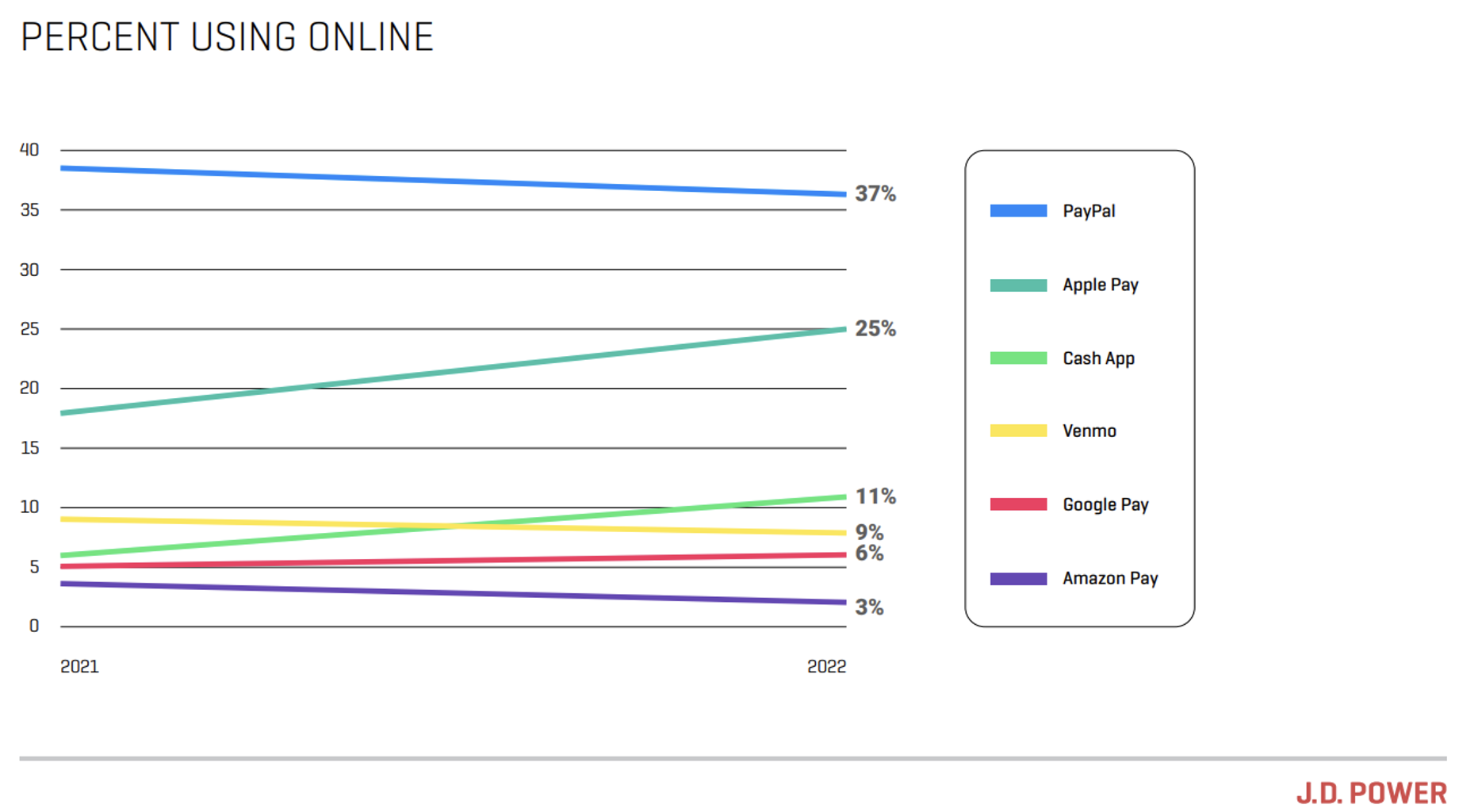
Overall, PayPal is the most recognized brand of digital wallets at 82%, followed by Apple Pay at 64% and Venmo at 60%, according to JD Power data. However, when it comes to consumer preference, PayPal is the most preferred digital wallet brand for online purchases (37%) while Apple Pay is most preferred in-store (33%). Google Pay follows just behind the leaders when it comes to brand awareness, with 53% brand recognition, but its point-of-sale consumer preference scores are considerably lower, with just 6% customer preference for online transactions and 7% consumer preference for in-store transactions.
graph1

Clearly, brand awareness is a big deal for consumers using digital wallet technology. PayPal is benefitting from its decade-long head-start in the space for online purchases and Apple is benefiting from sustained effective marketing to consumers and merchants alike. That level of awareness will be tough to fight.

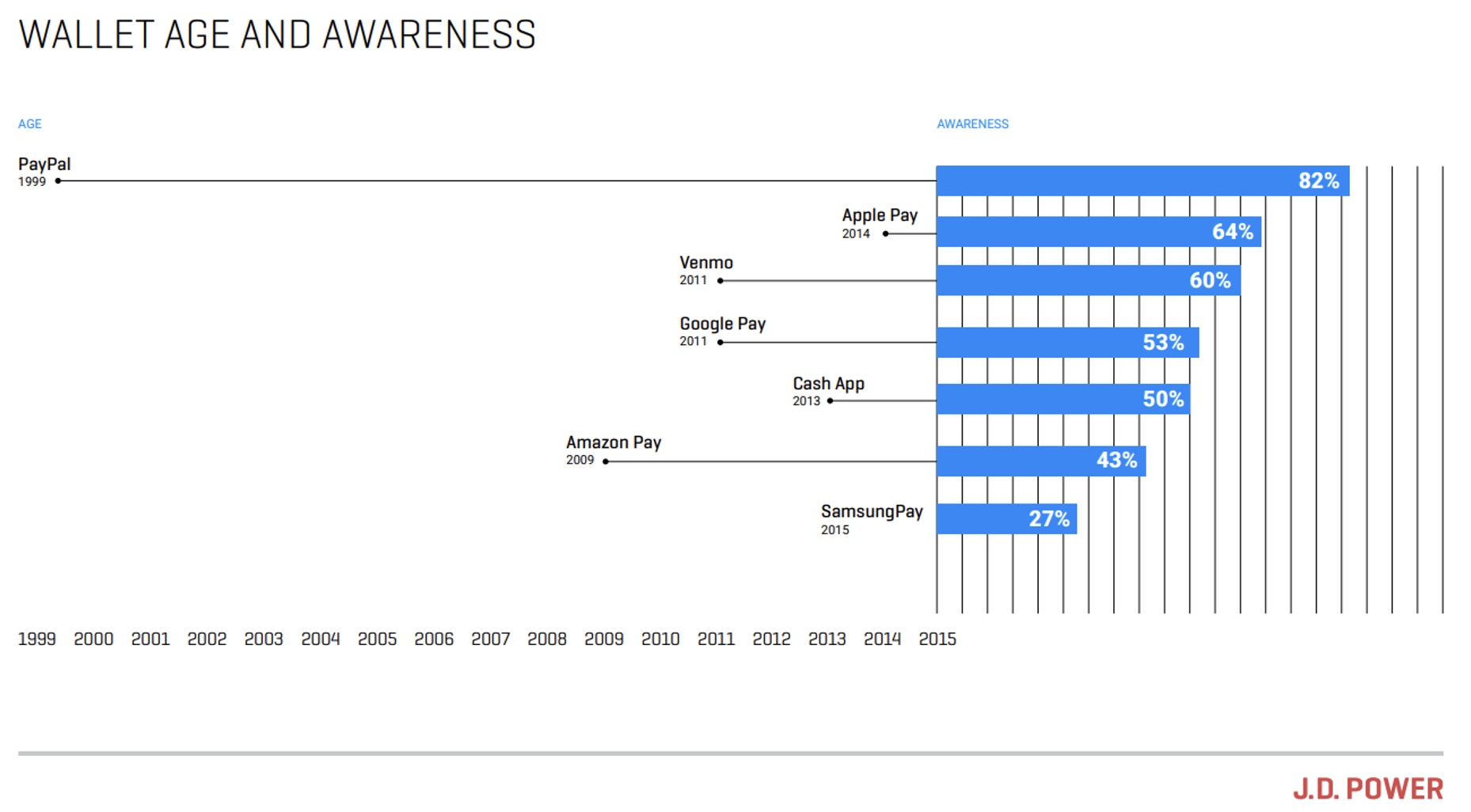
The importance of consumer awareness can be seen in the following chart, which illustrates digital wallet brand awareness based on the age of the service. While PayPal has been around the longest and has the highest overall level of brand awareness (82%), Apple Pay is relatively young by comparison and has already climbed to second place, with 64% total brand awareness.
graph2

While Apple Pay is one of the newest entrants in the space, it has established widespread awareness quickly through aggressive consumer and merchant-focused marketing efforts. SamsungPay, by contrast, was launched just one year after Apple Pay and is still at the bottom of the field in terms of customer awareness. Paze will need to move swiftly and effectively to build its brand.

Wooing Merchants

The other half of the equation, of course, is availability. Merchants need to accept these payment methods, and as digital payments platforms proliferate, that means making every payment option available at every point of possible interaction from the corner convenience store to the ecommerce website to the municipal parking meters that are increasingly fed with apps instead of quarters.

This is a hill that EWS will need to climb with its Paze digital wallet. The brand is entering the market with a big tailwind in the form of instant enrollment of more than 150 million credit cards, through its direct integration with bank networks. But the brand will need to generate merchant interest quickly by touting its vast network and, ideally, by introducing safe-pay features and other special benefits they can provide by virtue of their relationship with the big banks.

Sweetening the Deal

The wild card that is likely to start becoming a bigger factor in consumer adoption of digital payments and digital wallet technologies is incentives. Right now, the space is so new, that most customers are stumbling into a provider through a combination of general brand awareness and convenience. Perhaps they are at the check-out of an ecommerce site and a handful of options are presented and they pick the one for which they remember the password, or the one they used last time. Perhaps they are Android users and already have Google Pay loaded on their phones, or iPhone users with Apple Pay. It’s still early days and consumers are experimenting.

As digital payment consumers get more sophisticated, however, patterns of usage will evolve and customers will be swayed by incentives. Google Pay, for example, has already started offering rewards on every purchase, similar to the model followed by virtually every major credit card provider. Expect to see this area heat up if Paze begins to scale.

While Paze does have some significant advantages going for it, largely by virtue of its built-in relationship with the major banks, this space has grown so quickly and is becoming so competitive, that it will take more than just availability to open the new customer floodgates. Early Warning will need to double-down on consumer brand building, merchant relationship development, and perhaps incentives before Paze can become an entrenched part of rapidly changing patterns of consumer behavior.

Find out More

This Banking and Payments Intelligence Report is based on data from the JD Power U.S. Retail Banking Satisfaction Study, which is a yearly study that includes more than 20,000 responses annually, and the U.S. Merchant Services Satisfaction Study, which collects customer satisfaction data from over 4,000 small business customers of merchant services providers. It was authored by Miles Tullo, Managing Director of Banking and Payments at JD Power. Please contact us at the numbers below to connect with Mr. Tullo or to learn more about the underlying research.


Media Contacts

Brian Jaklitsch; East Coast; 631-584-2200; [email protected]

Geno Effler, JD Power; West Coast; 714-621-6224; [email protected]

Join our list!

To get the latest insights, announcements, and industry intelligence from our JD Power experts delivered right to your inbox, we invite you to sign up for the mailing lists that are critical to your role:

Study Redesign: 2023 Digital Banking and Credit Card Satisfaction Studies

The Digital Banking and Credit Card Satisfaction Studies have been redesigned for 2023 to reflect the changing landscape of the industry and evolving consumer preferences and behaviors. The JD Power Digital Banking and Credit Card Satisfaction Studies assess the adoption and satisfaction levels of website and mobile capabilities offered by top banks and credit card issuers. The results of these studies will be published separately for the U.S. and Canada, and will include the following four studies:

  • Banking Mobile App Satisfaction Study
  • Banking Online Satisfaction Study
  • Credit Card Mobile App Satisfaction Study
  • Credit Card Online Satisfaction Study

We invite you to explore the changes we have made in this year’s study by reviewing the recording available at the following link: WATCH RECORDING

Stay informed and ahead of the competition with our comprehensive and insightful research. Contact us to learn more

Join our list!

To get the latest insights, announcements, and industry intelligence from our JD Power experts delivered right to your inbox, we invite you to sign up for the mailing lists that are critical to your role:

Banking and Payments Intelligence Report
April 2023

Recent Bank Failures Strain Consumer Faith in U.S. Banking System

As if inflation and fear of a recession weren’t enough to stoke the fears of banking customers in the United States, a new concern has emerged: The overall stability of the U.S. banking system.

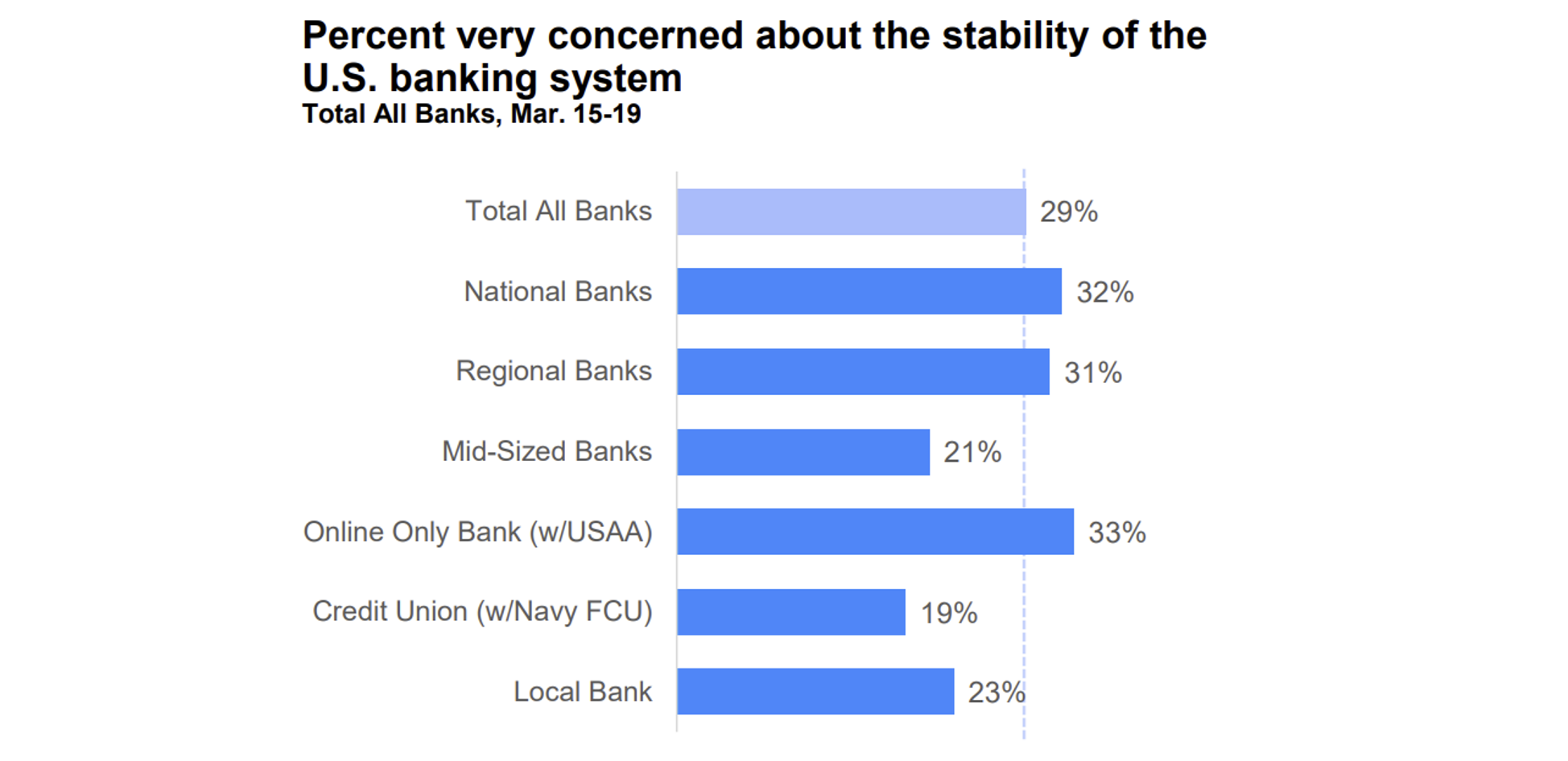
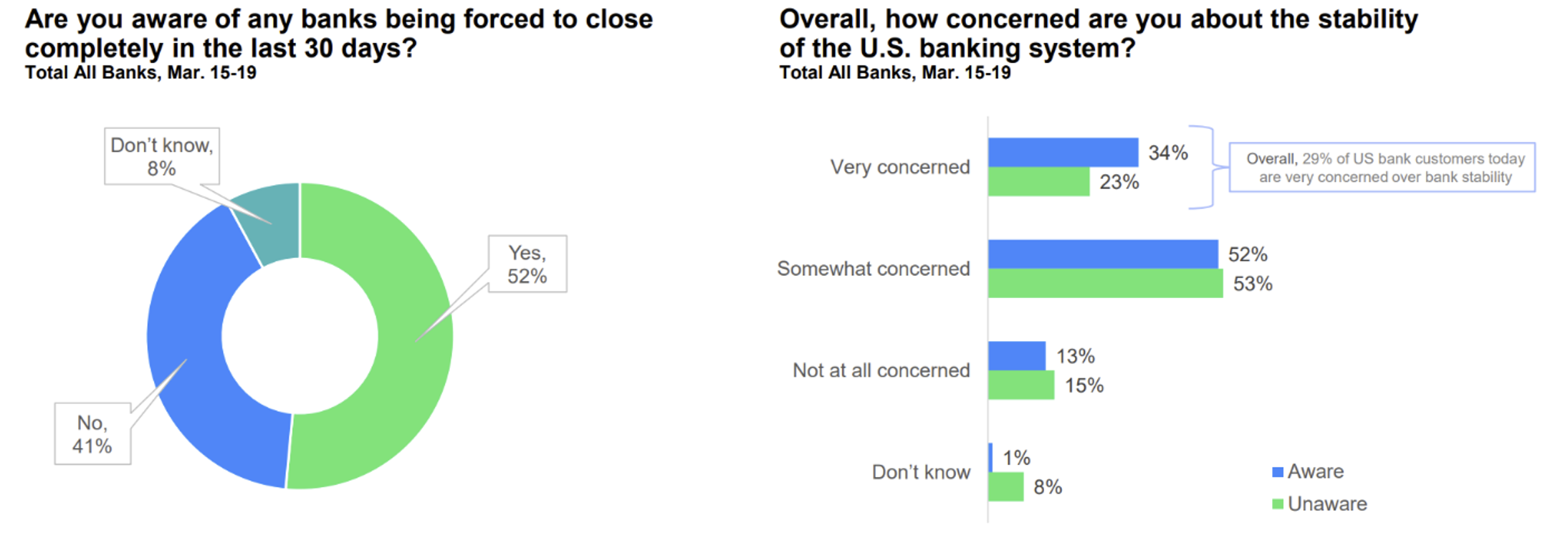
According to the latest JD Power data, nearly one-third (29%) of banking customers say they are “very concerned” with the stability of the banking system. Among those who are aware of the recent Silicon Valley Bank and Signature Bank failures, that number rises to 34%. Overall, customers with higher total deposits and higher financial health scores[1] show more concern about the stability of their banks and the safety of their deposits.

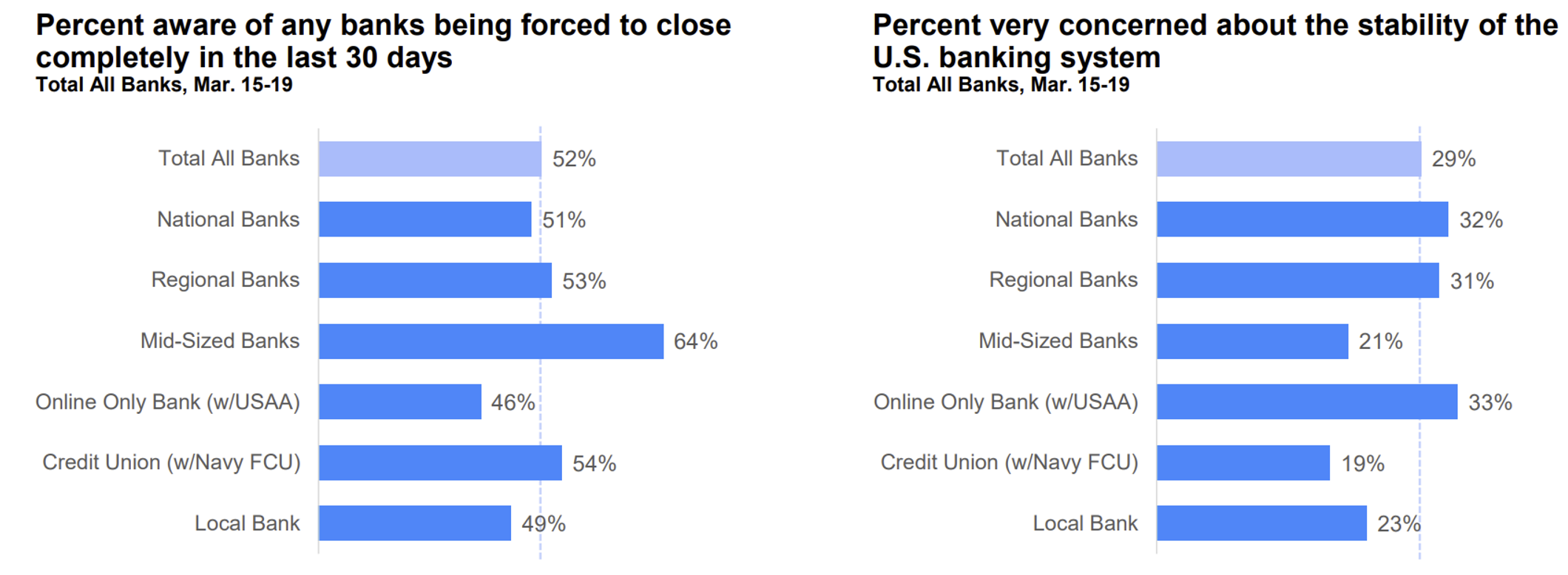
The high-profile bank failures have also stoked misconceptions among retail bank customers about bank failure risk and deposit protection. Notably, consumers banking with smaller, regional and mid-sized banks show consistently lower levels of concern about bank stability than those banking with larger, national institutions.

Overall Financial Health Holds Steady

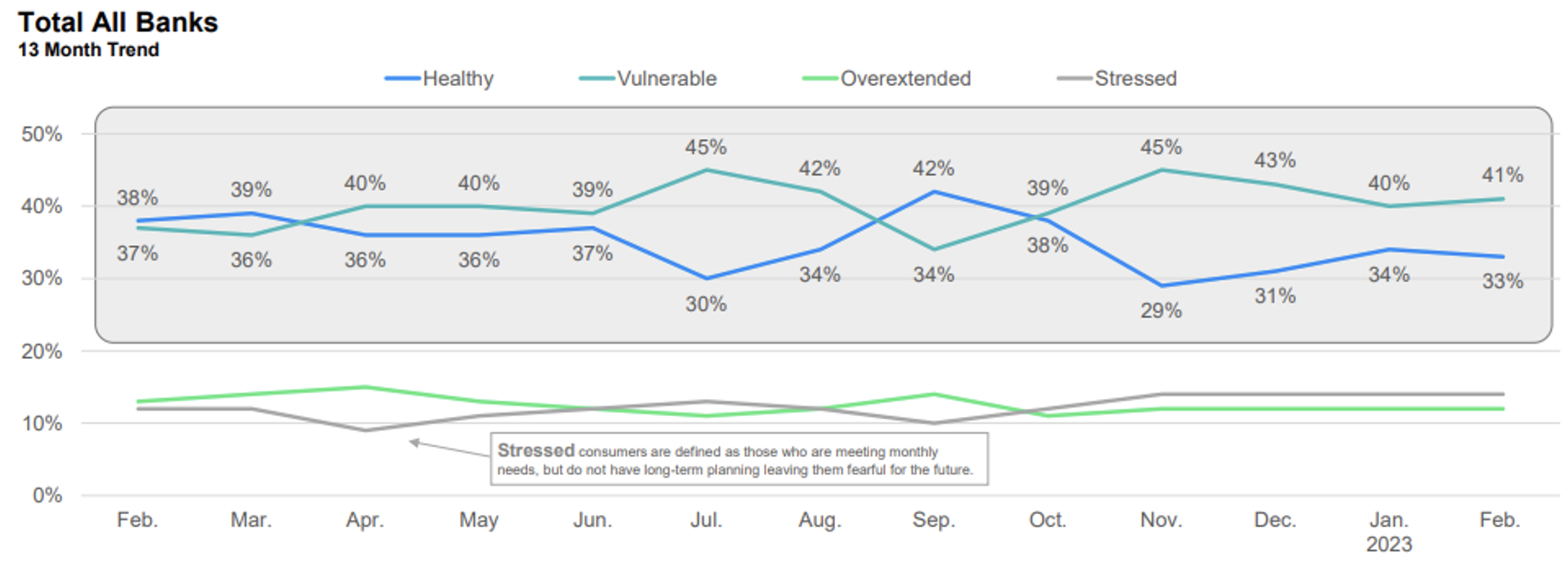
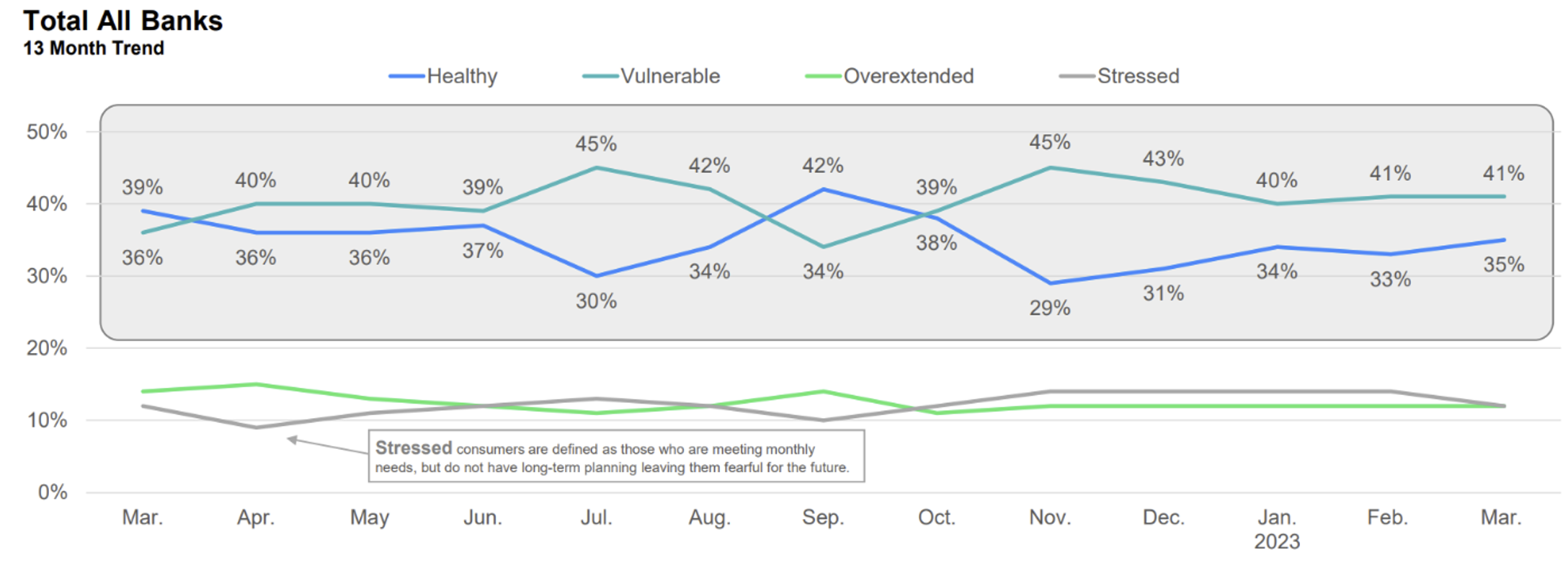
For the third straight month, there has been no noteworthy change in overall financial health. More than one-third (35%) of respondents are financially healthy, while 41% are vulnerable.


graph1

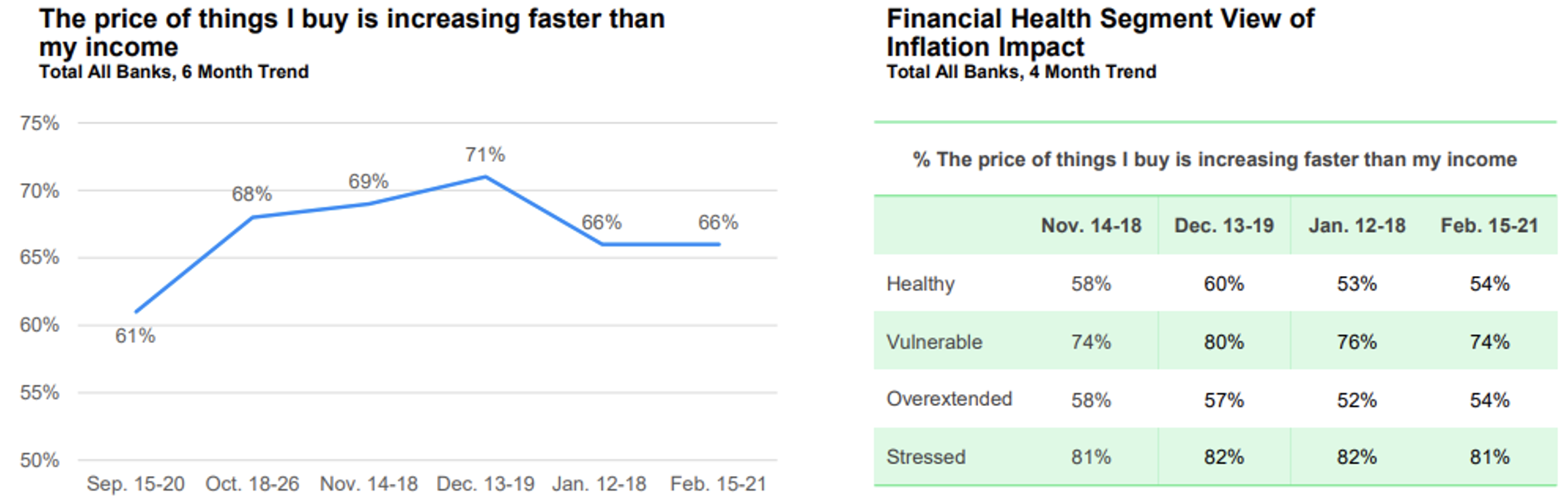
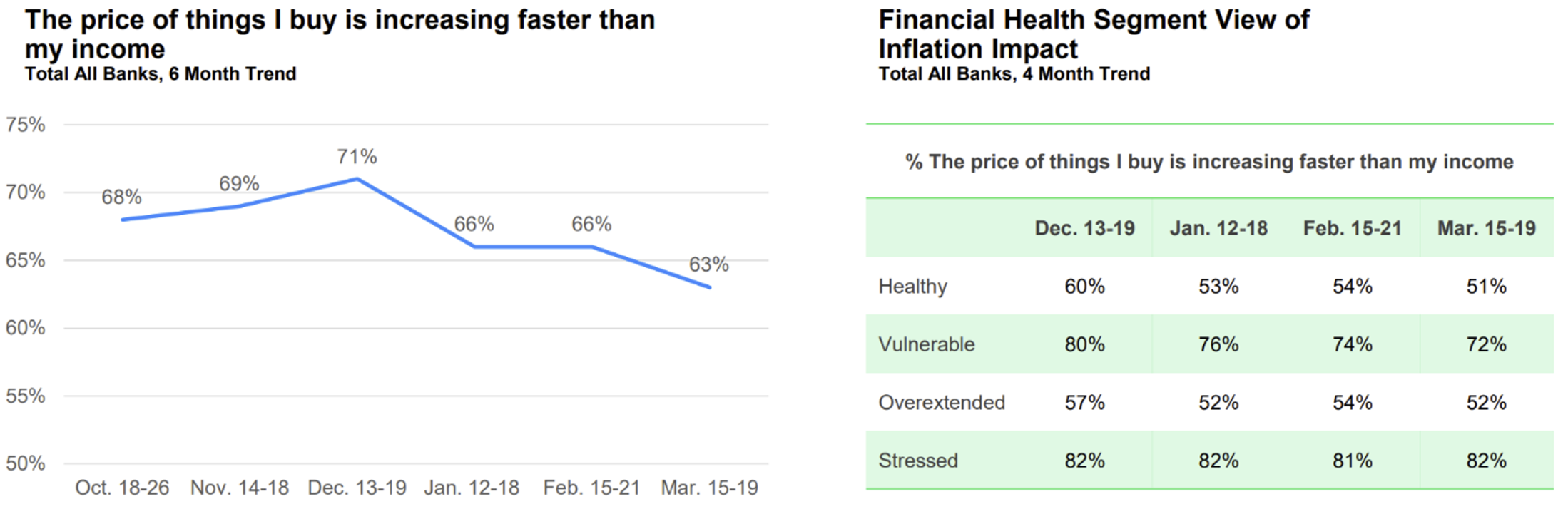
The overall level of inflation recognition fell slightly to 63%. The percentage of customers that said the price of goods is increasing faster than their income also fell slightly for most customer segment groups but was largely in line with the previous months as well.

graph2

Unpacking Bank Customer Fears

The failures of Silicon Valley Bank and Signature Bank have given some banking customers a case of 2008 déjà vu.

Overall, 29% of banking customers say they are “very concerned” about the stability of the U.S. banking system. That number increases to 34% among customers who are aware of the Silicon Valley Bank and Signature Bank failures. Just over half (52%) of banking customers are aware of any bank being forced to close.

graph3


Banking customers who are more likely to be aware of the collapse are financially healthy, more than 40 years old, and have more than $10,000 in deposits.

graph4

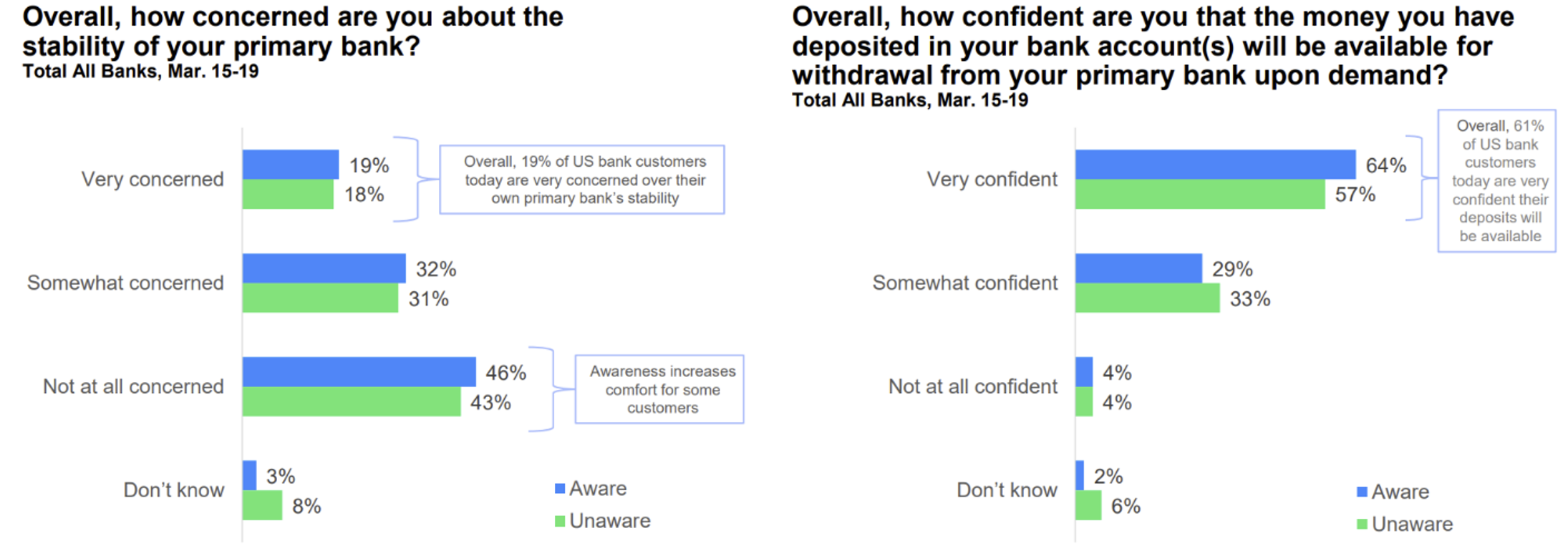
Interestingly, when asked about their specific bank, the level of customer concern falls from 29% to 19%, indicating that most customers view bank stability as someone else’s problem.

graph5

The survey also uncovered some widespread misconceptions among customers about which banks have the largest risk exposures. Customers of large, national banks express the second-highest level of concern (32%), even though those banks that are actually more protected. Conversely, local bank customers (23%), mid-sized bank customers (21%) and credit union members (19%) had the three lowest levels of concern, while those institutions have the bigger risk exposure.

graph6

Cash Under the Mattress?

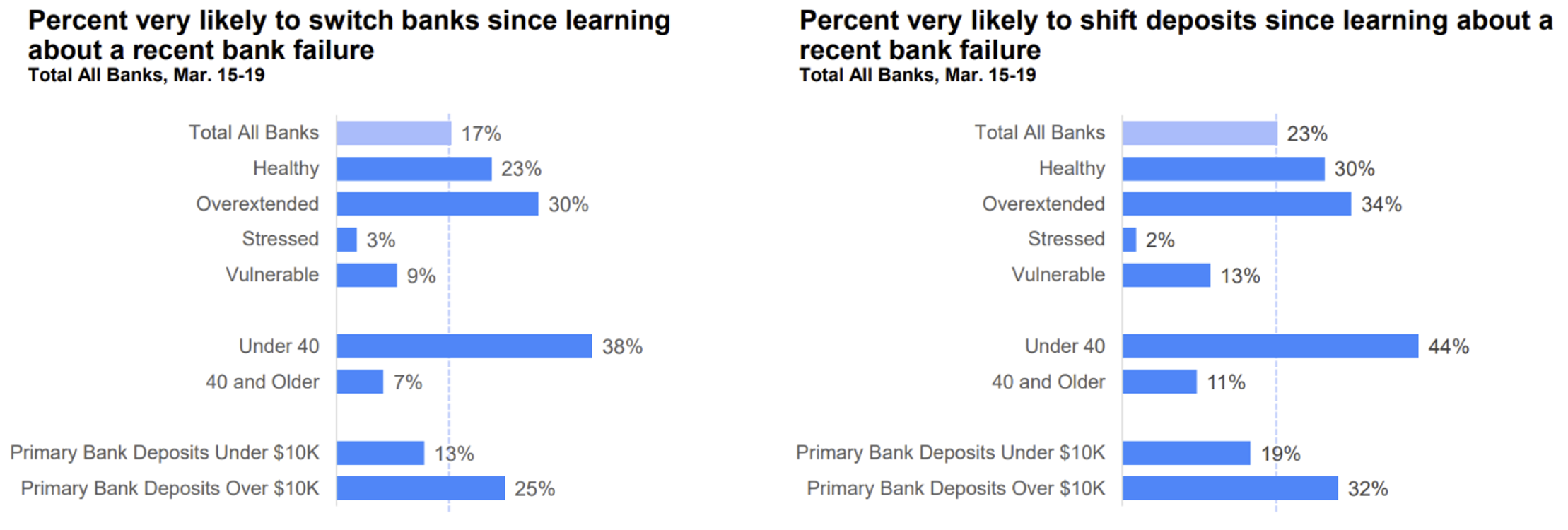
As customers contend with this new anxiety, will it lead to a mass exodus of deposits? Not necessarily. Overall, 17% of bank customers say they are very likely to switch banks in light of the recent bank failures. When asked about deposits, that number increases slightly to 23%, suggesting that customers are more likely to explore relationships with secondary banks than to completely exit their primary institutions.  

graph7

A Call for Customer Education

Bank customers are looking for guidance and now is a vital time to educate them about the ins and outs of FDIC insurance, restore confidence by outlining safeguards currently in place and deliver personalized messages that speak to their individual financial situations. By being transparent about risk and how best to protect a customer’s financial interest, banks will not only build a base that is more informed, but also one that is more confident and loyal.

It is also noteworthy that the customers who are most concerned are those with the highest deposits and strongest levels of overall financial health—in other words, the banks’ best customers. If banks want to retain these customers, they’ll need to help them understand the challenge at hand, and the steps they are taking to navigate through it.

Find out More

This Banking and Payments Intelligence Report is based on responses from 4,000 retail bank customers nationwide and was fielded in March 2023. It was authored by Jennifer White, senior director of banking and payments intelligence at JD Power. Please contact us at the numbers below to connect with Ms. White or to learn more about the underlying research.

Media Contacts

Brian Jaklitsch; East Coast; 631-584-2200; [email protected]

Geno Effler, JD Power; West Coast; 714-621-6224; [email protected]
 

[1] JD Power measures the financial health of any consumer as a metric combining their spending/savings ratio, creditworthiness, and safety net items like insurance coverage. Consumers are placed on a continuum from healthy to vulnerable.

Join our list!

To get the latest insights, announcements, and industry intelligence from our JD Power experts delivered right to your inbox, we invite you to sign up for the mailing lists that are critical to your role:

The Battle for Deposits, Digital and Relevancy: What Midsize Banks need to know.

Data-Driven Strategies for Content Delivery & Development from 4U & JD Power


JD Power is hosting a webinar dedicated to addressing specific areas that midsize banks must quickly address. Jennifer White, Senior Director of Banking Intelligence, will share exclusive insights from the recently released 2023 U.S. Retail Banking Satisfaction Study.

Missed the 2023 U.S. Retail Banking Satisfaction Study Press Release? You can read it here: https://www.jdpower.com/business/press-releases/2023-us-retail-banking-satisfaction-study

Here’s what you’ll learn:

  • Demonstrating your value proposition as customers’ financial health becomes fragile.
  • Prioritizing digital delivery channels that most impact satisfaction and new product openings.
  • “Top Five” ways to personalize your customers’ experiences.
  • Strengthen online and in-branch communication to cement long-term relevancy.


Click to watch the webinar now.

https://hub.jdpower.com/us-fs-msrb-rbs-recap-webinar-april-202

Join our list!

To get the latest insights, announcements, and industry intelligence from our JD Power experts delivered right to your inbox, we invite you to sign up for the mailing lists that are critical to your role:

JD Power Travel Podcast Explores Travel Reward Cards with Special Guest John Cabell

John Cabell, Managing Director of Payments Intelligence at JD Power, joined Michael Taylor, Managing Director of Travel Hospitality Retail, and Andrea Stokes, practice lead for hospitality, on a JD Power Travel Podcast to discuss results from the 2022 Credit Card Satisfaction Study and performance of co-branded travel credit cards.

The study reveals customer satisfaction with travel-related credit cards has improved in the last year, with hotel cards ranking highest in satisfaction. Airline cards rank second in satisfaction after hotel cards, with bank-branded credit cards ranking the lowest. Bank cards tend to lag in reward satisfaction compared to airline cards and every other kind of travel card. The key area of success for these cards is reward redemption and the perception of value.

Tune in as these industry experts discuss:

  1. What are cardholders most satisfied with when it comes to travel credit cards?
  2. How does satisfaction with travel cards compare to regular bank-branded credit cards?
  3. How important are rewards to cardholders, and how satisfied are they with reward programs?

JD Power · The Resurgence of Travel Credit Cards Feat. John Cabell | Travel & Hospitality Podcast | EP 49

Learn more about JD Power’s research on co-branded travel cards.

Join our list!

To get the latest insights, announcements, and industry intelligence from our JD Power experts delivered right to your inbox, we invite you to sign up for the mailing lists that are critical to your role:

Banking and Payments Intelligence Report
March 2023

As April 18 Looms, Banks Turn to Tech to Help Customers Ease Their Tax Anxiety

It’s been an arduous year for banking customers in the United States. Between historically high inflation and wading through the fear of a recession, one would assume tax season would seem tame in comparison. Unfortunately, that’s not the case.

According to the latest JD Power data, more than three-fourths (76%) of bank customers in the United States have some sort of worries about their taxes, and 21% say they have more fears about this tax season than normal.

That’s noteworthy, because many customers use their tax returns to inject some much-needed capital into their finances. And with just 33% of respondents financially healthy[1], customers may need some help in navigating this tax season to avoid further financial worries.

A Stagnant Landscape

As the end of Q1 approaches, there has been no noteworthy change in overall financial health. One-third (33%) of respondents are financially healthy, while 41% are vulnerable.

graph1

The overall level of inflation recognition also remains unchanged at 66%. The percentage of customers that said the price of goods are increasing faster than their income is virtually identical to the February 2023 report, as well.

chart2

Tax Troubles

With the financial landscape relatively unchanged, customers enter a tax season filled with new filing requirements and thresholds with some consternation.

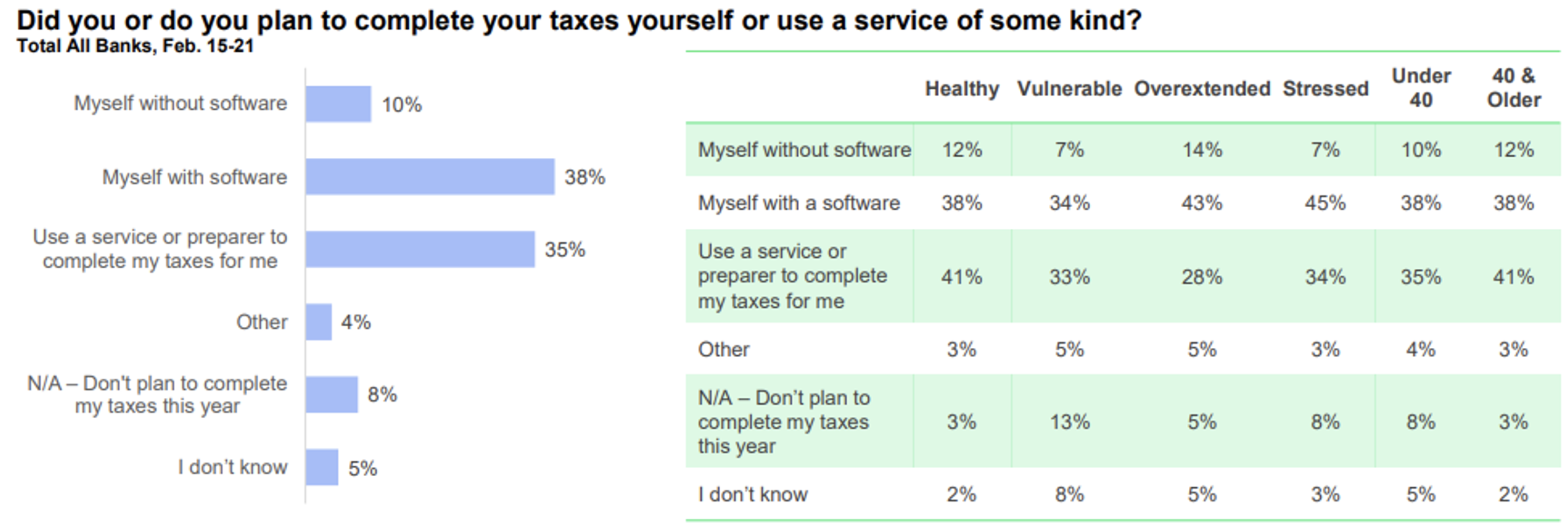
Nearly half (48%) of bank customers say they complete their taxes themselves (38% using software, 10% without software), while 35% say they use a service or a preparer. The stressed (45%) and overextended (43%) are most likely to use a software to complete their taxes themselves, while financially healthy customers (41%) are most likely to use a preparer.

chart3

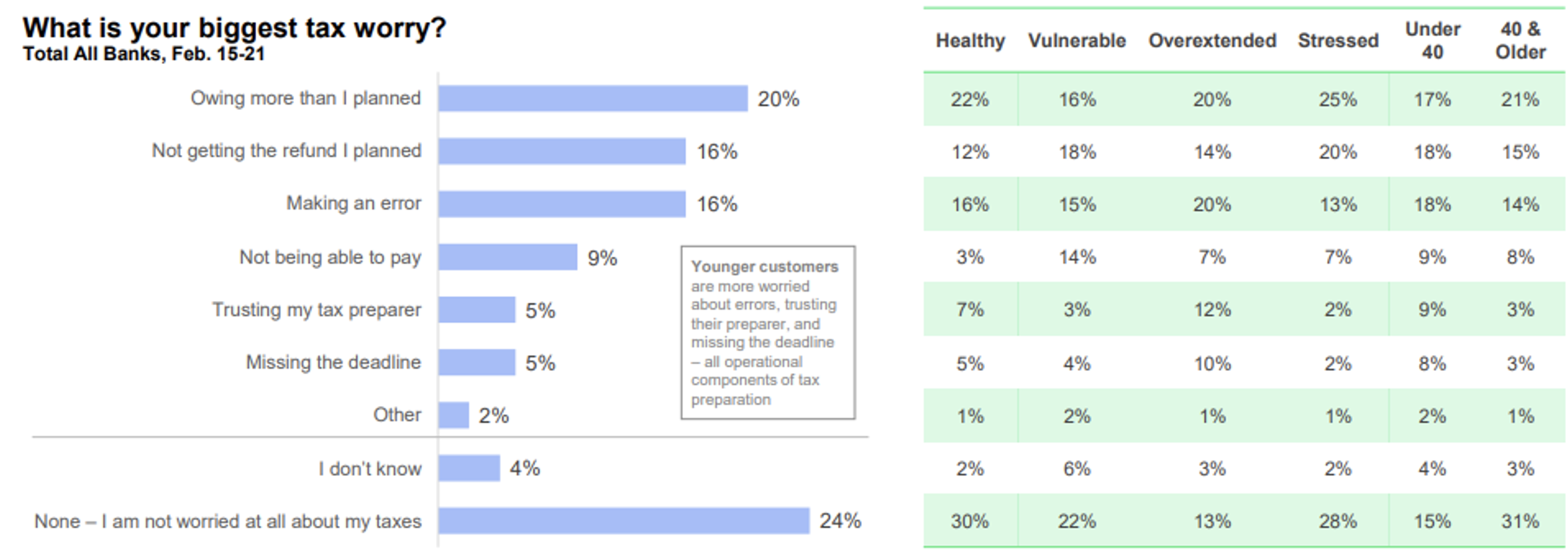
Bank customers’ worries center on the fear of sticker shock, as 20% worry that they’ll end up owing more than planned, and 16% fear they may not get any refund. Both of those scenarios would mean a huge financial setback to customers, many of whom rely on the liquidity to help them pay down debt or keep up with existing expenses.

chart 4

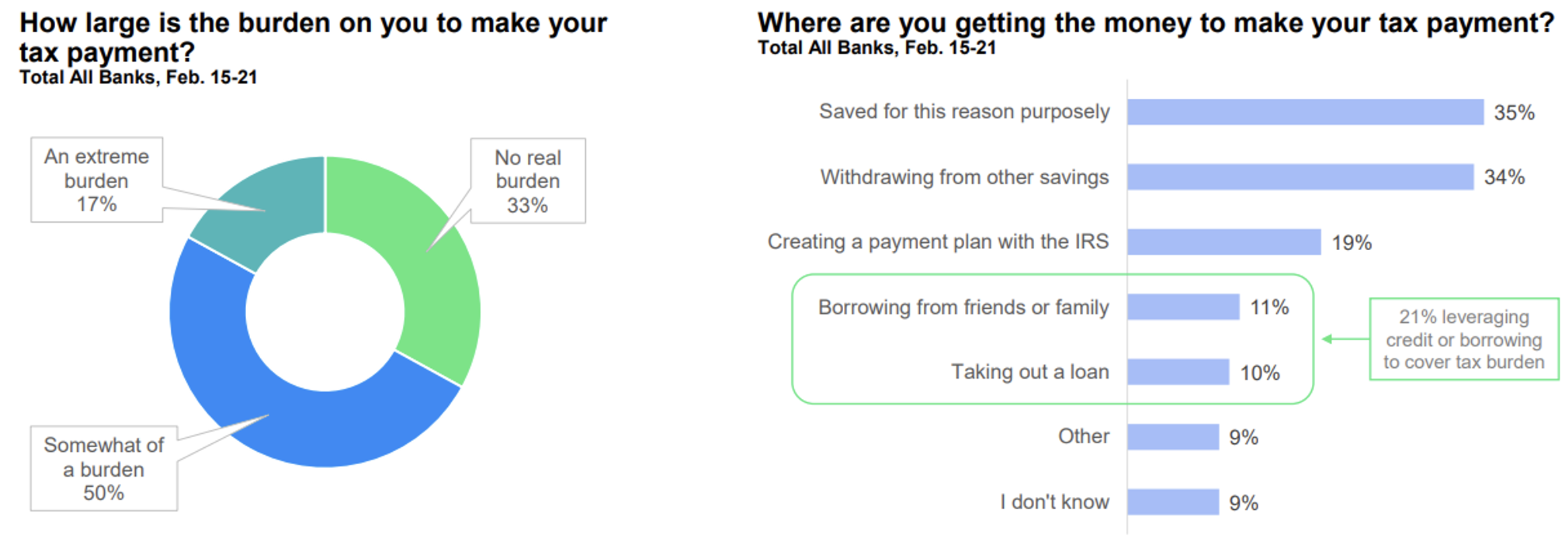
What’s more, half of bank customers (50%) say it is somewhat of a burden to make their tax payment, and 17% say it is an extreme burden. Of banking customers that have tax repayment, 21% are creating new debt by either borrowing from a friend or family member (11%) or taking out a loan (10%) to make that payment. Another 9% said they don’t know where they will get the money for tax repayment.

chart5

Banks to the Rescue?

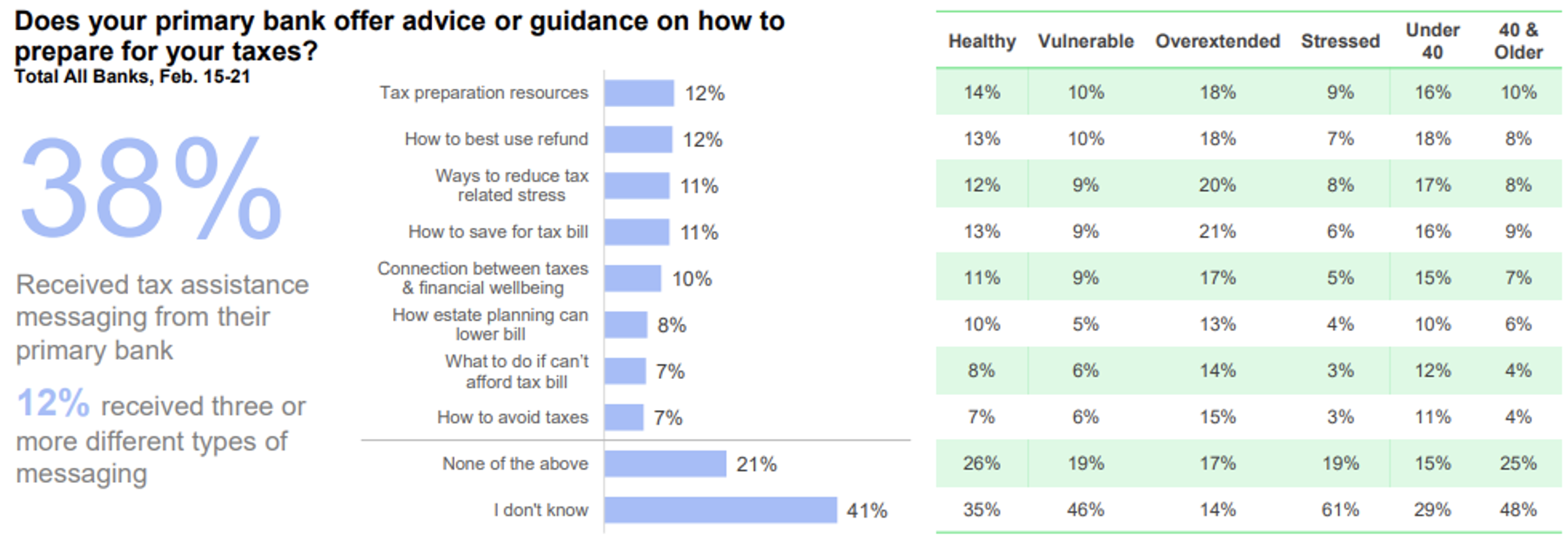
As customers contend with this anxiety, banks are hoping to step up and help guide their customers through it. Some fintech firms are rising to meet this challenge, helping banks install solutions that help their customers make tax-savvy decisions all year long. Yet just 38% say they have received any messaging about tax assistance at all.

chart6

While it is encouraging that even a small percentage (12%) of customers indicate having received three or more types of messaging on tax assistance, the market for that help is far more robust. Nearly half (46%) of the vulnerable population and 61% of the stressed population don’t know if they received tax advice from their banks, which clearly shows banks need to find a way to be more proactive and clear in their messaging, particularly to the customers that need it the most.

Building Trust

There remains a wide-open space for both more fintech firms and traditional incumbents to offer services that could bring advantages to customers and their financial institutions. Some customers, particularly those under-40, say their biggest tax worry is trusting their preparer (9%). That number is three-times higher than the over-40 population (3%). If a bank, especially one that has their customers’ trust already, can help a customer make better tax decisions and ultimately get a better return, that customer will likely be far more inclined to stay in-house when using that return, whether that’s in the form of making a down payment on a home, taking out an auto loan, or paying down debt.

Some challenger brands are already rising to meet this challenge. Take CashApp, which acquired Credit Karma Tax in 2020. It offers both federal and state tax preparation services at no charge, on top of offering traditional services around banking, investing, or sending and receiving money. Others, like SoFi, offer everything from basic banking services and credit cards to mortgages and loan refinancing and investing, and even comparison shopping for insurance. But not tax preparation.

Data consistently show that as customers use more bank services successfully, they become further engaged and, therefore, less likely to leave the branch and less likely to move deposits elsewhere. If banks can bolster their services with tax solutions that can have a meaningful effect for their customers, they’ll likely see a significant return on their investment.

Find out More

This Banking and Payments Intelligence Report is based on responses from 4,000 retail bank customers nationwide and was fielded in February 2023. It was authored by Jennifer White, senior director of banking and payments intelligence at JD Power. Please contact us at the numbers below to connect with Ms. White or to learn more about the underlying research.


Media Contacts

Brian Jaklitsch; East Coast; 631-584-2200; [email protected]

Geno Effler, JD Power; West Coast; 714-621-6224; [email protected]
 

[1] JD Power measures the financial health of any consumer as a metric combining their spending/savings ratio, creditworthiness, and safety net items like insurance coverage. Consumers are placed on a continuum from healthy to vulnerable.

Join our list!

To get the latest insights, announcements, and industry intelligence from our JD Power experts delivered right to your inbox, we invite you to sign up for the mailing lists that are critical to your role:

Banking and Intelligence Report
March 2023

The Battle for Buy Now Pay Later Customers is Being Won at the Point of Sale

Buy Now Pay Later (BNPL) usage continues to grow, but not all these payment plans are experiencing the same level of customer engagement.

By the end of 2021, shoppers had spent more than $20 billion using BNPL, and, since then, BNPL has been dubbed one of the hottest consumer trends in the world, projected to generate up to $680 billion in transaction volume worldwide by 2025. This, of course, has spurred legions of banks, fintechs, retailers and ecommerce platforms to get in on the action.

Interestingly though, according to consumers surveyed by JD Power, engagement is primarily happening at the point of sale.

Approach at Checkout

According to our data, the total percentage of consumers with an active BNPL account has increased to 22% in January 2023 from 18% in October 2022 and 14% in July 2021. This is rapid growth that merits the attention lenders are giving to the space, and the key to scaling a BNPL solution seems to be promoting it at the point of sale.

Overall, 29% of customers said they first became interested in a BNPL service because it was offered as an option at checkout. Respondents also cite friends and family recommendations (16%) and social media (14%) as other factors that piqued their interest in BNPL.

Card Issuers Join the Fray

The success of BNPL offers has not gone unnoticed by credit card issuers, and some are competing directly with BNPL providers. Issuers are doing this is by either allowing cardholders to convert balances on card purchases to fixed, monthly payments for a fee, or offering a fixed APR that is lower than the current rate on their card balances. That’s often attractive for cardholders since they are already familiar with the card issuer and their terms.

That advantage, though, only goes so far. If card-based BNPL payment plans aren’t top of mind in the precious moments when cardholders are paying for their purchase,  those cardholders may be more likely to try a competitive BNPL solution.

Knowing the BNPL Customer

Financial institutions and fintech companies alike have recognized the steady upward trajectory of this category and know there is great potential in the space. But as these companies jockey for position in the market, they’ll need to understand each customer’s decision-making process around BNPL. This is unfamiliar territory for credit card issuers, who largely compete for new customers through affiliates, direct mail and cross-sell activities – most of which are disconnected from the point of sale decision. Now, as the point of sale becomes the primary battle ground for BNPL customers, issuers need to shift their thinking from traditional card acquisition strategies.

By gaining more insight into the details of the customer journey, credit card issuers looking to compete with BNPL providers should build cardholder awareness of their own payment plans so that they aren’t tempted to try other BNPL solutions at the moment of purchase. As BNPL gains more social acceptance, these customer behaviors could change, which is why providers will have to stay diligent on tracking these trends as they evolve.

Find out More

This Banking and Payments Intelligence Report is based on data from the JD Power U.S. Retail Banking Satisfaction Study, which is a yearly study that includes more than 20,000 responses annually. It was authored by John Cabell, managing director of payments intelligence at JD Power. Please contact us at the numbers below to connect with Mr. Cabell or to learn more about the underlying research.


Media Contacts

Brian Jaklitsch; East Coast; 631-584-2200; [email protected]

Geno Effler, JD Power; West Coast; 714-621-6224; [email protected]
Join our list!

To get the latest insights, announcements, and industry intelligence from our JD Power experts delivered right to your inbox, we invite you to sign up for the mailing lists that are critical to your role:

The JD Power National Banking Satisfaction Study recently reported that satisfaction levels among banking customers aged 40 and under have seen a steep decline, whereas customers with an older age group have seen only marginal change.  Paul McAdam, Senior Banking and Payments sheds light on the issues on these findings to allow banks the opportunity to remedy them.

Fraud Issues Are on the Rise

A trend we are watching is rising incidents of fraud. Across our most detailed studies, fraud seems to be a widespread issue:

Customers Look to Banks for Advice

Customers tell JD Power that they want their bank to be proactive when it comes to providing advice on how to navigate this difficult economy. Banks should also think about providing educational programs and webinars to help customers gain more understanding of their finances. The topics covered can range from investments, retirement planning, and other financial strategies to practical tips on managing debt. This can help build relationships with customers, as well as enhance their trust in the bank

At the end of the day, the goal is to make sure all banking customers feel supported and valued, no matter their age. This video is an eye-opening take on the banking industry’s customer satisfaction needs. Discuss these insights and with JD Power’s Banking and Payments Intelligence Team.

Join our list!

To get the latest insights, announcements, and industry intelligence from our JD Power experts delivered right to your inbox, we invite you to sign up for the mailing lists that are critical to your role:

Banking and Payments Intelligence Report
February 2023


What Role is Poor Financial Literacy Playing in Financial Health of American Consumers?

As U.S. bank customers start to resign themselves to another year of persistently high inflation, many have grown increasingly aware of their own lack of financial literacy.

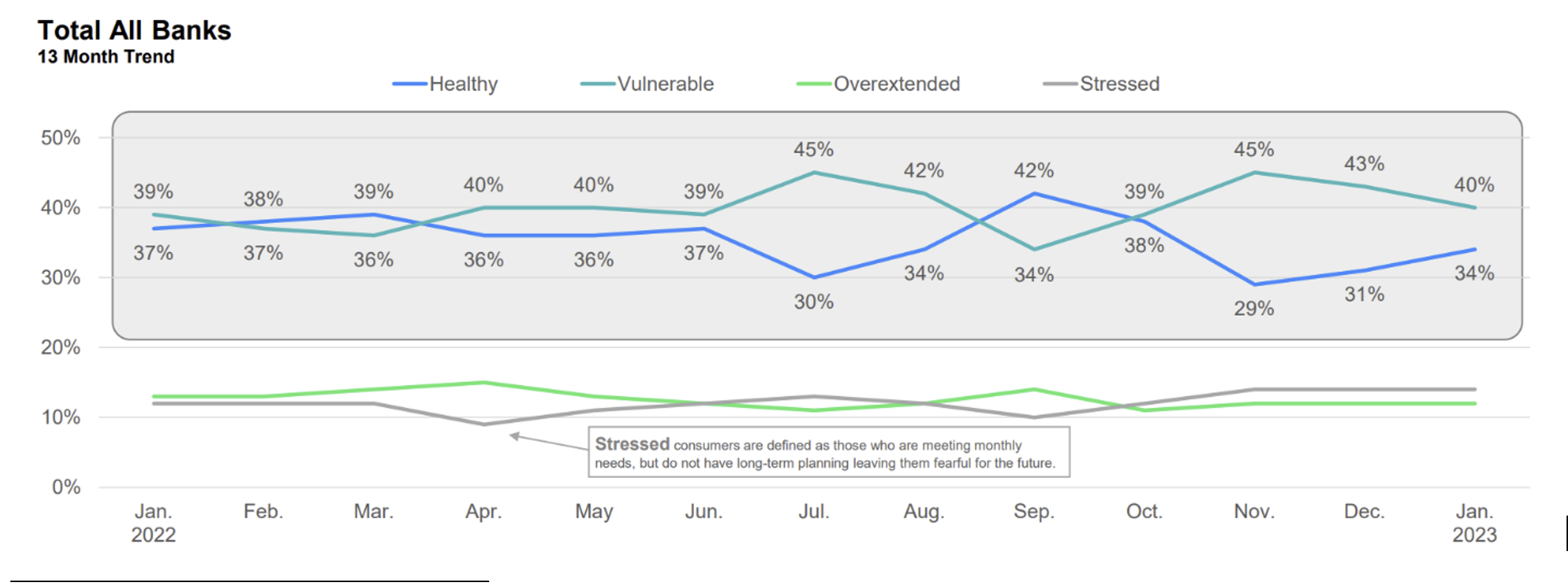
The overall financial health[1] of bank customers in America has slightly improved this month, according to JD Power data. Overall, 34% of bank customers are healthy, which is up 3 percentage points from January’s reading. That said, there is plenty of room for improvement.

Bank customers seem to grasp that too, and they seem to have found a culprit: poor financial literacy. Virtually all (91%) bank customers say that poor financial literacy is a problem for those under age 25, and 78% believe that financial literacy should be taught in high school. Moreover, 42% of bank customers say they have significant doubts in their own levels of financial knowledge.

Overall Economic Outlook Improves Slightly

As the first quarter begins to settle in, bank customers are starting to feel slightly better about their economic situations. More than one-third (34%) of bank customers are currently classified as financial healthy, up 3 percentage points from a month ago, and 40% are vulnerable, down from 43%.

img1


Still, despite those modest improvements, almost two-thirds (66%) of customers said that the price of goods is increasing faster than their income. While that is the lowest level of inflation recognition since the fall of 2022, the significant financial influence that inflation is having on consumers cannot be overstated.

img2


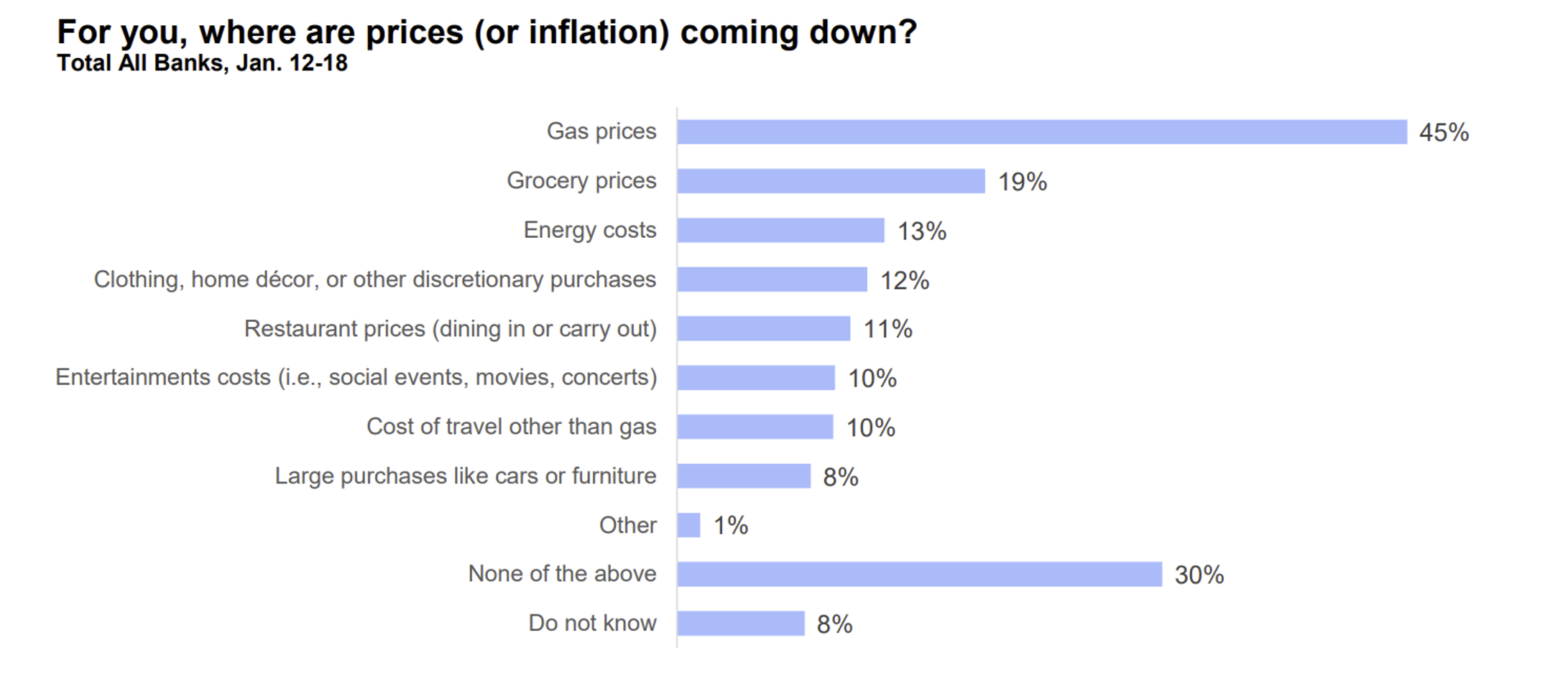
Nearly half (45%) of customers say they have felt relief at the gas pump and another 19% are noticing grocery prices declining. Almost one-third (30%) say that they have not experienced prices declining. Unsurprisingly, that is largely concentrated in customers that are stressed or vulnerable, but even 27% of healthy customers say they have yet to feel relief.

img3


Education is the Answer

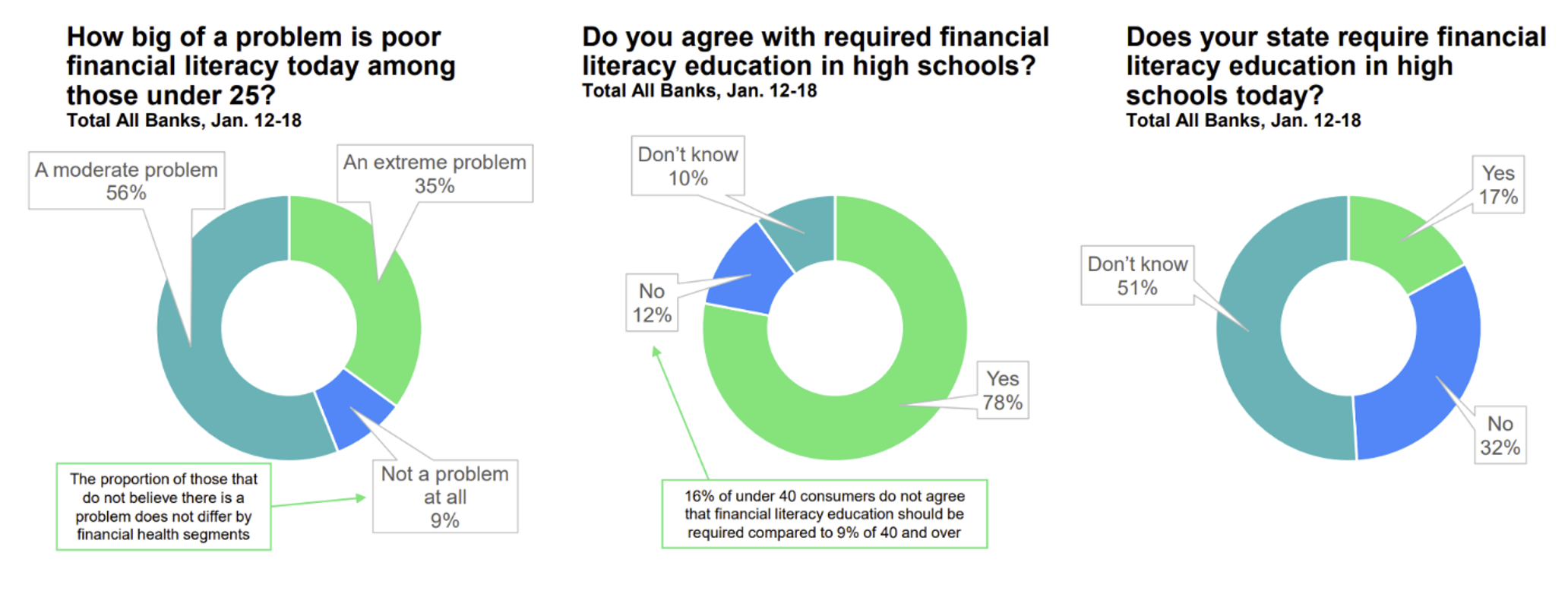
Perhaps the most encouraging indicator this month is that bank customers seem to understand that simply waiting around for inflation to subside isn’t the only way they can navigate toward financial security. Customers want to be financially literate, and many say that has not been an easy goal to achieve. Overall, 91% believe financial literacy is at least a moderate problem today among those under age 25, with 35% viewing it as an extreme problem.

graph


More than three-fourths (78%) believe in teaching financial literacy in high school, yet 32% say their state does not require financial literacy today, while 51% are unsure.

Banks to the Rescue

It’s clear from this latest data that many banking customers’ attitudes toward financial conditions will naturally ebb and flow. To steady customers through that natural volatility, banks can play a key role in educating their customers to be better prepared.

Our data finds that only 58% of banking customers think of themselves as financially knowledgeable, and those that are less knowledgeable are more critical of their banks. This does not only equate to lower satisfaction, customers with lower levels of understanding are less likely to open second accounts with the bank and are more likely to require customer support services. That means that banks can’t simply be passive bystanders to their customers’ financial literacy.

Banks must be proactive. That means more than just creating a library of educational articles and resources that customers will never see. Banks need to help encourage hands on learning among their customer base. They need to find better ways to encourage customers to engage with advice, then prompt them to move from it to using a tool to achieve better financial outcomes (perhaps even offering incentives to increase tool adoption), whether that is figuring out their current spending plan, directing them to check their credit score, or giving them a tool to list all their debts and prioritize which ones they are paying off first.

A better partnership between banks and their customers will only help both parties. Customers are eager for an education. Banks that give it to them will reap the benefits in the form of stronger customer loyalty and improved customer satisfaction.


Find out More

This Banking and Payments Intelligence Report is based on responses from 4,000 retail bank customers nationwide and was fielded in January 2023. It was authored by Jennifer White, senior director of banking and payments intelligence at JD Power. Please contact us at the numbers below to connect with Ms. White or to learn more about the underlying research.


Media Contacts

Brian Jaklitsch; East Coast; 631-584-2200; [email protected]

Geno Effler, JD Power; West Coast; 714-621-6224; [email protected]
 

[1] JD Power measures the financial health of any consumer as a metric combining their spending/savings ratio, creditworthiness, and safety net items like insurance coverage. Consumers are placed on a continuum from healthy to vulnerable.

Join our list!

To get the latest insights, announcements, and industry intelligence from our JD Power experts delivered right to your inbox, we invite you to sign up for the mailing lists that are critical to your role:

Retail banks looking to capture younger customers need to pay attention to how direct banks are gaining traction with both fee-sensitive and interest rate-sensitive customers by engaging them in services to help them improve their personal financial wellness. JD Power reported in the 2022 Direct Banking Study that direct banks are leading in NPS over neobanks and traditional banks. In the short video, Paul McAdam, Senior Director of Banking and Payment Intelligence, shares why more customers recommend Direct Banks to their friends and family. .

Why Does NPS Matter?

NPS is a widely used measurement of customer advocacy, engagement, and loyalty. Marrying NPS  with the depth of JD Power’s customer experience metrics provides clients a significantly enhanced capability to understand where they stand relative to competitors and prioritize improvement opportunities more precisely.

Financial Health Matters to Clients

Whether it is implementing onboarding programs so customers can utilize digital tools or suggesting products that fit customers’ needs, financial institutions that build financial health strategies into their operations can expect to see increased customer engagement.

About JD Power Direct Banking Study

The JD Power Direct Banking Satisfaction StudySM evaluates consumers’ satisfaction and experience with online-only direct banks and neobanks. The analysis explores satisfaction among customers who hold checking or savings account with more than 40 of these online-only providers. Information regarding brands profiled and date of publish can be found at JD Power | Direct Banking Satisfaction Survey

Join our list!

To get the latest insights, announcements, and industry intelligence from our JD Power experts delivered right to your inbox, we invite you to sign up for the mailing lists that are critical to your role:

Banking and Payments Intelligence Report
October 2022

Are Americans Adjusting to Inflation?

Inflation isn’t going away anytime soon. But according to the latest JD Power data, some signals suggest that Americans are getting a better handle on how to manage their finances in the face of challenging economic conditions.

According to the data, the share of American banking customers now classified as financially healthy[1] increased four percentage points, this month, the largest increase in nearly a year. What’s more, number of customers that said the cost of goods increased faster than their income fell for the first time since we began tracking the metric in March 2022.

While the improvement is modest—and a significant majority of American consumers are still experiencing financial difficulties—supporting data suggest that many Americans are starting to change their spending habits to adapt to rising prices.

Financial Health Improves Slightly

Although it is still too early to call it a rebound, some key indicators of financial health are starting to show month-to-month improvement. Notably, 34% of U.S. bank customers are now classified as financially healthy, up four percentage points from July.

Chart depicting financial health across banks


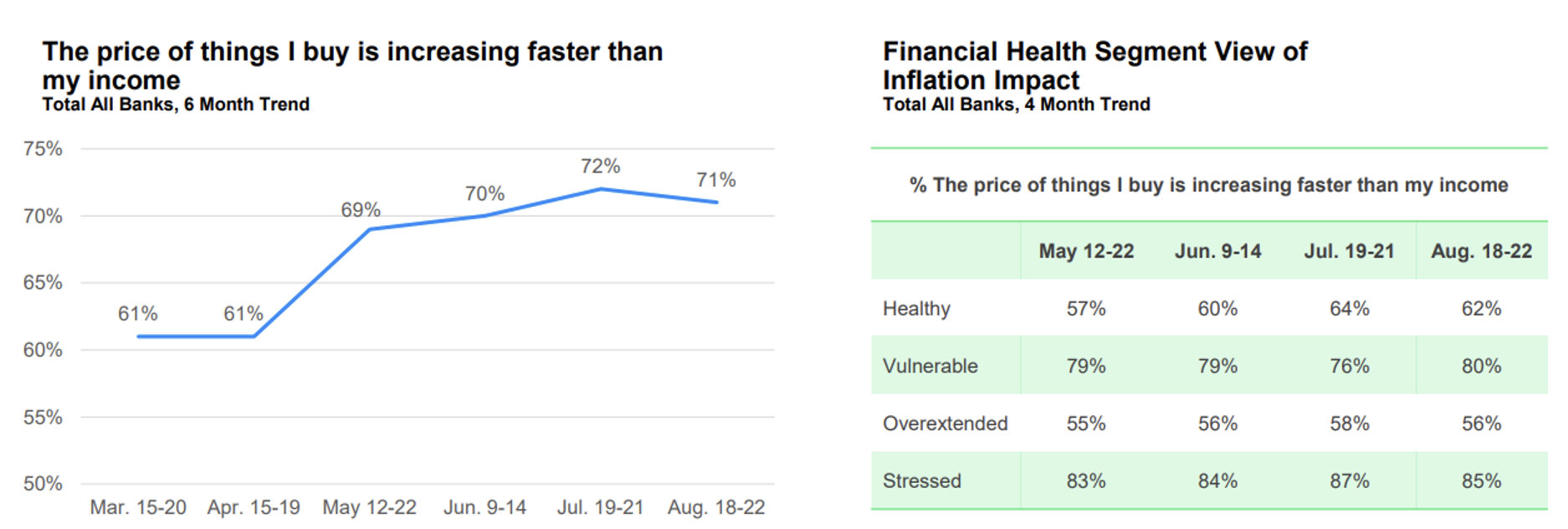
Meanwhile, the percentage of banking customers who said the price of goods is increasing faster than their income, decreased one percentage point to 71% in August.  

The price of things is increasing more than my salary


Spending, Budgeting, and Saving Strategies Evolve

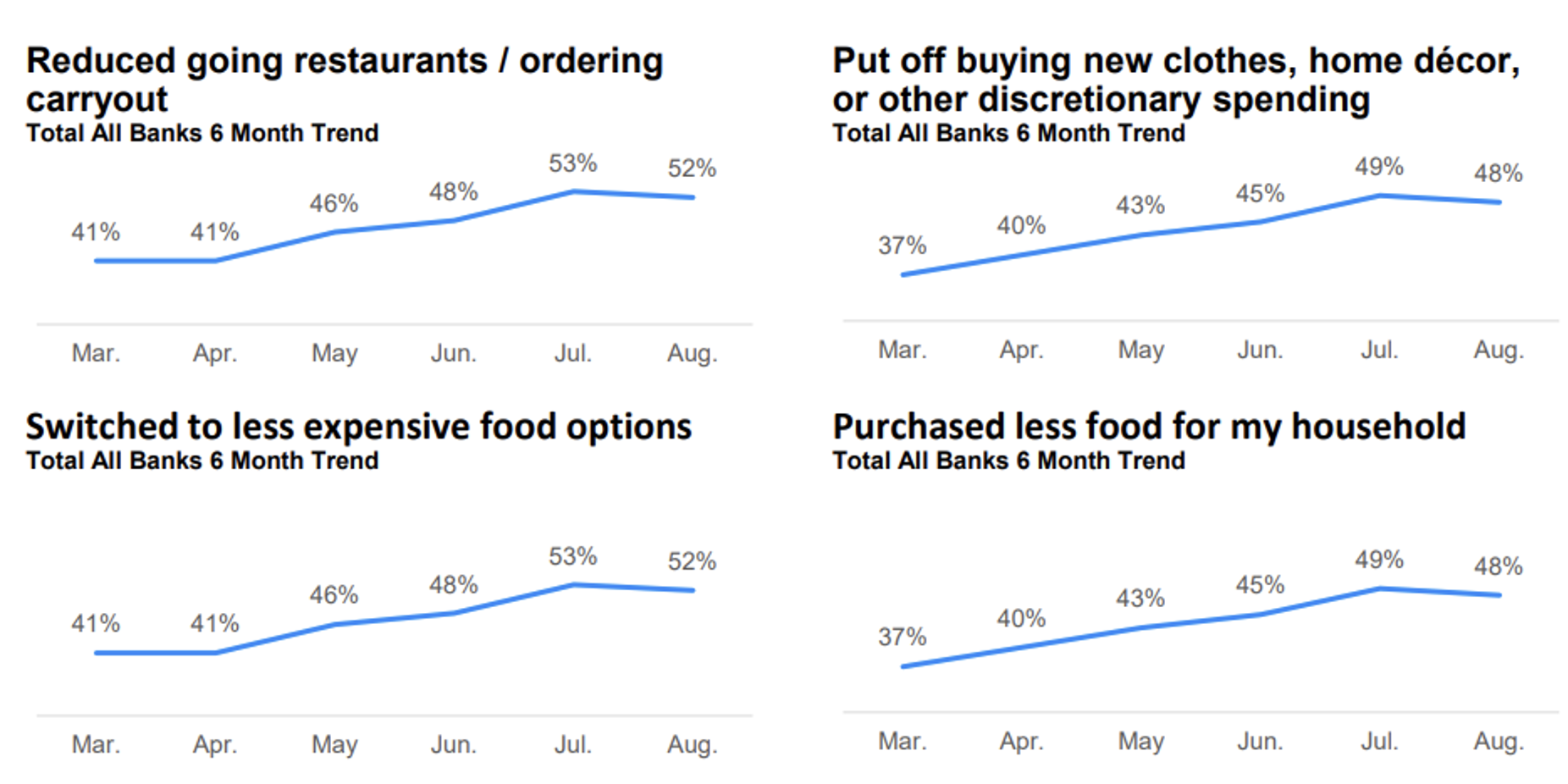
Americans also seem to be adjusting their spending to mitigate the stress caused by inflation. Currently, 86% of consumers say they are taking action to manage inflation in their lives today with steps such as increased budgeting, buying fewer items to stay on budget and increasing savings to safe for future services. For example, in October 2021, 12% of bank customers told JD Power that they do not have a budget. In August, that number fell to just 8%.

The biggest changes in consumer spending behaviors are focused on dining options and discretionary spending on items such as clothing.

Prices are rising


While Americans are reining in spending, it seems that they are backing off some of the emergency measures they took over the summer.  The number of Americans that reduced their savings to pay for immediate expenses decreased month over month, as did the percentage of those that experienced increased need for credit to pay for immediate needs.

bar graphs


Banks to the Rescue?

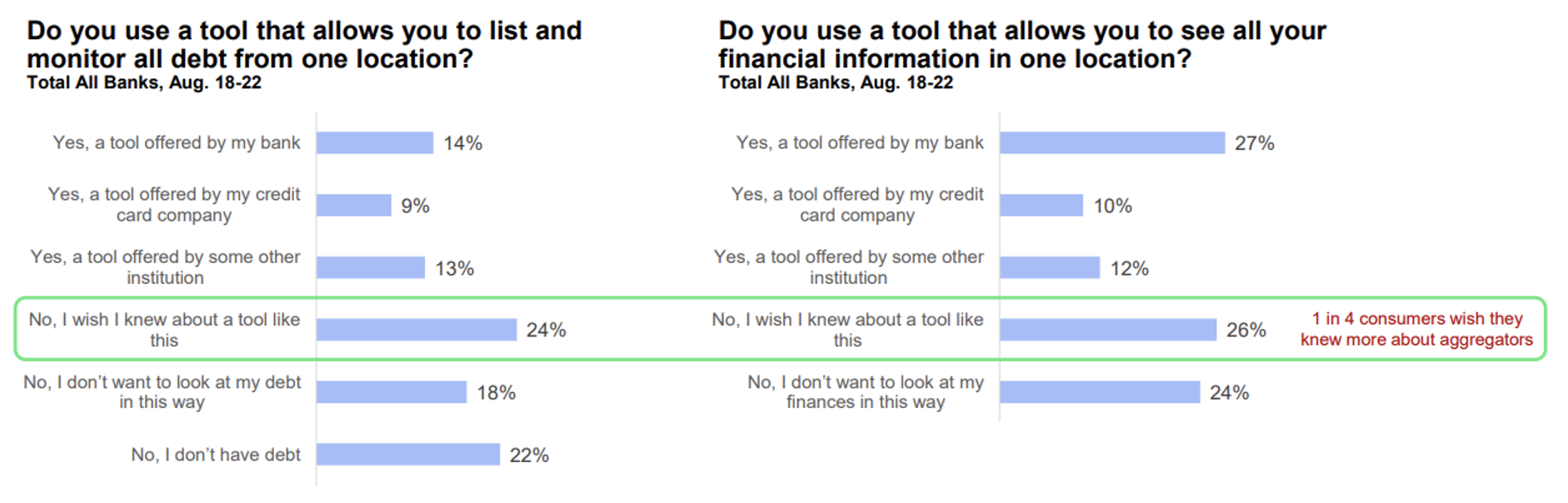
While banking customers try to navigate this financial landscape, banks are still slow to offer solutions that are making a meaningful difference. One-fourth (25%) of customers wish they received information from their bank about strategies and tool to manage inflation, save in a recession or pay down debt in a recession.

Graph showing who uses tools to monitor debt

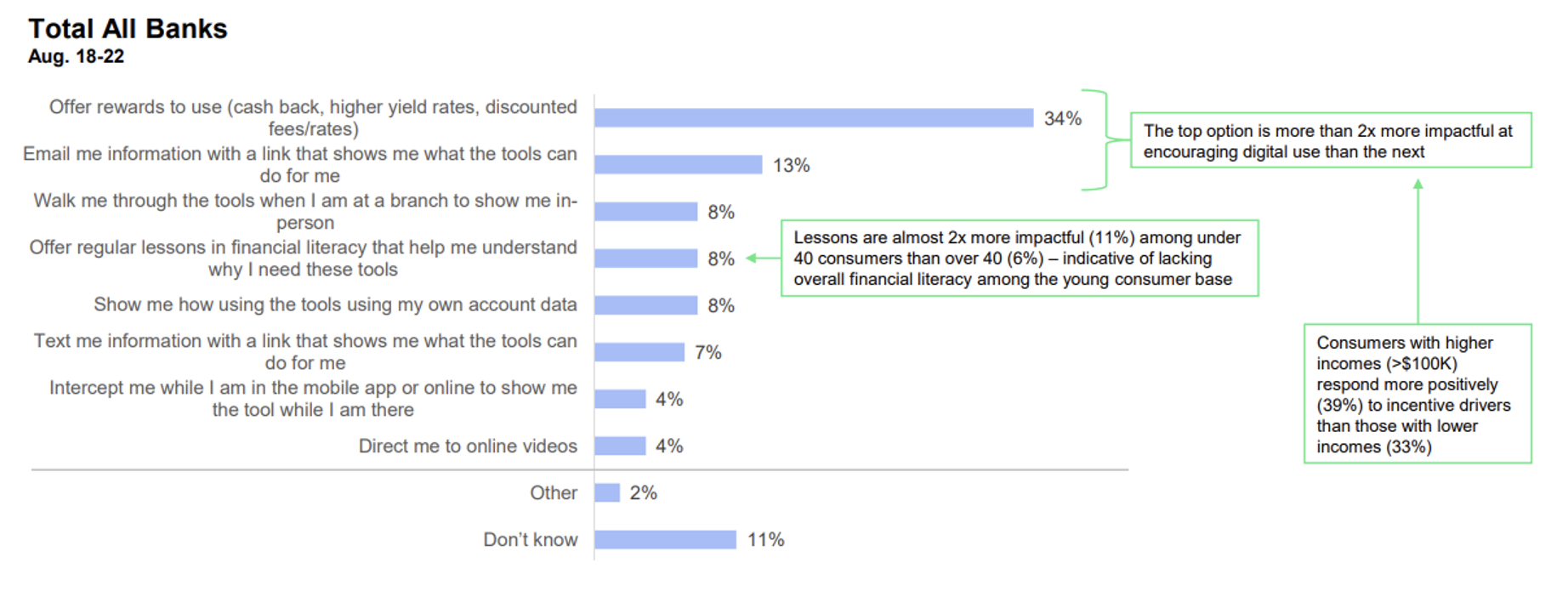
When asked what banks could do to make products compelling enough to use, Americans were quick to mention rewards, such as cash back, higher-yield rates and discounted fees (34%). Also, 13% said they would like to be emailed a link explaining benefits of such a tool, and 8% want to be walked through their options at a local branch.

Graph showing banking solutions to financial issues caused by inflation


Guiding to the Light

While the overall outlook on American financial health is still far from optimistic, the behavioral changes we are seeing in the data suggest many Americans are starting to adapt to the current inflationary environment.

For as long as that challenging economic environment persists, banks have an opportunity to make meaningful inroads in their relationships with their customers. Now more than ever, customers are looking to their financial institutions for guidance, and are receptive to programs banks have long been after customers to adopt. Handled properly, the current economic downturn could present an opportunity for banks to earn goodwill and advocacy by helping customers address their pain points.

Find out More

This Banking and Payments Intelligence Report is based on responses from 4,000 retail bank customers nationwide and was fielded in August 2022. It was authored by Jennifer White, senior director of banking and payments intelligence at JD Power. Please contact us at the numbers below to connect with Ms. White or to learn more about the underlying research.


Media Contacts

Brian Jaklitsch; East Coast; 631-584-2200; [email protected]

Geno Effler, JD Power; West Coast; 714-621-6224; [email protected]
 

[1]  JD Power measures the financial health of any consumer as a metric combining their spending/savings ratio, creditworthiness, and safety net items like insurance coverage. Consumers are placed on a continuum from healthy to vulnerable.

Join our list!

To get the latest insights, announcements, and industry intelligence from our JD Power experts delivered right to your inbox, we invite you to sign up for the mailing lists that are critical to your role:

Banking and Payments Intelligence Report
September 2022

Americans Want Inflation Assistance, Social Responsibility from their Banks

Americans have hit a brick wall in the form of inflation, according to the latest JD Power data. Nearly three-fourths (72%) of Americans now say that the cost of goods is increasing faster than their income. That’s up 2% since June, which was also an all-time high.

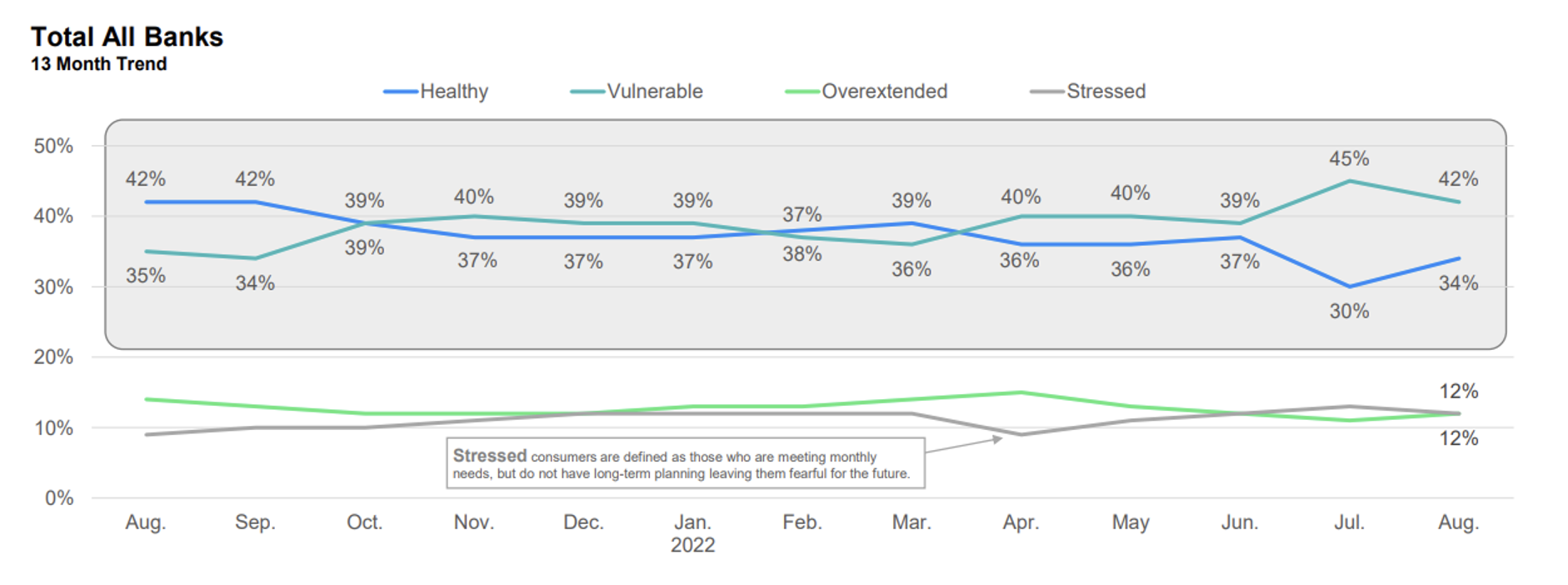
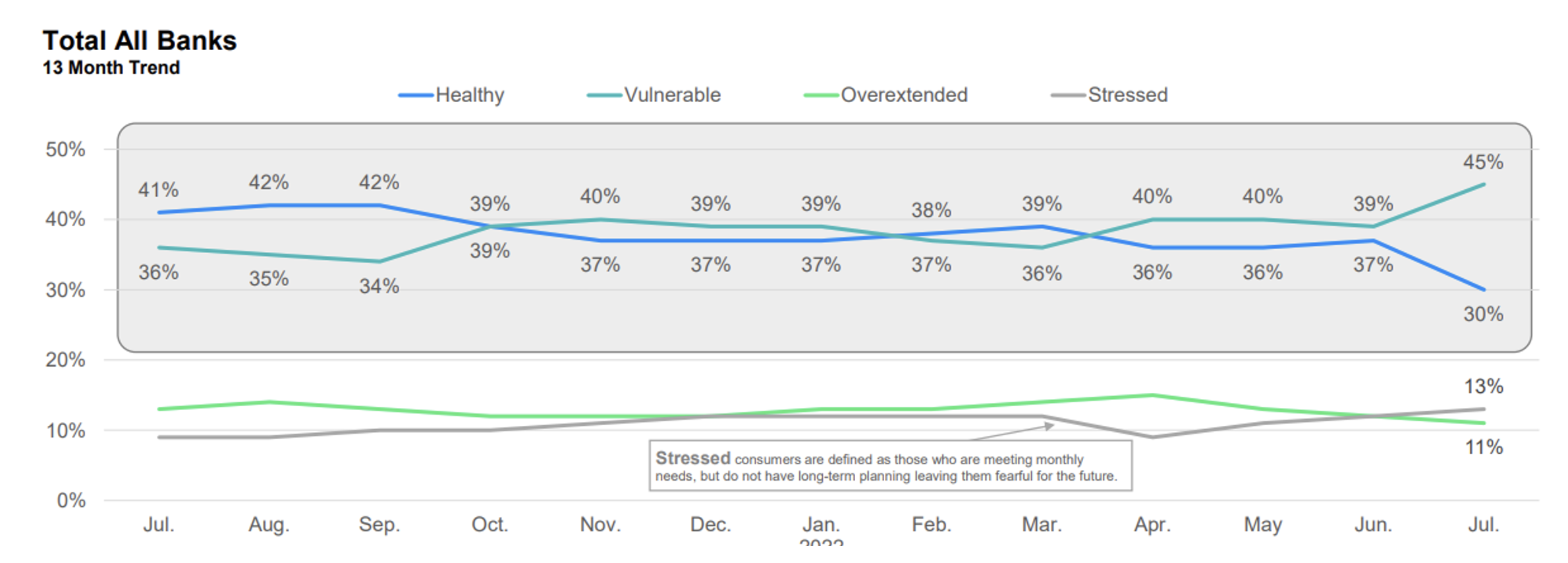
In addition, the share of retail bank customers currently classified as financially healthy[1] has dropped to an all-time low of just 30%, while the proportion of those falling into the financially vulnerable category has risen 6 percentage points to 45%.

While this economic shift has forced Americans to become more discerning about how and where they spend their money, it also has caused them to focus more closely on who is managing their money. Americans want assistance climbing out of the hole that inflation helped to dig, but they also want that help to come from socially responsible financial institutions.

Inflation Ratchets Up the Pressure

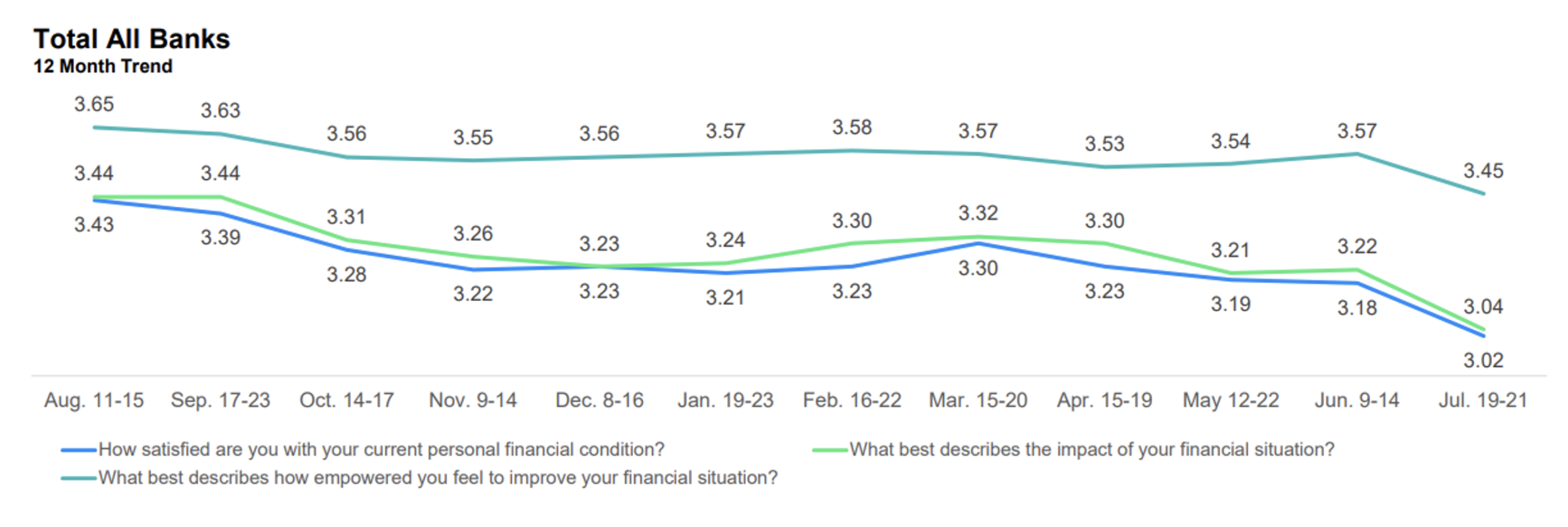
Inflation is still at the forefront of Americans’ minds, and it has caused overall consumer sentiment to plummet. Banking customers reported a dramatic increase in stress over their financial situation and decreasing levels of confidence that they would be able to manage it.

Increased stress in financial situations and decreasing levels of management confidience


The share of financially unhealthy customers has reached a new high, with 45% of Americans considered to be vulnerable, 13 to be stressed and 11% to be overextended. That leaves just 30% of Americans classified as financially healthy.

13 month trend showing the levels of stressed, vulnerable, overextended, and healthy banks.


Searching for Answers

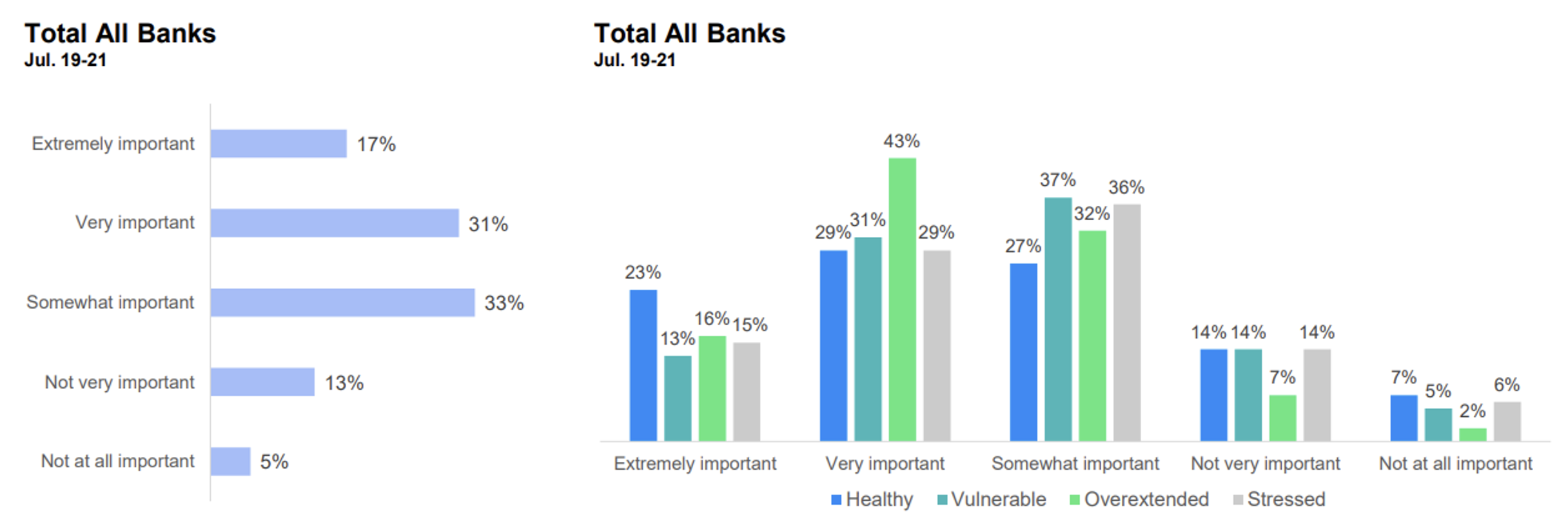
As the country braces for what many economists call a recession, one-third of customers are waiting for a lifeline from their banks. In fact, 81% of customers said that bank support is important to help them manage living with high inflation. That includes 91% of overextended customers.

bar graph demonstrating data pulled from surrounding paragraphs

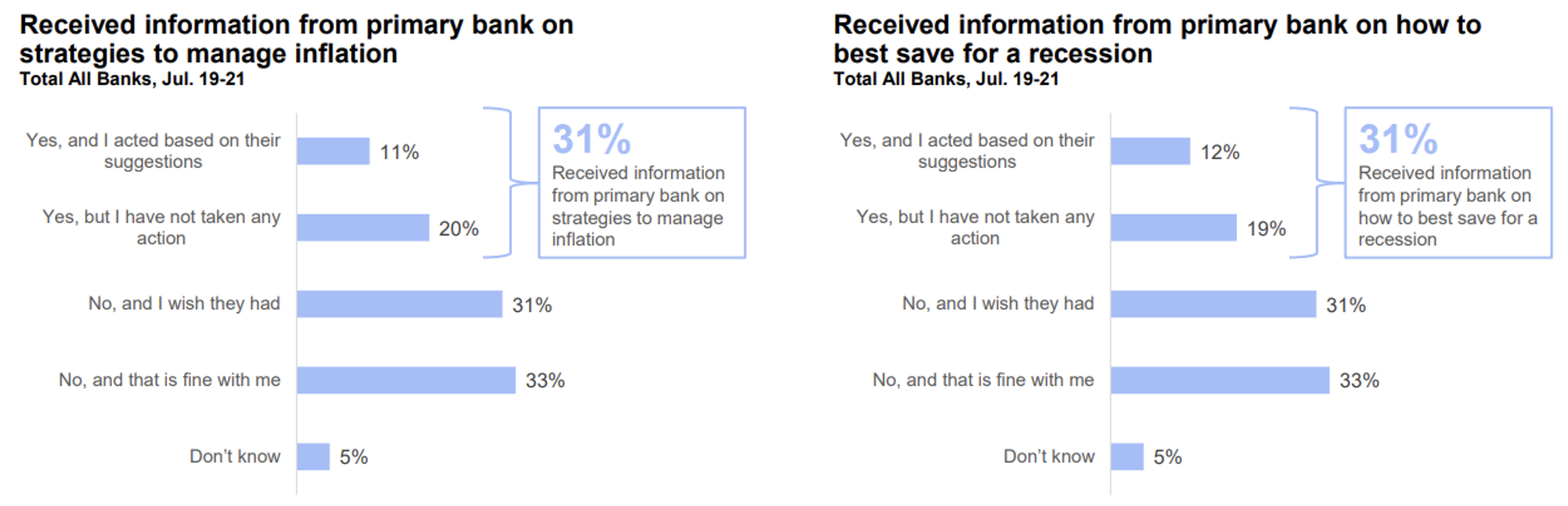
Asked whether banks have reached out with information on how to handle inflation, 31% said they received some form of communication. Another 31% said they had not received any information from their bank, but wish they had – seemingly a missed opportunity for banks to build a valuable relationship with their customers.

bar graph demonstrating data pulled from surrounding paragraphs

ESG Becomes a Priority

Retail banks’ track records on environmental, social and governance issues—by now, well-known by its shorthand (ESG)—have also come under greater scrutiny as bank customers navigate this turbulent economic cycle.

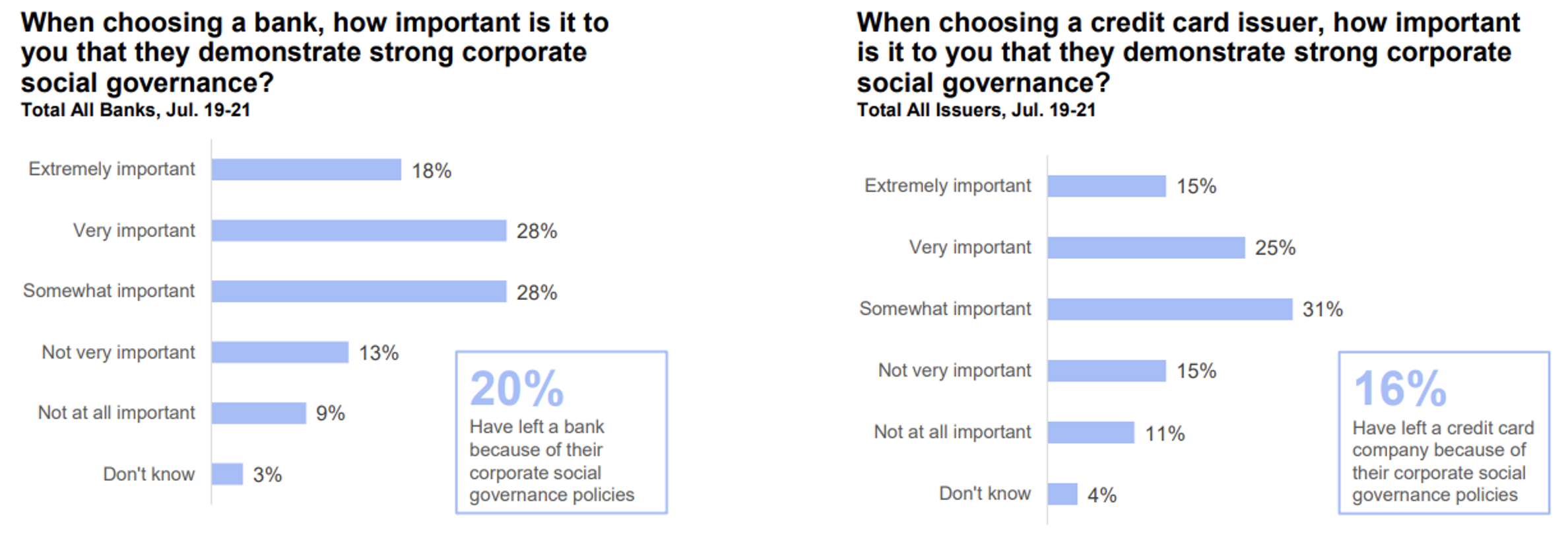
One in five Americans (20%) said they have left their bank because of their corporate social governance policies, and 16% have said the same about their credit card issuer.

bar graph demonstrating data pulled from surrounding paragraphs


While ESG initiatives may not be the determining factor for most, there has clearly been a shift in how banking customers view their financial institutions. Americans no longer want their banks to have a passive role in their finances, nor do they want to be tied to corporations that are disengaged from their communities. And that creates a huge opportunity.

Rising to the Occasion

If banks are going to play a role in helping their customers confront the growing challenges Americans face in this economy, they’ll need to understand what their customers value. Reaching out with pertinent debt-management information—even if it’s not acted on by the customer—or making sure they communicate a strong social agenda, can be just as important as a new product offering or fintech innovation. As Americans find their footing, they’ll remember the institutions that made the right impression in a trying time. It’s up to banks to put their best foot forward right now.

Find out More

This Banking and Payments Intelligence Report is based on responses from 4,000 retail bank customers nationwide and was fielded in July 2022. It was authored by Jennifer White, senior director of banking and payments intelligence at JD Power. Please contact us at the numbers below to connect with Ms. White or to learn more about the underlying research.

Media Contacts

Brian Jaklitsch; East Coast; 631-584-2200; [email protected]

Geno Effler, JD Power; West Coast; 714-621-6224; [email protected]
 

[1] JD Power measures the financial health of any consumer as a metric combining their spending/savings ratio, creditworthiness, and safety net items like insurance coverage. Consumers are placed on a continuum from healthy to vulnerable.

Join our list!

To get the latest insights, announcements, and industry intelligence from our JD Power experts delivered right to your inbox, we invite you to sign up for the mailing lists that are critical to your role: