• Chime sees highest new customer acquisition for checking accounts and conversion rates for checking and savings accounts
  • Fidelity leads on new investment account openings, SoFi leads on investment account conversion rate
  • Bank of America and Chase capture highest percentage of mass affluent and affluent banking customers


The “soft switching” phenomenon, whereby banking and investment services customers are opening secondary accounts and quietly making them their primary relationships, continues for a second consecutive quarter in the JD Power Financial Services Churn Data and Analytics report.

The report, which tracks customer attrition among the nation’s leading financial services providers, finds that FinTech brands, such as Chime and SoFi have become the biggest beneficiaries of this trend, attracting and converting new account openings faster than more established financial services brands. The trend is particularly noteworthy in the mass market banking segment, while traditional brands continue to lead on new account openings in the mass affluent and affluent banking segments[1].


Chime Leads on New Bank Account Openings and Conversions

Just under half of new checking (49%) and savings (46%) account openings in the fourth quarter of 2025 were for secondary accounts, opened by customers who already have an existing banking relationship, while 26% of checking and 18% of savings account openings were replacement accounts. Brand new banking relationships among customers who did not previously have a banking or checking account represented 25% of all checking and 36% of all savings account openings. This pattern of secondary account opening, which is consistent with Q3 2025, suggests that more banking customers are expanding and diversifying away from their primary deposit relationships.


Chime claimed the largest share of new checking account openings in Q4 with 12.8%. It was followed by Chase (8.4%) and Wells Fargo (7.1%). Among new savings account openings, Chase saw the largest overall market share at 9%. It was followed by Chime (8.4%) and Bank of America (6.3%).

One area where Chime has continued to show strength for a second consecutive quarter is its conversion rate—the percentage of time the checking account was opened with the bank after customers evaluated other brands. Overall, Chime has the highest conversion rate for customers who considered opening checking (78%) and savings accounts (85%). For both checking and savings accounts, Chime consistently outperformed both FinTechs and more established brands on new account conversion.


Bank of America and Chase Win More Affluent Banking Customers

When it comes to targeting higher income, and higher net worth, customers, the Big Four national banks are outperforming FinTech brands. Among checking account openings, Chime led on customer acquisition in the mass market segment, claiming 11.5% of new customers, while Chase led in the mass-affluent segment, with 10.9% of new customers, and Bank of America led in the affluent segment, with 14.1% of new customers in Q4. A similar trend played out in savings accounts, where Chime led mass market customer acquisition with 11.5% market share, and Chase led in both the mass affluent (9.7%) and affluent (11.5%) segments. 


Investment Account Openings, SoFi Converts More Customers

In the investment account category, Fidelity claimed the largest share of new account openings in Q4 with 16.8%. It was followed by Charles Schwab (9.1%) and Robinhood (8%). When it came to new account conversions, however, FinTech brand SoFi claimed the lead, capturing 83.1% of accounts that were opened after other brands were evaluated. SoFi was followed by Fidelity (80.2%) and Acorns (78.2%)


When segmenting customer acquisition by total investible assets, Fidelity maintained the top position among mass market (16.3%), mass affluent (17.7%) and affluent (16.4%) customers. It is followed by Robinhood (10.5%) in the mass market segment and Charles Schwab in the mass affluent (10.8%) and affluent (13.1%) segments.


A Mature Market Ripe for Disruption

The findings in this report are noteworthy because they spotlight a critical transition point in the decision-making process of financial services customers as they evaluate a steadily growing list of brands and options for how to manage their money. We are clearly seeing a trend toward more consumer interest and experimentation with relatively new FinTech brands, particularly in the mass market segment. The fact that many of these brands are succeeding at converting customers suggests that effective digital engagement will play a major role in the future development of the financial services industry. Incumbent brands need to monitor this trend closely and make sure they are continuing to connect with the right customers at the right time with the right approach.


Find out More

This Financial Services Intelligence Report is based on 263,151 responses collected as part of the JD Power Financial Services Churn Data and Analytics report between October and December 2025. It was authored by Jennifer White, senior director, financial services intelligence at JD Power. Please contact us at the numbers below to connect with the team or to learn more about the underlying research.


Media Contacts
 

Brian Jaklitsch; East Coast; 631-584-2200; [email protected]

Joe LaMuraglia, JD Power; East Coast; 714-621-6224; [email protected]
 

[1] JD Power defines wealth categories for banking as Mass Market (income <$150,000 and investable assets <$100,000); Mass Affluent (income of $150,000+ and investable assets <$250,000 or income <$150,000 and investable assets of $150,000+); and Affluent (income of $150,000+ and investable assets of $250,000+). Wealth categories for investment accounts are defined as Mass Market (<$250,000 in household investments); Mass Affluent ($250-<$1milion in household investments); and Affluent ($1 million+ in household investments).
 

View the 2025 Q4 Financial Services Churn Data and Analytics Report

With prices on consumer goods increasing at the fastest rate in five months in July, the number of consumers in the United States classified as financially unhealthy1 has climbed to its highest level in 12 months, as measured by JD Power.

As these struggling consumers increasingly seek guidance on a wide range of financial topics from budgeting to investing, many are turning to artificial intelligence (AI) tools for help.


Financial Health Shows Strain

After June showed the best financial health metrics in over a year, the proportion of consumers who are financially vulnerable rose to 40% in July. That increase brings the total share of financially unhealthy consumers, defined as vulnerable, overextended or stressed, to 64%.


The persistently high price of consumer goods is at the center of this trend. Overall, 71% of consumers say the price of goods is increasing faster than their income in July, up from 66% in June. Vulnerable (82%) and stressed (85%) consumers have notably higher levels of concern regarding inflation.  


AI Emerges as Consumer Financial Advice Tool

As consumers’ concerns about inflation persist, more than half (51%) say they are using AI to get financial advice or information. 

In the past 3 months, have you used an AI tool to get financial advice or information?


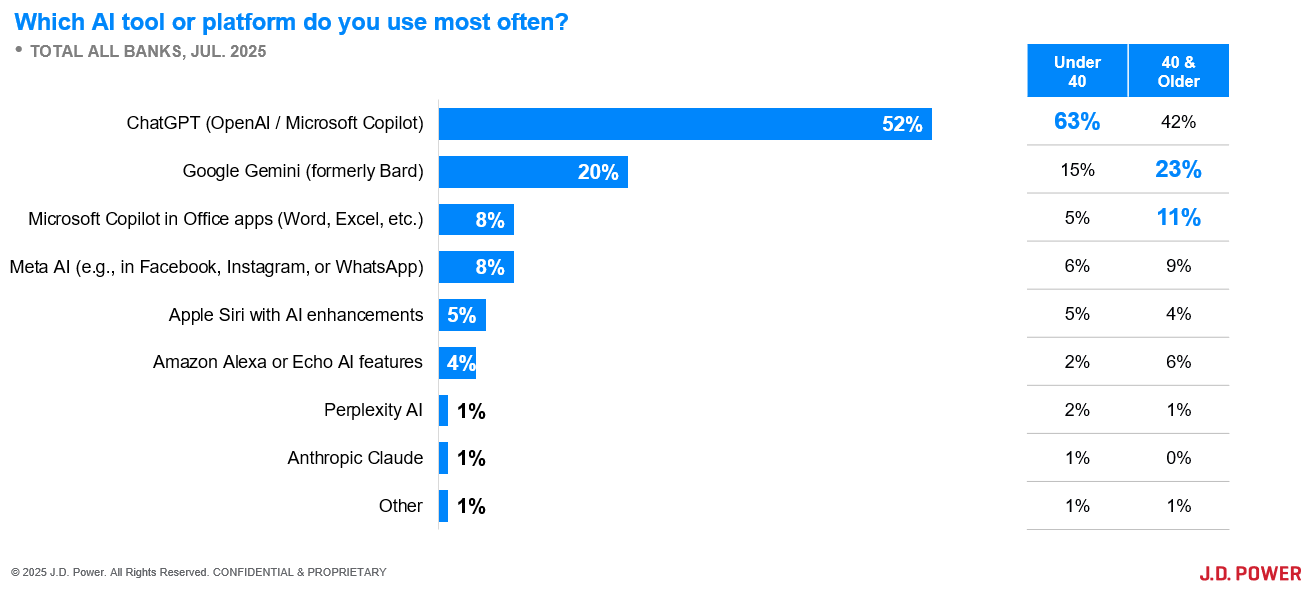
When asked about which AI tools or platforms they use, more than half (52%) say ChatGPT. That number gets even bigger for respondents under age 40 (63%). Google Gemini is also popular with consumers over age 40 (23% vs. 15% of those under age 40).

Which AI Platform are Consumers Using Most Often?

When asked what they are using these tools for, 13% of consumers say they use AI for banking and financial services on a daily basis. That is the highest percentage of daily users among all other AI use cases. However, 27% of respondents say they never use AI tools for banking and financial services, which suggests that consumer AI adoption rates vary considerably.

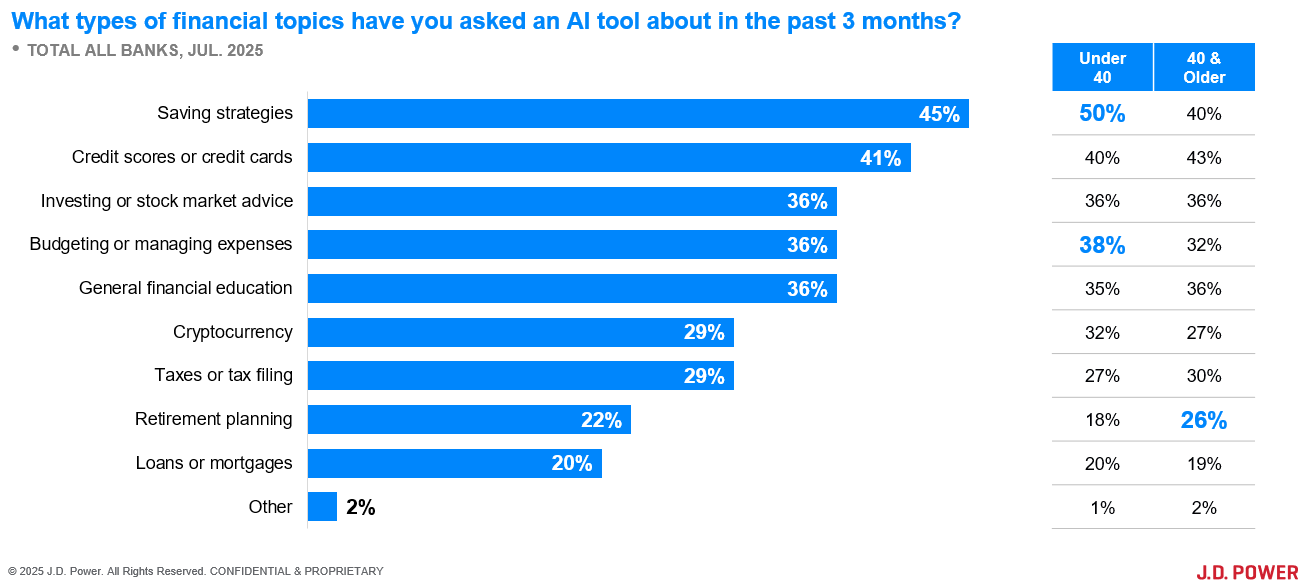
Consumers most frequently ask AI about saving strategies (45%) and credit scores or credit cards (41%). Investing in the stock market (36%), budgeting or managing expenses (36%), and general financial education (36%) were also among the most sought-after financial topics when using AI.

What types of financial topics have you asked an AI tool about in the past 3 months?


What Role Should Banks Play in this Evolution?

As consumers continue to grapple with market headwinds and economic volatility, and popular culture news stories continue to extol the virtues of AI as a tool to hack everything from a to-do list to a stock portfolio, consumers will undoubtedly experiment with AI-driven banking and financial advice solutions. While this analysis did not track the use of bank-branded AI tools, it establishes an important baseline of consumer interest in technology that should be noteworthy to retail banks. 

In times of economic uncertainty, consumers often turn to banks in the hopes of guiding them to solid ground. The current daily utilization of AI for banking and financial services tasks shows that consumers see value in these solutions. As banks hope to build better relationships with consumers, leveraging new technology and effectively building awareness behind it could be a key cog in building trust and might even help some consumers get a better handle on their financial health.


Find out More

This Banking and Payments Intelligence Report is based on responses from 4,000 consumers nationwide and was fielded in July 2025. It was authored by Jennifer White, senior director of banking and payments intelligence at JD Power. Please contact us at the numbers below to connect with Ms. White or to learn more about the underlying research.


Media Contacts
Brian Jaklitsch; East Coast; 631-584-2200; [email protected]
Joe LaMuraglia, JD Power; East Coast; 714-621-6224; [email protected]


[1] JD Power measures the financial health of any consumer as a metric combining their spending/savings ratio, creditworthiness, and safety net items like insurance coverage. Consumers are placed on a continuum from healthy to vulnerable.

Are consumers in the United States learning to persevere through turbulent economic times? Given the latest data from JD Power, that certainly seems to be the case.

The overall financial health of consumers in the United States improved, as the percentage of financially healthy consumers hit its highest point in 13-months. What’s more, fewer say they are having a hard time keeping up with the price of goods—even as costs remain high—and fewer are changing their summer travel plans due to cost.


Financial Health Gets a Lift  

After a discouraging turn in May, the number of consumers who are financially healthy rose to 37% in June. This reflects a 13-month high.


The positive development also translated to consumers’ dealings with inflation. Nearly two-thirds (66%) of those surveyed said the cost of goods is increasing faster than their income, which reflects a monthly decline of 4 percentage points. The improvement was spread throughout all levels of consumer financial health, with consumers in the overextended category seeing the biggest monthly improvement. Currently, 54% of those classified as overextended say the price of things they buy is rising faster than their income, down from 58% in May of 2025.

While consumers currently suggest their financial health may be improving, data in the months ahead will indicate if this is the start of a deeper trend or just something temporary.


Travel Liftoff?

Consumers are also still planning summer travel. More than three-fourths (76%) of consumers say they will travel this summer, up from 74% a year ago. That’s noteworthy, because it shows that consumers were still making plans, even as financial health fluctuated throughout the year, hinting that consumers are simply pushing through in the face of economic uncertainty. Younger and healthier consumers are more likely to travel.


In fact, 28% of consumers made no changes to their summer travel plans, down from 32% a year ago. Consumers under 40 are more likely to make changes to their itinerary as opposed to respondents over 40, who are committed to making travel work under almost all circumstances. Overall, just 10% say they are not going to travel when they usually would have taken a trip.


Developing Discipline

While it’s encouraging to see consumers’ financial health bounce back, these data points have shown fluctuations before and are subject to ongoing volatility. And while financial health may ebb and flow from month to month, the overall picture largely remains unchanged. What is new, though, is how consumers are handling it. And for some, that means simply forging ahead with what they had already planned to do.

For banks looking to help their customers navigate these conditions, it’s essential to first recognize the pressures consumers face and encourage mindful spending. While it’s certainly tempting to live for the moment, customers need to be mindful that long-term financial health requires some level of discipline. To truly build better financial health, banks need to be active partners in customers’ planning, budgeting and investing.


Find out More

This Banking and Payments Intelligence Report is based on responses from 4,000 consumers nationwide and was fielded in June 2025. It was authored by Jennifer White, senior director of banking and payments intelligence at JD Power. Please contact us at the numbers below to connect with Ms. White or to learn more about the underlying research.


Media Contacts

Brian Jaklitsch; East Coast; 631-584-2200; [email protected]
Geno Effler, JD Power; West Coast; 714-621-6224; [email protected]


Stay on top of the latest JD Power Financial Services study releases with our official calendar. As the trusted source for voice of the customer data, this schedule keeps you informed on when key satisfaction results and press announcements go live.


2026-2027 Release Schedule

Track what’s ahead for banking, payments, wealth management and lending. 


Access JD Power Customer Satisfaction Data

Get full access to JD Power’s customer satisfaction data and see how the insights can drive your strategy forward. Connect with our team to get started. 

CONTACT US →


Financial Services Email Opt In Button


New findings from the JD Power 2025 U.S. Direct Banking Satisfaction Study reveal how direct banks are shaping the future of banking by delivering more than just competitive rates. Paul McAdam, Senior Director of Banking and Payments Intelligence at JD Power, breaks down what’s driving satisfaction—and where direct banks still have work to do.

Growth Beyond Rates: Checking Satisfaction Rises

While savings satisfaction has taken a hit due to falling interest rates, checking satisfaction among direct bank customers is on the rise. What’s behind the upward trend?

“Customers are feeling like their direct bank checking accounts are helping them grow their money,” McAdam explained. “Not through interest, but through credit access, budgeting tools, and insights into their creditworthiness.”

These features go beyond the basics, supporting customers in managing their financial lives more holistically. As a result, customers are engaging more and reporting higher satisfaction with their checking relationships.

Savings Satisfaction Slips Amid Lower Deposit Rates

In contrast, satisfaction with savings accounts is declining. Interest rates have dropped, and customers are noticing.

But declining rates aren’t the only issue.

“We’re also seeing more frustration with website usability,” McAdam noted. “Navigation, login ease, and general user experience are falling short for some brands.”

With many customers accessing their savings accounts through digital platforms, a smooth experience is critical. Poor digital performance is now a differentiator and not in a good way.

Younger Customers Are More Engaged—And More Satisfied

Direct banks are gaining traction with younger customers, especially in the checking space. While the overall profile of a direct bank customer looks similar to a traditional bank customer, subtle differences are emerging.

“Younger customers are gravitating toward checking products, while older customers are more likely to hold savings accounts with direct banks and larger balances,” said McAdam.

This year, satisfaction rose among younger generations, thanks largely to their use of tools that support credit management and financial education. In contrast, older customers, particularly Gen X and Boomers, saw their satisfaction decline, driven primarily by lower interest rates.

Big Brands, Big Competition

Direct banks are no longer niche players. Leading the way are powerhouse brands like Charles Schwab and American Express—both of which topped the checking satisfaction rankings this year.

“These customers are serious about their relationships,” McAdam said. “They typically hold three or more accounts with their direct bank provider.”

The implication for traditional banks is clear: competition is intensifying, and digital-first players are quickly earning customer loyalty.

When Products Are Equal, Service Matters Most

Despite similar product offerings across brands, customer service remains a key differentiator, especially when something goes wrong.

“Direct bank customers don’t experience a lot of issues,” McAdam noted. “But when they do, service quality really matters. The lower-ranked brands are falling short on resolving problems and delivering strong phone support.”

This is a red flag for providers: product parity means that customer service quality can make or break the overall experience.

What’s Next for Direct Banking?

The 2025 study makes it clear that continued success in the direct banking space hinges on a few critical areas:

  • Double down on value-added tools like credit tracking, budgeting, and expense management to keep younger customers engaged.
  • Improve digital usability, especially on the savings side, where outdated platforms are dragging down satisfaction.
  • Don’t overlook service—strong customer support is still one of the most powerful drivers of satisfaction and loyalty.

As direct banks continue to expand their footprint, delivering seamless and supportive experiences across digital and service channels will be the key to staying ahead.

Read the full findings in the JD Power 2025 U.S. Direct Banking Satisfaction Study press release.

Read Press Release

Facing a conflicting stream of economic news that contains both positive economic indicators and continued uncertainty over the long-term fate of the United States economy, even the world’s leading economists cannot agree on the likelihood of a U.S. recession in the coming months.  

Bank customers in the U.S. are less optimistic, with a majority (86%) concerned that a recession will affect their everyday finances. The concern is understandable. According to JD Power data, just 35% of customers are financially healthy.[1] While that level is steady month-over-month, many customers are still feeling the pain of high prices and preparing for the worst. 

Financial Health Holds Steady Amid Rising Concerns                                                        

The number of customers who are financially healthy remained steady at 35% for a second consecutive month. This is the first time in over a year that customer health has not regressed after a one-month bump, giving some hope that the recent gains could be sustainable.

J.D. Power Understanding the Populations Financial Health Status April 2025


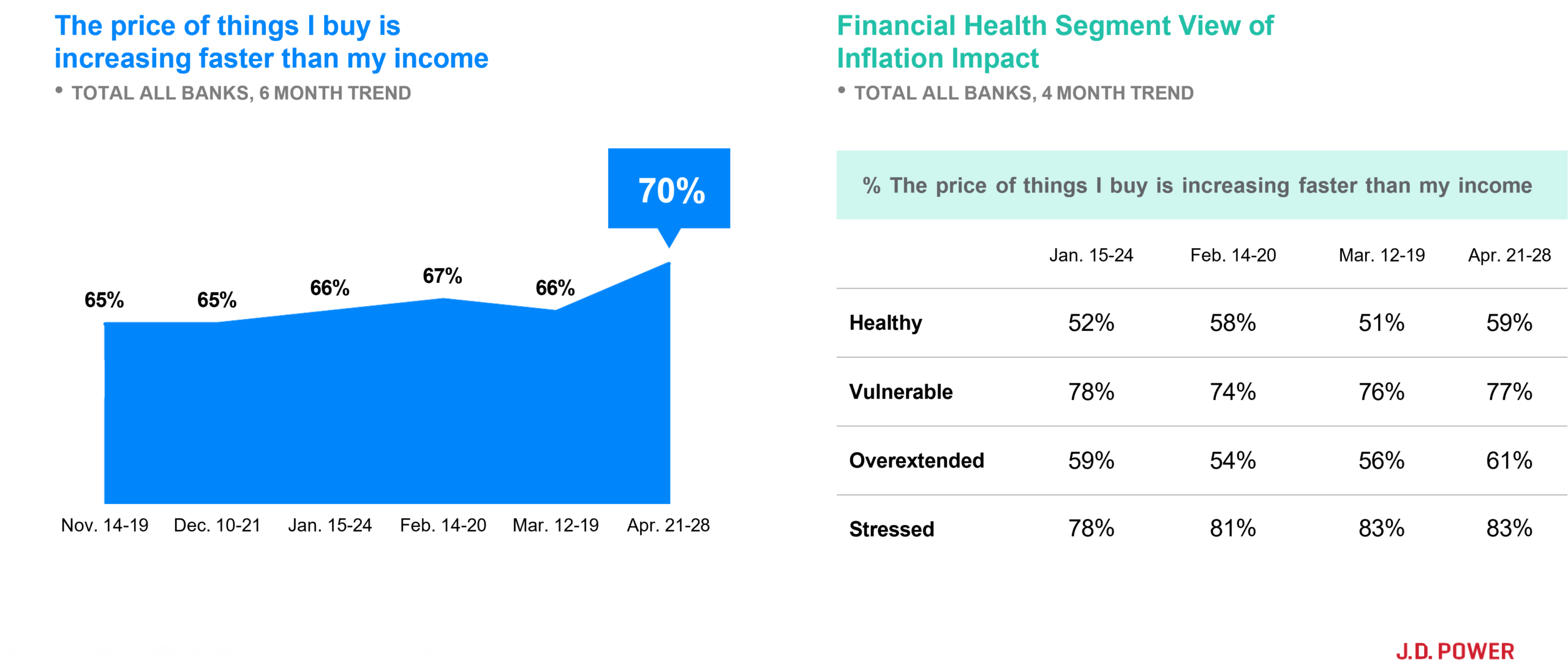
Despite the steady financial health numbers, the percentage of bank customers who say the cost of goods is increasing faster than their income rose sharply to 70%. The biggest gain was among healthy customers (59%), up 8 percentage points in the last month. 

J.D. Power Tracking Consumer Recognition of Inflation


Recession Confessions

Even as some customers firm up their financial footing, the looming threat of an economic downturn has the majority of people on edge. Overall, 86% are either somewhat or very worried that a recession will make things worse in their everyday life. This rate is highest among overextended customers (54%), followed by healthy customers (53%). 

J.D. Power How worried are you that recession will make things worse for your everyday life

When asked how prepared they are for a recession, 18% of customers say they are not at all prepared, and another 22% of customers say they do not know where to begin to get prepared. Just 9% of customers feel comfortable enough to weather a recession in their current economic situation.

J.D. Power How prepared are you financially for a recession

Customers cite reducing their discretionary spending (47%), creating or building up an emergency fund (43%), or having more cash available (39%) most often as measures they can take to prepare for a recession. One-third (34%) say pay down debt, while only 9% say having access to more credit or loans. 

J.D. Power What are the three most important activities for you to prepare for a recession chart


Building Partnerships

After finally making inroads on financial health, customers are worried about losing that progress. But instead of being paralyzed by fear, customers need to spring into action and plan contingencies. That’s where banks come in.

Customers seem to understand that preparedness is within their grasp. Instead of leaning on loans and more lines of credit, customers are ready to hunker down, reduce spending, and pay down their debt. But they may need help from their bank to devise a plan. With 40% of customers indicating that they either do not know how to go about preparing or do not know where to start in preparing for an economic lull, banks can tailor their communications to educate and triage in the event of any setbacks. Those who can do this effectively will reap the rewards of healthier customers and better relationships.

Find out More

This Banking and Payments Intelligence Report is based on responses from 4,000 retail bank customers nationwide and was fielded in April 2025. It was authored by Jennifer White, senior director of banking and payments intelligence at JD Power. Please contact us at the numbers below to connect with Ms. White or to learn more about the underlying research.


Media Contacts

Brian Jaklitsch; East Coast; 631-584-2200; [email protected]

Geno Effler, JD Power; West Coast; 714-621-6224; [email protected]


[1] JD Power measures the financial health of any consumer as a metric combining their spending/savings ratio, creditworthiness, and safety net items like insurance coverage. Consumers are placed on a continuum from healthy to vulnerable.

What do the next three months look like for the United States economy? 

That’s the question that’s seemingly on the tip of everyone’s tongue ever since the U.S. imposed sweeping tariffs on several countries around the world. Accordingly, bank customers in the U.S. are trying to figure out exactly what that will mean for their finances, particularly those who are struggling. 

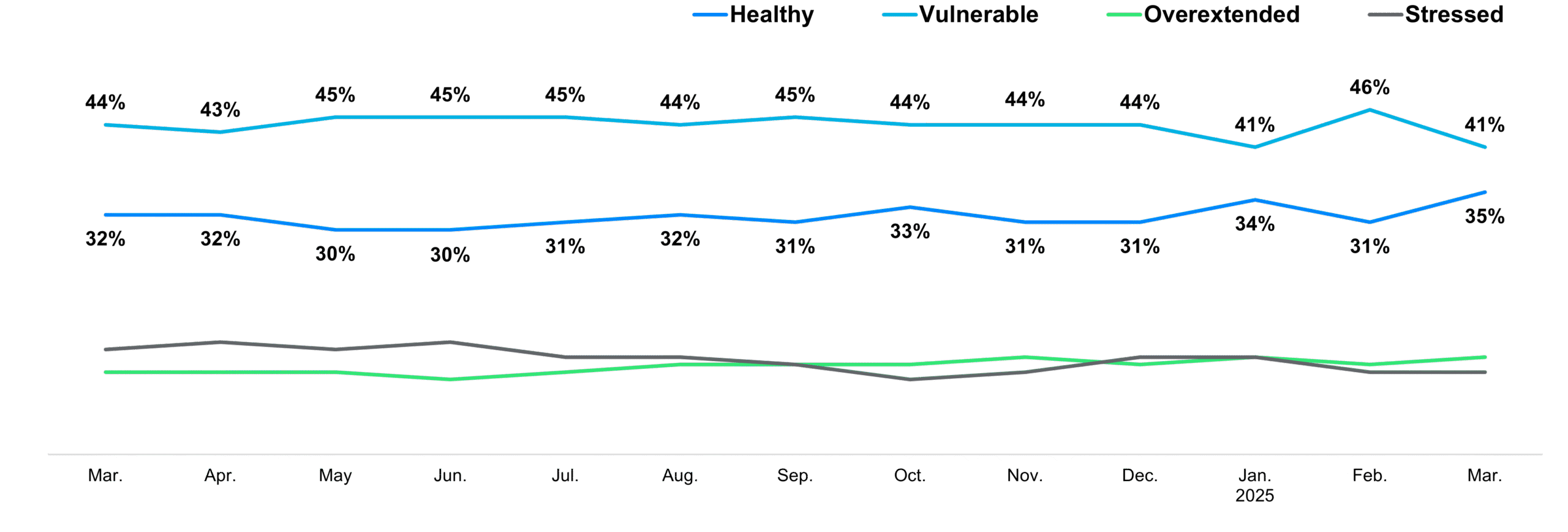
According to JD Power data, 35% of customers are financially healthy,[1] a new 13-month high. But even as customers seem to be gaining some ground on the financial health front, many are expressing uneasiness about their future finances.

Financial Health Gets Another Boost

The number of customers who are financially healthy increased to 35%, a 13-month high. As observed between January and February, this trend may not be long-lasting, but after financial health was stagnant for so long, the fact that there has been more movement of late could be seen as a positive development. 

Line Chart of J.D. Power Financial Health Status


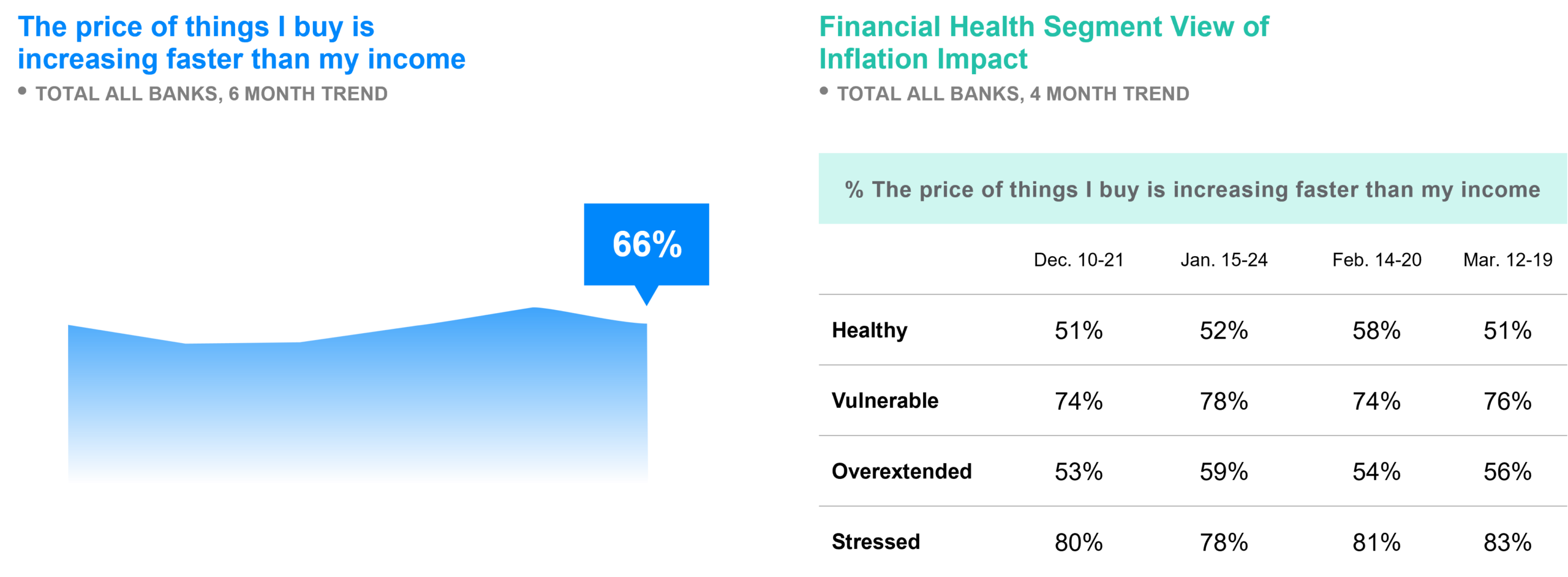
The percentage of bank customers who say the cost of goods is increasing faster than their income fell slightly to 66%. Stressed customers (83%) were most likely to say they are grappling with the cost of goods, up from 81%. Just 51% of healthy customers say they are having trouble keeping up with the cost of goods, down from 58%. 


Survey Results: Tracking Consumer Recognition of Inflation. Results described below.


Tough Times Ahead?

Less than half (43%) of customers say their current financial situation is stable and secure. That rate is virtually identical for customers under 40 and over the age of 40 (42% vs. 43%, respectively). 

Survey Results: How much do you agree your current financial situation is stable and secure. Chart data explained below.


Conversely, 41% believe their financial situation is at risk of getting worse in the next three months. While stressed customers (45%) were most likely to agree that their finances are at risk, healthy customers (42%) are not far behind.

Survey Results: How much do you agree that your financial situation is getting worse in the next three months. Data described below.


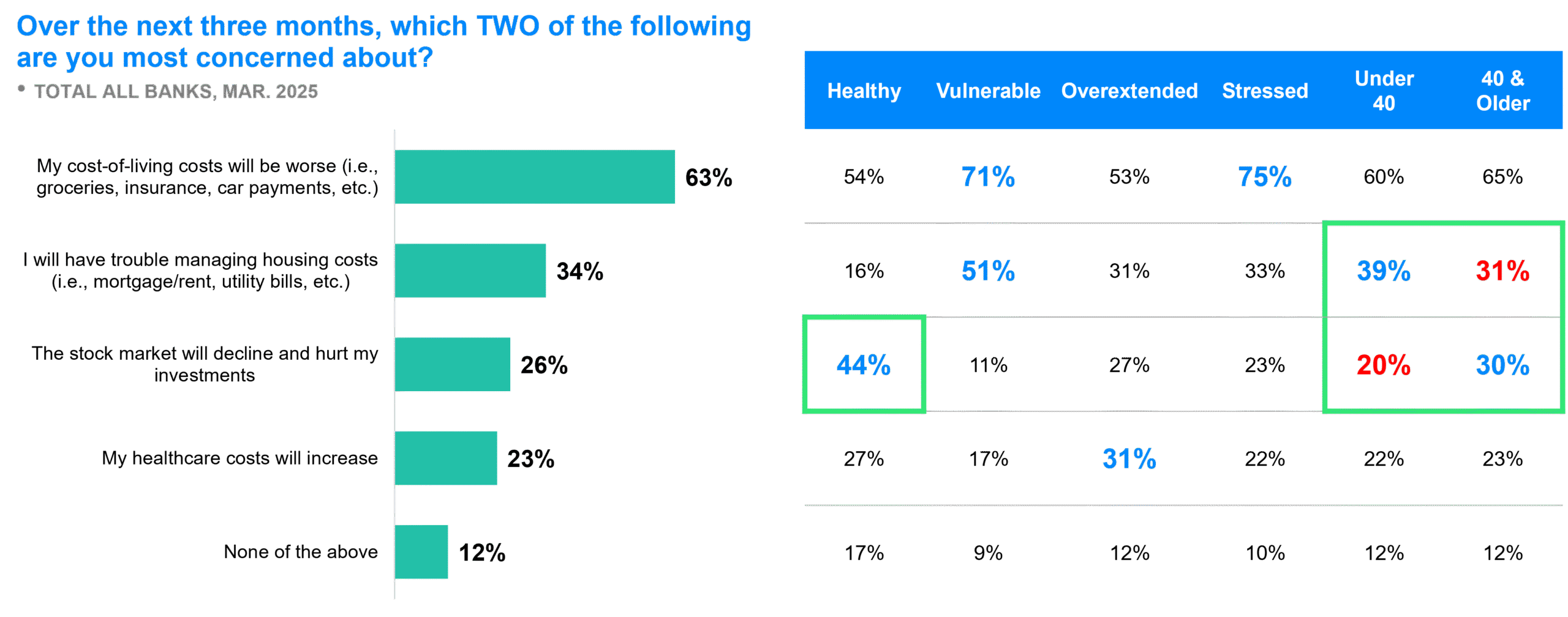
When asked about the root of their fears, 63% believe that their cost of living will be worse in the next three months, while 34% say they will have trouble managing housing costs, and 26% say the stock market will decline and hurt their investments.


Survey Results: Over the next three months, which TWO of the following are you most concerned about? Data described below.


Rising to the Challenge

Customers have been operating under the specter of another economic downturn for years. And while that has never fully materialized, the most recent events have certainly sparked some concern. That is enough to get many customers wondering if this is finally the other shoe getting ready to drop.

As the U.S. sits down with various countries to negotiate these tariffs, those fears may soon be quelled. But regardless of the specifics of the next several months, one thing is certain: Customers will likely seek counsel in the entities they know best. Banks need to be prepared to step up in times of uncertainty and help customers navigate these unpredictable times. Those that can help will enjoy better customer relationships and financially healthier clientele. 


Find out More

This Banking and Payments Intelligence Report is based on responses from 4,000 retail bank customers nationwide and was fielded in March 2025. It was authored by Jennifer White, senior director of banking and payments intelligence at JD Power. Please contact us at the numbers below to connect with Ms. White or to learn more about the underlying research.


Media Contacts

Brian Jaklitsch; East Coast; 631-584-2200; [email protected]

Geno Effler, JD Power; West Coast; 714-621-6224; [email protected]


[1] JD Power measures the financial health of any consumer as a metric combining their spending/savings ratio, creditworthiness, and safety net items like insurance coverage. Consumers are placed on a continuum from healthy to vulnerable.


Despite ongoing financial strain, customer satisfaction with retail banks is on the rise. New findings from the JD Power U.S. Retail Banking Satisfaction Study reveal how banks are adapting to consumer needs and building trust. Jennifer White, Senior Director of Banking Intelligence, shares the latest trends. 

Rising Satisfaction Amid Financial Strain
Even though consumers are facing economic hardships—reflected in declining deposits and investment amounts—overall satisfaction with their banks has increased. Consumers are more likely to return for additional products, and Net Promoter Scores (NPS) have improved. Despite the challenging financial environment, customers are finding value in their banking relationships.

Banks Are Rising to the Challenge
“Banks are spending more time helping customers manage their financial lives in a way that goes well beyond routine transactions,” White explained.

Building on this positive sentiment, banks have been investing heavily in digital tools and personalized services to support customers in managing their finances. Features like budgeting tools, savings goal trackers, and proactive alerts in mobile apps are helping consumers feel more empowered to navigate their financial situations. These efforts are a key reason behind the increasing satisfaction scores.

Tackling the “Three F’s” (Fees, Fairness, and Fraud)
However, consumer concerns about fees, fairness, and fraud persist. Despite these challenges, banks have been taking necessary steps to address these issues. Increased transparency around fees, enhanced fraud protection measures, and efforts to ensure fair treatment are helping build greater trust with customers. While there’s still work to do, these improvements are contributing to more positive customer experiences.

Declining Deposits
The study also finds that the average deposits held by consumers at their primary bank continue to decline. With 33% of consumers reporting less than $1,000 in deposits, the divide between those with significant savings and those struggling to save is widening. This highlights the financial strain many consumers are facing and presents a challenge for banks in providing accessible financial solutions.

Financial Advice Is Gaining Traction—But Awareness Is Still a Hurdle
More customers are recalling their banks’ advice and guidance—and many are taking action. Still, banks face challenges in cutting through the noise.

“The leak is still really occurring at just getting customers’ attention,” White said. “That, at the core, is about the volume of messaging, the spread of the messaging over a calendar year. It’s about making sure that the content is personalized.”
Banks that succeed here are integrating guidance across channels—from in-branch conversations and call centers to in-app banners and automated savings nudges.

Whether through a mobile app or in-person interactions—customers feel more supported in their financial decisions, contributing to their overall satisfaction.

What’s Next for Retail Banking?

The findings from this year’s study make one thing clear: to maintain long-term customer loyalty, banks must continue to:

  • Invest in digital tools that enable consumers to manage their financial lives with ease and confidence.
  • Enhance transparency around fees, fraud protection, and fairness to foster trust.
  • Provide personalized financial advice that empowers customers to make informed financial decisions.

As the banking landscape continues to evolve, these findings underscore the importance of banks acting as trusted partners in helping customers manage their financial health and navigate uncertain times.

Read the JD Power 2025 U.S. Retail Banking Satisfaction Study press release for more key findings.

Read the Press Release

Banking and Payments Intelligence Report
March 2025

As Financial Health Declines, Customers Try to Parse How New Tariffs Will Affect their Spending

As the inflation rate dipped below 3% in February, a whole new financial landscape has emerged for bank customers in the United States in light of new tariffs on foreign imports.

Earlier this month, the United States imposed a new 25% tariff on imports from Mexico and Canada. Accordingly, customers are trying to figure out exactly what that will mean for their finances, particularly those who are struggling.  

According to JD Power data, 31% of customers are financially healthy,[1] a rate at which customers have been largely stuck since 2024. And even though the headline inflation rate has come down, many customers are still saying it affects their day-to-day decisions. Could tariffs start to have the same kind of effect?

Financial Health Returns to Baseline    

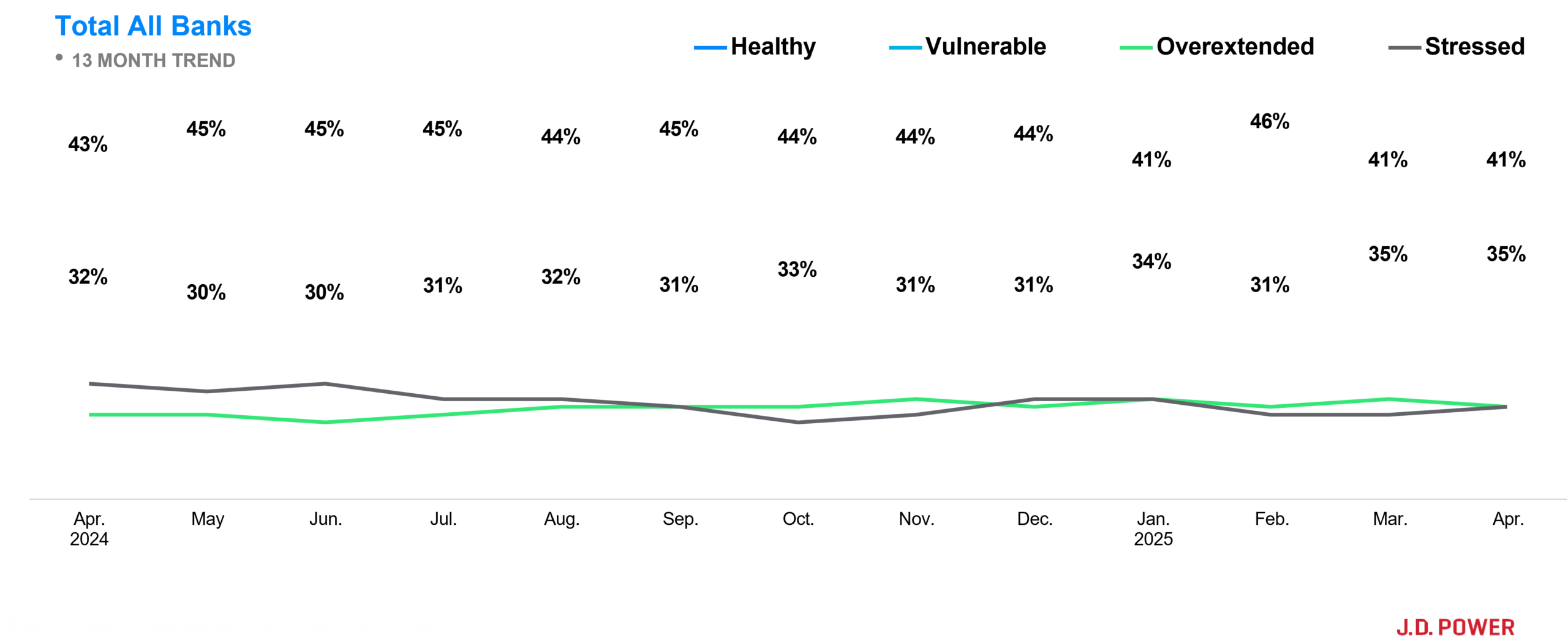
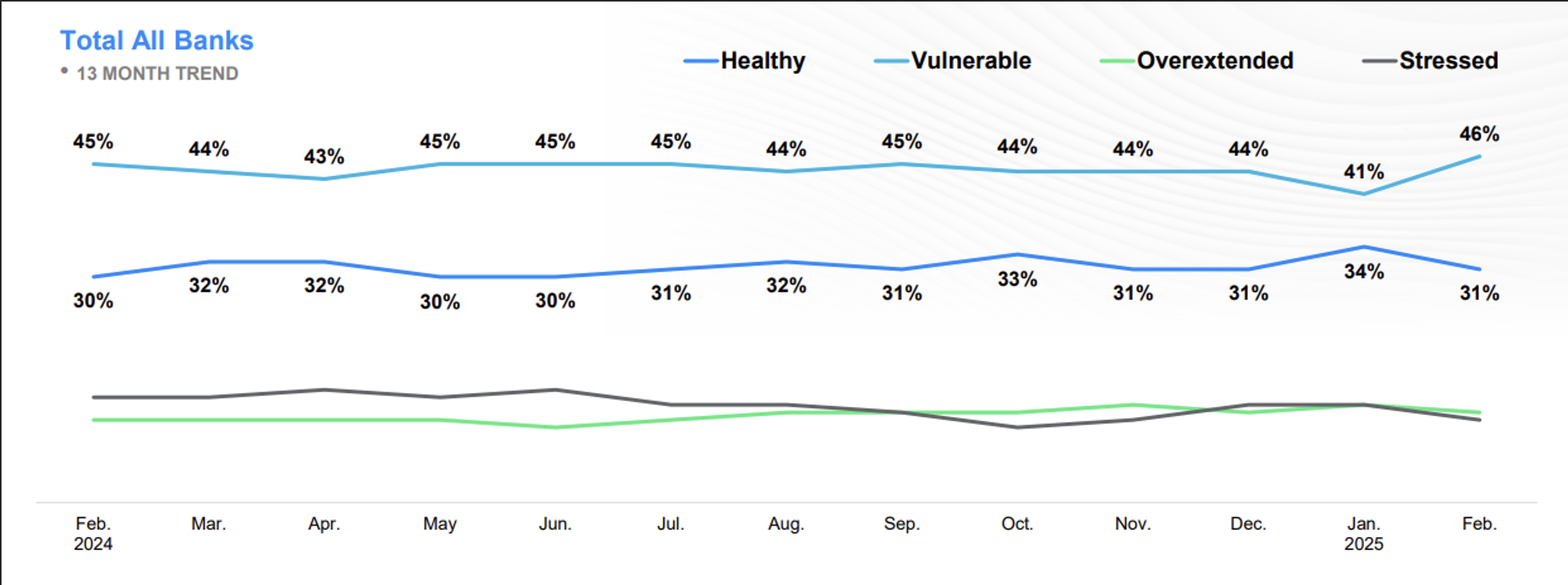
After a slight upward swing, the number of customers who are financially healthy returned to 31% in February, while 46% of bank customers were in the vulnerable category. The rate of vulnerable customers represents a 13-month high.

Total all banks trends chart

The percentage of bank customers who say the cost of goods is increasing faster than their income rose to 67%. Healthy customers represented the biggest increase, up to 58% from 52% last month, a sobering metric that could portend a further decline in customer health.

Tariff Trouble?

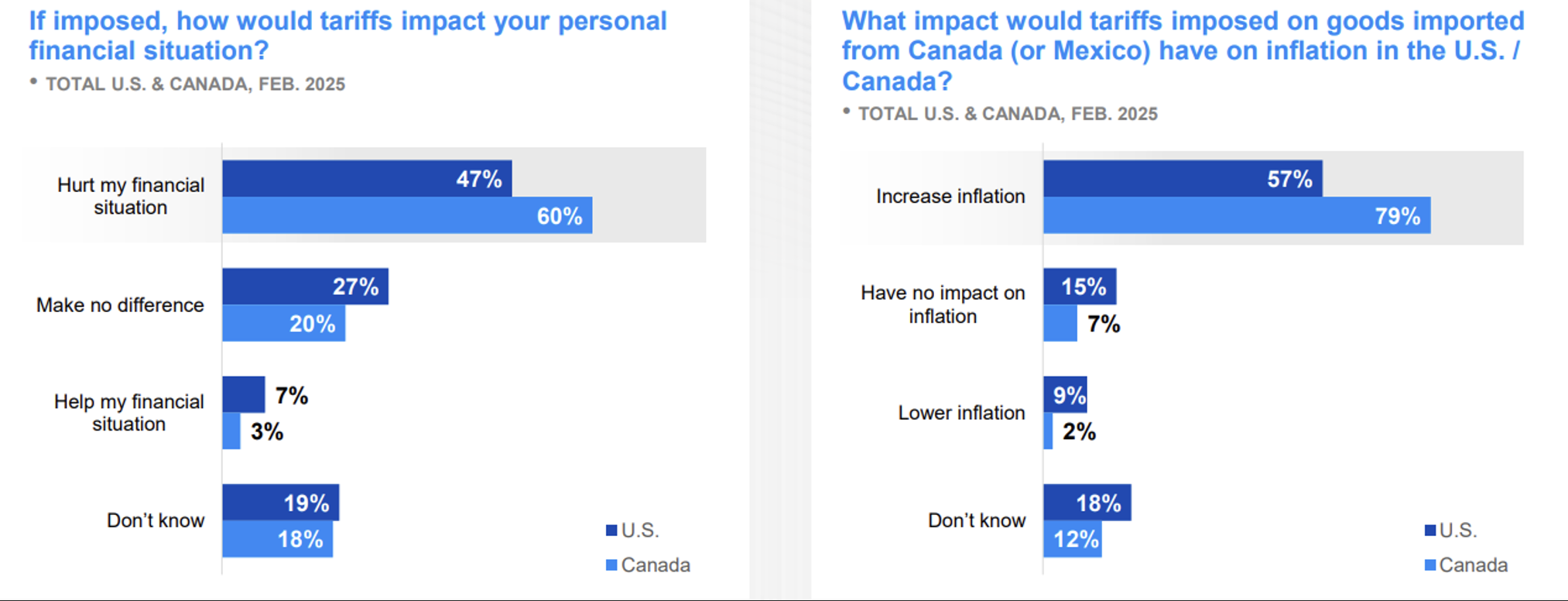
Prior to tariffs taking effect on March 6, less than half (47%) of U.S. bank customers said that these tariffs would hurt their financial situation, while 27% said it would make no difference and 7% said it would help their financial situation. Nearly one-fifth (19%) of customers said they did not know. Meanwhile, bank customers in Canada had a more pessimistic view, as 60% said tariffs would hurt their financial situation and just 20% said they would make no difference. Eight in 10 (79%) customers in Canada said that tariffs would increase inflation, while 57% of U.S. customers agreed. Interestingly, 9% of U.S. customers said tariffs would lower inflation, compared with only 2% of customers in Canada. 

Tariff charts

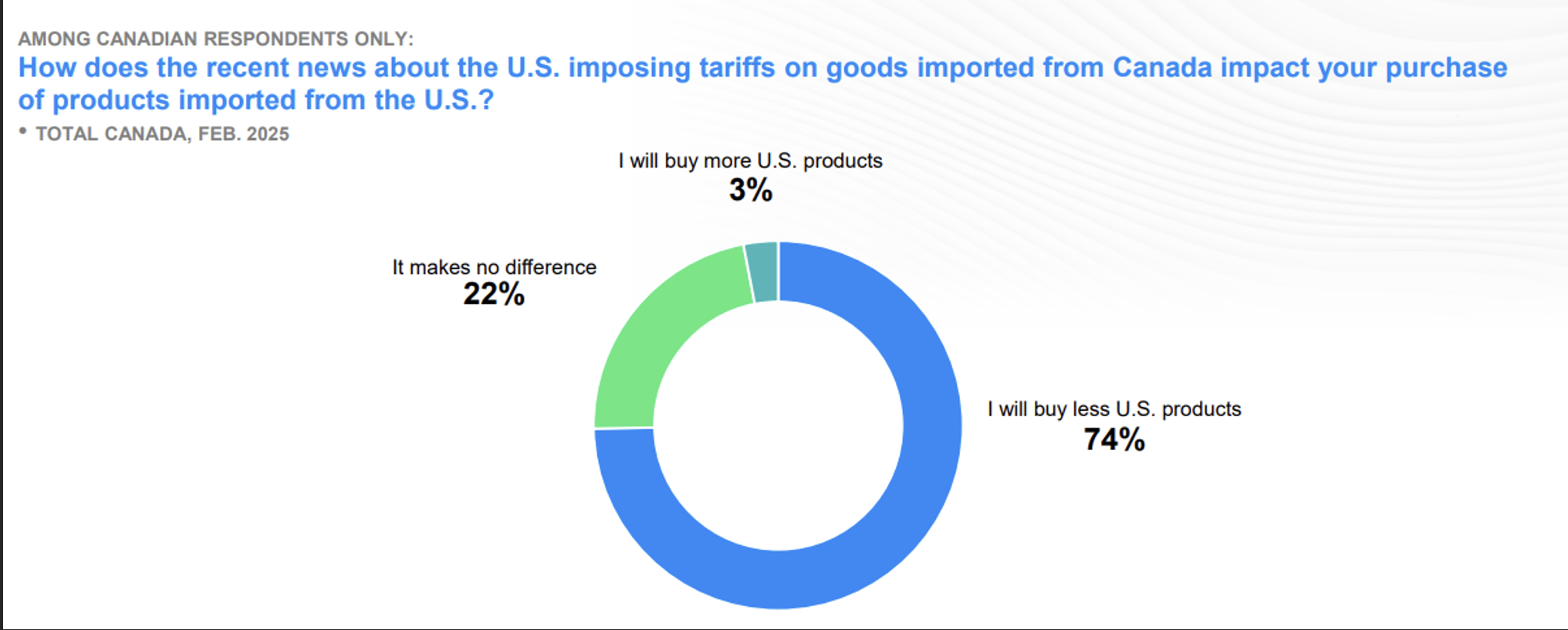
Regardless of how tariffs affect the economies of the U.S. and Canada, one thing seems certain: Bank customers north of the border plan to buy fewer American products. Nearly three-fourths (74%) of customers in Canada say they will buy fewer U.S. products in light of tariffs, while 22% say it will not make a difference in their purchasing decisions.

Tariff news chart

Navigating the Uncertainty 

As the U.S. begins to define carve outs for tariff exemptions, and companies rush to secure them for their products, it’s still unclear exactly what the end of result of these tariffs will look like. But for customers trying to find some certainty in a very fluid situation, banks have a chance to step in offer some stability.

Customers who are both dialed into the latest developments of this trade standoff and those that haven’t been paying attention are just as susceptible, and they’ll need guidance to get through it. Short of some momentary glimmers, the financial health of customers in the U.S. has been largely unchanged, even as inflation has fallen steadily since 2023. Banks that can keep their customers informed and help them chart a course through the clutter will stand to build better relationships.

Find out More

This Banking and Payments Intelligence Report is based on responses from 4,000 retail bank customers nationwide and was fielded in February 2025. It was authored by Jennifer White, senior director of banking and payments intelligence at JD Power. Please contact us at the numbers below to connect with Ms. White or to learn more about the underlying research.

Media Contacts

Brian Jaklitsch; East Coast; 631-584-2200; [email protected]

Geno Effler, JD Power; West Coast; 714-621-6224; [email protected]

[1] JD Power measures the financial health of any consumer as a metric combining their spending/savings ratio, creditworthiness, and safety net items like insurance coverage. Consumers are placed on a continuum from healthy to vulnerable.


The Buy Now Pay Later (BNPL) market continues its rapid expansion, solidifying its position as a preferred payment method for many consumers. In the latest JD Power Buy Now Pay Later Satisfaction Study, findings reveal not only an increase in BNPL usage but also critical insights into why consumers are turning to these payment solutions. This month, JD Power’s Miles Tullo sat down with Sean Gelles, Senior Director, Payments Intelligence,  to discuss the study’s key takeaways. 

BNPL is Surging 

One of the most striking findings from the study is the significant year-over-year growth in the percentage of consumers using BNPL usage.  BNPL was the payment method that grew the most in terms of the percentage of consumers saying they used it.  Usage was particularly strong during the holiday shopping season, with Gen Z shoppers leading the charge. “It was really surprising to see just how much BNPL surged—especially among younger consumers,” said Gelles. 

Why Consumers Choose BNPL 

While the primary appeal of BNPL remains its ability to defer payments, the study highlights another crucial factor: repayment terms. Consumers report that they appreciate the structured and predictable nature of BNPL repayment plans. 

“When we look at credit cards, deferred payment is an option there as well,” Gelles explained. “But interestingly, ‘repayment terms are reasonable’ doesn’t even rank in the top 10 reasons why people use credit cards. That tells us BNPL is filling an important gap in the market.” 

Defining the BNPL Market 

The Buy Now Pay Later Satisfaction Study examined both fintech-based BNPL providers—such as Klarna, Afterpay, and Affirm—and card-based installment plans from major credit card issuers. While fintech players have popularized BNPL at checkout, traditional financial institutions have entered the space by offering fixed payment plans that allow consumers to convert credit card purchases into structured installment payments. 

The Fintech Challenge: Building Long-Term Trust 

One of the key differentiators in satisfaction levels appears to be the longevity of the customer relationship. Traditional financial institutions have a built-in trust advantage, as their customers are often long-term credit card users. 

“The biggest advantage for card-based BNPL plans is their longstanding brand relationship with customers,” Gelles noted. “Many users of these plans have been with their banks or card issuers for years, which fosters greater trust and satisfaction.”

In contrast, many fintech BNPL users are either first-time or relatively new customers, making it harder for these brands to achieve high satisfaction scores. However, the study shows that customer satisfaction increases the longer consumers use a BNPL provider, indicating that fintech firms are making progress in building loyalty. 

What’s Next for BNPL? 

As BNPL continues to grow, both fintech and traditional financial institutions will need to refine their strategies to capture and retain consumers. The study’s findings suggest that trust and repayment flexibility will remain key differentiators in driving long-term satisfaction. 

With continued advancements in digital payments and shifting consumer preferences, the BNPL landscape is poised for even greater transformation in the years ahead. 

You can read the latest BNPL press release to learn more key findings and see how each brand ranks for overall customer satisfaction. 

Read the JD Power 2025 U.S. Buy Now Pay Later Press Release 

While the inflation rate climbed above economists’ expectations in January, the overall outlook for bank customers in the United States offers some modest optimism.

According to JD Power data, 34% of customers are financially healthy,[1] the highest rate in more than a year. While the improvement isn’t a massive leap by any means, it is an encouraging metric following the holiday season.

As some customers begin to find their financial footing, concerns persist about anything that could potentially set them back, particularly the risk of credit or debit card fraud. And for almost half of customers, debit card fraud casts a bigger shadow than unauthorized credit card purchases.

Financial Health Gets a Slight Boost                                                      

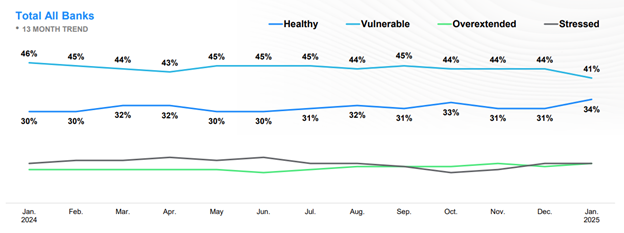
The number of customers who are financially healthy rose to 34% in January, while 41% of bank customers were in the vulnerable category. Both numbers reflect 13-month bests in their respective categories, albeit a modest improvement.


U.S. Bank Financial Health Trend February 2025


The percentage of bank customers who say the cost of goods is increasing faster than their income rose to 66%. Vulnerable customers saw an increase to 78% and over extended customers saw an increase to 59%, perhaps an indication that the improvements in financial health will not be long-lasting.


U.S. Bank Financial Health Are Card Providers Providing Enough Security February 2025


Security of Cards

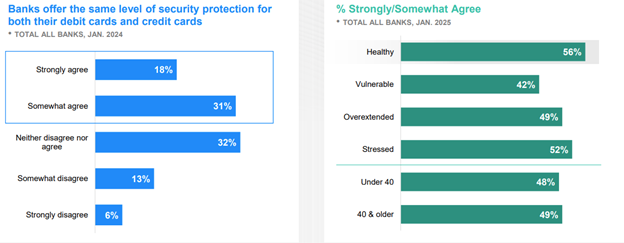
Almost half (49%) of customers say that banks offer the same level of security protection for both their debit and credit cards. This rate is highest among healthy (56%) and stressed (52%) customers.


U.S. Bank Financial Health Are Card Providers Providing Enough Security February 2025


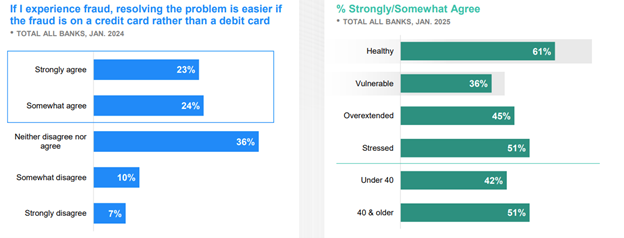
When asked which type of fraud is easier to resolve—debit or credit card—nearly half (47%) of customers said their credit card was easier to manage. Whether that perception is true or not, it does chart a course for banks and/or card issuers that are looking to bolster confidence in their security. More messaging may be needed about the security of their debit cards and issue resolutions if/when those instances of debit card fraud occur.


U.S. Bank Financial Health Experience Debit or Credit Card Fraud February 2025


Safe and Sound

Whether customers’ financial health builds on this past month’s incremental gains or not, credit and debit cards play a big overall role in the overall picture. And with banks and issuers hoping to build confidence in the security of their products, more communication is needed around the safety of debit cards.

Customers need to feel secure to store card information, especially those who could have their financial situation go from bad to worse with even a minor incidence of fraud. Communicating that banks and issuers prioritize the same support around any incidence of fraud will undoubtedly boost utilization of debit cards, which may lead to better budgeting and customers paying lower interest rates. Time will tell if banks can effectively deliver this message.


Find out More

This Banking and Payments Intelligence Report is based on responses from 4,000 retail bank customers nationwide and was fielded in January 2025. It was authored by Jennifer White, senior director of banking and payments intelligence at JD Power. Please contact us at the numbers below to connect with Ms. White or to learn more about the underlying research.


Media Contacts

Brian Jaklitsch; East Coast; 631-584-2200; [email protected]

Geno Effler, JD Power; West Coast; 714-621-6224; [email protected]


[1] JD Power measures the financial health of any consumer as a metric combining their spending/savings ratio, creditworthiness, and safety net items like insurance coverage. Consumers are placed on a continuum from healthy to vulnerable.

A new year has arrived, but the same financial malaise persists. Inflation ticked up in December 2024 and the Consumer Price Index saw a 2.9% year-over-year increase, which is keeping bank customers in the United States on their heels.

According to JD Power data, 31% of customers are financially healthy[1], a rate that has largely remained unchanged since the summer. As a result, customers are trying to decipher new ways to get a handle on their finances, with many turning to banks in the hopes of a more holistic view of their finances. Part of that search includes an increased interest in open banking, which is the practice of banks securely exchanging financial information with other financial institutions or third parties, such as financial advice apps, digital payment processors and other service providers. 

Financial Health Remains Unchanged                                                 

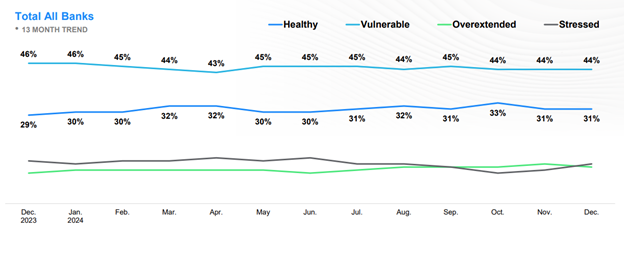
The number of customers who are financially healthy remained the same in December at 31%, while 44% of bank customers fall into the vulnerable category.

J.D. Power Financial Health Trend January 2025

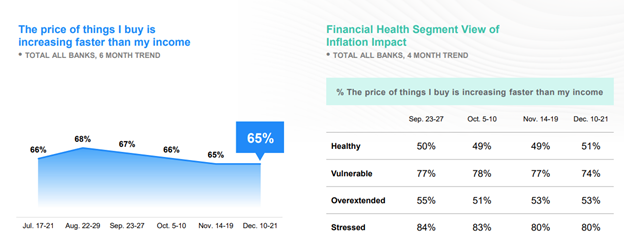
The number of bank customers who say the cost of goods is increasing faster than their income also remained steady at 65%. Vulnerable customers saw a slight decrease to 74%, while healthy customers actually rose slightly to 51% from 49%.

J.D. Power Cost of Inflation January 2025


A Holistic View

As customers continue to grapple with a tenuous financial landscape, many are expressing a bigger interest in seeing a complete picture of their finances in one place. One way to accomplish that is through more comprehensive financial aggregator tools. Overall, 41% of bank customers say it is extremely important for a bank’s mobile app to show the balances of their external accounts, up from 32% from May.

J.D. Power Financial Health Importance of External Bank Info in Mobile Apps January 2025

That interest has grown across all financial health segments, with stressed customers seeing the biggest jump in interest since the question was last asked in May 2024. Even older customers (40 and older) saw an increase of 9 percentage points.

J.D. Power Financial Health Importance of External Bank Info in Mobile Apps by Financial Health Type January 2025


Open for Business

The desire for more complete financial tools is indicative of an overall customer trend toward open banking. While historically, only customers and their banks have had access to their financial data, open banking is now enabling the development of new financial services products and offerings. By creating an easier flow of information from the bank to third parties, customers are finding improved ways to manage their money, make payments, and gain access to credit. With the practice gaining popularity with customers, the onus now shifts to banks to meet customers where they are and support better experiences—even when their customers are working with third parties.

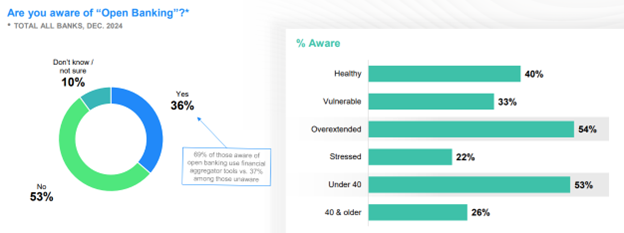
Overall, more than one-third (36%) of banking customers are aware of open banking, with overextended (54%) and younger (53%) customers most familiar with the practice.

J.D. Power Financial Health Opening Banking Awareness January 2025

There is also a strong relationship between open banking and financial aggregator tools. For example, customers who are aware of open banking are more likely to use financial aggregator tools and understand the value of these tools.


A Better Understanding

With many customers still stuck in the same financial predicaments for the better part of two years, many seem to have a genuine interest in new ways to get a handle on their finances, and a willingness to try new solutions. For banks, that means they’ll have to be receptive to customer desires and tailor their products to those needs. 

Open banking and better financial aggregator tools allow customers to glean complete insights into their finances and that is a vital component of understanding how to take the next step. Banks that can provide this intelligence stand ready to benefit from a more informed and, eventually, more financially healthy customer base.

Find out More

This Banking and Payments Intelligence Report is based on responses from 4,000 retail bank customers nationwide and was fielded in December 2024. It was authored by Jennifer White, senior director of banking and payments intelligence at JD Power. Please contact us at the numbers below to connect with Ms. White or to learn more about the underlying research.

Media Contacts

Brian Jaklitsch; East Coast; 631-584-2200; [email protected]

Geno Effler, JD Power; West Coast; 714-621-6224; [email protected]


[1] JD Power measures the financial health of any consumer as a metric combining their spending/savings ratio, creditworthiness, and safety net items like insurance coverage. Consumers are placed on a continuum from healthy to vulnerable.