By embracing innovation and prioritizing personalized experiences, banks and credit card providers can redefine their role in enhancing financial well-being. We unpack the latest insights from the 2024 U.S. Retail Banking Advice Satisfaction Study in the June 2024 JD Power Financial Services Intelligence.

Here are some key insights that you can’t miss:

  • Youthful Engagement: Younger consumers (<40) are actively seeking personalized financial advice. While they act on the advice received, satisfaction levels indicate room for improvement. Delivering robust tools and services alongside advice is crucial.
  • Industry Standard Setters: Leaders like Citi, Bank of America, Chase, and American Express set benchmarks with proactive financial guidance, defining satisfaction norms.
  • Frequency Optimization: Increasing interaction frequency across digital and traditional channels enhances satisfaction, engagement, and loyalty. A multichannel approach ensures comprehensive service accessibility.

Watch the full video for impactful insights on how improving customers’ financial health impacts loyalty and advocacy.

Bonus Content: Financial Health Personas

Understand the different groupings that Jennifer referenced in this edition of Financial Services Update. Your teams can begin to personalize financial services with strategic segmentation based on customer financial health personas. Access key demographics on the financially healthy, vulnerable, overextended, and stressed personas.

View Personas Details

Where can you find more insights like this?  

The JD Power U.S. Financial Health and Advice Program empowers banks and credit card providers to elevate customer financial wellness. By analyzing deep consumer insights and benchmarking performance, financial institutions can enhance their advisory services. Leveraging this data enables banks and credit card providers to optimize customer satisfaction, implement best practices, and refine strategies for superior financial outcomes. This proactive approach not only boosts service quality but also strengthens customer loyalty and market competitiveness.

Read the latest press release

More About These Experts 

Jennifer White is the Senior Director of Banking and Payments Intelligence at JD Power, is pivotal in shaping the financial industry’s understanding of consumer behavior. With over 20 years of market research experience, Jennifer leads prestigious studies, including the Retail Banking Satisfaction Studies and the Financial Health & Advice Program, driving critical insights that influence banking strategies across the U.S. and Canada. Her work on consumer financial health, digital banking trends, and fraud impacts is highly regarded and widely featured in top-tier publications like Forbes, The New York Times, and The Wall Street Journal. A respected thought leader and speaker, Jennifer’s expertise helps financial institutions enhance customer satisfaction, loyalty, and trust through innovative, data-driven strategies.

Miles Tullo is the managing director of the JD Power Financial Services team. He oversees the company’s consumer payments program, focusing on point-of-sale choice and non-credit card payment methods. Drawing from over 20 years of experience in both payments and mortgage lending, Miles brings valuable expertise to clients.  
Join our list!

To get the latest insights, announcements, and industry intelligence from our JD Power experts delivered right to your inbox, we invite you to sign up for the mailing lists that are critical to your role:

The Difference is Zelle

On the surface, it’s hard to parse the difference between most P2P transfer services. They all ultimately provide the same service with largely the same processing time. Zelle, however, no matter which specific bank is providing the end-user experience, tends to perform significantly higher in overall customer satisfaction than other brands. In fact, among the top eight performing brands in the study, seven are part of the Zelle network. They are (in alphabetical order): Bank of America, Capital One, Chase, PNC, Truist, U.S. Bank and Wells Fargo.

Interestingly, the three brands with the highest market share (PayPal, Cash App and Venmo) are all performing at or below the study average. That presents an opportunity for improvement in customer satisfaction for these platforms, and a chance for Zelle to expand its market share.

Users Love the One They’re With

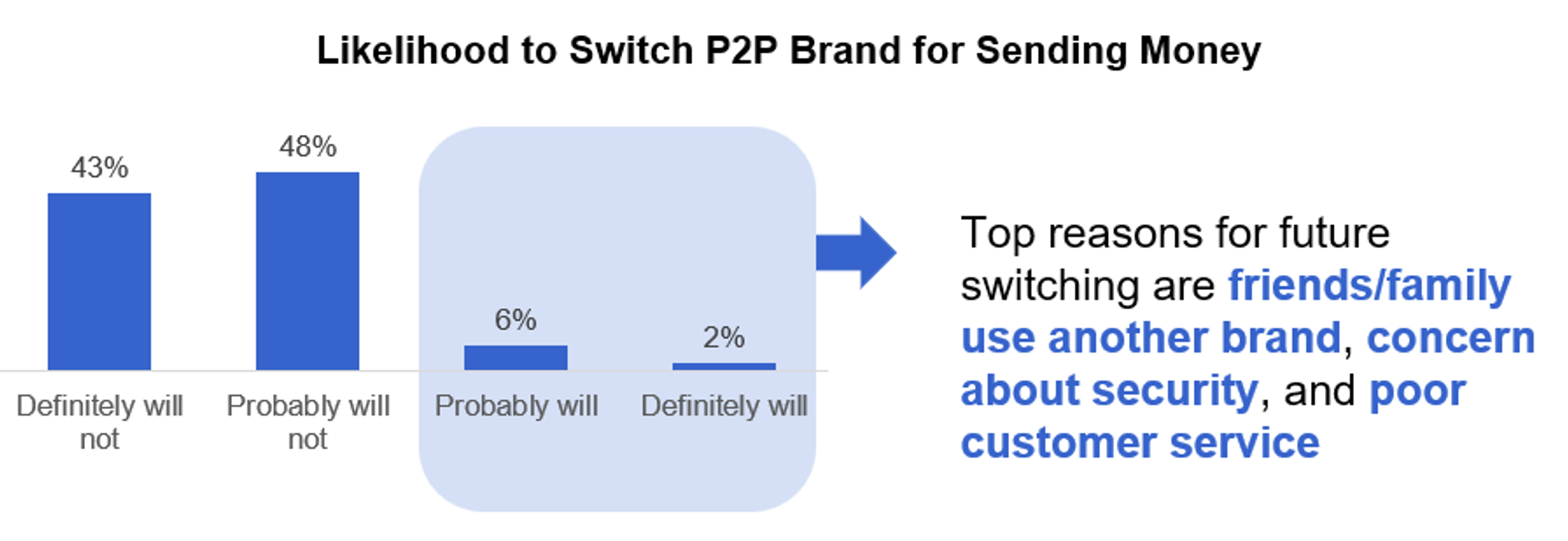
Even though customers indicate there is room for improvement in the service they receive, 89% say they prefer the brand that they use most frequently for P2P transfers. Just 8% of P2P users say they “definitely will” or “probably will” switch the brand they use for sending money in the next year.

Top reasons for future switching are friends/family use another brand, concern about security, and poor customer service

The most common reason customers are looking to switch brands for sending money is to be on the same platform as their friends/family (39%), followed by security concerns (28%) and poor customer service (19%).

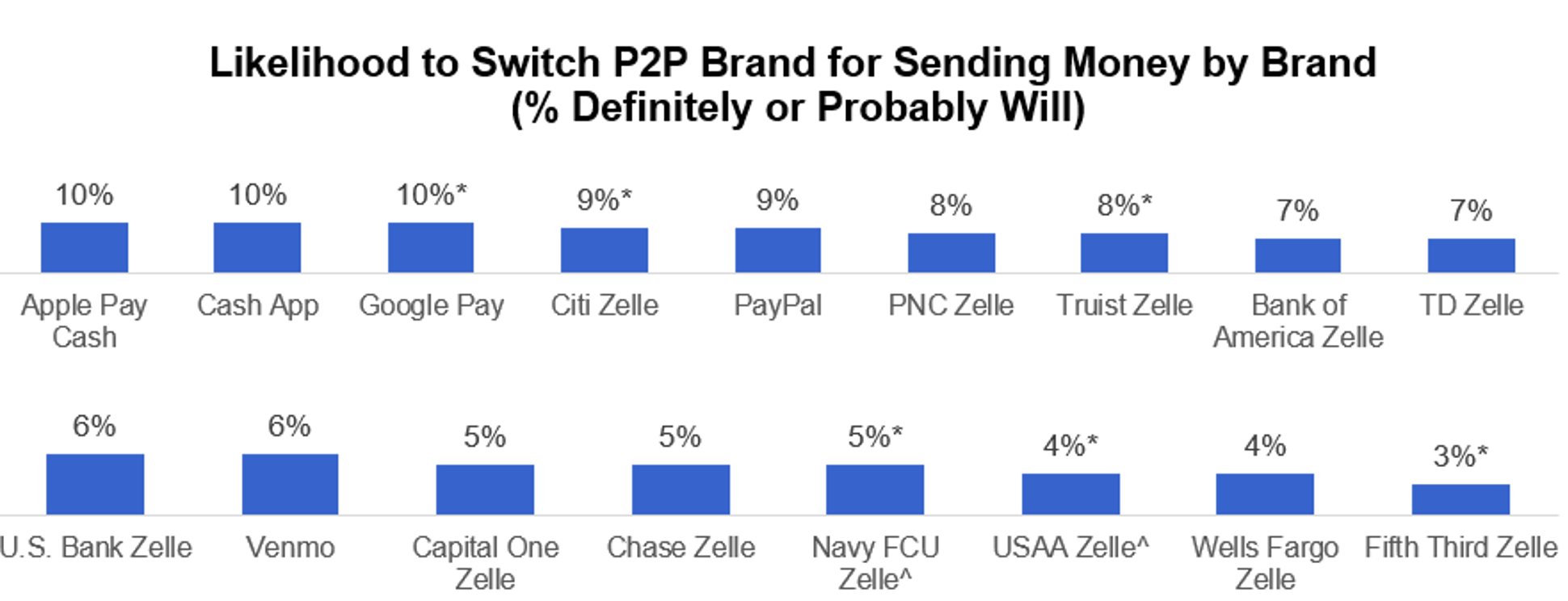
Likelihood to Switch P2P Brand for Sending Money by Brand

Apple Pay Cash and Cash App customers have the highest intention to defect.  Conversely, less than 5% of Wells Fargo Zelle users indicate they are going to switch brands for sending money.[1]

The Opportunity Ahead

As P2P transfer services mature, users will start expecting more in terms of overall customer service. Whether that’s seamlessly integrating into a digital wallet, more convenience for paying at point of sale, or offering an increased level of security, platforms need to find a way to identify where their services can be strengthened, but also effectively communicate those improvements to users.

That’s evident in customers’ experiences with Zelle. Services in the Zelle network boast impressive customer service totals but lack the market share of other platforms. For Zelle to capitalize on the experience they’re providing, they’ll need to find a way forward that shows they understand how, when and why the user is transferring money on their platform so that they can convert on those high satisfaction scores into a broader user base. 

Find out More

This Banking and Payments Intelligence Report is based on responses from the JD Power 2024 U.S. P2P Transfers Satisfaction Study, which included 5,727 responses and was fielded in January-February 2024. It is authored by Sean Gelles, Senior Director, Payments Intelligence. Please contact us at the numbers below to connect with Mr. Gelles or to learn more about the underlying research.

Media Contacts

Brian Jaklitsch; East Coast; 631-584-2200; [email protected]

Geno Effler, JD Power; West Coast; 714-621-6224; [email protected]

[1] * Indicates small sample size for Fifth Third Zelle, Google Pay and USAA Zelle

Join our list!

To get the latest insights, announcements, and industry intelligence from our JD Power experts delivered right to your inbox, we invite you to sign up for the mailing lists that are critical to your role:

Banking and Payments Intelligence Report
May 2024

Leveling Out

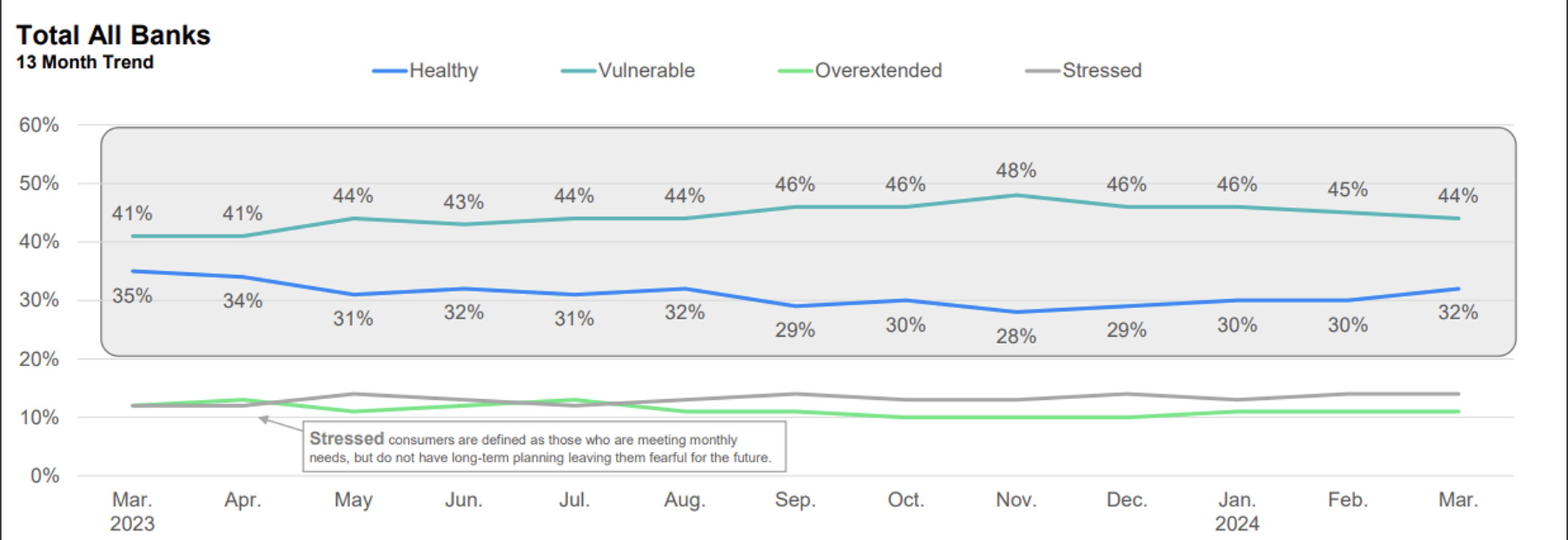
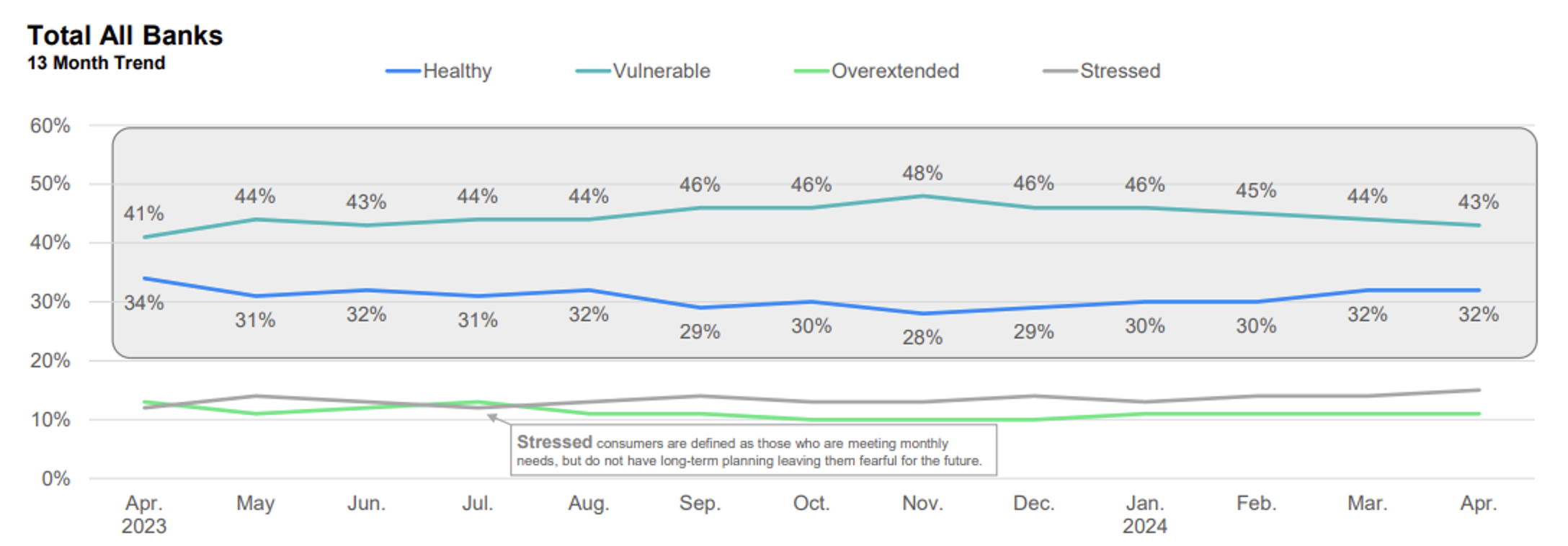
While customers’ financial health has seen gradual improvement over the last six months, the changes are modest. Nearly one-third (32%) of respondents are financially healthy, while 43% fall into the vulnerable category. This stabilization reflects a certain acceptance of the current economic landscape.

Image 1 Website

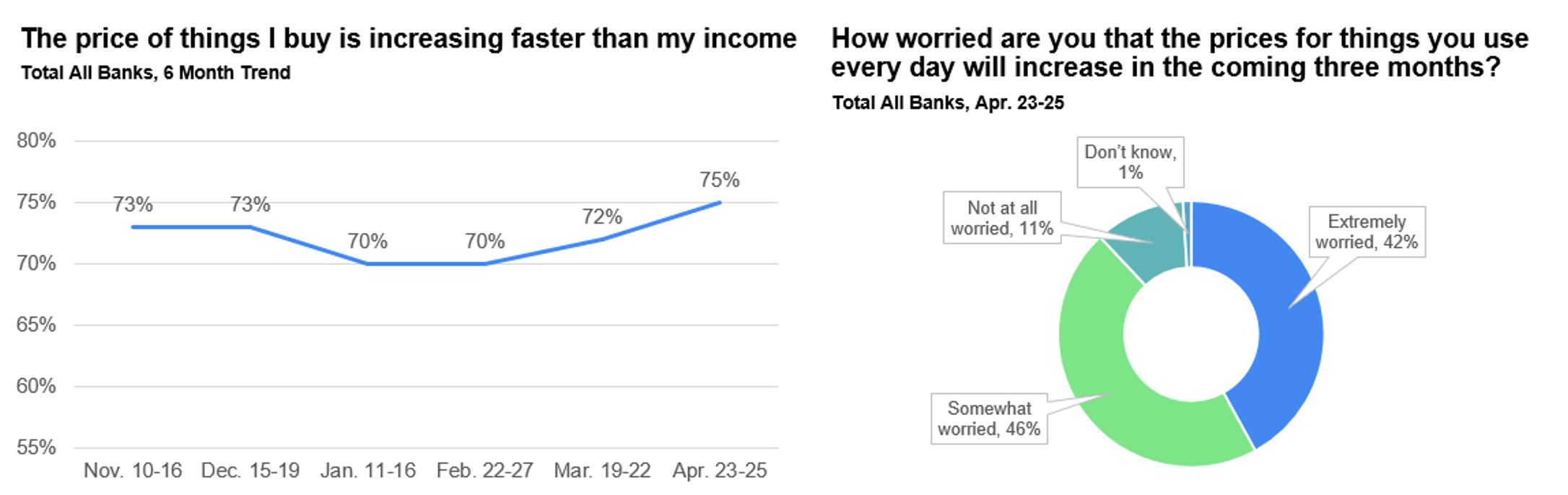
While there may be acceptance, there is palpable uneasiness about managing inflation. Three-fourths (75%) of bank customers say that the cost of goods is increasing faster than their income and 42% are extremely worried prices for goods they use every day will increase in the next three months. Those figures both reflect the highest level observed in the past six months.

Image 2 Website

All Dried Out

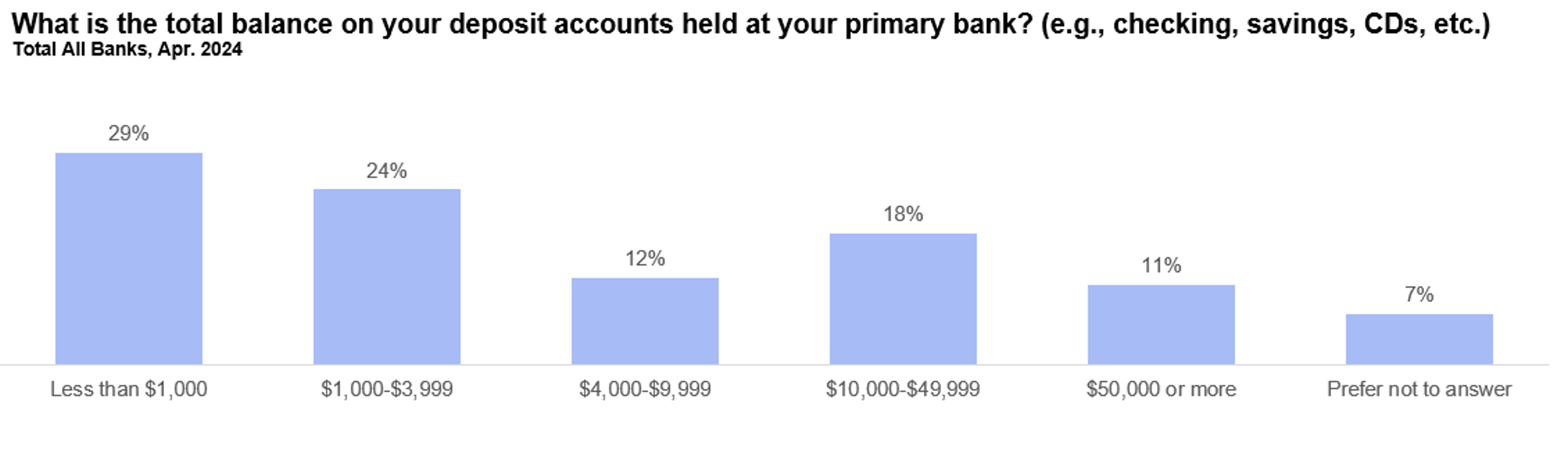
That worry is likely a reflection of how much—or how little—liquidity bank customers currently have on hand. More than half (53%) of customers have less than $4,000 in their primary deposit accounts.

Image 3 Website

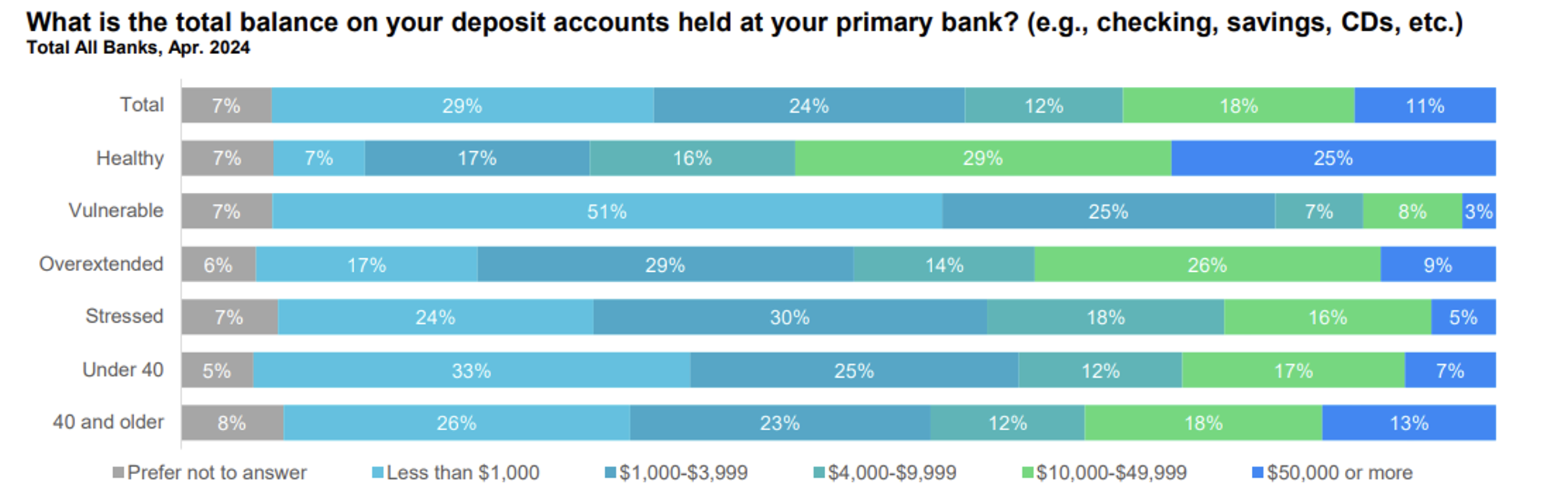
Interestingly, having a higher deposit level does not guarantee financial health. When asked about their deposits at their primary bank, 29% of healthy customers said they had between $10,000 and $49,999 on deposit compared with 26% of customers in the overextended category and 16% in the stressed category.

Image 4 Website

The Search for Higher Yields

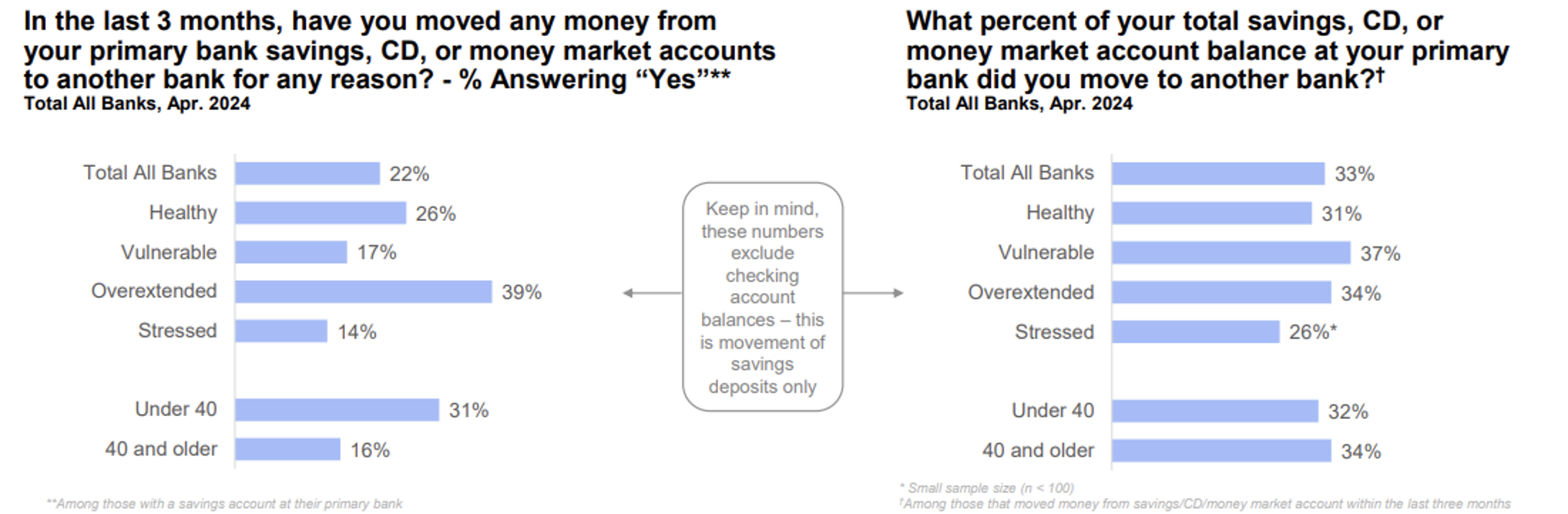
To combat these concerns about funds, some bank customers have begun to shift their money from their primary bank to another institution often seeking to earn as much as possible. Overall, 22% said they have moved money from their primary bank shifting one-third of their deposits. This rate is highest among customers in the overextended category.

Image 5 Website

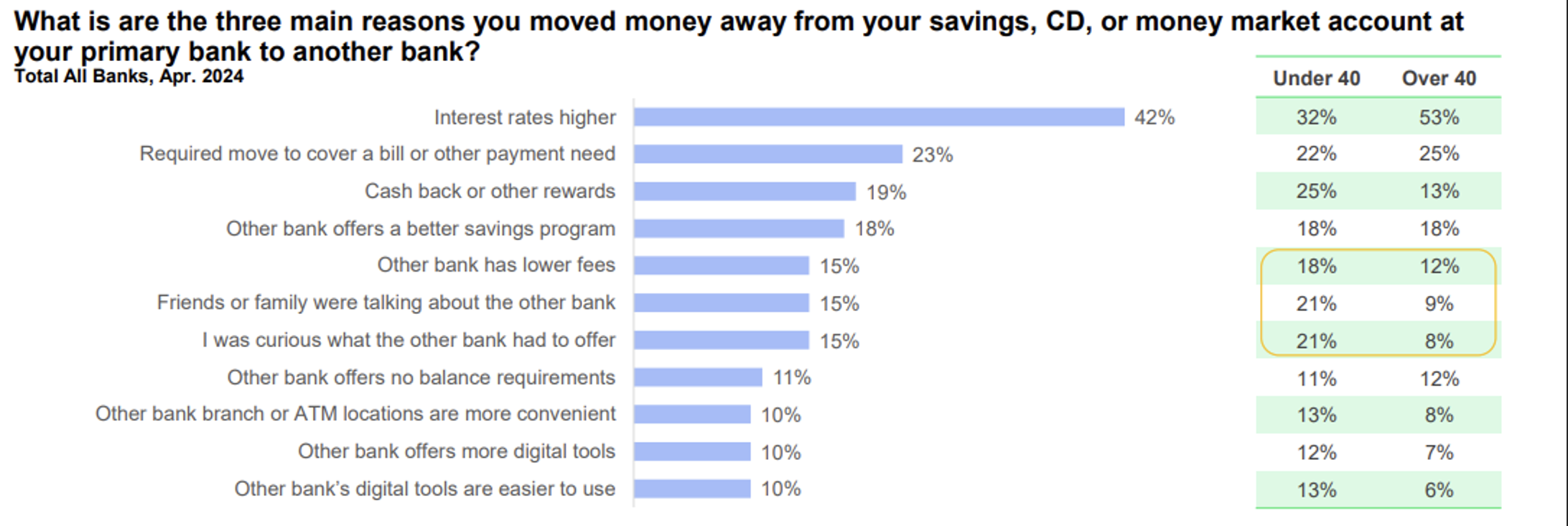
When asked why they moved their funds, some were required to make moves but among those choosing to shift deposits 42% said higher interest rates and cash back or other rewards (19%). Overall, 40% of primary savings customers earn less than 1% APY on their money, while 23% do not know what their savings interest rate is. This means there are some savvy customers taking advantage of current high interest rates to help grow their money, but a large portion are not making these money moves.

Image 6 Website

Chartering New Territory

While customers try to navigate the next phase of a very uncertain economic landscape, they are going to be on the hunt for any way they can gain an edge. Whether that’s a loan product, budgeting tools, or higher interest rate accounts, more customers than ever before are willing to test waters with banks both new and familiar.

That means that there is not only a need for more proactive customer engagement, but also an opportunity to help customers through a time of great stress. For banks willing to offer higher yield accounts, they have the potential to coax a lot of new business through the doors and, if done properly, convert that new business into long-lasting relationships.

Find out More

This Banking and Payments Intelligence Report is based on responses from 4,000 retail bank customers nationwide and was fielded in April 2024. It was authored by Jennifer White, senior director of banking and payments intelligence at JD Power. Please contact us at the numbers below to connect with Ms. White or to learn more about the underlying research.

Media Contacts

Brian Jaklitsch; East Coast; 631-584-2200; [email protected]

Geno Effler, JD Power; West Coast; 714-621-6224; [email protected]


Join our list!

To get the latest insights, announcements, and industry intelligence from our JD Power experts delivered right to your inbox, we invite you to sign up for the mailing lists that are critical to your role:

With a remarkable surge in the use of P2P transfers, the May edition of the Financial Services Intelligence Update dives into JD Power’s newest research – the JD Power U.S. P2P Transfers Satisfaction Study. Over half of U.S. consumers have embraced P2P transfers, with a 10% rise in usage since Q3 2023.

In this video, Miles Tullo invites Sean Gelles, Senior Director of Payment Intelligence, to shed light on what matters most to customers when it comes to building loyalty and authority in the P2P landscape, as well as surprising brand performance observations on Venmo, PayPal, Cash App, and Zelle.

Here’s a rundown of the top moments showcased in the video.

Driving Factors of P2P Transfers Satisfaction

Maintaining customer satisfaction is paramount in deterring defection to new digital payment platforms. The key factors driving satisfaction with P2P transfers, ranked by importance, include:

  • Account management through mobile apps
  • Ease of money transfer
  • Account linkage
  • Security of funds and personal data
  • Ease of receiving funds
  • Customization of user experience

Brands excelling in these areas are reaping the rewards of exceptional customer loyalty. Only 8% of P2P users say they “definitely will” or “probably will” switch the brand they use for sending money in the next year.

JD Power U.S. P2P Transfers Satisfaction Study

The JD Power U.S. P2P Transfers Satisfaction Study offers an in-depth analysis of consumer satisfaction with brands providing digital money transfers between individuals. It encompasses valuable data on consumer behaviors, preferences, adoption strategies, and competitive benchmarking. Learn more about this study.

About Sean Gelles

Sean Gelles is a seasoned professional with 20 years of experience in consumer analytics, particularly in the payments industry. At JD Power, he spearheads research on various payment methods, aiming to enhance client competitiveness. Prior to this, he led analytics teams at American Express, leveraging customer data for improved digital experiences and revenue growth. Gelles holds degrees from Northwestern and Cornell University.

Follow Sean on LinkedIn

About Miles Tullo

Miles Tullo is the Managing Director of the JD Power Financial Services team. He oversees the company’s consumer payments program, focusing on point-of-sale choice and non-credit card payment methods. Drawing from over 20 years of experience in both payments and mortgage lending, Miles brings valuable expertise to clients. 
Follow Miles on LinkedIn

Join our list!

To get the latest insights, announcements, and industry intelligence from our JD Power experts delivered right to your inbox, we invite you to sign up for the mailing lists that are critical to your role:

Banking and Payments Intelligence Report
April 2024
Woman starring at phone

Incremental Improvement 

While the changes in customers’ financial health are modest, they are trending slightly upward. Nearly one-third (32%) of respondents are financially healthy, while 44% fall into the vulnerable category. These are the most encouraging levels we’ve observed since August 2023.  

Graphic 1

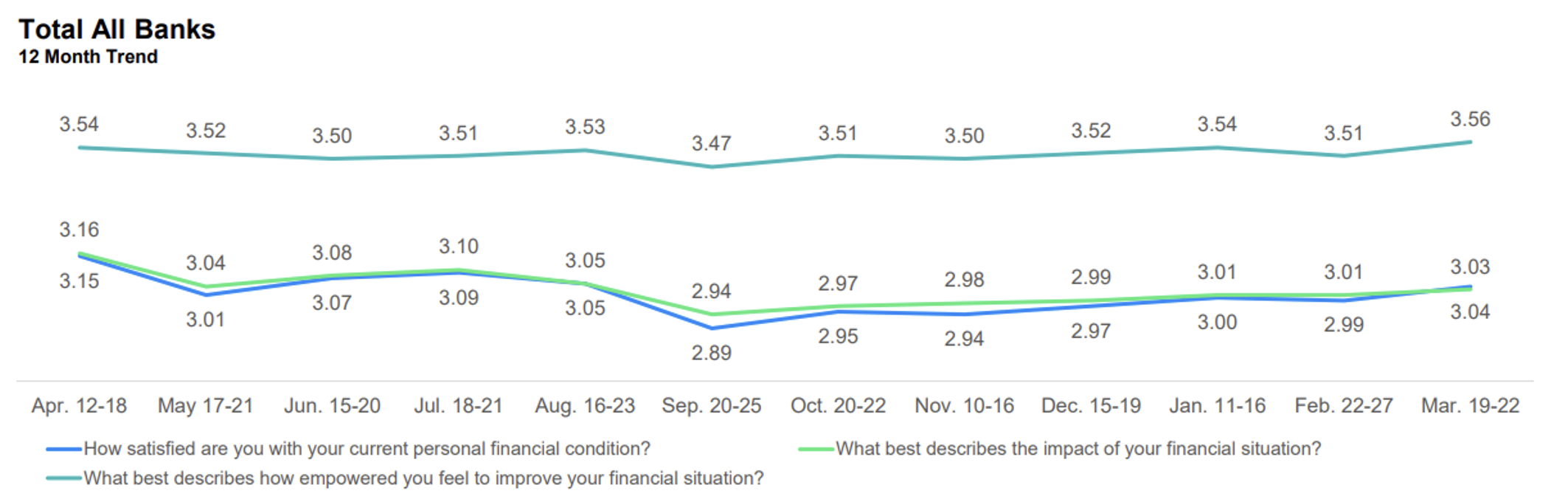
Customer sentiment regarding financial health status, stress levels and empowerment to improve one’s financial situation also ticked slightly upward to levels not seen since August 2023. These changes can be attributed to improving levels of customer savings to cover both short- and long-term needs.

Graphic 2

Late Fee Cap Could Help
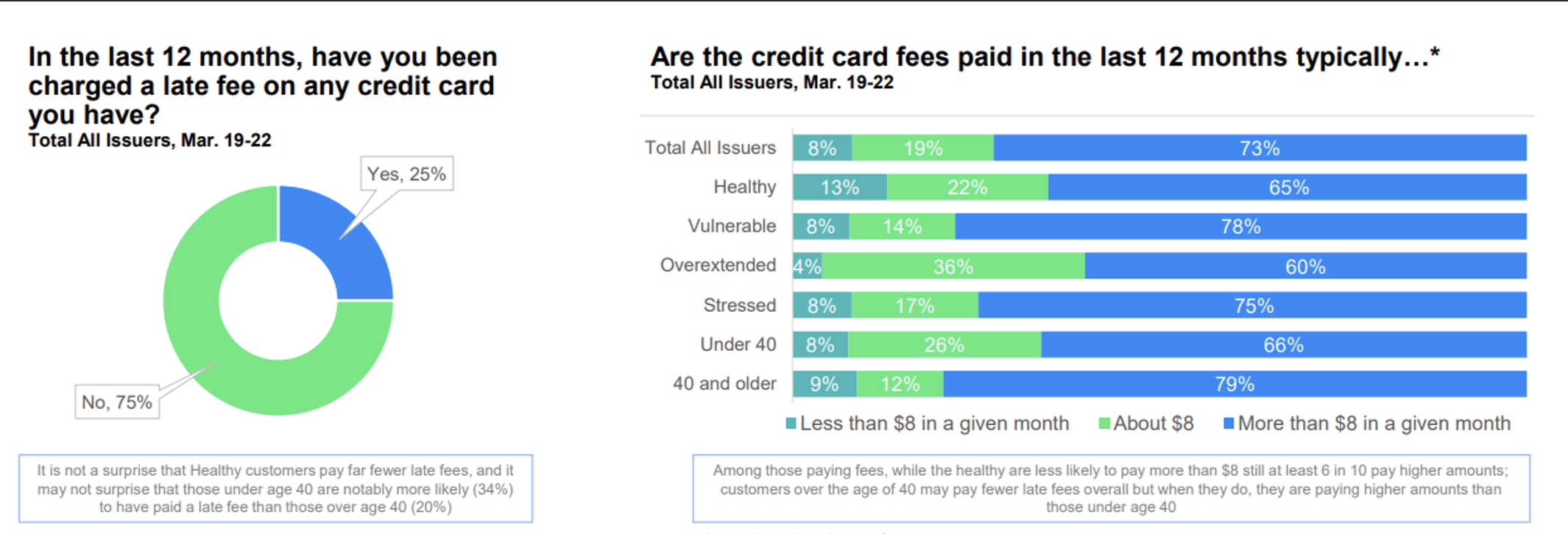
Even as conditions start to improve, 25% of customers say they have paid a credit card late fee in the past year. Unsurprisingly, this level is higher among financially unhealthy customers. When asked how much they paid on this late fee, 73% said the fee was more than the proposed $8 cap.

Graphic 3

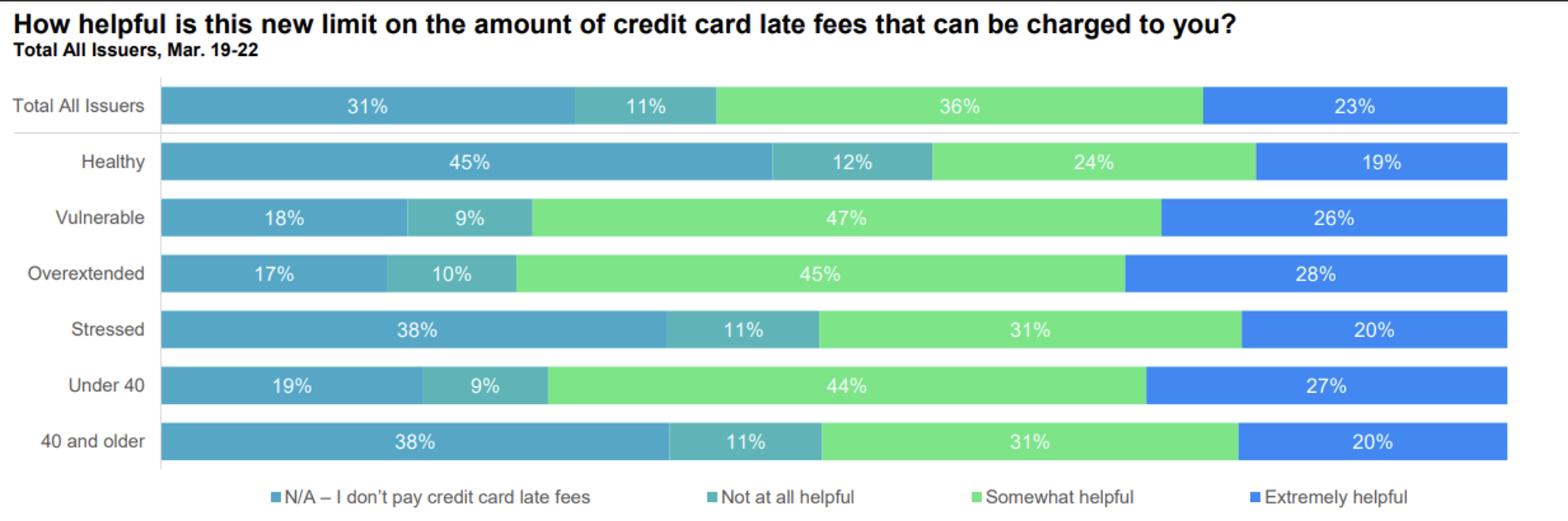
More than half (59%) of customers view the proposal to cap late fees as at least somewhat helpful, with 23% considering it to be very helpful. Younger customers—and those who are financially unhealthy—are the most likely to see the cap as a benefit.

Graphic 4

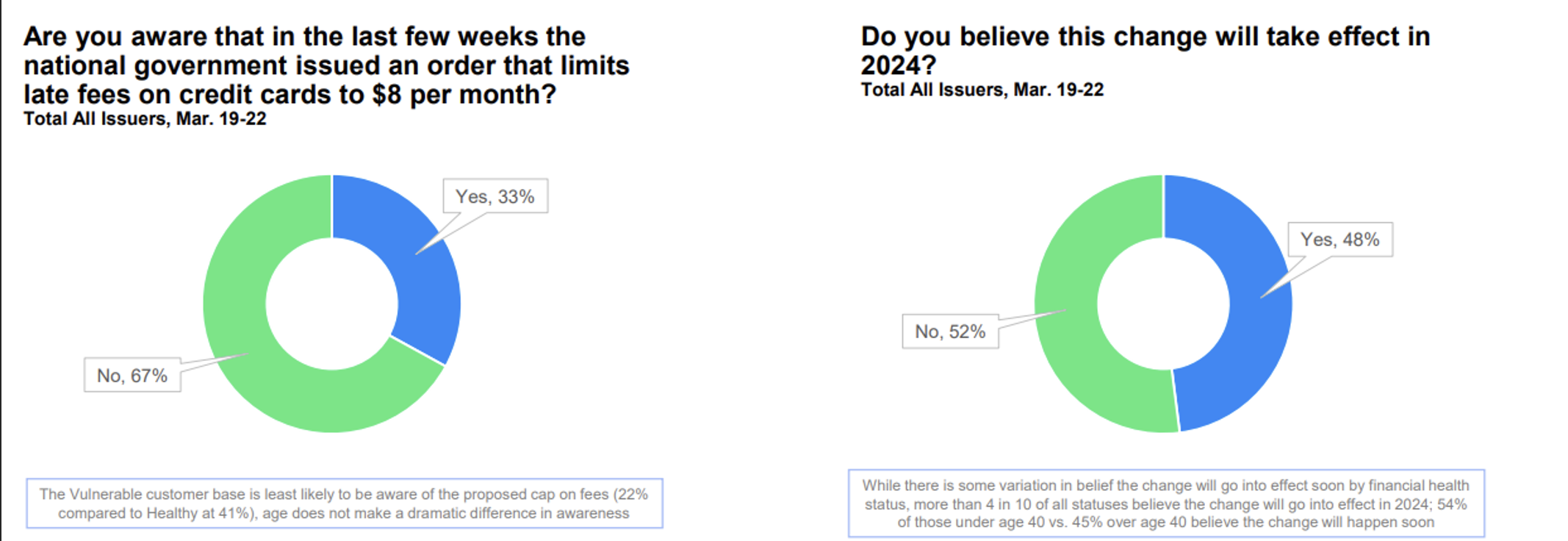
Even though this proposed legislation could help some bank customers, most are unaware of it. Two-thirds (67%) said they have not heard of this proposed change. And even once they do hear about it, many customers doubt it will come to fruition. More than half (52%) of all respondents say they do not believe this change will take effect this year.

Graphic 5

The Fraud Factor

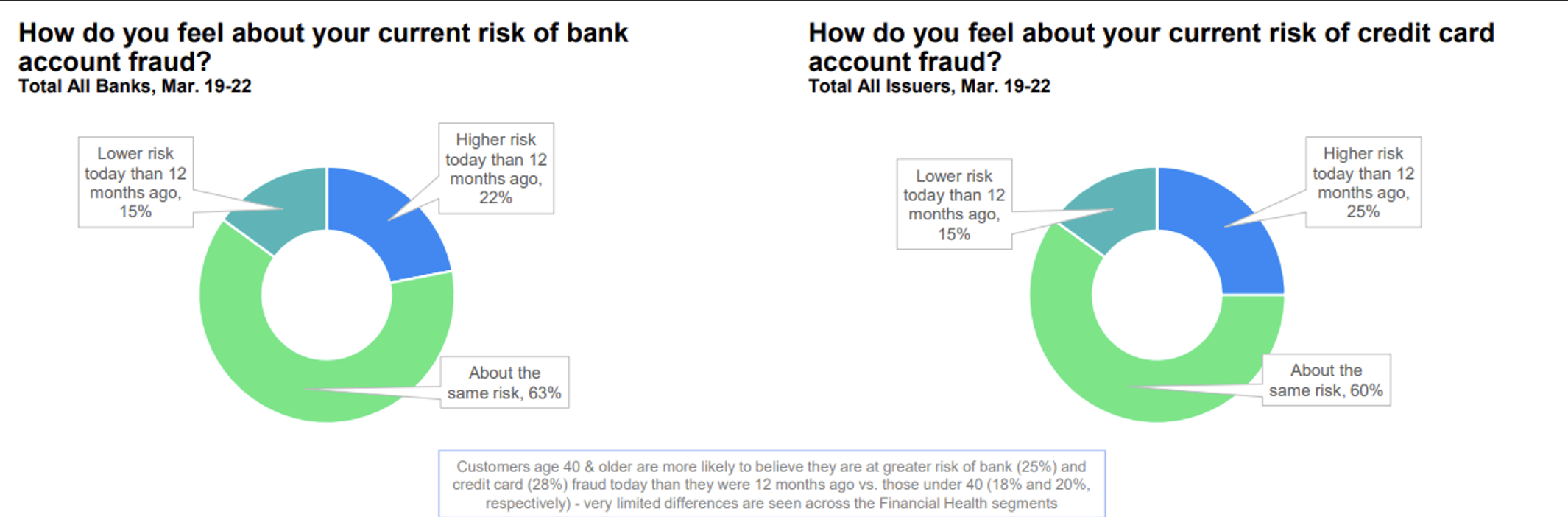
As customers await changes on late fees, they are still grappling with instances of fraud on their bank accounts and credit cards. Nearly one-fourth (22%) believe their risk of fraud has increased during the past 12 months, with older customers more likely to believe they are more susceptible.

Graphic 6

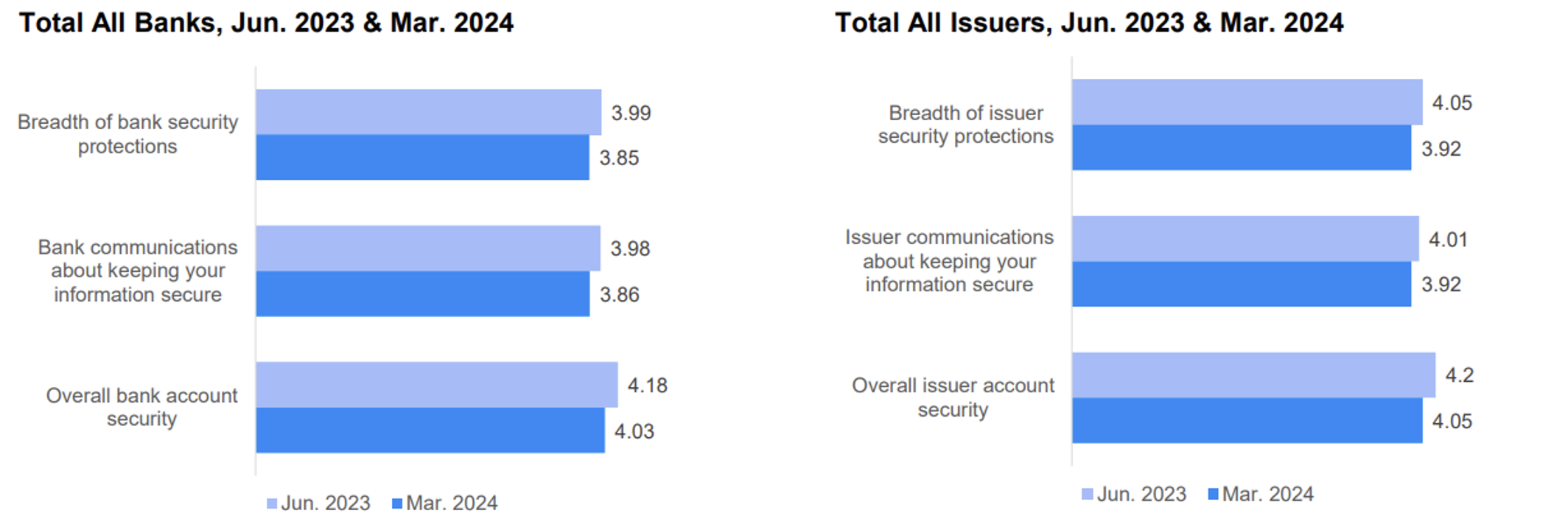
Customer ratings of both their bank and card issuer security protections have declined across all key metrics since June 2023, when JD Power established a baseline. Overall, customers with healthy financial situations and those under 40 years old are more likely to rate their bank or card issuer’s security higher.

Graphic 7

Building Awareness

As customers begin a slow climb back toward better financial situations, many are still living in a precarious financial state. Receiving a large late fee on a credit card or falling victim to fraud could take a customer on the precipice of a healthier financial outlook and plunge them back into a vulnerable state.

As programs from governmental or in-house bank or credit card programs focused on tamping down late fees or bolstering security enter the marketplace, institutions will need to build awareness. It’s possible that even a small piece of aid could make a major difference.

Find out More

This Banking and Payments Intelligence Report is based on responses from 4,000 retail bank customers nationwide and was fielded in March 2024. It was authored by Jennifer White, senior director of banking and payments intelligence at JD Power. Please contact us at the numbers below to connect with Ms. White or to learn more about the underlying research.

Media Contacts

Brian Jaklitsch; East Coast; 631-584-2200; [email protected]

Geno Effler, JD Power; West Coast; 714-621-6224; [email protected]


See What's New for the 2024 Financial Health and Advice Program

Join our list!

To get the latest insights, announcements, and industry intelligence from our JD Power experts delivered right to your inbox, we invite you to sign up for the mailing lists that are critical to your role:

In the JD Power Financial Services Intelligence update for April 2024, we discuss the 2024 U.S. Full-Service Satisfaction Study and the 2024 U.S. Self-Directed Satisfaction Study. Kapil Vora notes: “Full-service investors express greater satisfaction compared to DIY investors.” The discussion explores intersecting trends from both studies, examining how investor types and segments, such as financial health and generation, influence satisfaction levels. 

Key highlights from the update include: 

  • Service Levels Impact Satisfaction: Investors working with advisors report higher satisfaction; DIY platforms lack personalized guidance. 
  • Trends Over Time: Full-service investor satisfaction rises due to market performance and staffing investments; self-directed investor satisfaction remains stable. 
  • Segmentation Matters: Older investors more satisfied year over year; younger investors show declining satisfaction, requiring targeted outreach. 
  • Trading Habits and Financial Health: Active traders are more satisfied; buy-and-hold investors may need additional guidance. 
  • Brand Spotlight: T.D. Ameritrade and Charles Schwab excel among DIY investors; U.S. Bank stands out in the full-service segment. 
  • Differentiation Strategies: Clear communication, effective support, and transparent fees are vital for a unique value proposition. 


Where can you find more insights like this?  

  • The JD Power Full-Service Investor Satisfaction Study measures overall investor satisfaction among those who invest through a dedicated advisor or team of advisors, unveiling insights into affluence, age, and gender preferences. It offers valuable insights for enhancing client satisfaction, loyalty, and retention rates, refining investment strategies, and promoting client advocacy, aiding in identifying areas for improvement within wealth management firms. Read the Press Release  
  • The JD Power Self-Directed Investor Satisfaction Study evaluates the satisfaction levels of investors utilizing self-directed investment platforms, providing critical insights into their needs, expectations, and preferences. These valuable insights pinpoint the dynamics that influence satisfaction, such as portfolio size and trading activity, enabling them to tailor their offerings better to meet the needs of different types of investors.  Read the Press Release  


More About These Experts 

Kapil Vora is the Senior Director of Wealth Intelligence at JD Power. In this role, he is focused on equipping clients with data, analytics, and strategy to make them competitive with today’s investors and financial advisors. He leads research for various syndicated studies, including Investor Satisfaction Study, Financial Advisor Satisfaction Study, Retirement Plan Digital Study, Advisor Online Experience Study, and Wealth Management Digital Satisfaction Study.  

Miles Tullo is the managing director of the JD Power Financial Services team. He oversees the company’s consumer payments program, focusing on point-of-sale choice and non-credit card payment methods. Drawing from over 20 years of experience in both payments and mortgage lending, Miles brings valuable expertise to clients.  
Join our list!

To get the latest insights, announcements, and industry intelligence from our JD Power experts delivered right to your inbox, we invite you to sign up for the mailing lists that are critical to your role:

Despite a challenging year for retail banks in 2023 due to factors like bank failures, inflation, and declining consumer health, customer satisfaction with primary banks only slightly declined, registering at 644 out of 1000 on the JD Power scale. However, satisfaction declined in four out of seven dimensions, with millennials leading the decline, particularly in levels of trust.

What do banks need to do to win over millennials? Watch the latest Financial Services Intelligence Update for key takeaways from the 2024 U.S. Retail Banking Satisfaction Study and discover what areas banks need to focus on to retain and grow younger generations before the relationship solidifies with another institution.

BONUS: Download our exclusive insights detailing each generation’s overall satisfaction (OSAT) with their primary retail bank, followed by satisfaction levels with the seven dimensions that determine overall satisfaction.

Download Now

JD Power 2024 U.S. Retail Banking Satisfaction Study

The J. D. Power Retail Banking Satisfaction StudySM  is the longest-running and most in-depth, independent analysis of retail banking customers available. While some things have changed, banks have continued to rely on this invaluable study for unbiased intelligence about retail banking customers’ satisfaction with their primary financial institution.

The study measures customer satisfaction with retail banks in 15 geographic regions. Read key insights from this year’s press release and view the highest-ranking banks and scores, by region.

Read the 2024 U.S. Retail Banking Satisfaction Study Press Release.

View Press Release

Ready to leverage JD Power data and insights?

Contact us today.

Get Started

Miles Tullo 

Miles Tullo is the Managing Director for the JD Power Financial Services team. He oversees the company’s consumer payments program, focusing on point-of-sale choice and non-credit card payment methods. Drawing from over 20 years of experience in both payments and mortgage lending, Miles brings valuable expertise to clients. 
Follow Miles on LinkedIn  

Join our list!

To get the latest insights, announcements, and industry intelligence from our JD Power experts delivered right to your inbox, we invite you to sign up for the mailing lists that are critical to your role:

Banking and Payments Intelligence Report
March 2024

Banking and Payments AI

Just as the inflation rate seems stuck at just above 3%, the financial situations of U.S. banking customers have similarly hit a plateau.

According to JD Power, the percentage of U.S. bank customers that are financially healthy[1] remains near the all-time low. While banks would love to use artificial intelligence (AI) to help customers out of this malaise, customers remain unconvinced that AI has a practical benefit to their financial health.

Stuck in Neutral

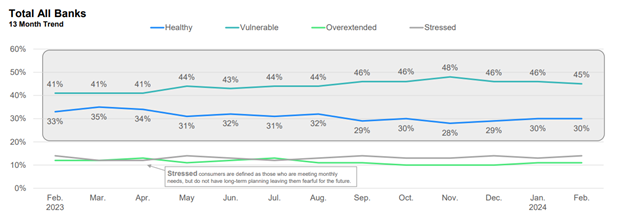
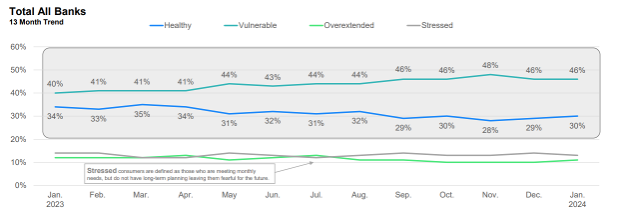
Customers’ financial health seems to have bottomed out. Nearly one-third (30%) of respondents are financially healthy, while 45% fall into the vulnerable category, virtually identical to levels we have seen during the past five months.

13 Month Financial Health Trend

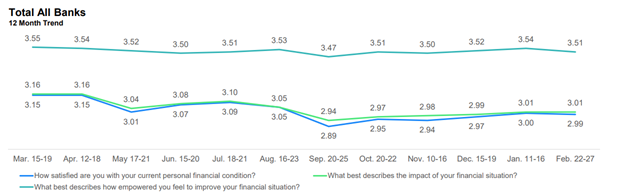
Customer sentiment regarding financial health status, stress levels and empowerment to improve one’s financial situation also remain virtually unchanged month-over-month. The effects of inflation are still being felt, but they are declining slowly. Lower grocery prices are the most recognized way customers are feeling relief from inflation, with prices for dining out, clothing/discretionary items and energy also falling.

12 Month Sentiment Trend


Customers Not Sold on AI

While banks are investing time and resources to integrating AI into their offerings, customers are simply not convinced that AI is to be trusted. More than half (56%) say they only somewhat trust the quality of the output generated by their bank’s use of AI, with 32% saying they don’t trust it at all.

Chart - How much do you trust in the quality of the output generated by your banks use of AI


Part of that could be how banks’ utilization of AI is perceived by the customer. Bank customers either view their institution’s use of AI as less advanced than other industries’ solutions, or they simply don’t know. If banks are hopeful to incorporate AI into their solutions, they must understand that the measuring stick is not other banks, but how AI is used in other industries as well.

Chart - In your view is your banks use of AI more or less advanced than how companies in other industries are using AI


Falling Short of the Hype?

A central theme to AI marketing is often that it helps customers “focus on what matters most,” but banks have yet to prove AI solutions achieve that goal. Just 28% agree that the use of AI lets them focus on what matters most about their financial life. Nearly half (43%) said they do not know.

Chart - How much do you agree that your banks use of AI allows you to focus on what matters most in our financial life


What’s more, customers do not believe AI is being used to personalize their service or experience. Nearly one-third (32%) said AI is not personalizing their experience at all, while 57% said only somewhat.

Chart - How much do you believe the use of AI in any form personalizes interactions with your bank


Proving the Concept

In a time of financial uncertainty, customers want tangible, personalized solutions from their banks. Broad, sweeping messages from institutions about how AI can help them simply don’t augur the type of trust that customers need.

For banks to truly integrate AI to a point where their customers feel comfortable, they need to go the extra mile by making the individual understand how they’ll personally benefit from it. A promise to keep them focused simply doesn’t win hearts and minds. To bridge this trust chasm, they need to show a true value tailored to each customer’s need. It’s a heavy lift, but if banks want to roll out AI in a way that will make meaningful progress, it’s the only way.

Find out More

This Banking and Payments Intelligence Report is based on responses from 4,000 retail bank customers nationwide and was fielded in February 2024. It was authored by Jennifer White, senior director of banking and payments intelligence at JD Power. Please contact us at the numbers below to connect with Ms. White or to learn more about the underlying research.

Media Contacts

Brian Jaklitsch; East Coast; 631-584-2200; [email protected]
Geno Effler, JD Power; West Coast; 714-621-6224; [email protected]

[1] JD Power measures the financial health of any consumer as a metric combining their spending/savings ratio, creditworthiness, and safety net items like insurance coverage. Consumers are placed on a continuum from healthy to vulnerable.


New! J.D. Power Financial Protection Satisfaction Study


Join our list!

To get the latest insights, announcements, and industry intelligence from our JD Power experts delivered right to your inbox, we invite you to sign up for the mailing lists that are critical to your role:

Banking and Payments Intelligence Report
March 2024
Mobile wallet

Digital wallets are now the fastest-growing payment method in the United States, with almost half (48%) of U.S. consumers indicating that they have used a digital wallet in the past 90 days, up 12 percentage points from 2023, according to JD Power data. What’s driving this surge in adoption and how will it all play out for the major players in the space?

This Banking and Payments Intelligence Report dives into the findings of the JD Power 2024 Digital Wallet Satisfaction Study to spotlight emerging trends and important shifts in consumer sentiment with digital wallet brands.

Satisfaction Increasing with Frequency of Use

Remember when cash was king? Now, convenience is the top driver of payment method choice and that’s causing consumers to increasingly turn to digital wallets for all types of transactions. Overall customer satisfaction with digital wallets is up 4 points (from 660 to 664, on a 1,000-point scale), according to the JD Power 2024 Digital Wallet Satisfaction Study, and the top factor driving that increase is ease of use, both online and in-person.

As a result, consumers are using digital wallets more frequently than ever. Overall, 48% of consumers have used a digital wallet in the past 90 days. Among those, 40% have used PayPal; 28% have used Apple Pay; 22% have used Venmo; and 19% have used Cash App Pay. Among more frequent users who access their digital wallets at least once a month, Venmo and Cash App Pay are seeing the highest overall customer volume. However, within the subset of digital wallet power users, who are using these services at least five times per month, Apple Pay is the most frequently used service.

A Market Ripe for Competition

While digital wallet usage rates and satisfaction scores are both going in the right direction, the industry is far from mature and gaps exist for new entrants. Chief among these gaps is inconsistent merchant acceptance. As we saw in the JD Power 2024 Merchant Services Satisfaction Study, only 57% of small businesses now accept digital wallets (94% accept cards) and some large merchants are still not wallet enabled in-store. Some wallets can only be used for online purchases while others can only be used in-store. And, no wallets are universally available at accepting merchants the same way that cards are.

The lack of perks associated with digital wallet providers, such as rewards programs or merchant discounts, is also a problem. Among the most important drivers of customer satisfaction with digital wallet providers, such as ease of use and security of account information, scores are lowest for perks. These gaps mean that customer loyalty is hard to secure in this space, with just 34% of customers indicating that they “definitely will not” switch brands.

Watch This Space

In the near-term, we expect digital wallet usage to continue to grow rapidly, outpacing other methods of payment at the point of sale, by virtue of its ease of use and its privileged position in the center of consumer lives in smartphones and online. It is noteworthy, for example, that the percentage of people who say they prefer to use digital wallets for online and mobile purchases rises 5 percentage points and 6 percentage points (from 12% to 17% and 22% to 28%, respectively) in 2024. As online and mobile continue to be the channels of choice for so many consumer transactions, digital wallets are certain to benefit from that volume.

Merchant acceptance will continue to grow. Seventy-nine percent (79%) of small businesses have a favorable impression of digital wallets, calling out fast transaction speed and customer demand as the primary attributes of the payment method, and traditional large merchant holdouts continue to convert as demand increases.

Find out More

This Banking and Payments Intelligence Report is based on responses from the JD Power 2024 Digital Wallet Satisfaction Study, which included 3,957 responses and was fielded from September-November of 2023. It is authored by Miles Tullo, Managing Director of Financial Services. Please contact us at the numbers below to connect with Mr. Tullo or to learn more about the underlying research.

Media Contacts

Brian Jaklitsch; East Coast; 631-584-2200; [email protected]

Geno Effler, JD Power; West Coast; 714-621-6224; [email protected]

Join our list!

To get the latest insights, announcements, and industry intelligence from our JD Power experts delivered right to your inbox, we invite you to sign up for the mailing lists that are critical to your role:

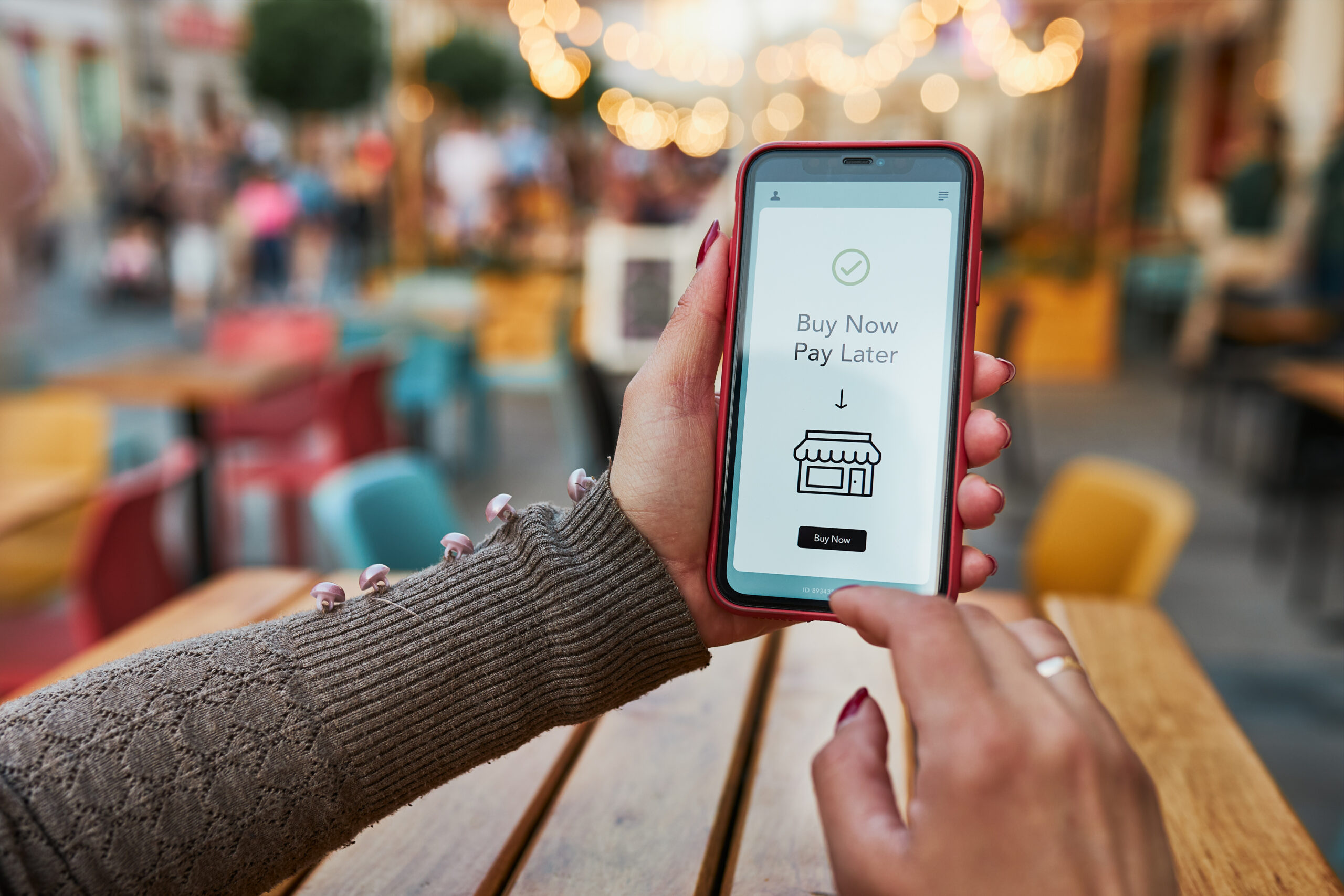
Miles Tullo shares the results of the JD Power Buy Now Pay Later Satisfaction Study and surprising details on brands, like American Express, Affirm, AfterPay, Zip, and PayPal.

JD Power 2024 U.S. Buy Now Pay Later Satisfaction Study

The JD Power 2024 U.S. Buy Now Pay Later Satisfaction Study is a syndicated benchmarking study profiling the experiences of Buy Now Pay Later customers in the United States.

This study identifies the dominant factors that drive customer satisfaction with Buy Now Pay Later lenders.

View all the study details

Miles Tullo 

Miles Tullo is the Managing Director for the JD Power Financial Services team. He oversees the company’s consumer payments program, focusing on point-of-sale choice and non-credit card payment methods. Drawing from over 20 years of experience in both payments and mortgage lending, Miles brings valuable expertise to clients. 
Follow Miles on LinkedIn  

Join our list!

To get the latest insights, announcements, and industry intelligence from our JD Power experts delivered right to your inbox, we invite you to sign up for the mailing lists that are critical to your role:

Banking and Payments Intelligence Report
February 2024
Online banking

Although the annual inflation rate is close to dipping below 3% for the first time since 2020, bank customers in the United States have yet to see major improvement in their financial situations.
According to JD Power, the percentage of U.S. bank customers that are financially healthy[1] remains near the all-time low, while new concerns are cropping up with the emergence of artificial intelligence (AI) in the financial services sector. And despite that many of these AI-driven tools could help customers, many are hesitant to trust the technology to help manage their money.
Financial Woes Continue

Customers’ financial health remains at a standstill. Nearly one-third (30%) of respondents are financially healthy, while 46% fall into the vulnerable category. These numbers are in line with the previous four months.

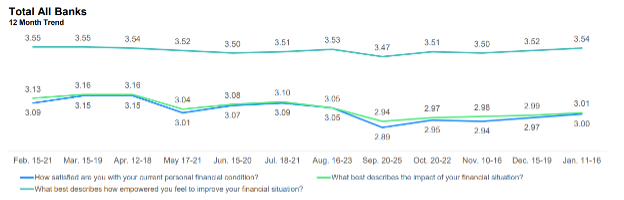
Total All Banks Trends

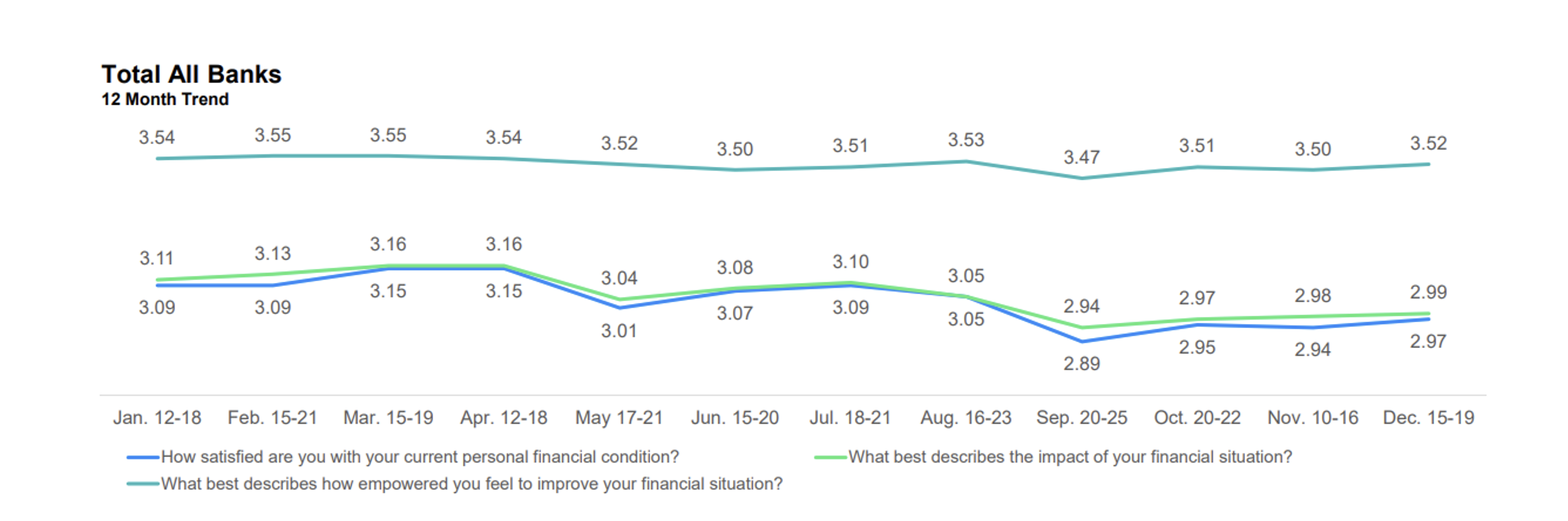
Customer sentiment regarding financial health status, stress levels and empowerment to improve one’s financial situation also remain virtually unchanged month-over-month. A small silver lining: The percentage of customers that are extremely worried that the prices for common goods will continue to rise dropped to 37% from 40% in January.

FS Article Pic 2

The More You Know: AI Edition

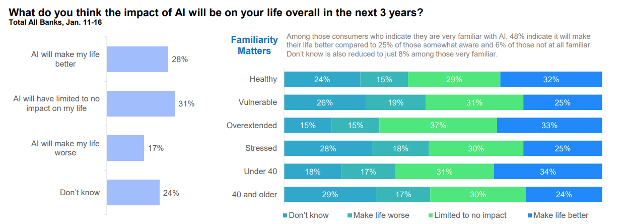
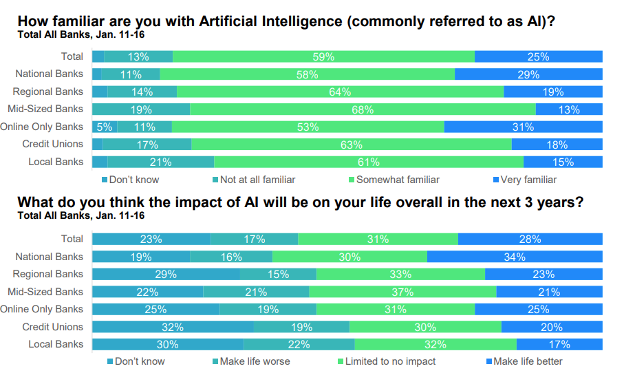
After exploding onto the scene in 2023, many industry analysts expect this to be the year when generative artificial intelligence will make a meaningful difference in consumers’ lives. Banking customers in the U.S. are skeptical. More than one-fourth (28%) believe AI (either generative or machine-learning/algorithmic) will make their lives better, while 17% think it will make their lives worse and 24% say they don’t know.

AI Edition

Familiarity with AI matters, as nearly half (48%) of customers that were very familiar with AI thought it would make their lives better vs. 6% of those who are not at all familiar with AI. To that point, customers of the nation’s largest banks and online-only banks are more familiar with AI than customers at credit unions or local banks.

Artificial Intelligence Insights

The Hesitant Adopters

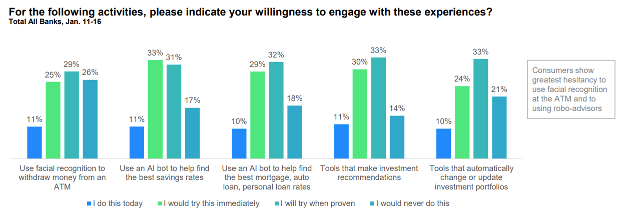
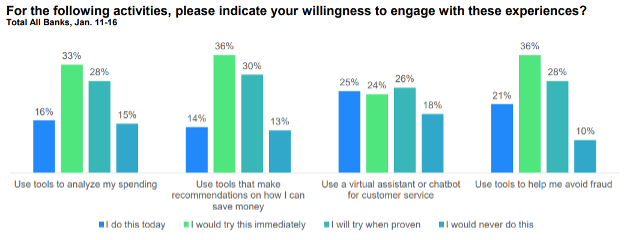
More proof of customers’ unease about AI is their willingness to let the adoption of this technology play out before they try. While many of these options are broadly available to customers, anywhere from 14% to 26% of customers (depending on the application) say they would not use AI for financial applications. Those include using facial recognition to withdraw money (26%), using tools that automatically change or update investment portfolios (21%), and using an AI bot to help find the best mortgage, auto loan or personal loan rates (18%).

AI activities

Interestingly, customers are more willing to set aside their security worries or AI fears when the tools make an immediate impact on managing their financial lives. Notably, the percentage of customers that answered they would never use AI tools was the lowest (10%) when it would them avoid fraud.

Willingness to Engage

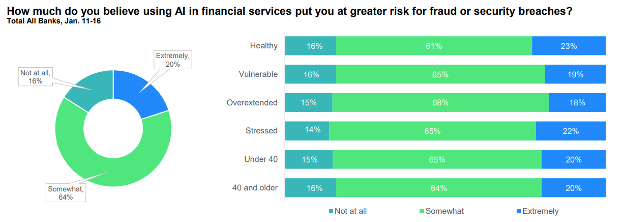
When asked how much AI in financial services put them at greater risk for fraud or security breaches, 64% of all respondents said “somewhat.” One in five (20%) thought it put them at an extreme risk, while 16% said not at all. Key to financial institutions encouraging AI driven tool adoption will be reassuring customers about tool security.

Security breaches

Trusting the Machines

When it comes to AI, customers seem perfectly content to let someone else be the guinea pig. But, considering the current financial landscape, they might want to be early adopters of a tool that can move money from one fund to another if AI can read or anticipate trends that might keep more of their money safe.

It’s clear that if banks are going to get customers to buy in, they need to educate them about these tools. AI can be a gamechanger for underwriting loans, managing money, and streamlining time-consuming processes, but it will all be for naught if customers don’t trust it. The banks that can boost awareness and put their customers’ minds at ease on AI stand to make major gains.

Find out More

This Banking and Payments Intelligence Report is based on responses from 4,000 retail bank customers nationwide and was fielded in January 2024. It was authored by Jennifer White, senior director of banking and payments intelligence at JD Power. Please contact us at the numbers below to connect with Ms. White or to learn more about the underlying research.

Media Contacts

Brian Jaklitsch; East Coast; 631-584-2200; [email protected]

Geno Effler, JD Power; West Coast; 714-621-6224; [email protected]

Join our list!

To get the latest insights, announcements, and industry intelligence from our JD Power experts delivered right to your inbox, we invite you to sign up for the mailing lists that are critical to your role:

Banking and Payments Intelligence Report
January 2024

Even as Financial Health Remains Troublingly Low,  Bank Customers in the U.S. Resolve to Improve in 2024

As the U.S. inflation rate continues to hold steady, bank customers in the United States are hopeful to take charge in 2024, even in the face of their current economic struggles.

According to JD Power, while the percentage of U.S. bank customers that are financially healthy[1] remains near the all-time low, four-in-five customers plan to eliminate debt, improve their budgeting and set specific savings goals in 2024.

Financial Woes Continue                                

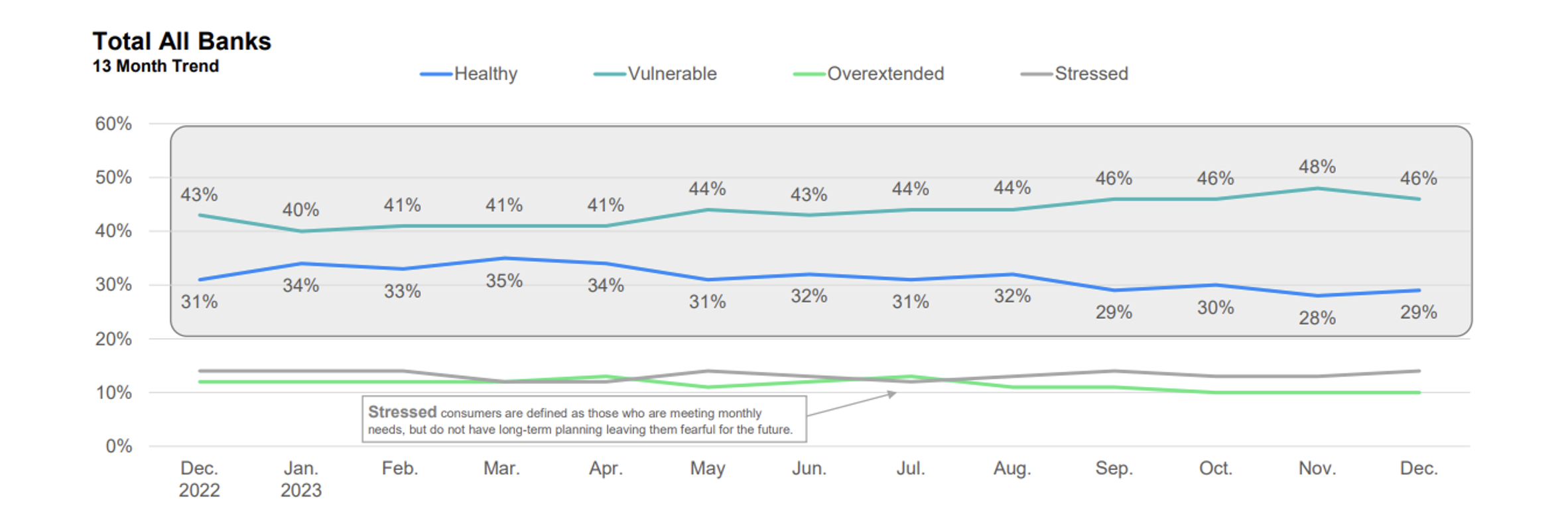
Customers’ financial health remains troublingly low. Just more than one-fourth (29%) of respondents are financially healthy, while 46% fall into the vulnerable category. These numbers are in line with the previous three months.

13 Month Trend of Financial Health

Customer sentiment regarding financial health status, stress levels and empowerment to improve one’s financial situation also remain virtually unchanged from the previous month. What’s more, 40% of customers remain extremely worried that the prices for common goods will continue to rise.

12 Month Trend of Financial Health

New Year, New Budget?

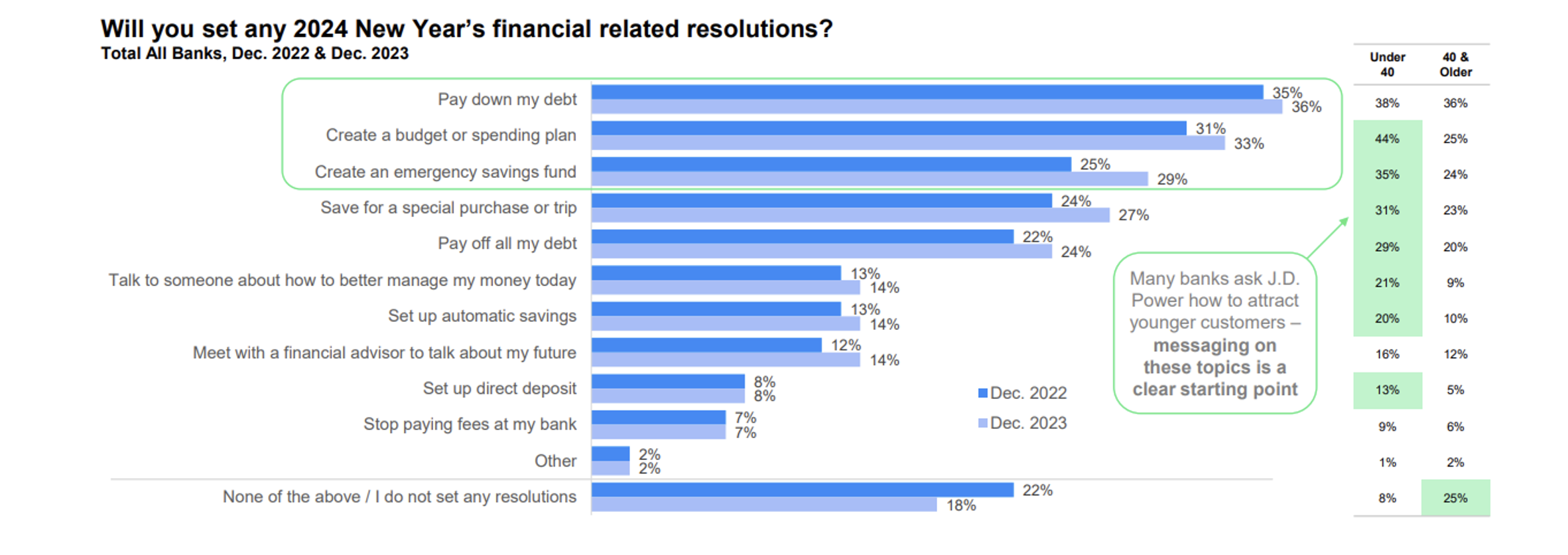
With the start of the new year, many customers are inspired to improve their financial health. More than one-third (36%) of customers say they plan to pay down debt throughout 2024, while 33% say they will create a budget or spending plan, and 29% say they will establish an emergency fund. All these response levels reflect year-over-year increases from December 2022. Notably, customers under the age of 40 were more likely to say they would make these changes. 

Bar Graph of New Year's Financial Goals

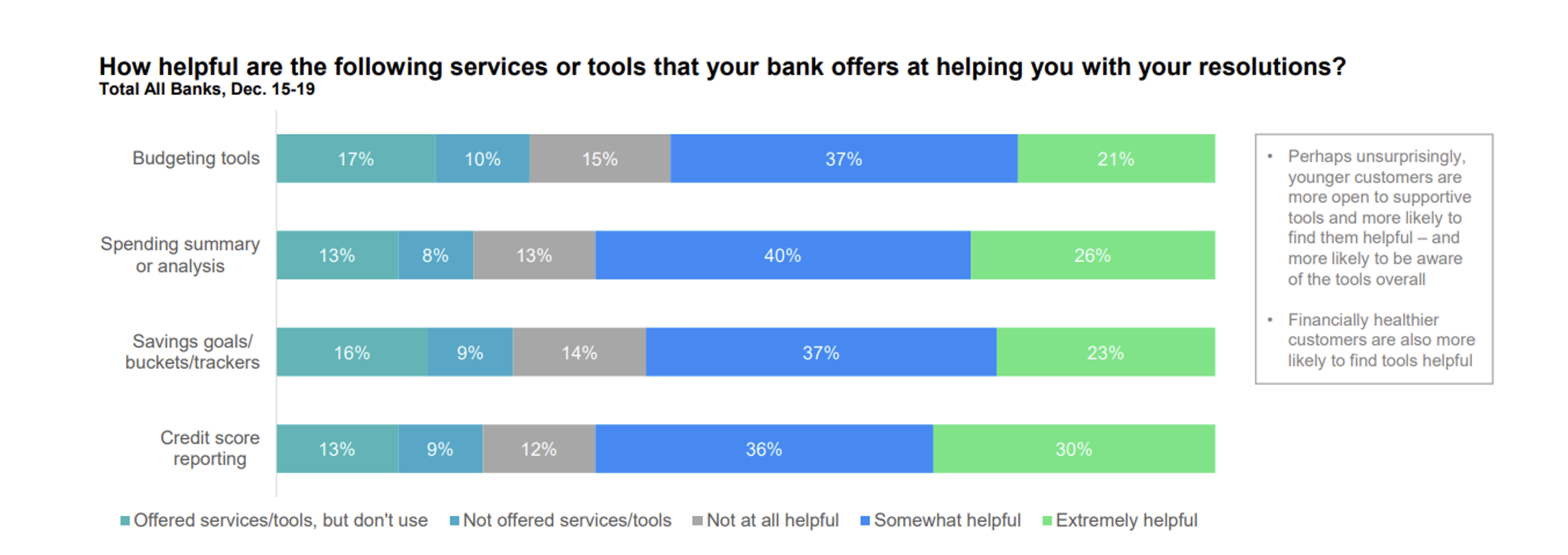
When asked which tools that banks provide are particularly helpful to achieving these goals, credit score reporting (66%); spending summary or analysis (66%); and savings goals and budget trackers (60%) rank high. Financially health customers are more likely to find tools helpful, and younger customers are more likely to utilize these tools.

Graph of Bank Survey Results

The Stress Test

When customers who do not use tools that banks offer to improve their financial situation were asked why, 49% said they already have their own system to monitor their finances, while 25% said they get this support from outside their bank.

Survey Results of Customer Bank Services

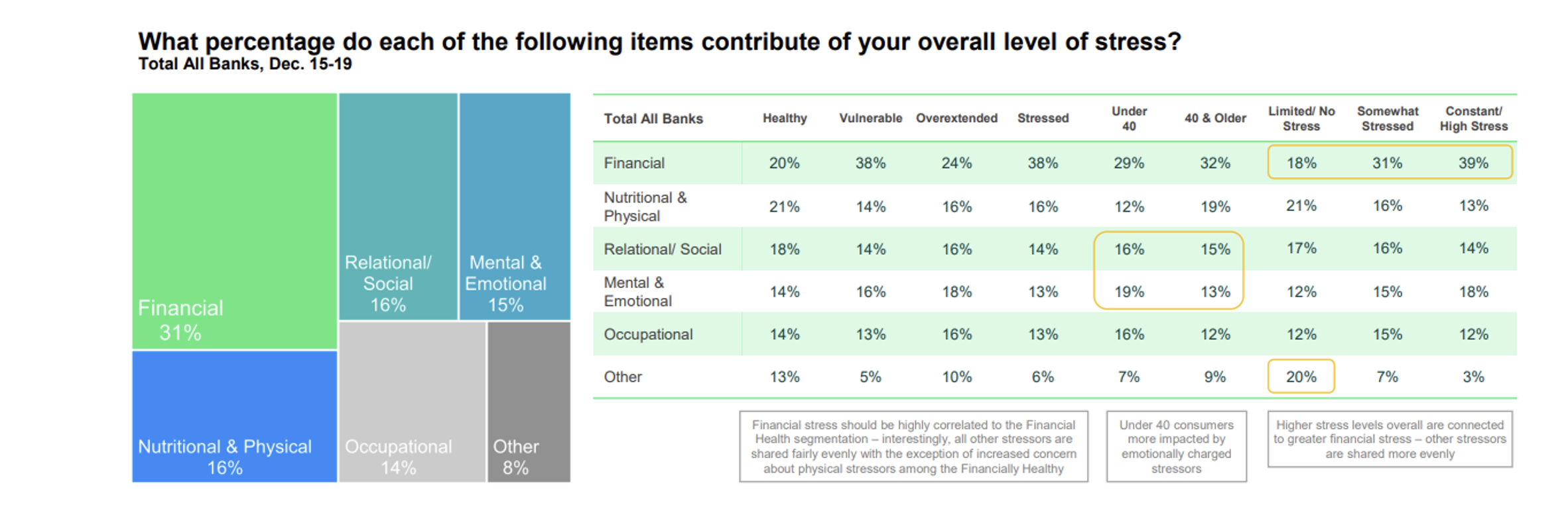
Interestingly, there is also an emotional barrier to tool adoption. About one-fifth (21%) say that looking this closely at their finances causes them added stress, and another 17% say these tools make them feel worse about their finances. In fact, when asked what drives their overall stress, 31% of customers say finances, which is the highest response rate of any reason. 

Graph of Financial Stress

Judgment-Free Zone

As customers look to dig out of their respective financial holes, they need to feel like they have a partner in their climb. Banks can be integral to that journey, but only if customers feel that they are not being judged and that their financial institution has a real plan to move forward.

Staring down a big debt number on a spreadsheet or working with a budgeting tool that creates a plan that doesn’t feel realistic can create a divide between the customer and the bank. And when that happens, customers feel like they must turn elsewhere. But these financial institutions are uniquely positioned to help, and in the process, build relationships that will continue toward better economic times. Banks that can find a balance in their constructive criticism will be rewarded.

Find out More

This Banking and Payments Intelligence Report is based on responses from 4,000 retail bank customers nationwide and was fielded in December 2023. It was authored by Jennifer White, senior director of banking and payments intelligence at JD Power. Please contact us at the numbers below to connect with Ms. White or to learn more about the underlying research.


Media Contacts

Brian Jaklitsch; East Coast; 631-584-2200; [email protected]

Geno Effler, JD Power; West Coast; 714-621-6224; [email protected] 

Join our list!

To get the latest insights, announcements, and industry intelligence from our JD Power experts delivered right to your inbox, we invite you to sign up for the mailing lists that are critical to your role: