At the halfway point of 2025, new-car registrations in Germany were struggling. Strong results since then have propelled the market to growth, but can this momentum be carried into 2026? Tom Hooker, Autovista24 journalist, analyses the full-year figures.

The German new-car market recorded 2,857,591 registrations in 2025. Compared to 2024, this represented a 1.4% improvement. Volumes were helped by another strong month in December, with deliveries rising by 9.7% year on year to 246,439 units.

Throughout the first half of 2025, it seemed Germany’s new-car market would continue its 1% full-year decline in 2024. This bottomed out in June, with the worst monthly year-on-year drop of 2025 at 13.8%. At this point, total registration volumes for the six-month period were down 4.7% year on year.

However, the market bounced back with an 11.1% increase in July. From there, momentum began to build. In October, the year-to-date deficit was finally overturned. The new-car market continued to push forward, with stronger volumes at the end of the year. Even so, the danger of decline still lingered at the final hurdle.

Germany’s full-year growth pales compared to the results in Spain or even the UK. However, considering some of the influencing factors on the market this year, it should still be regarded as a strong performance.

The sector has faced a stagnating national economy and supply-chain disruptions, for example. The German new-car market is also becoming increasingly competitive, with many new brands entering or expanding in the country.

The transition to electric vehicles (EVs) has also presented significant strategic and financial challenges. However, they also presented a lifeline for many new-car markets in 2025, with Germany no exception.

Can EVs drive growth past 2025?

EVs, consisting of battery-electric vehicles (BEVs) and plug-in hybrids (PHEVs), drove overall new-car market growth in Germany last year.

Yet, 2025’s plug-in volume gain could not compensate for the losses incurred by internal-combustion engine (ICE) models. They fell short by just 18,520 deliveries, after a powerful performance in the second half of the year. But can this momentum continue into 2026?

‘New-car registrations in 2025 send a clear signal in the direction of an upswing in EVs. If this trend continues in 2026, the ramp-up of EVs can really gain a foothold if the course is set right,’ explained ZDK president Thomas Peckruhn.

‘Broader model offerings, especially in lower-priced segments, decreasing price gaps between combustion engines and EVs, and the continuous expansion of the charging infrastructure will strengthen demand in the long term,’ he highlighted.

EV incentives return

Another major factor in 2026 will be the introduction of a new national EV incentive scheme. It arrives two years after the conclusion of the last programme in December 2023.

‘A two-year comparison shows the need for targeted subsidies. If you exclude the sharp increase in self-registrations by manufacturers and dealers in commercial registrations, the EV market in 2025 will only have reached the level of two years ago. In the private sector, we are limping,’ commented Peckruhn.

‘This makes it all the more urgent for the federal government to make a clear announcement that subsidies for new EV registrations in the private sector will apply with immediate effect. This will ensure a real and sustainable awakening of EVs in Germany,’ he stated.

Overall, the ZDK expects a year-on-year increase in new-car registrations of between 3.5% and 4% in 2026 to roughly 2.95 million units. Of these, it forecasts that 1.1 million will be EVs. This would mean a year-on-year improvement of around 28.4%, according to Autovista24 calculations.

Meanwhile, the VDA expects a more moderate improvement of 2% to 2.9 million deliveries from January to December this year. The industry body partly attributed this to a weaker economy. It projected a lower annual EV volume of 979,000. This would equate to growth of around 14.3%, according to analysis by Autovista24.

EVs bounce back in 2025

The full-year EV volume for 2025 represents year-on-year growth of 49.6%, bouncing back after a disappointing 2024 result.

This was thanks to a total of 856,540 deliveries from January to December, equating to an increase of 284,026 units. EVs accounted for 30% of all new-car registrations, up 9.7 percentage points (pp) compared to 2024.

This annual growth was boosted by a strong end to the year. The powertrain group enjoyed a 61.5% delivery increase in December. This continued a perfect run of double-digit improvements, which began in January. EVs posted a 34.5% market share in the month, up by 11.1pp year-on-year.

A total of 85,033 plug-in registrations were recorded in December, the third consecutive month where the 80,000-unit threshold was surpassed. While this has been achieved before, it has previously occurred for a one or two-month spell. Moreover, these instances were often caused by a pull-forward effect, where incentives ended in the following month.

Still short of expectations?

Despite strong recent results, some industry figures have stressed that EVs, and specifically BEVs, are not making progress fast enough.

‘The share of BEVs falls short of expectations. It is true that international motor vehicle manufacturers have made a disproportionately large contribution to growth in these segments with affordable EVs and have boosted the plug-in market with a strong product offensive,’ noted VDIK president Imelda Labbé.

‘Nevertheless, the overall market share was not yet sufficient to achieve the CO2 fleet limits. Therefore, it is right that the EU Commission has announced that the limit values will be made more flexible,’ Labbé added.

Automotive package implications

The new flexibilities announced by the European Commission in the automotive package will not alter carmaker CO2 emission targets until 2030. However, it could still have a big impact on Germany’s EV market.

With manufacturers under less pressure to transition to plug-in models in the long term, this may reduce their EV sales ambitions over the next few years. Conversely, the Commission’s proposal for mandatory zero and low-emission vehicle share targets for corporate fleets could aid uptake.

Yet, some industry figures have opposed the idea. VDA president Hildegard Müller highlighted that they do not tackle the expansion of charging infrastructure, a vital factor in the corporate sector’s EV transition.

‘The ideas of the Corporate Fleets initiative and its distribution among the various member states are completely out of touch with reality,’ she stated.

‘We firmly reject these because they do not meet the central challenges of the ramp-up of EVs in view of the expansion of the charging infrastructure and prices at the charging stations. Existing initiatives, as well as individual decarbonisation commitments, ensure sufficient control and support the electrification of vehicle fleets,’ commented Müller.

BEVs end 2025 on a high note

While regulatory changes and incentives may impact EV progress moving forward, in 2025, both BEV and PHEV registrations soared. The former enjoyed a 43.2% uptick in volumes to 545,142 units across the full year. This gave the technology a 19.1% share of overall deliveries, up from 13.5% in 2024.

December marked the powertrain’s best year-on-year growth since the incentive pull-forward month of August 2023, with a 63.2% improvement. The result meant that BEVs achieved double-digit growth, of at least 30%, in 11 months of 2025. The only exception was June, when the market improved by just 8.6%.

A total of 54,774 all-electric models took to German roads in December, translating to a 22.2% share. This was up 7.3pp from one year prior. It also proved its joint-highest share since December 2023. This was another period impacted by an incentive pull-forward effect.

PHEVs perfect 2025 performance

PHEVs capped a perfect 12 months of double-digit registration growth in December. This culminated in an annual improvement of 62.3% year-on-year. Its 311,398-unit total provided the powertrain with a 10.9% share, up from 6.8% in 2024.

December alone saw 30,259 PHEVs registered, a 58.4% improvement compared to one year prior. The technology’s share stood at 12.3%, up 3.8pp on December 2024. It was also 1.3pp ahead of diesel’s share, as the powertrain’s struggles continued.

ICE slides further adrift

Diesel was not alone in having a difficult 2025, with registrations of petrol-powered cars also down. This meant the overall ICE market saw demand cool significantly in the year.

From January to December, the powertrain group suffered a 20.5% drop to 1,172,663 units. In turn, its share plummeted from 52.4% in 2024 to a 41% hold last year. The situation did not improve towards the end of 2025 either.

In both November and December, ICE models accounted for 36.1% of new-car registrations. This was the lowest share recorded since December 2022, when EV incentive changes caused another pull-forward effect. Volumes dropped by 11.3% in the last month of 2025, reaching a total of 89,005 units.

Petrol plummets in 2025

In terms of year-on-year percentage change, petrol was the worst-performing powertrain in 2025. Deliveries of the fuel type slumped by 21.6% across the full year, with 777,641 units. This translated to a 27.2% share, down from 35.2%.

While it ended the year with three consecutive double-digit declines, the biggest falls were recorded in the first half of 2025. Petrol endured a 10.7% drop in December, with 61,917 new models registered. The fuel type represented 25.1% of overall volumes, down 5.8pp year-on-year.

Volumes of diesel-powered models fell by 18.3% in 2025 to 395,022 units. Meanwhile, its share slumped from 17.2% to 13.8%.

December saw a new low for diesel, as its market hold dipped to 11%. This marked a decline of 2.8pp compared to 12 months prior and was its smallest market share since December 2022. Deliveries in December 2025 dropped by 12.7% to 27,088 units.

Have hybrids passed their peak?

While EV registrations soared and ICE deliveries slumped, hybrid volumes, including full and mild hybrids, sat somewhere in the middle.

The technology did record growth in 2025. Registrations improved by 8% year on year to 816,111 units. It was also the popular powertrain choice among new-car buyers in the year. Hybrids captured 28.6% of overall volumes, up from 26.8% in 2024 and 1.4pp ahead of petrol.

However, more recent figures tell a different story. In December, registrations improved by 1%, with 71,273 units delivered. This followed its only decline of the year, in November.

Hybrids took a 28.9% market share in the last month of the year, down 2.5pp on December 2024. Yet 12 months before, hybrid shares peaked, surpassing the 30% threshold. Now, as the upward momentum for EVs continues, the technology is stagnating.

As emissions targets tighten, hybrids may face more declines in 2026, as carmakers try to push EV sales. However, they still contributed to the success of the electrified market in 2025, which combines hybrids with EVs. The group saw deliveries increase by 26% from January to December. Meanwhile, its share soared from 47.1% to 58.5%.

Elsewhere, the ‘others’ category, including hydrogen fuel-cell electric vehicles, natural gas and liquified petroleum gas vehicles, E85/ethanol and other fuels, struggled in 2025.

The grouping suffered a 13% decline in volumes to 12,277 units, as its share fell 0.1pp to 0.5%. The market remained stagnant in December, as a growth of just 0.4% equated to 1,128 deliveries, according to Autovista24 calculations.


The UK’s new-car market ended 2025 with growth. But what happened with battery-electric vehicle (BEV) deliveries? Did they reveal a zero-emission vehicle (ZEV) mandate problem? Autovista24 special content editor Phil Curry reviews the numbers.

The UK’s new-car market ended 2025 well, growing 3.9% year on year in December, according to data from the SMMT. In total, 146,249 passenger cars were delivered to customers in the month, 5,463 units more than in December 2024.

December was the sixth month of improvement for the UK market last year. With a uniform mix of ups and downs, 2025 provided a mixed reception for new cars. Internal-combustion engine (ICE) popularity dropped, the full-hybrid (HEV) sector slowed, and BEVs were polarising.

However, the overall picture of 2025 was one of positivity. For the first time since 2020, the market achieved over two million registrations across the 12-month period. In total, 2,020,520 new cars were registered, a 3.5% improvement against 2024.

But with challenges continuing, will the country’s new-car momentum continue, and can potential new-car buyers be inspired in the year ahead? 

A complex picture

While the figures are encouraging, the UK’s automotive industry encountered a number of hurdles last year. Many of these related to electric vehicles (EVs), as the government sought to encourage uptake, while evening the tax balance.

The ZEV mandate required 28% of a carmaker’s fleet sold last year to be either battery-electric or hydrogen fuel-cell powered. Having come into effect in 2024, this target increases from 22%. This year, carmakers will need to reach 33%.

Earlier in 2025, the UK government made amendments to the mandate, reducing the penalties for missing targets and increasing flexibility. However, it appears this was not enough.

BEVs only made up 23.4% of all registrations, revealing the market as a whole was still behind. This was further away than the 2024 result, with a 19.6%. With both years indicating shortcomings, what does this mean for 2026 and the future of the legislation?

BEV incentives not helping

To help boost BEV uptake, a new incentives programme, the Electric Car Grant, was launched in July, with up to £3,750 (€4,330) being offered against eligible models. However, many options did not meet the requirements for this maximum discount, instead qualifying for the lower £1,500 band.

In late August, the Ford Puma Gen-E and Ford E-Tourneo Courier were the first models to make the top grade.

Since then, just six other models have met the requirements for the maximum discount. Meanwhile, 38 derivatives now sit in the second band. This includes cars from Volkswagen Group, Kia, Renault Group and Stellantis.

The SMMT highlighted that more than 160 BEVs could be purchased at the end of 2025. Therefore, 28.8% of available BEVs were eligible for the Electric Car Grant, and only 5% qualified for the maximum subsidies.

This meant manufacturers continued to shoulder the burden of driving up demand, especially to meet the ZEV-mandated target. According to the SMMT, carmakers subsidised BEV sales themselves by more than £5 billion, equivalent to around £11,000 per unit.

A future shock?

While a push for electrification intensified last year, there were also many mixed messages. In April, BEV models became eligible for vehicle excise duty (VED). This meant that drivers are required to pay £10 for their vehicle’s first year of registration, then £195 a year after.

Exemption from the Expensive Car Supplement was scrapped, although the threshold was later raised from £40,000 to £50,000 for BEVs. From the second year of registration, models receive an additional annual tax of £425. This is on top of the standard rate for five years.

In the November Budget, plans for a ‘pay-per-mile’ scheme for BEVs and plug-in hybrids (PHEVs) was announced. eVED is set to come into effect in 2028 and will see all-electric models pay 3p per mile, while PHEVs will be charged 1.5p. However, these vehicles will also be paying fuel duty, making their overall rate per mile much higher.

From the start of 2026, BEV drivers must also pay London’s congestion charge, from which they were previously exempt.

Ban ahead

These changes come as the EU is looking to push back its 2035 ban on new petrol and diesel car sales. Its earlier targets could also be more flexible, with banking and borrowing allowed between 2030 and 2032

According to Auto Express, the UK government plans to stick to its plans for a new-car petrol and diesel ban from 2030. Yet, with lacking BEV registrations and tax changes likely to put a strain on demand, further consideration may be needed.

‘Rising EV uptake is an undoubted positive, but the pace is still too slow and the cost to industry too high. Government has stepped in with the Electric Car Grant, but a new EV tax, additional charges for EV drivers in London and costly public charging send mixed signals,’ commented SMMT chief executive Mike Hawes.

‘Given developments abroad, government should bring forward its review and act urgently to deliver a vibrant market, a sustainable industry and an investment proposition that keeps the UK at the forefront of global competition,’ he added.

BEV growth misses the mark

Despite the rollercoaster of announcements, BEVs ended 2025 with solid growth. In total, 473,348 units were delivered to customers, a rise of 23.9% compared to the same period in 2024. This equated to an increase of 91,378 units, according to Autovista24 calculations of SMMT figures.

The 23.4% BEV market share was up by 3.8 percentage points (pp) year on year. However, this indicated below the 28% required of carmakers by the ZEV mandate. Since the first eligible vehicles for the Electric Car Grant were announced in August, this share has increased by just 0.8pp. Yet growth slowed, dropping from 29.5% across the first eight months of 2025 to the 23.9% recorded after 12 months.

December saw a registration improvement of 8%, with 47,139 BEVs taking to UK roads in the month. This was enough for a 32.2% market share, up by 1.2pp. This was the second consecutive month of single-digit growth, following a 3.6% rise in November.

The monthly results may be skewed by a pull-forward effect from the previous year. Carmakers rushed registrations into 2024, as they sought to meet the ZEV mandate requirement of 22%. With stricter penalties for missing this target, numbers in November and December 2024 may have been inflated. This makes the comparison with this year’s figures imbalanced.

Standout performance from PHEVs

In terms of volume growth, the best powertrain performance of 2025 came from PHEVs. With a 34.7% rise across the 12-month period, 225,143 units made their way to customers. This was 57,965 more registrations than the whole of 2024.

The result meant the powertrain’s market share remained stable from November’s year-to-date result at 11.1%. This was up by 2.5pp year on year.

In December, PHEVs proved to be the standout powertrain. Volumes grew by 32.9% in the month, with 16,898 units delivered. This was enough for an 11.6% share of total registrations, up 2.6pp year on year.

This growth is especially impressive considering PHEVs are not eligible for the Electric Car Grant. Yet volumes were still some way off from BEV totals.

Combining BEVs and PHEVs, the EV market saw growth of 27.2% in 2025, with 698,491 registrations. This gave it a 34.6% share of the market, up 6.5pp.

In December, EV deliveries increased by 13.6% to 64,037 units, giving the technology a 43.8% market share. This 3.8pp increase allowed the technology to beat ICE registrations for the first time, albeit by just 0.2pp. However, EVs have closed the gap from a 26.2pp difference since January. Should this continue, the UK will start 2026 with a shift in powertrain dynamics.

Hybrid slowdown continues

While EVs powered forward in 2025, HEVs saw slower sales growth. Unlike other major European markets, the UK does not combine full and mild-hybrid (MHEVs) models into one category. Instead, MHEVs are included within their respective petrol and diesel markets.

At the end of 2025, HEVs represented 13.9% of total registrations across the year. Volumes grew by 7.2%, with 280,185 units taking to UK roads.

This performance meant that over the 12 months of the year, HEVs were just 2.8pp ahead of PHEVs in terms of market share. This gap has narrowed slowly across the year, a trend that could continue into 2026.

In December, HEVs accounted for 18,430 registrations, up 3% year on year. This gave the powertrain a 12.6% market share, down by 0.1pp compared to the same month in 2024.

Adding HEVs to the EV total, the electrified market ended the year with 978,676 registrations, an improvement of 20.7% year on year. Despite a 6.9pp increase, their 48.4% share was not enough to topple ICE.

However, in December, electrified deliveries outperformed ICE for the fourth consecutive month, accounting for 56.4% of all registrations. With an 11% jump and 82,467 units leaving dealerships, this sets up the UK market for electrified dominance in 2026.

Petrol and diesel struggle again

Petrol deliveries were down by 8% across the 12 months, with 937,938 registrations. This was 81,190 units below its tally in 2024. The powertrain still dominated the UK new-car market, with a 46.4% share of deliveries, but this was down by 5.8pp year on year.

Diesel’s decline continued, with just 103,906 registrations, a 15.6% fall compared to 2024. In total, 19,198 fewer units were delivered to customers. The technology’s 5.1% market share was down by 1.2pp.

In December, petrol registrations fell by 3.1%, with 57,607 units making their way to customers. This was enough for a 39.4% market share, down 2.8pp. There was just 7.2pp between petrol and BEVs in terms of share, the closest the two powertrains have been all year.

Yet this may also have more to do with market manipulation in December 2024 than BEVs proving more popular. In that month, carmakers likely held back petrol deliveries to help them meet their BEV targets. This resulted in a 20.9% drop in registrations for the fuel type, their biggest fall since June 2022.

Diesel suffered a 12.5% decline in December, with 6,175 deliveries. This was good enough for a 4.2% market share, down 0.8pp.

Is ICE dominance over?

The ICE market ended 2025 as the dominant force in terms of volumes. In total, 1,041,844 petrol and diesel models were registered, down 8.8% year on year. The group still led the market with a 51.6% share, although this was down by 6.9pp.

Yet the ICE market seems to have finally run out of fuel. It was beaten by EVs and electrified models in December. 63,782 UCE units were registered, a 4.1% decline. This gave the powertrain group a 43.6% share, down 3.6pp compared to the same month in 2024.

If 2026 begins as 2025 ended, the year will see a shake-up in powertrain dynamics for the UK market. ICE will no longer dominate, with EVs and electrified models out ahead. But with tax changes and confusion over the electrification direction, 2026 may be a rollercoaster for the country’s new-car market.  

The French new-car market struggled again in December, recording another decline. However, the monthly result marked a shift in the overall powertrain dynamic as EVs stepped up. Autovista24 special content editor Phil Curry examines the figures.

The new-car market in France saw instability across 2025. Amid this troubled year, December’s results prompted a change in powertrain dominance, as electric demand took hold. 

In total, 172,929 units were registered in the last month of 2025, according to Autovista24 analysis of PFA data. This was down 5.8% year on year, meaning that the country only achieved growth in three months of 2025.

December’s poor result owed much to the continued decline of internal-combustion engine (ICE) models. Additionally, the hybrid market, made up of full and mild-hybrid powertrains, remained relatively stable. This meant it was unable to fill the void created by the decline in petrol and diesel deliveries.

With nine months of declines, the French new-car market finished the year with registrations down by 5%.  A total of 1,632,154 new cars made their way to customers, a drop of 86,262 units, according to PFA data.

EV ascension

December’s results led to a swing in powertrain dominance across the year. Electric vehicles (EVs), including battery-electric vehicles (BEVs) and plug-in hybrids (PHEVs), recorded a greater market share than ICE across 2025.

This was thanks to a strong run of BEV performances, boosted by new incentives. Yet, the wider market decline is most likely due to the demise of petrol and diesel. There was an 8.9 percentage point (pp) market share gap between ICE and EVs in January, according to Autovista24 calculations.

This decreased slowly across the year, but narrowed significantly in October, thanks to stronger BEV results. This momentum continued, leading EVs to overtake ICE by the end of December. Therefore, the change in powertrain dynamics will likely continue into the new year.

Thanks to their increased popularity, BEVs ended 2025 just behind petrol in terms of market share. There was only 1.2pp between the two technologies by the end of the year. This was down from 8.7pp at the start of 2025, according to Autovista24 calculations.

This run of form could continue throughout 2026, with the country’s ecological bonus extended. Furthermore, social leasing plans will continue to run until the end of 2030, making EV ownership more affordable for drivers.

Good month for BEVs

With their run of strong results toward the end of the year, BEVs ended 2025 with 326,923 units registered. This was a 12.5% increase on 2024, with an additional 36,309 units taking to the road, according to Autovista24 calculations. This was an impressive result, considering the powertrain was down against 2024 year-to-date volumes until October.

Even more impressively, BEVs ended the year 18,310 units behind petrol, having been more than 46,000 units in its wake halfway through 2025. After 12 months, all-electric vehicles accounted for 20% of France’s registrations tally, up 3.1pp year on year. This was just 1.2pp behind petrol’s share of the yearly total.

In December, 42,212 new BEVs were delivered, according to Autovista24 analysis. This was a 42.5% improvement compared to the same month last year. The volume meant that in the final month of 2025, BEVs held a 24.4% market share, up 8.3pp.

PHEV struggle continues

While BEVs rode high, PHEVs had a difficult year. Across the 12 months, the technology saw registrations fall by 25.8%, with 108,627 units delivered. This meant that 37,771 fewer models took to French roads throughout the year.

December completed a full year of monthly declines, as drivers in the country shunned the powertrain. While still proving more popular than diesel, PHEVs ended 2025 with a 6.7% market share, down by 1.8pp.

In December alone, PHEVs saw a 30.1% reduction in volumes, as 17,272 units were registered. The technology achieved a 10% share of the overall total, down by 3.5pp. This made it the country’s fourth most popular powertrain.

Strong EV ending

The PHEV decline in 2025 meant that overall EV registrations ended the year with a drop. However, this was just a 0.3% fall, equating to just 1,462 fewer units delivered across the 12 months of the year.  

This represents quite a turnaround, with all the lifting done by BEVs. The result left electric models with a 26.7% market share, up by 1.3pp compared to the whole of 2024.

In December, EV registrations totalled 59,484 units, a rise of 9.5%. Again, this was all thanks to the BEV performance. Plug-in models represented 34.4% of overall volumes in the month, up by 4.8pp year on year.

Petrol plummets again

While BEVs have pushed on in the second half of 2025, the French new-car market still suffered. This can be largely attributed to the performance of petrol models.

Like many other European markets in 2025, France saw fuel type plummet, with drivers turning to hybrid or electric technologies. By the end of 2025, a total of 345,233 petrol cars were delivered, a drop of 32% year-on-year. This left the powertrain with a 21.2% share of the market, down 8.3pp.

Without petrol, the total French new-car market would have seen a 6.3% rise in volumes across 2025, according to Autovista24 analysis. This indicates how the technology dragged the sector down.

December completed a full year of monthly declines, with figures down 31.1%. In total, 30,111 units were delivered, based on Autovista24 analysis of PFA figures. With a 17.4% hold of the total in December, petrol’s market share fell by 6.4pp year-on-year.

Meanwhile, diesel deliveries dropped by 36.5% across the whole of 2025, as just 79,397 models took to the road. This was 45,555 units fewer than 2024. The 4.9% market share achieved by the powertrain was 2.4pp down compared to last year.

In December, 7,625 diesel models were registered, a drop of 34.1%. The powertrain took 4.4% of the total new-car tally, down by 1.9pp compared to the same month in 2024.

Is ICE still relevant?

Combining petrol and diesel deliveries, the ICE market struggled in 2025. With 424,630 registrations in total across the 12-month period, volumes were down by 32.9%. This equated to 208,078 fewer registrations.

The group’s market share plummeted by 10.8pp, ending the year at 26%. This put it behind EVs in terms of volumes and share. The feat is even more startling considering the difficult year for PHEVs.

In December alone, ICE deliveries fell by 31.7%, with 37,736 registrations, according to Autovista24 calculations. This left the group with a 21.8% hold on the market, down 8.3pp. This was also 12.6pp behind the market share of plug-in models.
Hybrids end on top

Hybrids ended 2025 as the most popular powertrain in France. In total, 714,998 units were registered in the country across the year, a rise of 21.4%. This meant that 126,108 more units were delivered compared to 2024’s tally.

While hybrids were just ahead of petrol in 2024, the electrified powertrain dominated 2025. With a market share of 43.8%, it was up 9.5pp year on year. It also sat 22.6pp ahead of the petrol share.

However, this growth has slowed throughout the year. In December, just 0.6% more hybrids were registered. This followed two consecutive months of single-digit growth. In total, 69,374 units were delivered in the month. The powertrain held a 40.1% market share, up by 2.6pp year on year.

Adding hybrid totals to the EV group, and the electrified market was the clear leader in 2025. With 1,150,548 units, the grouping saw registrations up 12.1%, while a 70.5% market share jumped by 10.8pp.

In December alone, electrified models achieved 128,858 deliveries, a 4.5% rise. The group took 74.5% of total deliveries, up 7.4pp compared to the same month in 2024.

What to expect in 2026?

For France’s new-car market, 2025 was a year of change. Overall figures wavered as petrol sales plummeted, and diesel and PHEV registrations spluttered. The combined efforts of hybrids and BEVs were not enough to help overcome the deficit.

Petrol is unlikely to pick up again this year. This means 2026 could prove to be even more transformative for the French automotive market. In terms of volume, BEV registrations have outpaced the fossil-fuel technology since September 2025. If that continues, petrol will drop behind.

So, 2026 could be a year of electrified dominance in France. With EVs outselling ICE across the year, drivers and fleets in the country have already signalled their intent.

The fly in the ointment is the PHEV sector. Other major European markets had not seen PHEV declines by the end of November 2025, according to ACEA. France was the only one of the five biggest markets in the EU, EFTA and the UK to see this trend. Should this reluctance to adopt the technology continue, it could hinder further electrified growth.

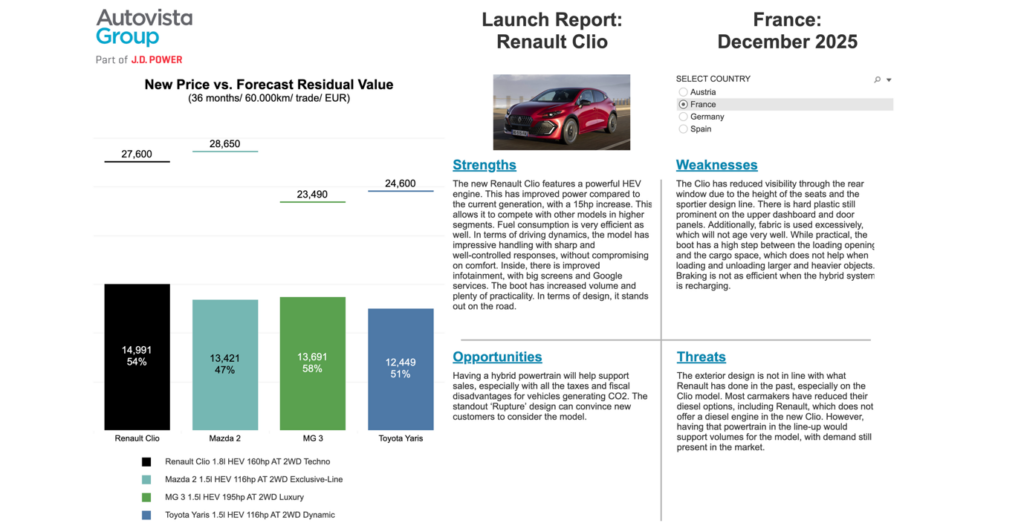
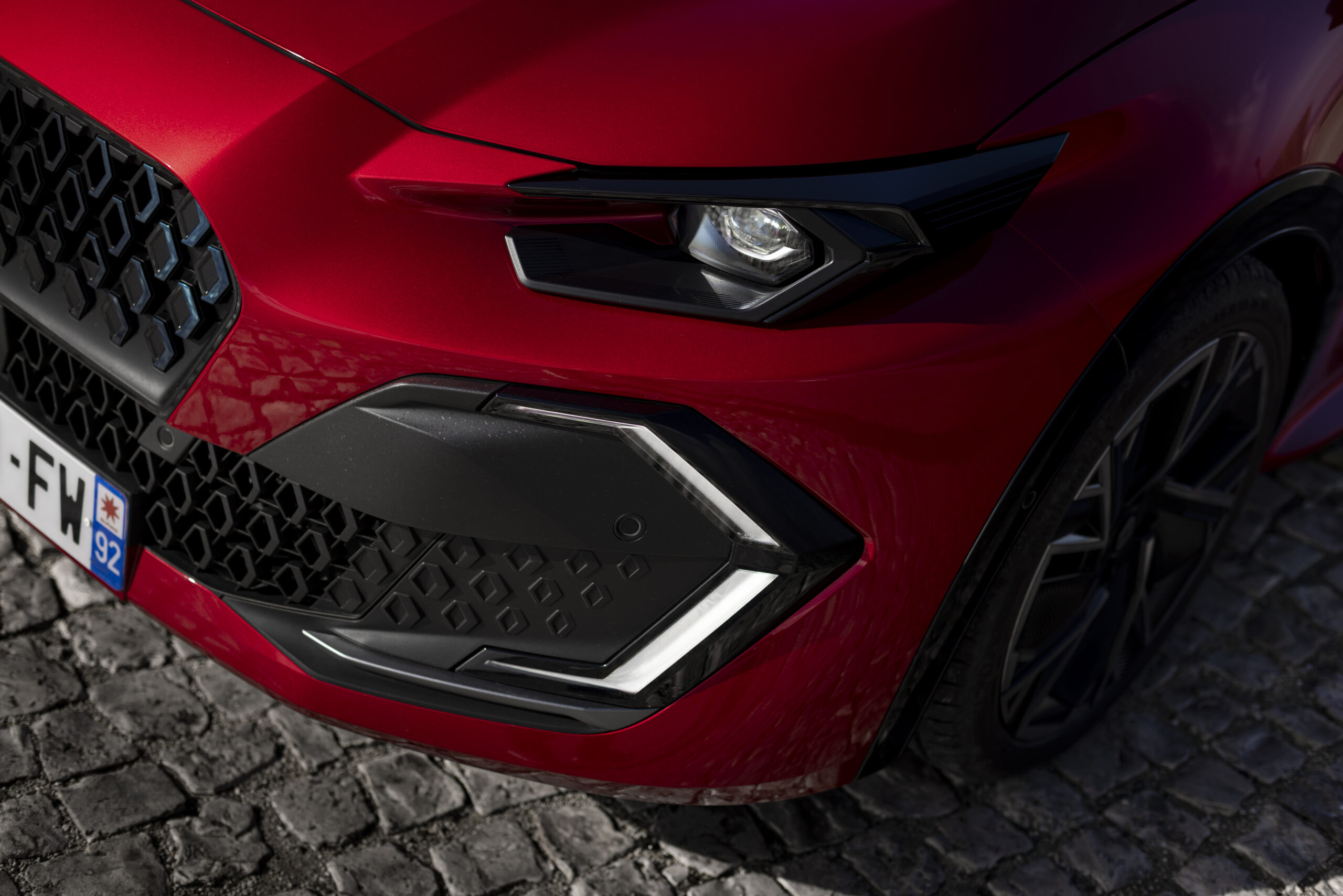
The new Renault Clio is not just fighting the competition for buyers, but also other models in the carmaker’s portfolio. Does it have what it takes to enhance the reputation of the Clio name? Autovista24 special content editor, Phil Curry, reviews the model alongside regional experts.

The Renault Clio has been a mainstay of the automotive market for decades. It has built a reputation as a fun and reliable hatchback, which has stood the test of time while others have faded from view.

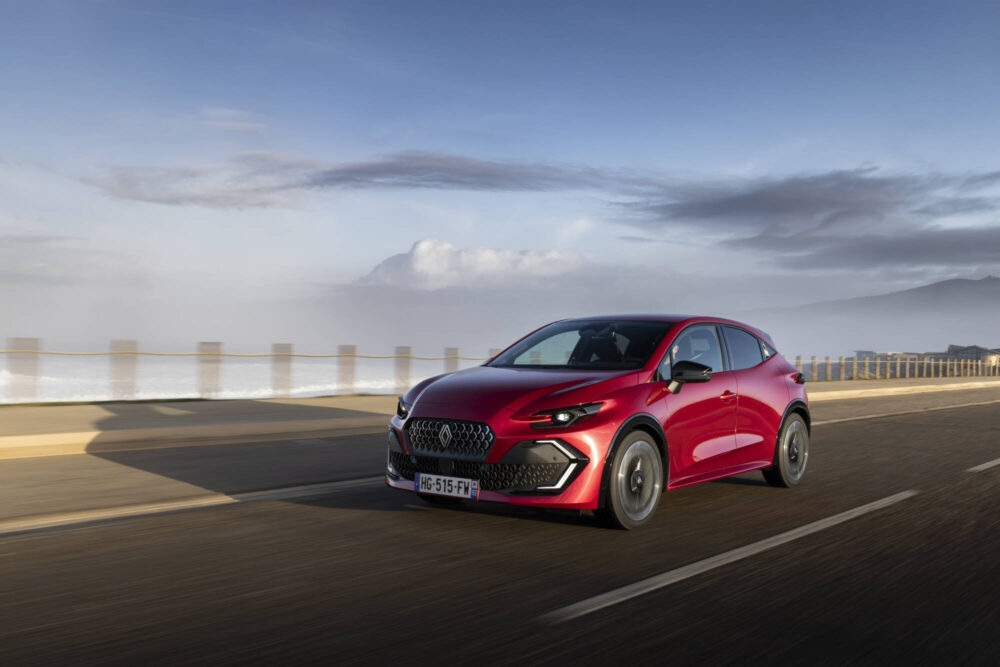
With the European small-car market growing once again, Renault recently unveiled its sixth-generation Clio. The new model offers more than just a facelift,  complete with a refreshed design philosophy,  and backed up by a new powertrain lineup.

However, with competition coming from the all-electric Renault 5 and Renault 4, can the Clio utilise its previous success to draw in buyers?

Autovista24’s latest Launch Report benchmarks the Renault Clio against its key competitors in Austria, France, Germany and Spain. Regional experts also provide a breakdown of the car’s strengths, weaknesses, opportunities and threats.

Renault Clio goes bold

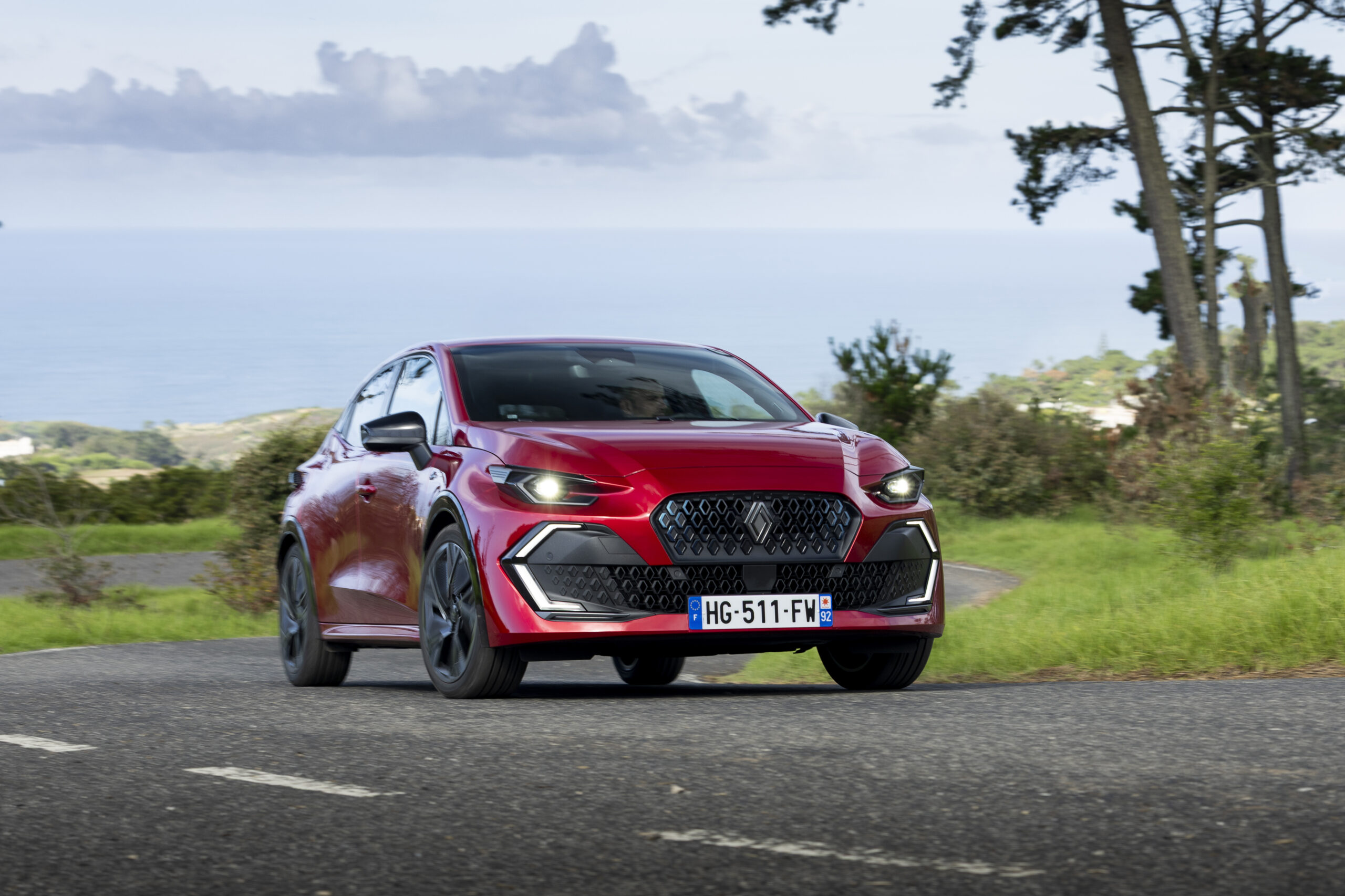
Renault is not playing it safe with its sixth-generation of the Clio. This new model possesses a whole new exterior design, with a bold look that differs from the ‘retro’ philosophy of the Renault 5 and Renault 4.

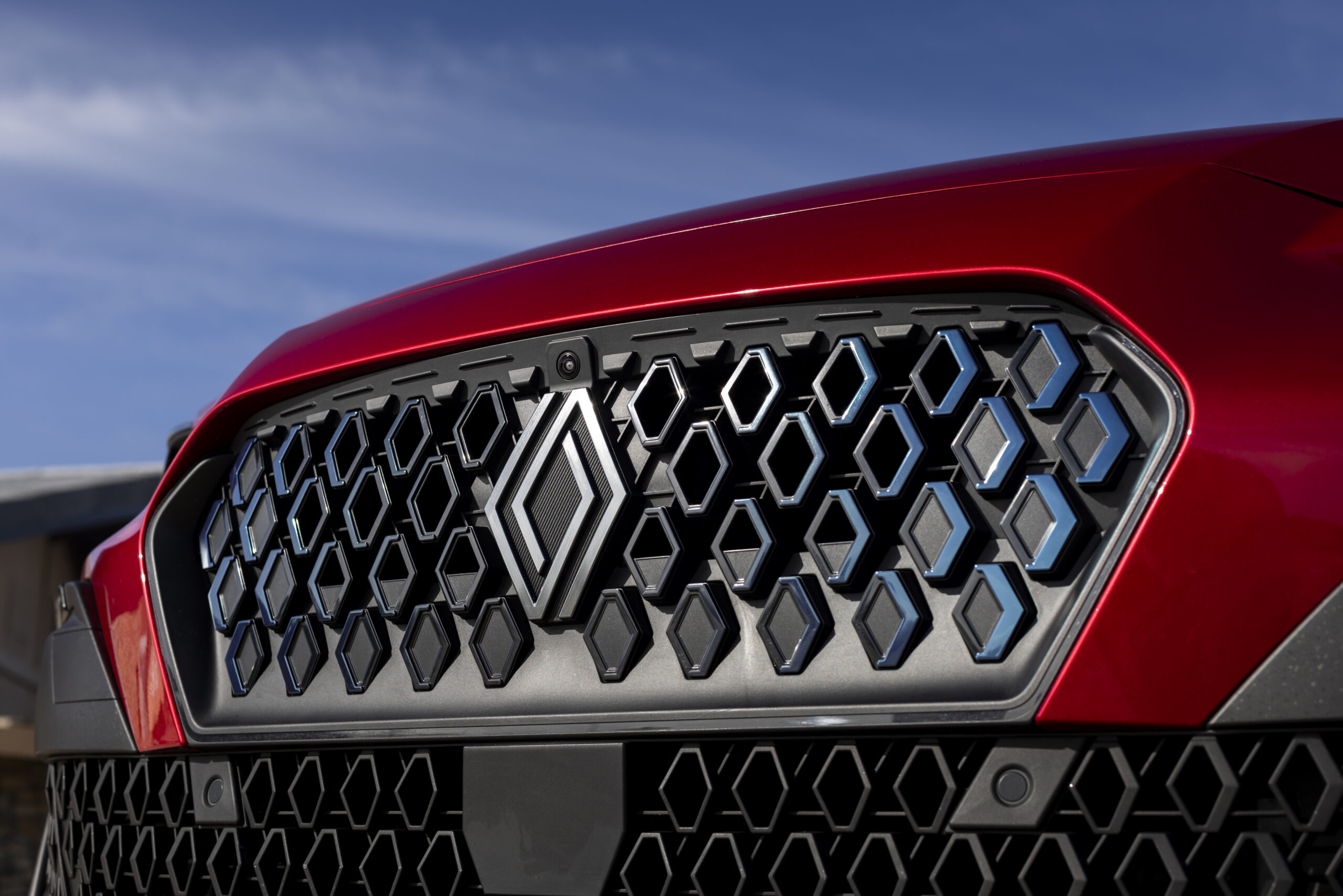
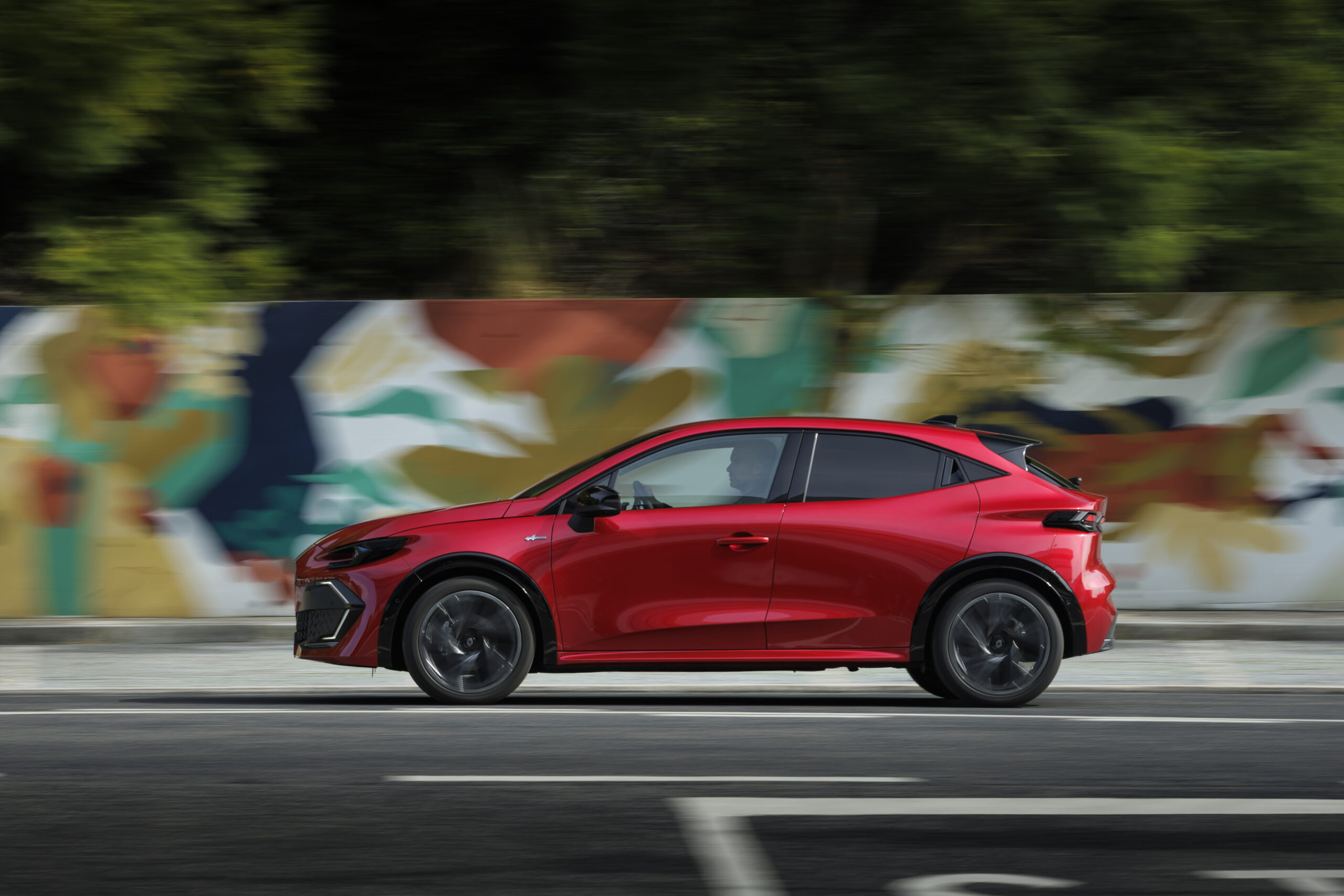
Instead, the Clio features a drooping front end, with a pronounced central bonnet section flowing down into the front grill. The narrow headlights are subtly blended within the design, while the big, angular running lights provide a strong visual impact.

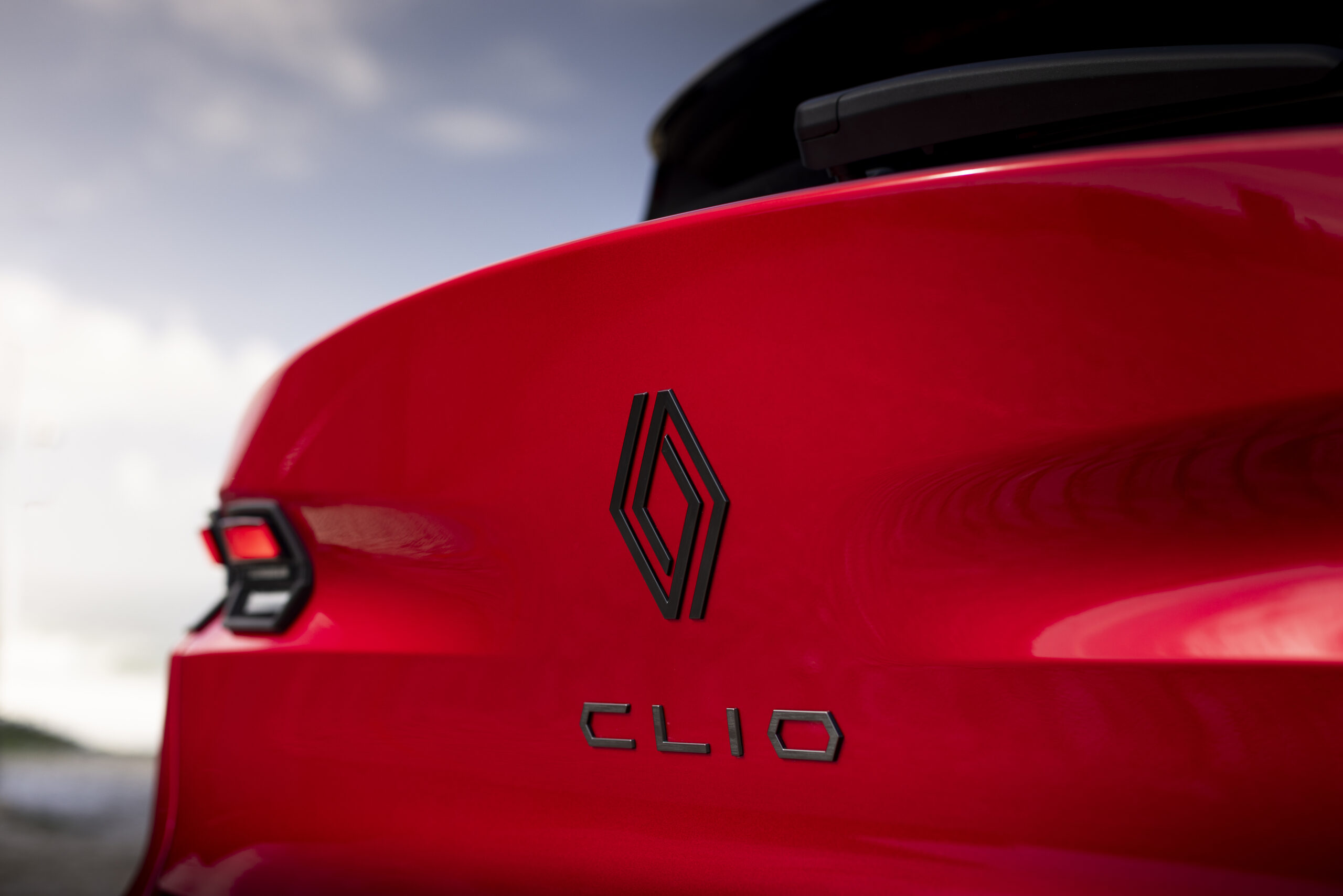
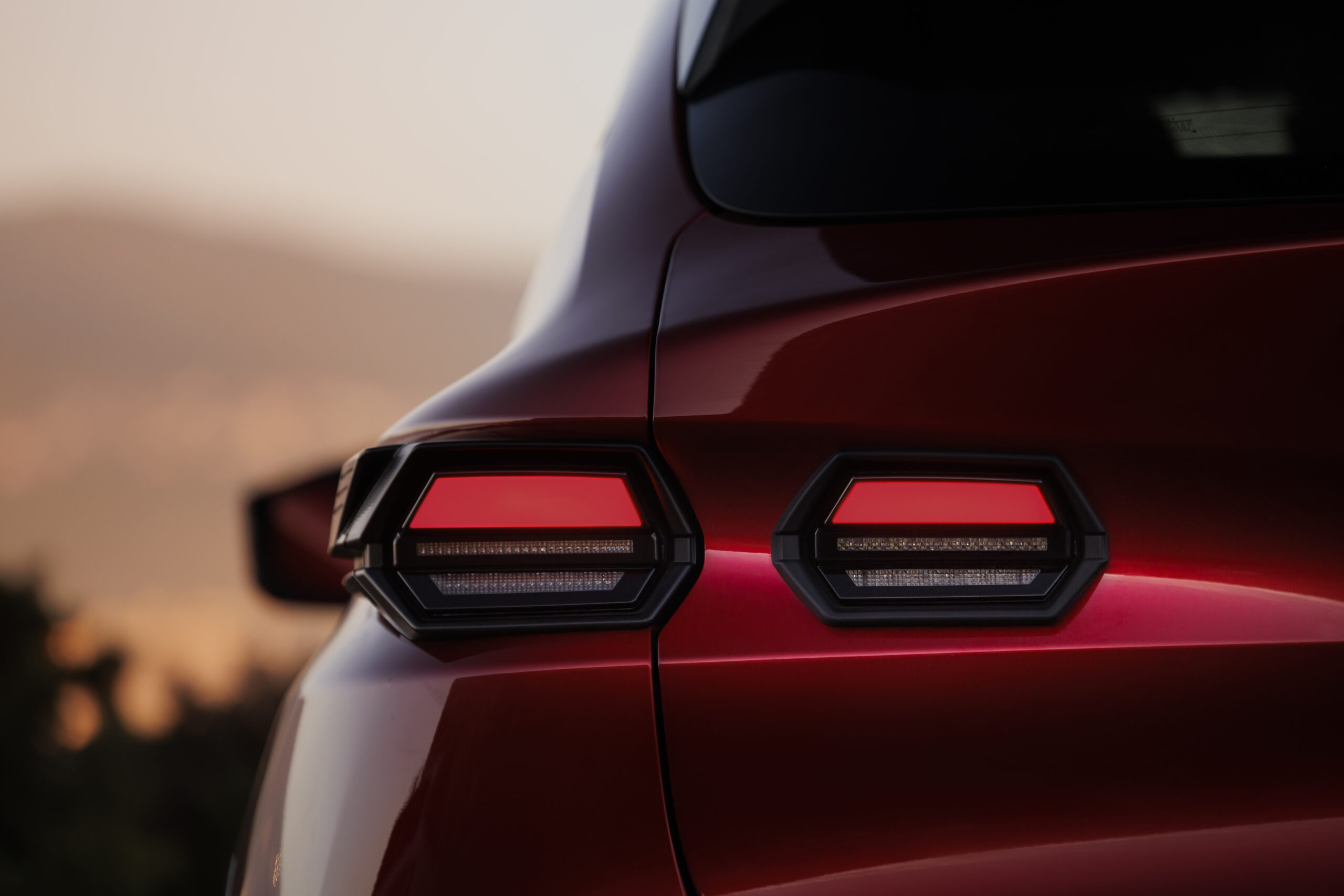
The rest of the car is more conservative, a sloping roofline flows into a lipped rear end, while the split light profile sits in a recess that comes out to highlight the Renault badge. Overall, the design is sporty and modern, but perhaps not as clean as its predecessors, or plug-in stablemates.

Familiar feel

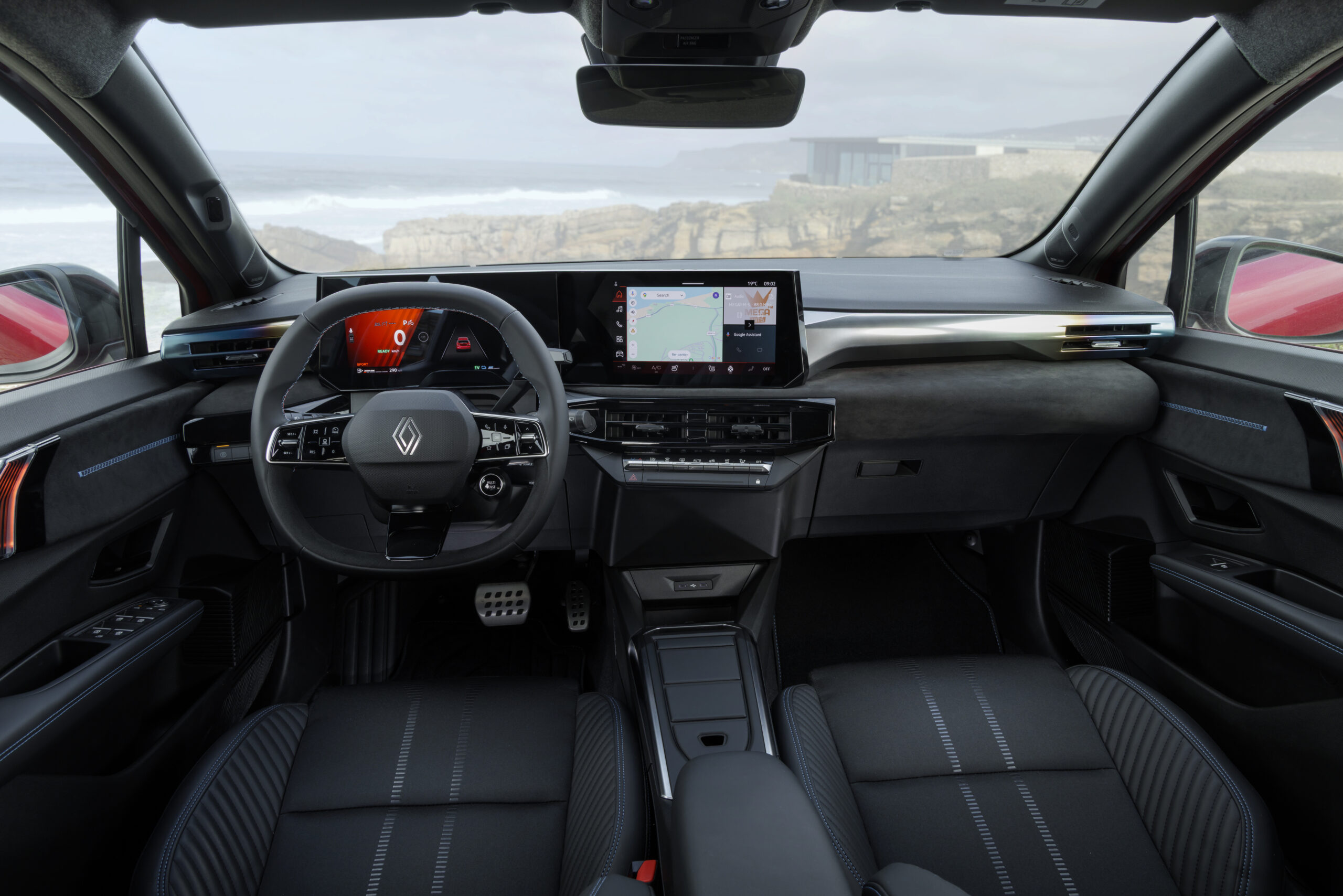
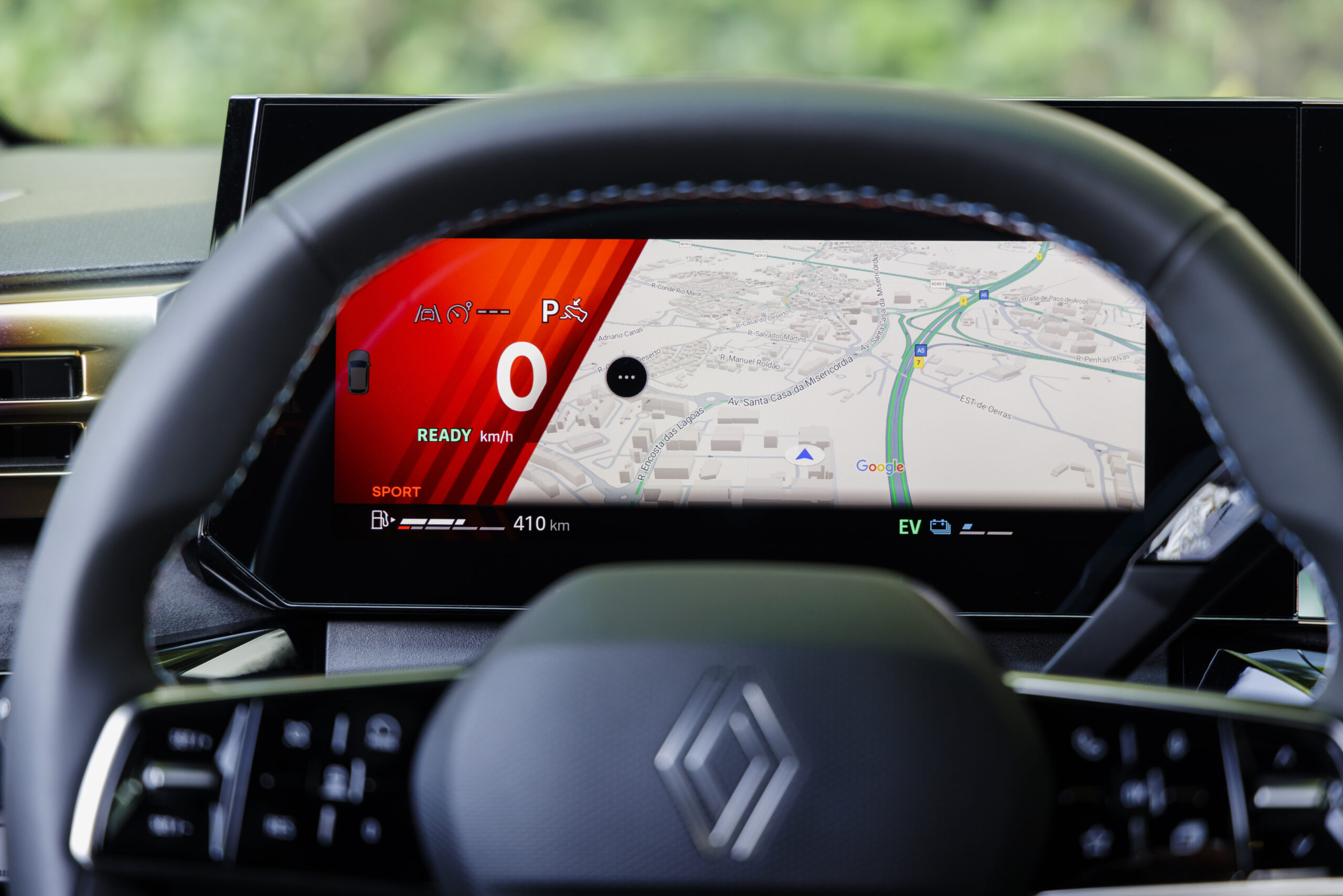
Inside, however, the carmaker has kept things in the family. The new Clio features the same dual-screen and a similar two-level dashboard layout as the Renault 5. The pair of 10-inch screens sit in a V shape, with one displaying driver information, and the other for the infotainment system.

This system features Google integration, with Google Maps built in, and Google Assistant. It will also integrate Gemini AI via an update, which will provide many more capabilities.

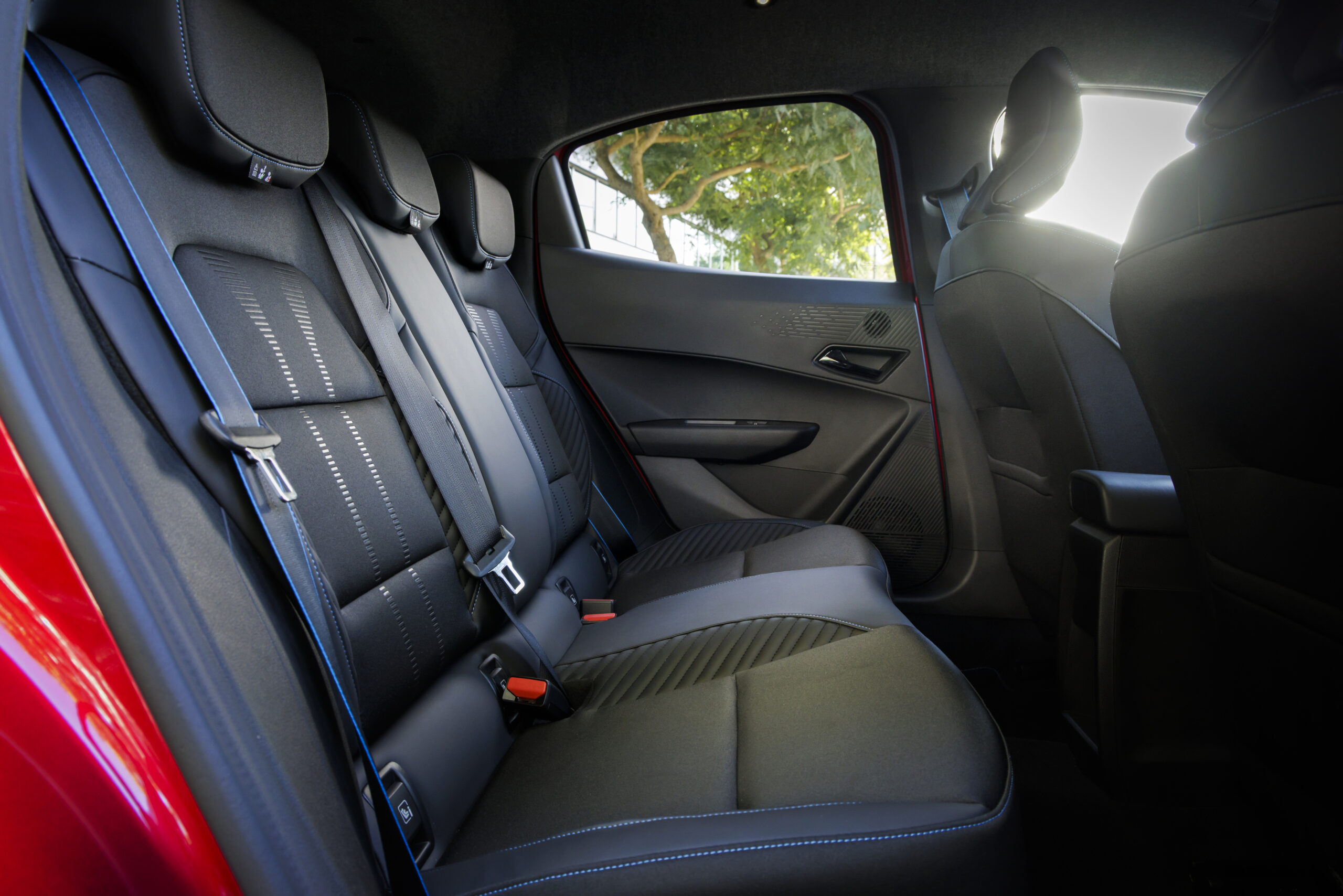
For front occupants, the longer dimensions of the new Clio provide ample room. However, with no addition made to the width of the car, it can still feel cramped. This is especially noticeable for rear-seat passengers, with no dividing central tunnel to buffer against. Rear headroom is also limited, although this is to be expected in a small hatchback.

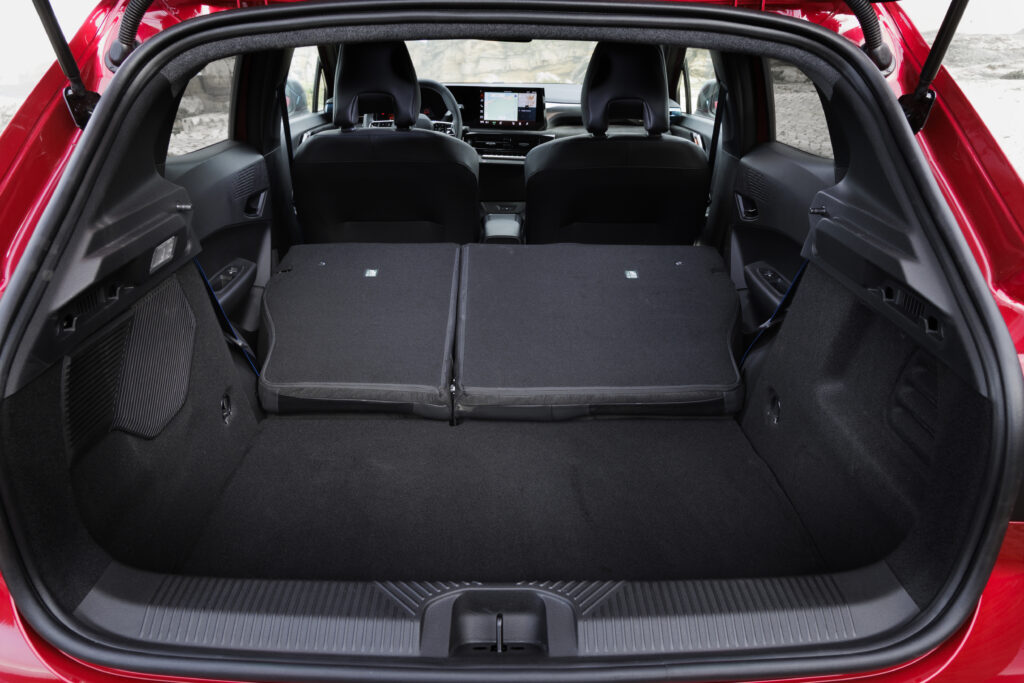
There are plenty of storage options in the centre console and door pockets, which make the new Renault Clio very practical. This is also backed up by the boot space. The petrol version gets 391-litres of capacity, while the  full-hybrid (HEV) model gets 309, due to the space needed for the battery.

However, the boot does not feature a flat floor. The loading bay lip could, therefore, make it difficult when loading large or heavy items.

Differentiation for the Renault Clio

Some may question the relevance of the Clio, especially as the Renault 5, is proving popular in the same segment. However, the carmaker has chosen to diversify its powertrain portfolio between the two cars, a move that could pay dividends for both.

The new Clio is offered with either a 1.2-litre petrol, or a 1.8-litre HEV powertrain. There is no battery-electric version, meaning the Renault 5 maintains its position for electric-vehicle buyers, while the Clio offers an internal-combustion engine (ICE) alternative.

With UK sales expected to start in 2027, this choice is a reason for the new model’s delay into that market. The EU ban on new petrol, diesel and hybrid models was due to begin in 2035, although this has now shifted to 2040. However, the UK is starting its internal-combustion engine phase out in 2030. The carmaker is waiting to see how the political landscape around the motoring market in the UK changes, leading to the delay.

On the road

While the petrol-only version produces around 114hp, the HEV model features 158hp, up by 15hp on the current Renault E-Tech HEV powertrain. This gives a 0.62mph time of 8.3 seconds, and provides smooth power delivery, with smooth automatic gear chances from the four-speed box.

The Renault Clio offers a comfortable ride. Power delivery in the HEV model is adequate, if a little sedentary. The model features an intuitive B-mode that increases the regenerative energy from braking back into the battery. While not providing the ‘one-pedal’ feel of battery-electric vehicles, it does add to the braking, while increasing electrical assistance.

There is also a ‘Smart’ drive mode, which can automatically change from Eco, Comfort or Sport depending on how the vehicle is being driven, improving efficiency without input from the driver.

Overall, the new Renault Clio offers something different from its stablemates. While the Renault 5 has attracted attention with its retro characteristics and funky design, the Clio provides a nameplate that can be relied upon. By setting it out to cover the petrol and HEV markets, the carmaker is spreading its powertrain potential. The familiar Clio name will have to ensure it can hold the demand for ICE-based models in the B-segment.

View the interactive dashboard, which benchmarks the Renault Clio in Austria, France, Germany and Spain. The interactive dashboard presents new prices, forecast residual values, and SWOT (strengths, weaknesses, opportunities, and threats) analysis.

What were the major takeaways from the European Commission’s automotive package? How has the industry reacted to further vehicle emissions flexibility in the EU? Plus, are global electric vehicle (EV) sales increasing, or has momentum slowed? Autovista24 journalist Tom Hooker presents The Automotive Update podcast.

This latest episode dives into the key announcements from the European Commission’s new automotive package. Autovista24 explores how the various proposals, including more emissions leniency, could transform the future of car sales in the EU. 

Subscribe to the Autovista24 podcast and listen to previous episodes on SpotifyApple and Amazon Music.

Changes to EU ICE ban confirmed

The European Commission has presented an automotive package that could significantly alter the EU’s approach to vehicle emissions. Central to this, the package will allow new internal combustion engine (ICE) vehicles to be sold after 2035.

This confirms a distinct departure from the previous framework. The former legislation required all new cars and light commercial vehicles (LCVs) sold in the EU from that year to have zero tailpipe CO₂ emissions.

Instead, the proposal aims to provide greater flexibility in how manufacturers achieve emissions reductions amid longer-term climate objectives. The new package allows for new petrol and diesel models to be sold after 2035. The legislation also allows for new mild hybrids, full hybrids, plug-in hybrids (PHEVs), and extended-range electric vehicles, can be sold after that date.

Under the new framework, carmakers must reduce tailpipe CO₂ emissions by 90% compared with 2021 levels from 2035 onwards. Remaining emissions could be offset through the adoption of low carbon steel produced within the EU, as well as the incorporation of e-fuels and biofuels.

The package also proposes adjustments to interim emissions targets via a ‘banking and borrowing’ mechanism between 2030 and 2032. This would give manufacturers additional flexibility to meet the 2030 target of a 55% CO₂ reduction.

Rapid technology transformation

Additional measures include revised vehicle labelling requirements, plus expanding CO₂ and amended energy performance information. Mandatory zero and low-emission vehicle targets for corporate fleets would be set at a national level.

To support affordability and competitiveness, the package also introduced incentives aimed at smaller electric cars. There were also announcements for funding to strengthen the European battery chain. This includes significant support for battery-cell production.

‘Innovation. Clean mobility. Competitiveness. This year, these were top priorities in our intense dialogues with automotive sector, civil society organisations and stakeholders,’ said European Commission President von der Leyen.

‘Today, we are addressing them all together. As technology rapidly transforms mobility and geopolitics reshapes global competition, Europe remains at the forefront of the global clean transition,’ she outlined.

EV adoption upswing in Europe and beyond

Deliveries of EVs in Europe, including battery-electric vehicles (BEVs) and PHEVs, have grown by 27.8% across the first 10 months of 2025. In all, just over three million units were sold in the region.

BEVs recorded a smaller cumulative growth of 25.7%, with a higher overall delivery volume. Between January and October, the powertrain saw over two million vehicles take to Europe’s roads.

PHEVs have witnessed a greater year-on-year sales increase of 32.1% from January to October. This, however, is based on a smaller figure. Just over one million PHEV units were delivered.   

Globally, the EV market grew by 28.8% year on year, across the first 10 months of 2025. This was driven by BEVs, which captured a 64.3% share of total plug-in sales. Conversely, PHEVs, saw slower growth. Hampered by China’s relatively receding market, the powertrain made up just over a third of all EV sales globally between January and October. 

In China itself, PHEV growth reached 18.7%, over the first 10 months of 2025. Hampered by slow growth since July, this is, significantly down from its 84.1% improvement in the same period of 2024. However, the Chinese market saw overall EV sales increase by 29.1% from January to October, with BEVs driving this growth. 

The Wuling Mini led the global battery-electric vehicle (BEV) market in October 2025. Does this mean there is a new contender for the throne this year? Autovista24 editor Tom Geggus analyses the latest data from EV Volumes.

Globally, sales of new BEVs reached 1,371,557 units in October 2025, equating to year-on-year growth of 28.8%. Throughout the first 10 months of the year, the growth was even more pronounced, up by 32.7%. This meant 11,124,595 new all-electric cars took to roads across the world.

Plug-in hybrid (PHEV) deliveries increased by 22.4% across the same time period, with 6,185,446 units moved across the world. In October, it only recorded growth of 7.8% with 752,358 sales recorded.

China’s slowing PHEV market

Much of this year’s downturn has fed through from China. The country accounted for 71.8% of all PHEV sales between January and October. In the first 10 months of 2024, the country saw deliveries of the technology grow by 84.1% year on year. Across the same period this year, this growth rate was down to 18.7%.

So far, 2025 has seen a more stable performance from BEVs. After a comparatively slower January, year-on-year growth accelerated in February to 56.9%, before hitting 25.2% in May and stabilising.

While most of the world’s all-electric cars were sold in China, it was a lower percentage than PHEVs at 59.5%. However, this might have been to the powertrain’s detriment, as the country saw BEV sales increase by 37.2% year-on-year. This was an improvement from the 15.3% growth recorded at the same time last year.

The country’s accelerating all-electric car market was also reflected in the best-selling models’ table. Eight of the top 10 BEVs came from Chinese brands in the first 10 months of 2025. In October, a model from the country even managed to take first place.

Wuling Mini takes first

In October, the Wuling Mini was able to dethrone the long-standing market leader, the Tesla Model Y. It saw sales increase by 78.8%, with 61,139 units hitting the roads. This meant it made up 4.5% of all new BEV sales in the month, 1.3 percentage points (pp) from October 2024.

Meanwhile, the Tesla Model Y saw its sales slip by 3.9pp to 4.1%, putting it in second place. Its fortunes were reversed compared to the Wuling Mini, with sales down by 34.7% year on year to 55,920 units.

The Geely Geome Xingyuan, also known as the EX2 in some markets, finished third in October. Its sales soared by 192.7% to 44,289 units. This meant its market share grew by 1.8pp to 3.2%.

Not far behind was the BYD Seagull, also known as the Dolphin Surf. While it also accounted for 3.2% of the global BEV market, this was down 2pp as its sales dropped by 20.6% to 43,575 units.

New entrants enjoy success

With its first sales recorded in June this year, the Xiaomi YU7 has performed very well. It came fifth in the global ranking, taking a 2.5% market share. Entering the market at roughly the same time, the BYD Sea Lion 06 finished sixth. It managed 24,800 deliveries and a 1.8% share.

The Wuling Bingo Plus came seventh as its deliveries surged forward by 381.8% to 24,462 units. This meant it represented 1.8% of all BEV sales, up from 0.5% at the same point 12 months ago.

The Tesla Model 3 slipped back down the table as the brand’s quarterly reporting pattern strained results. This trend could not be blamed entirely. Compared with October 2024, it still saw sales fall by 15.1% to 23,220 units. The sedan represented 1.7% of global BEV sales, down from its 2.6% share from 12 months ago.

The BYD Yuan Up, also known as the Atto 2, came ninth, with 23,040 sales, up by 12.3%. However, with increasing market competition, the model saw its market share fall by 0.2pp to 1.7%. The BYD Dolphin came 10th, as its deliveries slipped by 3.8% to 21,319 units. It represented 1.6% of all BEV sales, down 0.5pp.

Wuling Mini looks to podium

While other models have been gaining ground, the Tesla Model Y continued to rule over the BEV leader board. Between January and October, the crossover recorded a 7.8% share with 862,645 sales.

Its sibling, the Tesla Model 3, held less than half the market share and sales in second. It saw 392,799 deliveries in the first 10 months of 2025, taking a 3.5% share. The Geely Geome Xingyuan held steady, as it also made up 3.5% of global BEV volumes. It was less than 5,000 units behind, after recording 387,803 sales.

With its record October, the Wuling Mini moved up a place, gaining ground on the top three. It posted 348,221 sales between January and October, taking a 3.1% share. With 336,153 deliveries, the BYD Seagull was not far behind, representing 3% of all BEVs sold.

The Xiaomi SU7 held sixth with a 2.1% share and 234,914 sales. The BYD Yuan Plus, also known as the Atto 3, was next. It captured 1.8% of the market thanks to 198,252 deliveries. Its sibling, the BYD Yuan Up, was less than a thousand units behind with 197,363 sales and a 1.8% share.

With a 1.7% share, the BYD Dolphin managed 184,066 sales in the first 10 months of 2025. The Xpeng M03 took 10th, as it moved 148,236 units for a 1.3% share.

BYD’s new brand

BYD took five spots in the top 10 best-selling PHEVs list in October. The BYD Qin Plus saw sales increase by 30.1% to 36,037 units, giving it a market 4.8% share, up 0.8pp. The BYD Song Plus, also known as the Seal U, came second. However, its deliveries fell by 27.9% to 31,885 units. This meant its market share slumped by 2.1pp to 4.2%.

The BYD Seal 6 finished third after also seeing a decline in sales. With 20,909 units making their way to customers, the model hit a market share of 2.8%, down from 5.6% 12 months ago. BYD’s sub-brand, Fang Cheng Bao, saw its Tai 7 model reach fourth after first recording deliveries in August. It represented 2.7% of the global PHEV market.

Meanwhile, the BYD Song Pro saw a sales decline of 45.4% to 19,396 units. This meant it claimed a 2.6% share, down 2.5pp. The Aito M7 was next as its sales grew by 20.3% to 18,200 units. Its grip on the market strengthened by 0.2pp to 2.4%. Its sibling, the Aito M8, was next with a 2.3% share. The model first recorded deliveries in April this year and reached 17,484 units in October.

The Galaxy A7 was next with a 2.1% market share. It first hit the market in June, reaching a new best in October with 15,888 sales and a 2.1% share. The BYD Qin L also hit a 2.1% share, although this was down by 3.5pp. The model saw sales drop by 60.4% to 15,586 units. With sales first recorded in June, the Chery Fengyun A9 came 10th with a 1.8% share and 13,378 deliveries.

Seven places for BYD

Between January and October, BYD claimed seven of the top 10 best-selling PHEV positions. The BYD Song Plus remained in first place with a 4.8% share of the market and 294,401 sales.

The BYD Qin Plus was next with a 3.7% share and 228,515 deliveries. Then came the BYD Song Pro in third with 194,645 sales, claiming 3.1% of the PHEV market. The Seal 6 was next with a 3% share and 188,479 sales. The BYD Qin L came fifth with 148,380 deliveries and a 2.4% share.

The Li Auto L6 was not far behind, representing 2.3% of all PHEV sales with 144,882 deliveries. Then BYD returned in seventh with the Destroyer 05, also known as the Seal 05. It captured 2.1% of the market with 131,005 sales.

The BYD Song L was next with a 2% share and 122,530 units hitting the roads. The Aito M8 was in hot pursuit with 121,811 sales, holding 2% of the market. The Galaxy Starship 7, also known as the Starray, came 10th with a 1.8% share and 110,698 deliveries.

Every year, dozens of new cars are launched across Europe. Each bring their own benefits to buyers and the wider automotive market. Autovista24 analyses many of these vehicles in the monthly Launch Report series. Special content editor Phil Curry explains the valuable insights on offer.

Carmakers are constantly developing vehicles for the automotive market. This results in either brand-new nameplates or next-generation versions of existing models.

These new cars each aim to offer drivers something different in an increasingly crowded market. This could be through their design, interior options, technological advances or driving characteristics.

While many vehicle reviews will focus on these traits, the Autovista24 Launch Report offers something unique. These monthly vehicle overviews combine a standard review of the car alongside detailed expert analysis and residual value (RV) forecasts.

These combined insights elevate the Launch Report to a key piece of information for automotive industry decision makers.

Launch Report breakdown

Each Launch Report features an interactive dashboard that provides analysis and RV comparisons against three competitors. This information is compiled by experts from key European markets, including Austria, France, Germany, Italy, Spain and the UK.

The Dashboard features an overview of a vehicle’s strengths, weaknesses, opportunities and threats. These areas of examination provide a balanced analysis.

The strengths segment will look at the best elements of a car, while the weaknesses will point out areas that could be improved. The opportunities section looks at the potential of the model in the automotive market. For threats, the experts look at possible competition, and market conditions that could impede success.

Examining residual values

Autovista Group experts will also benchmark RV performance against three direct market competitors. These forecast values are determined after 36 months, and market-specific mileages.

The study shows the recommended retail price for the model and trim level in question. It also provides the expected value after the time and mileage conditions. This is presented together with the RV, expressed as a percentage of the retained original price.

This allows buyers to understand the vehicle’s potential future value. They can then factor this into their purchase decision. This is especially important for fleet buyers, who can understand the financial potential of new models, especially around the average de-fleeting period.

This RV information is provided by each market participating in the Launch Report feature. The data is specific to that country, allowing for a more precise and region-specific understanding of vehicle performance.

Providing the review

Alongside the interactive dashboard, each Launch Report also includes a detailed review of the model itself. This summarises the comments and thoughts of Autovista Group editors, along with Autovista24’s research and experience.

The review provides an analysis of the vehicle and adds more context for the dashboard analysis. They are written by experienced motoring journalists and provide a balanced view of each model.

This includes more information on design, practicality and driving characteristics. Overall, the Launch Report provides buyers with the complete picture of a vehicle.

Alongside the written article, Autovista24 also produces a number of Launch Report videos. These give a visual overview and a detailed look at new models. Alongside this, there is also a breakdown of forecast residual values in select European markets.

China saw another month of low plug-in hybrid (PHEV) improvement, as new models made gains on established players. Moreover, with battery-electric vehicle (BEV) deliveries rising, is the country’s electric vehicle (EV) market becoming more diverse? Autovista24 special content editor Phil Curry investigates.

China’s tale of two markets continued in October. BEV deliveries jumped while the PHEV slowdown continued. The month saw 928,863 BEV sales, up 36.6% compared to October 2024, according to the latest figures from EV Volumes.

Meanwhile, the 577,940 PHEV volume reflected just a 4.2% increase. EV Volumes does include extended-range electric vehicles in its plug-in hybrid figures. The result means that in October, BEVs made up 61.6% of the total EV market, while PHEVs accounted for 38.4%.

Across the first half of 2025, PHEVs enjoyed a double-digit improvement. But since July, the powertrain has struggled to exceed mid-single-digit figures.

Across the first 10 months of 2025, 6,620,049 BEVs were sold in China, a 37.2% improvement year on year. However, despite increases, the PHEV market’s growth slowed. The 4,443,977-unit total between January and October was up by 18.7%, but dropped from a much greater cumulative improvement earlier in the year.

Wuling dominates BEV sales

The Wuling Mini dominated the Chinese BEV market in October. In a rollercoaster year for the model, it took control of the market with 61,119 sales. This was a 78.8% year-on-year improvement, as the model pushed for top spot in the cumulative table. It took a 6.6% market share in the month, up 1.6 percentage points (pp).

The Wuling Mini was 16,880 units ahead of its closest rival, the Geely Geome Xingyuan. The Geely model saw 44,239 sales, a 192.4% increase against its first meaningful month on the Chinese market in 2024. This was enough for a 4.8% market share, up 2.6pp compared to 12 months prior.

Third went to the BYD Seagull, with 36,604 sales in October. Despite the high placing, this was a drop of 28.6% from October 2024, when it led the monthly standings. The model was a consistent mid-table performer across the first 10 months of the year. Yet, its 3.9% market share in October was 3.6pp down year on year.

In just its fifth month on the market, the Xiaomi YU7 took fourth. This was thanks to a record total of 33,662 sales, as the model continues to ramp up deliveries. It accounted for 3.6% of all BEV sales in China in October.

It was followed by the BYD Seal Lion 06, with 24,800 units. This was the model’s first placement in China’s top 10 BEV list. Since hitting the market halfway through this year, it took a 2.7% hold of the market in the month.

Tesla struggles in China

Also making its way into the top 10 for the first time was the Wuling Bingo Plus. Despite seeing its sales begin in March 2024, the model passed the five-digit volume mark for the first time. With 24,448 units, this represented a 382% year-on-year increase and a 2.6% market share.  

The BYD Yuan Up took seventh, with 19,813 units representing a 2% decline year on year. Its 2.1% market share was 0.9pp down compared to October 2024. The Tesla Model Y dropped to eighth in October, its worst volume month since February. The result followed its quarterly delivery boost in September.

While it performed well in July, its April and October figures suggest a similar trend as seen in Europe. Severe sales drops have followed high periods. It saw 19,488 sales in October and a 46.2% decline compared to the same month last year. This left it with 2.1% of the market, a 3.2pp drop.

Ninth went to the Changan Lumin, with 18,755 units equating to a 10.1% increase. However, its 2% market share was 0.5pp down year on year. Rounding out the table was the Deepal S05, with 18,169 units, and a 1,414.1% increase year on year. However, its deliveries were still ramping up 12 months ago.

Race to the end

After 10 months of 2025, the Geely Geome Xingyuan remained in the lead of the Chinese BEV market. With 387,753 units, it looks set to end the year as the best-selling all-electric model in the country. However, this is not without a challenge.

Jumping into second place, after two months of monthly market-leading performances, was the Wuling Mini. With 348,111 units, it held 5.3% of the market. The Mini was only 39,642 units behind the Geely. The gap may seem large, but a slow month from its rival could provide a small chance of victory.

The Tesla Model Y dropped to third after its poor October performance. In the first 10 months of 2025, it recorded 312,331 sales. It ended the period with a 4.7% market share and a 35,780-unit gap to the Wuling Mini. With its quarterly reporting pattern, the carmaker could still jump into second with a strong December.

New models push forward

The following three models remained stable from September. The BYD Seagull was fourth with 282,740 units, followed by the Xiaomi SU7 in fifth, with 234,521 deliveries. Sixth went to the BYD Yuan Up, with 178,420 units and a 2.7% market share.

Seventh saw a change, with the Xpeng M03 moving up the table thanks to 148,236 units. It overtook the Tesla Model 3, which dropped to eighth, having not featured in October’s top 10. Between January and October, it achieved 146,379 sales, with a 2.2% share of the overall BEV total.

Ninth went to the Changan Lumin thanks to a strong result in October. With 142,163 sales, it took 2.1% of the market. Rounding out the table was the Geely Panda Mini, with 140,434 deliveries in the 10-month period. 

New entrant features in PHEV market

The BYD Qin Plus once again topped the monthly PHEV chart, with 35,096 units delivered in October. This was a 29.5% increase year on year. The Qin Plus was the first of five BYD models in China’s PHEV top 10 for the month. However, it was the only one to achieve growth.

Despite sales dropping 50.1% year on year, the BYD Song Plus took second, with 20,613 units sold. This translated to a 3.6% share of the total PHEV market, a drop of 3.9pp.

In third was the Fang Cheng Bao Tai 7, with 20,024 sales. This was just 589 units behind the popular BYD Song Plus. Considering the PHEV began large-volume deliveries in the previous month, this was an impressive performance. The boxy SUV is making its mark in China’s slowing PHEV market, and took 3.5% of total deliveries in the month.

Taking fourth was the BYD Seal 6, with 19,355 units. However, this was a big drop for a model, with volumes down 49.2% year on year. It captured 3.3% of overall PHEV sales, down 3.6pp.

BYD struggles continue

A pair of Aito models came next, with the M7 taking 18,199 sales, a 20.3% rise compared to October 2024. With 3.1% of the market, its share increased by 0.4pp. Following this was the Aito M8, with 17,484 deliveries in its seventh month on the Chinese market. This was enough for a 3% market share.

The Galaxy A7, in its fifth month on sale, achieved 15,888 deliveries with a 2.7% hold of total volumes in seventh. Another pair of BYD models followed in eighth and ninth, with the BYD Song Pro and BYD Qin L, respectively. Both saw large sales declines compared to October 2024.

The Song Pro achieved 15,758 deliveries, a 50.4% fall, with a 3pp drop in market share to 2.7%. The Qin L fell further, down 60.4% to 15,586 units. This was also a 2.7% hold of the total PHEV market, down from 7.1% a year prior.

Closing out the table was the Chery Fengyun A9, in its fifth month on the market. It achieved 13,378 sales and a 2.3% market share.

Clear at the PHEV summit

The cumulative PHEV top 10 remained fairly static. Despite its struggles, BYD filled the top five places and seven of the top 10 positions.

The BYD Qin Plus kept hold of the top spot, with 218,509 units and a 4.9% market share. As the only BYD model in October’s chart to make year-on-year gains, its momentum could carry it forward.

The BYD Seal 06 held second with 175,577 sales between January and October. This gave it a 4% share of total PHEV volumes. The model was 42,932 units behind the Qin Plus, a gap that continues to widen.

Next was the Song Plus, with 170,377 deliveries in the first 10 months of the year. It closed the gap to second in October, with just 5,200 units between it and the Seal 6.

The BYD Song Pro was next, with 154,001 sales and a 3.5% market share. Following this was the BYD Qin L, which jumped a position to fifth with 148,380 deliveries cumulatively. This was good enough for a 3.3% market share.

Good results help strugglers

Having only placed 18th in October’s sales figures, the Li Auto L6 lost ground to the BYD Qin L, dropping to sixth after 10 months of the year. Its 144,406 total for the period equated to a 3.2% market share.

The BYD Song L, which ended October in 11th, followed the L6 in the cumulative table. A total of 122,029 units was good enough for seventh, with a 2.7% market share. Both the L6 and the Song L are holding on thanks to good performances earlier in 2025.

However, the Aito M8 continued its rapid approach. Despite having only become available this year, it held eighth with 121,811 units. This was just 218 deliveries behind the BYD model, while it matched its 2.7% market share.

The BYD Destroyer 05 was ninth, with 111,617 sales between January and October. The model placed 23rd in the monthly sales figures. Rounding out the cumulative table was the Galaxy Starship 7. Its 110,115-unit tally gave it a 2.5% market share.

What has defined 2025 for carmakers? Will these trends continue into 2026? Enterprise sales director Thomas Luxenburger considers the upsides and downsides with Autovista24 editor Tom Geggus.

What do you think the big trends have been for OEMs in 2025?

We need to distinguish between the established OEMs and the newer players, including those trying to strengthen their position. Established carmakers are struggling with declining margins as they lose market share, particularly in former emerging markets.

In China, there is fierce competition between importers and domestic brands, which means lots of pressure on margins. Established brands have been losing local market share, resulting in smaller margins.

This means these companies have less money to invest back into development. The timing could not be worse, as these brands need to put money into the electric vehicle (EV) transition.

Carmakers are also at the forefront of more protectionist politics and policies, such as tariffs. There has also been increased supply chain tension this year, impacting chips and rare earth metals.

To remain competitive, companies are looking to balance the books elsewhere. This can include experimenting with direct sales models or monetising software and services. They have also looked to cut staffing and production costs, with manufacturing moved to more affordable locations.

Carmaker competition

So, new-car markets have seen increased competition this year. How has this impacted pricing, operational strategies and future products?

In terms of development, established players have historically needed up to seven years to bring a new model to market. Meanwhile, new players can develop their cars much faster. Software-defined vehicles take far less time to launch and often cost less. This is pushing established OEMs to accelerate their development process and bring more affordable vehicles to the market.

Think just about earlier generations of battery-electric vehicles (BEVs), established brands offered these at a higher price point. These models have now entered the used-car market and have changed hands once or even twice. But their residual values (RVs) are under pressure from a higher cost-new price.

But now, established brands are under more pressure to increase new-car sales volumes, which means investing in more affordable cars. This means a lower list price between €20,000 and €30,000.

Direct sales model hype?

You mentioned direct sales models earlier. What have carmakers learnt about these systems in 2025?

Following the COVID-19 pandemic, there was a lot of hype for carmakers to do everything by themselves. Some set up a flagship store in a big city and thought brand awareness would secure the business. But now perspectives on that approach have changed.

Previously, I was surprised that a country like Germany did not see larger dealer groups investing in the market from abroad. However, nowadays there is a very different landscape with much larger groups acquiring medium-sized dealers. Additionally, dealers are quite open to new logos and Chinese brands.

This is a totally different situation with larger dealer groups becoming increasingly important and having even greater influence. Meanwhile, new brands are battling each other to acquire their interest.

In this landscape with margins under pressure, direct sales are being considered as an opportunity for OEMs. Premium brands could run direct sales models, but mass market ones might struggle more.

For these carmakers, having dealer groups in the field and closer to the customer is more advantageous. This is because the risk is carried by the dealer, not the carmaker. If the current socioeconomic situation were more stable, the direct sales model would probably be more advanced.

Affordable all-electric cars

Carmakers have been looking to affordable BEVs to stay competitive. Do you think this trend will continue?

The benefit of my job is getting to see cars at an early stage, so we know what is coming down the pipe. There is obviously an appetite to bring more affordable cars into the market. Also, battery chemistries and technologies are advancing, making it possible to reach target groups at a lower price point.

In the coming years, we will see more affordable cars for commuting in urban areas. Even so, carmakers still need to earn money to justify the investment in affordable models, and only volume will cover this.

To reach optimum volumes, there must be marketing, with advertising to reveal this new generation of cars. The price point for mobility is the key. Consumers will need to ask themselves what they really need in the day to day. Is a 500km BEV necessary for urban commuting, or would a solar panel and a home charger make more sense?

But the used-car market is going to play an important role in the future. In the future, internal-combustion engine cars and affordable BEVs will compete in this space in terms of price attractiveness.

I think OEMs need to think about a second or a third used cycle. This means supporting dealerships with the likes of a subscription model for used BEVs. Away from the new car market, this would be a new approach for the powertrain. This would certainly help while registrations continue to recover from a turbulent few years.

Commercial vehicle connection

What about the light-commercial vehicle (LCV) sector, where the electric transition seems far slower. Could 2026 be the year this changes?

I would hope so. You know me, I am LCV addicted. I spoke with some of our colleagues to get their electric LCV adoption forecast, and it will take time. We will not see a significant move in 2026. Change will maybe start in 2027 until the end of the decade.

I think it will take much more time beyond 2030 for potential customers to become fully aware of the powertrain. But I do know OEMs that have not previously offered electric LCVs and are now investigating the technology.

Elsewhere, the hydrogen discussion has become a bit stuck for LCVs. For heavy trucks, it could be a solution in the future, but I would not expect that personally.

I think OEMs will invest in electric LCVs. With the legislation and regulations in the EU, I think this technology will be the way forward. It will take a bit of time, but it will become more important, particularly for the total cost of ownership.

Carmakers and supply chains

You mentioned advancing automotive technology several times. The need for more advanced parts, like chips, has increased accordingly. But how can OEMs protect themselves when supply chains for these parts become disrupted?

It will remain a real challenge. I think OEMs have responded by increasing inventory buffers. We saw this with the disruption of Nexperia chips, where many carmakers tried to fast-track alternatives. It also depends on the contracts and the supply in general.

But OEMs are now seeing more reason to spread their risk. Just counting on one supplier can result in quite a mess. Companies may invest in long-term contracts to ensure supply, as well as buffers and alternatives.

Some carmakers may even look to get rid of some technology. I think development will now emphasise reducing the number of control units a car needs. Less technology means less reliance on these supply chains.

These countermeasures may help OEMs ride the waves of supply chain disruption, but they cannot stop the geopolitical storm. International tensions have a huge impact on the automotive industry, and that is unlikely to change in the short term.

The opportunities and challenges

With all that in mind, what are the biggest challenges and the greatest opportunities for OEMs in 2026?

We can start with opportunities. It is generally hard to say, because I do not have a crystal ball here on my desk. However, I believe that the key lies in the used-car business. This can help support decreasing new-car sales margins.

With the right pricing, taking care of RV development could be a pillar for securing the business or covering decreasing margins. A well-established, certified pre-owned programme could also help.

It is about developing, coaching, and teaching in the established dealer landscape and taking care of these programmes. They could support a stable value of the cars in the market.

Yet, I think the greatest opportunity is to make faster development cycles. The market requires that we move faster technologically. However, this must be done purposefully, not randomly or sporadically. A well-thought-out transition to a new technology will take time.

I think 2026 will be another year of transition. Established brands will need to reduce costs, optimise their workflows and strengthen their value chains. Newcomers wanting to make an impact in Europe will look to acquire dealer groups and bring volume into the market.

This increased competition will likely be reflected in pricing strategies. New brands will be able to quickly gain ground by utilising customer trust in known dealer groups. So, I am not sure whether all OEMs will survive to the end of the decade. There may be another wave of consolidation on the horizon.

The European Commission’s automotive package proposes new internal-combustion engine (ICE) powered vehicles could be sold past 2035 in the EU. Autovista24 editor Tom Geggus unpacks the news and what it means for the region’s automotive industry.

The European Commission’s automotive package has opened the door to greater CO2 emissions flexibility for carmakers. The proposal comes following pressure from member states and big automotive players.

Under current rules, all new cars and light-commercial vehicles (LCVs) sold in the EU would need to emit zero CO2 from 2035 onwards. Instead, the automotive package published today considers the possibility of technological neutrality.

What is in the automotive package?

From 2035 onwards, carmakers will only need to cut vehicle CO2 tailpipe emissions by 90%, compared with 2021 figures. The companies will need to make up for the remaining 10% by using low-carbon steel made in the EU, or from e-fuels and biofuels.

ICE-powered models, plug-in hybrids (PHEVs), mild hybrids (MHEVs), and extended-range electric vehicles (EREVs) will still be available to purchase. Battery-electric vehicles (BEVs) and hydrogen vehicles will also be available.

The 2030 target could also be more flexible, with a ‘banking and borrowing’ scheme between 2030 and 2032. This means manufacturers could get three years to reduce their CO2 emissions by 55% compared with 2021.

The Commission acknowledged the slower progress of the electric LCV market. It suggested the 2030 CO2 target for LCVs will be reduced from 50% to 40%.

The automotive package also sets mandatory zero and low-emission vehicle share targets for corporate fleets. These will be set at the member state level to reflect differing levels of market maturity, according to the Commission. The total number of corporate vehicles registered by large companies will then be passed back to the Commission.

The Commission has also updated its car labelling rules, which provide CO2 and energy performance information to consumers. This will now include electric energy consumption and the range of electric vehicles (EVs). The scope of these labels will also be increased beyond new vehicles. New LCVs, used cars and used vans will also be covered.

Further automotive measures in the EU

The package also proposes the use of what the Commission is calling ‘super credits’. Carmakers will be able to earn these by selling small and affordable electric cars made within the EU. The hope is that this will incentivise the introduction of smaller EVs.

The Commission also stated a €1.8 billion battery booster could accelerate the development of a local battery value chain. Of this, €1.5 billion is earmarked to support European battery cell producers with interest-free loans.

The omnibus proposal could bring savings for businesses and national administrators to €706 million, according to the Commission. This is broken down into €655 million in compliance costs and €51 million in administrative costs.

Alongside the Commission’s other omnibus measures and simplification initiatives, administrative savings could climb to €14.3bn per year. This should help local carmakers concerned about the cost of electrification and the adoption of zero-emission vehicles.

Support for automotive package

‘Innovation. Clean mobility. Competitiveness. This year, these were top priorities in our intense dialogues with automotive sector, civil society organisations and stakeholders,’ said European Commission President von der Leyen.

‘Today, we are addressing them all together. As technology rapidly transforms mobility and geopolitics reshapes global competition, Europe remains at the forefront of the global clean transition,’ she outlined.

Apostolos Tzitzikostas, Commissioner for sustainable transport and tourism, highlighted that Europe’s automotive industry is a cornerstone for the region’s economy. He stated that it contributes 7% towards EU gross domestic product and provides nearly 14 million jobs.  

‘With today’s automotive package, we are strengthening the sector’s competitiveness introducing flexibility into the CO₂ standards for cars and vans and a technology-neutral framework. We are also creating demand for cleaner corporate cars and vans, reinforcing EU manufacturing and supply chains,’ he said.

Germany’s automotive body, the ZDK, came out in full support of the automotive package. It called the proposal necessary and overdue in the step towards a more realistic European climate policy.

‘We offer highly efficient combustion engines, namely the 48-volt mild-hybrid engine, which provides a climate protection benefit when fuelled with carbon-neutral fuel. This technology is one of the options for complying with future CO2 fleet regulations,’ said ZDK president Thomas Peckruhn.

‘Specifically, emissions measurements at the exhaust must account for fuel origin. Carbon-neutral fuels should be excluded from the balance. If in the future only pure electric vehicles are demanded, these offerings will naturally disappear from the market without complicated regulations and high penalties,’ he added.

Proposal creates concern

The proposal also drew criticism. Green group Transport and Environment (T&E) said reversing the phase-out of ICE sends a confusing signal to the automotive industry and consumers. It calculates the 90% CO2 target could result in 25% fewer BEV sales in 2035 than under the current target.

It welcomed the introduction of national electrification targets for large company fleets. However, it claimed that these will not be ambitious enough to drive greater uptake for the sector.  

‘The EU has chosen complexity over clarity. Breeding faster horses could never have halted the ascent of the automobile,’ said William Todts, executive director at T&E.

‘Every euro diverted into PHEVs is a euro not spent on [B]EVs while China races further ahead. Clinging to combustion engines will not make European automakers great again,’ he commented.

‘While China accelerates, Europe is hesitating, and hesitation is not a strategy. Changing the rules midway through the game undermines business confidence after companies have already committed capital and built factories around a 100% trajectory,’ said Chris Heron, secretary general of E-Mobility Europe.

‘But once the dust has settled, we are confident the core of the 2035 framework will still matter more for the market than today’s exemptions. The world’s transition to EVs is irreversible, shaped by cost and efficiency,’ he added.
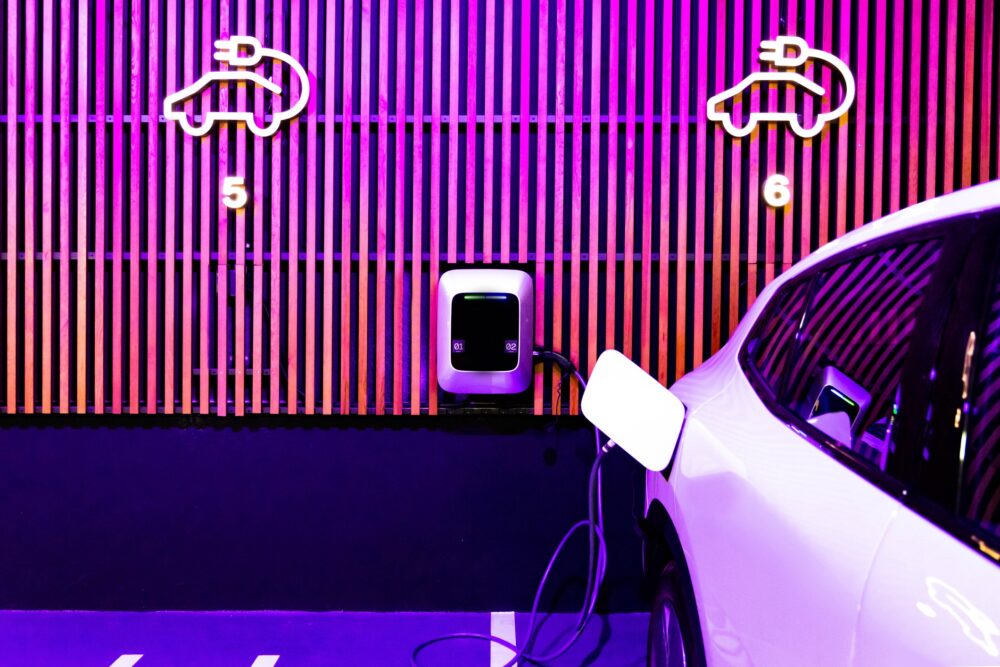
As Turkey’s electric vehicle (EV) market grows, a domestic carmaker is taking the battery-electric vehicle (BEV) fight to Tesla. But which BEV and plug-in hybrid (PHEV) models have been driving the country’s electrification in 2025? James Roberts, Autovista24 web editor, assesses the latest data from EV Volumes.

Between January and October, 183,748 new BEVs and PHEVs took to Turkey’s roads, according to EV Volumes data. This is compared with 68,309 units in the first 10 months of 2024, ensuring a year-on-year increase of 154%.

Of the two powertrains, all-electric cars made up 79.7% of all EV deliveries in the country. In total, 146,511 new BEVs entered the Turkish market, up from 68,309 between January and October 2024. This equated to a 114.5% volume increase.

Despite holding a smaller share of Turkey’s EV market, PHEV popularity significantly increased in 2025. This trend has gathered momentum since January 2024, and deliveries of the powertrain have hit monthly triple-digit figures ever since.

Between January and October, 37,237 PHEVs entered Turkey. This was up by a huge 820.3% from just 4,046 units across the same period in 2024.

Beguiling BEV market battle

After the first 10 months of 2025, the fight for top spot in Turkey’s BEV market proved a close one. In 2023 and 2024, domestic manufacturer Togg ended the year with the best-selling BEV in the country: the Togg T10X. In 2023, 2024, and so far this year, its closest rival has been the Tesla Model Y.

In the cumulative standings, the Model Y pulled ahead with 27,420 deliveries, compared with the Togg T10X’s 23,754 sales. The two models made up 18.7% and 16.2% of the overall Turkish BEV market, respectively.

Assessing October in isolation, Togg headed the BEV market with not one, but two models. The month saw the meteoric rise of the T10F. In just its second month on the market, it reached the BEV summit with 2,532 deliveries.

The T10F was followed by stablemate, the T10X, with 1,623 units, down a significant 47.5% year on year. With 871 deliveries and a 6% market share, the Volvo EX30 rounded out the top three.

Between January and October, Togg sold the most BEVs in Turkey. The homegrown manufacturer accumulated 27,480 sales, according to EV Volumes. Tesla emerged just 60 units behind with 27,420 all-electric cars sold.

Kia best of the rest

Behind the Tesla and Togg duel, Kia followed with its EV3. The Korean SUV has performed well since its Turkish debut in November 2024. In the opening 10 months of 2025, the BEV has recorded 6,786-unit sales and taken a 4.6% market share.

Following the EV3 was the first of three BYD models, namely the Yuan Plus. The Chinese BEV held 3.7% of the market with 5,467 units. Meanwhile, BYD took eighth and 10th place with the Seal U and Dolphin, respectively.

The KG Torres held fifth place in Turkey’s BEV rankings. The SUV has performed well since first recording sales in the market in April 2024. In the first 10 months of this year, it posted 4,888 deliveries, according to EV Volumes data. Just 752 units behind came the Mini Countryman, with 4,163 sales and a 2.8% market share.

BYD dominate Turkey’s PHEV market

In Turkey, BYD has also enjoyed irresistible PHEV dominance in the first 10 months of 2025. While the company sells a range of BEVs in the country, it currently only offers one PHEV: the Seal U. It first saw sales in April 2024 and has gone on to command Turkey’s new PHEV market. EV Volumes does include extended-range electric vehicles in its PHEV figures.

The Seal U accounted for 53.5% of all PHEV sales in the country, with 19,920 sales between January and October. This eclipsed the nearest challenger, the Volvo XC90. It posted with 2,751 units and accounted for 7.4% of the market, according to EV Volumes data.

Last year, BYD announced plans to invest the equivalent of $1 billion in a factory in Turkey. It would have the capacity to produce 150,000 vehicles a year, according to electrive. Turkey’s relatively low labour costs and favourable customs-union agreement with the EU could be a major draw for Chinese OEMs like BYD.

However, earlier this year, BYD’s Turkish aspirations seemed to be in limbo. In August, The Economist reported that little progress was being made in constructing the factory. If the carmaker does go ahead with these efforts, this would signal greater competition for domestic brands like Togg.

Peugeot’s PHEV podium

In the first 10 months of 2025, Peugeot took a spot in Turkey’s top three PHEV standings. It saw 2,094 sales of the 3008 locally, ensuring a 5.6% market share. The model was first sold in Turkey in January this year and has seen consistent triple-digit sales each month. The French car could be a strong Turkish PHEV market presence in 2026.

The Jaecoo J7 has also impressed this year after its deliveries began in August 2024. Between January and October this year, it moved 1,953 units to take fourth with a 5.2% share. This position could be under threat with increased competition from the likes of Skoda and Mercedes-Benz.

Another Chinese offering followed in the shape of the Qiyuan A07. It rounds out the top five with 1,686 units sold between January and October, and with it, a 4.5% market share.

As battery-electric vehicle (BEV) volumes continue to rise in Europe, Skoda impressed with another table-topping performance. But can it topple Tesla come the end of the year? Tom Hooker, Autovista24 journalist, reviews the latest figures from EV Volumes.

BEV and plug-in hybrid (PHEV) sales continued to surge in Europe during October, as both technologies saw similar year-on-year growth. PHEVs enjoyed a rise of 36.6% to 112,653 units, according to data from EV Volumes. The improvement for BEVs was less pronounced at 31.1%, equating to 222,235 new deliveries.

Yet this was a more positive performance for BEVs than seen in recent months. It was the powertrain’s biggest increase since July, and marked its third-biggest monthly growth in the first 10 months of 2025. Conversely, October’s PHEV improvement was the technology’s lowest since April.

From January to October, a total of 1,032,137 plug-in hybrids were delivered, a rise of 32.1% year-on-year. This remained ahead of the 25.7% growth accrued by BEVs during the same period. However, the all-electric technology recorded a superior volume, with 2,023,682 deliveries.

Due to its smaller growth, the BEV share of the electric vehicle (EV) market has shrunk. It captured 66.2% of total EV deliveries after 10 months of 2025, down 1.1 percentage points year-on-year.

BEV success for Skoda

The Skoda Elroq topped the best-selling BEV table in October, its third monthly triumph in the first 10 months of the year. This was thanks to a record 11,291 units, after nearly one year of European deliveries.

The combined volumes of the Renault 5 and Alpine A290 sat 1,090 units behind in second. The duo posted 10,201 units in October alone. This was its highest-ever monthly figure and up 592.1% year-on-year. It was also the first time the model broke into five-digit monthly volumes.

Third went to the Skoda Enyaq. While it was unable to replicate its January success, it still managed its biggest delivery haul since March. Yet, the SUV’s 7,427-unit total was down 33.6% year-on-year.

A trio of VW’s

The Volkswagen (VW) ID.7 finished fourth in the month, with 7,172 sales, up 34.7%. This was its best performance in terms of volume since March. The BEV was followed by two of its siblings, namely the ID.3 and ID.4. The former sat fifth with 6,860 deliveries, an increase of 45.6% year-on-year.

Meanwhile, VW ID.4 volumes stalled compared to 12 months prior. Its 6,627-unit total equated to a 0.2% dip, despite this being its highest total since May.

Then came the Audi Q4 e-tron in seventh. The SUV recorded 9.2% growth year-on-year to 6,081 deliveries. This was its best sales tally since March. Its German rival, the BMW iX1, placed eighth, thanks to 5,748 units. This translated to an improvement of 21.8% compared to volumes from one year prior.

Tesla Model Y’s headache

After topping the BEV best-sellers table in September and August, the Tesla Model Y fell to ninth in October. This was due to the crossover’s quarterly delivery schedule, with September’s total nearly five times bigger than October’s. Its total of 5,496 sales in October was down 37.9% year on year.

Rounding out the top 10 was the Kia EV3, which completed a full year of deliveries in Europe. The BEV posted 5,067 deliveries in the month.

Can Skoda close the gap?

Despite a poor October, the Tesla Model Y still holds a seemingly insurmountable lead in the cumulative standings. The crossover recorded 115,414 units from January to October. So far, it remains the only EV with six-digit deliveries in Europe.

At the end of October, its closest rival was the Skoda Elroq, which moved up to second with its monthly success. The SUV posted 70,182 sales after 10 months of 2025.

However, despite the disparity in their October performances, the gap is simply too large to close. The Tesla Model Y can also be expected to post high volumes in December, due to its delivery schedule pattern.

A little further behind the Skoda Elroq was the combined volumes of the Renault 5 and the Alpine A290. The duo placed third in the cumulative standings and recorded 67,176 units from January to October.

The VW ID.3 placed fourth, with 64,272 sales. Just 204 units behind was the Skoda Enyaq. The SUV managed 64,068 deliveries after 10 months of 2025.

A last-minute comeback?

These models benefited from the recent poor performance of the Tesla Model 3. The sedan fell to sixth in the cumulative standings, after placing 57th in October with 1,301 sales.

Based on its delivery peaks this year in March, June and September, the Model 3 is unlikely to replicate its runner-up finish in 2025. However, a strong December could make things close. It will need a swing of 6,704 units in the last two months of 2025.

Two VW models followed in seventh and eighth. The ID.4 secured seventh, with 63,012 units. Then came the VW ID.7 with 60,965 deliveries. The Kia EV3 landed ninth, thanks to 55,415 sales, while the BMW iX1 placed 10th with 52,530 units.

Volvo’s return to the top

Volvo’s XC60 was Europe’s best-selling PHEV in October. Its 5,967-unit total was the SUV’s highest monthly figure since December 2024. It also equated to a 5.7% increase year-on-year.

Just 415 deliveries behind was the BYD Seal U, which led the chart in the previous month. The PHEV posted 5,552 sales in October, nearly half of its September total. Even so, volumes were still up 459.7% year-on-year.

The VW Tiguan took third, with deliveries up 41.8% to 4,946 units. Fourth was the Mercedes-Benz GLC. The SUV recorded 3,905 deliveries, up 19% compared to 12 months prior.

Fifth was the MG eHs, with sales surging by 162.3% to 3,557 units. In contrast, the Ford Kuga witnessed a 9.4% drop year-on-year to 3,494 deliveries. The Jaecoo J7 secured seventh thanks to 3,264 units, after volumes ramped up earlier this year.

The BMW X1 endured a 22% sales drop to 3,189 units in eighth. Its sibling, the X3, was just 38 units behind. However, its 3,151-delivery total represented a much more positive performance, up 608.1% year-on-year. The Audi A3 placed 10th, with 3,083 sales.

An ever-closer battle

In the cumulative PHEV standings, a three-way battle to take the full-year title remains. The BYD Seal U led the chart after moving into first place at the end of September. This was despite only topping the monthly table twice. The SUV recorded 51,389 deliveries between January and October.

The VW Tiguan saw its gap to first grow slightly to 1,193 units. With three monthly wins so far in 2025, the PHEV posted a total of 50,196 deliveries.

Gaining ground on both models was the Volvo XC60. The SUV has managed 48,582 deliveries overall. Despite this, the XC60 still has some catching up to do. After its October success, the gap between the top three PHEVs has been reduced to 2,807 units.

This showcases the high competitiveness of the PHEV market. One slip-up or surge in volumes during the last two months of the year could be the difference between taking a full-year victory and placing outside the top two.

Changing positions

A considerable distance behind was the Ford Kuga in fourth, with 37,730 sales. The SUV is the only model outside of the top three to record a monthly victory so far this year.

The BMW X1 finished fifth after 10 months of 2025, thanks to 33,416 deliveries. The Mercedes-Benz GLC followed in sixth, with 30,054 units. The SUV was closely followed by the MG eHS, recording 29,579 sales. Eighth in the cumulative table was the Toyota C-HR, with 29,130 units.

The BMW 5-Series claimed ninth in October, posting 24,014 units, while the Cupra Formentor was 10th with 23,816 deliveries.