When it comes to P2P (person-to-person) transfers, bank customers are fiercely loyal to the brand they prefer. However, according to new JD Power data, network effects, security and ease of use play a large role in determining which “additional” brands consumers are using.
This Payments Intelligence Report dives into the findings of the JD Power 2025 U.S. P2P Transfers Satisfaction Study to spotlight the prevailing sentiment and emerging trends in P2P transfer customer experience.
 

Customers Prefer Adding Over Switching

Most customers say they do not intend to switch using their primary P2P brand, but most also use more than one brand, indicating openings exist for providers to grab more market share. The average P2P user has accounts with 2.8 brands, with PayPal being the most common additional brand. Overall, 47% of P2P users have a secondary account with PayPal.
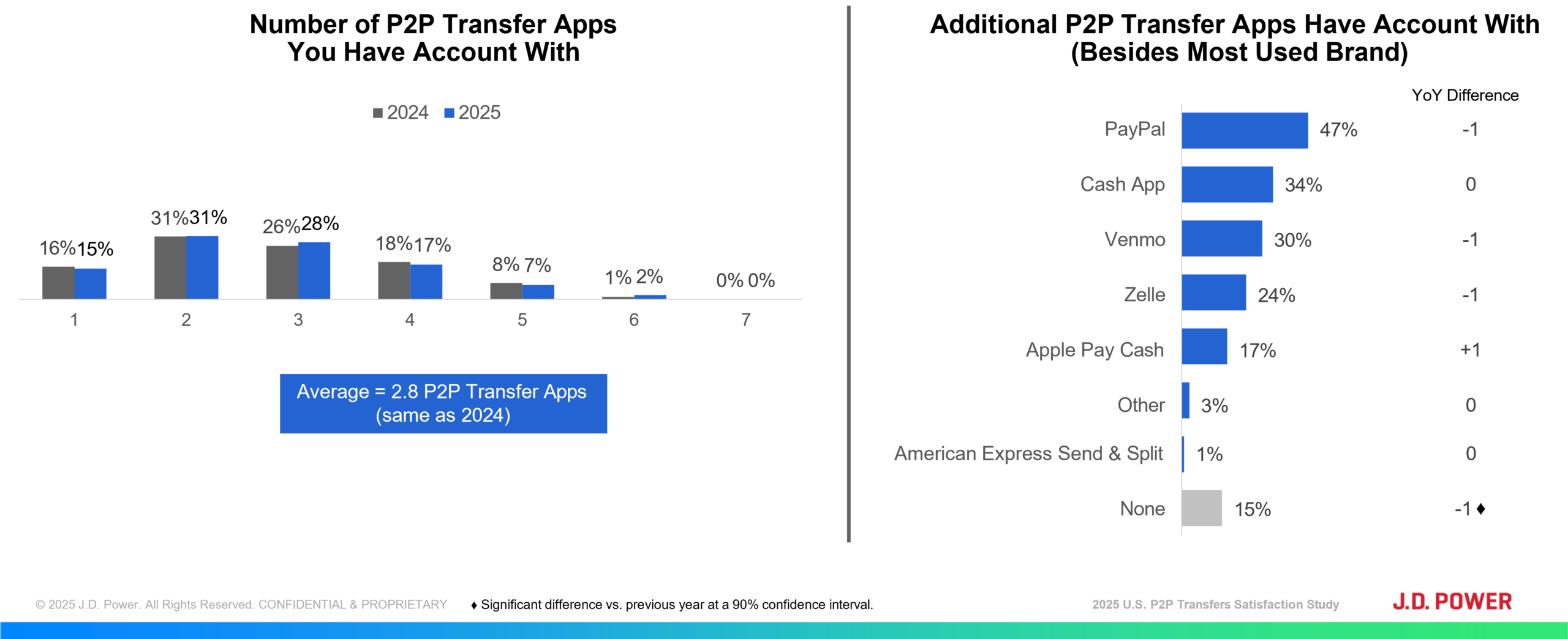
Bar chart showing how many P2P payment accounts consumers have with different brands.


Customers Want Ease of Use, Security

Customers say the most likely reason to switch P2P brands for both sending and receiving money is family and friends using a different P2P transfer account (41%). Security concerns (27% for sending money, 25% for receiving) were also among the top reasons.
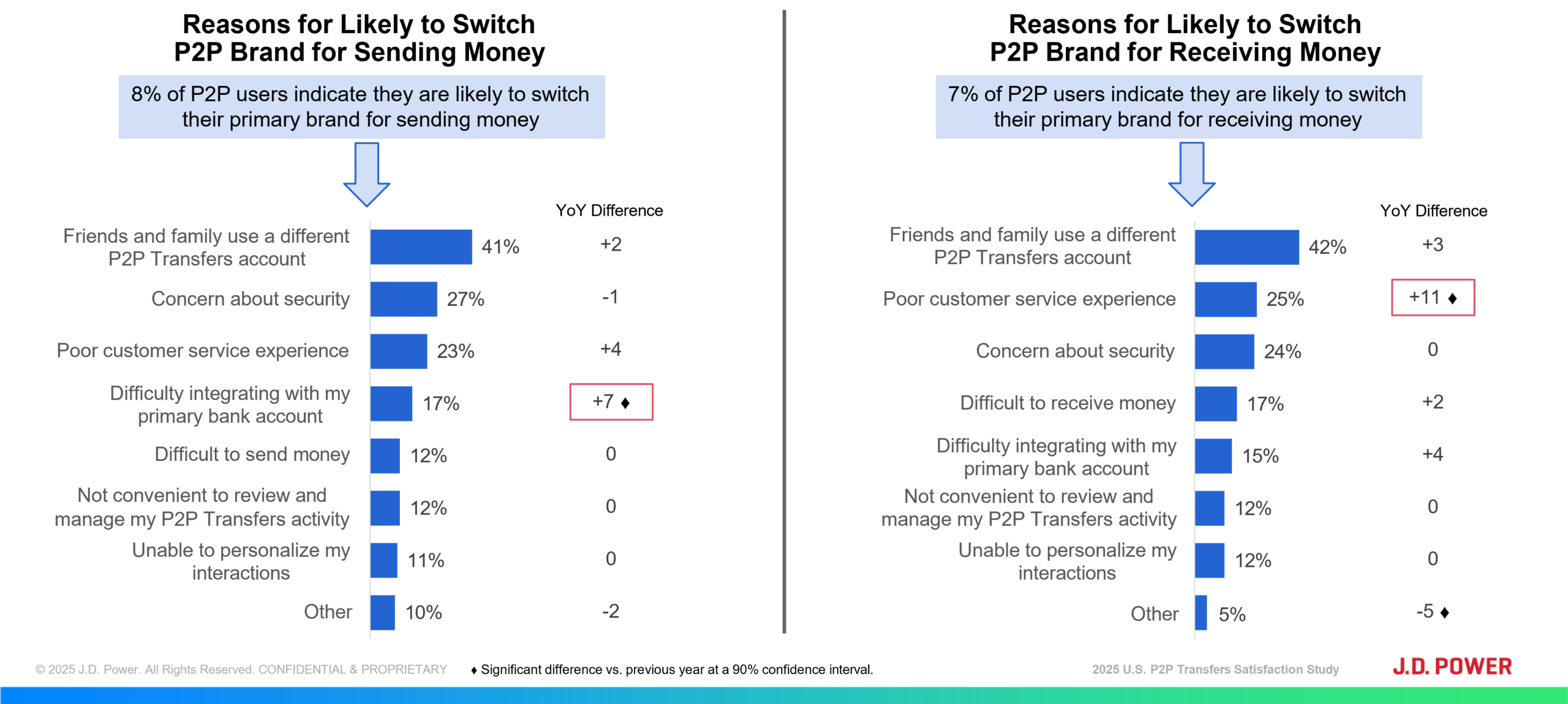
Chart showing reasons consumers would switch P2P brands for sending or receiving money.


Brands using the Zelle network continue their dominance over industry peers. For a second consecutive year, among the top eight performing brands in the study, seven are part of the Zelle network. They are (in alphabetical order): Bank of America, Capital One, Chase, PNC, Truist, U.S. Bank and Wells Fargo.

That said, how banks integrate Zelle into their mobile and electronic platforms has a large effect on satisfaction. Zelle integration is largely customizable, so how and where Zelle’s features appear in each bank’s tool vary.

Capital One’s P2P customer experience, for example, is enhanced by strong discoverability from the home screen, a pay/move screen featuring a Zelle-centric money movement experience, and a final send screen that displays the recipient’s information to reconfirm money is being sent to the right person.


Breaking Through

While P2P users are steadfastly loyal to their primary brand, competing providers have a real opportunity to expand their customer base by turning existing users into advocates. Many users are receptive to opening secondary accounts to ensure they can send money across their entire social network. This means an incumbent—or even a new disruptor—doesn’t need to break brand loyalty to make meaningful gains. Sometimes, all it takes is one friend or family member requesting a transfer via another service, and suddenly, that competitor has gained a new user.

As brands build out their platforms, it is incumbent on them to understand what differentiates the top performers.


Find out More

This Payments Intelligence Report is based on responses from the JD Power 2025 U.S. P2P Transfers Servicer Satisfaction Study, which included 6,105 responses and was fielded from January to March 2025. It is authored by Sean Gelles, Senior Director, Payments Intelligence. Please contact us at the numbers below to connect with Mr. Gelles or to learn more about the underlying research.


Media Contacts

Brian Jaklitsch; East Coast; 631-584-2200; [email protected]
Geno Effler, JD Power; West Coast; 714-621-6224; [email protected]



Despite the rise of digital platforms and DIY investing tools, younger DIY investors are increasingly open to seeking advice from financial advisors. Gen Y and Gen Z DIY investors are showing a stronger preference for working with financial advisors than their older DIY counterparts, even though they grew up using technology for almost everything, according to the latest JD Power U.S. Investor Satisfaction Study.

Kapil Vora, Senior Director of Wealth Intelligence at JD Power, shares his expertise in the Financial Service Intelligence Update on why this shift is happening and what it means for the future of wealth management.

DIY Investors Are Reaching Out

“We tend to think of DIY investors as confident and independent,” said Vora. “But the data shows many of them are open to advice, especially younger ones. Gen Y and Gen Z investors are the ones most likely to say they want help from an advisor”

As these younger investors move through major life milestones like starting families and building wealth, they are realizing that digital tools alone may not be enough.

“They’re beginning to recognize that they don’t have all the answers,” Vora added. “Many are saying that online information just is not enough to support their financial decisions anymore.”

Why Advisors Matter More Than Ever to Gen Y & Z

Younger investors are not turning away from digital platforms. Instead, they are saying they want more support than digital alone can provide. The study shows that they often feel uncertain about financial matters and want guidance that feels personal and reliable.

“Younger investors are growing, and so are their financial responsibilities,” Vora said. “They want to talk to someone who understands their unique goals and challenges.”

This presents a clear opportunity for wealth management firms.

What Must Firms Do?

To meet the needs of younger investors, firms should focus on three key priorities:

  • Combine digital platforms with access to financial advisors
  • Create services and products that support goals like homeownership, debt repayment, and asset building
  • Make their platforms easy to use and understand

“The most successful firms will be the ones who make advice accessible and relevant without forcing a choice between tech and people,” Vora explained.

Market Volatility Is Accelerating the Shift

With market volatility continuing, more investors are reaching out for support. According to Vora, this environment is increasing the desire for professional guidance.

“Some DIY investors may be caught off guard, and we expect to see a growing interest in advice during this period,” said Vora. “For investors who already work with an advisor, those who receive comprehensive advice feel more confident and secure.”

Who’s Leading the Pack?

This year’s top-performing firms stand out for their ability to align with investor needs, whether that means offering hands-on advice or robust self-directed tools. Raymond James ranks highest in overall satisfaction among advised investors, with a score of 748 (on a 1000-point scale). U.S. Bank (738) ranks second and Edward Jones (734) ranks third.

Vanguard ranks highest in overall satisfaction among DIY investors, with a score of 704. Fidelity (703) ranks second and T. Rowe Price (691) ranks third.

“These firms are meeting their clients where they are, whether they want self-directed tools or hands-on support,” said Kapil Vora.

To see the full list of rankings and detailed insights, read the press release.

Read Press Release

What’s Next for Gen Y and Z Wealth Management?

The future of wealth management for this emerging cohort lies in a hybrid model that blends technology with human empathy. As Kapil Vora put it:

“It’s not just about being digital. It’s about being helpful. That’s what younger investors are asking for.”

Firms that recognize and respond to this shift will be better positioned to earn long-term loyalty from the next generation of investors.

See how your firm can benchmark performance and uncover deeper insights with JD Power investor satisfaction data and analytics.

Explore Now

What do the next three months look like for the United States economy? 

That’s the question that’s seemingly on the tip of everyone’s tongue ever since the U.S. imposed sweeping tariffs on several countries around the world. Accordingly, bank customers in the U.S. are trying to figure out exactly what that will mean for their finances, particularly those who are struggling. 

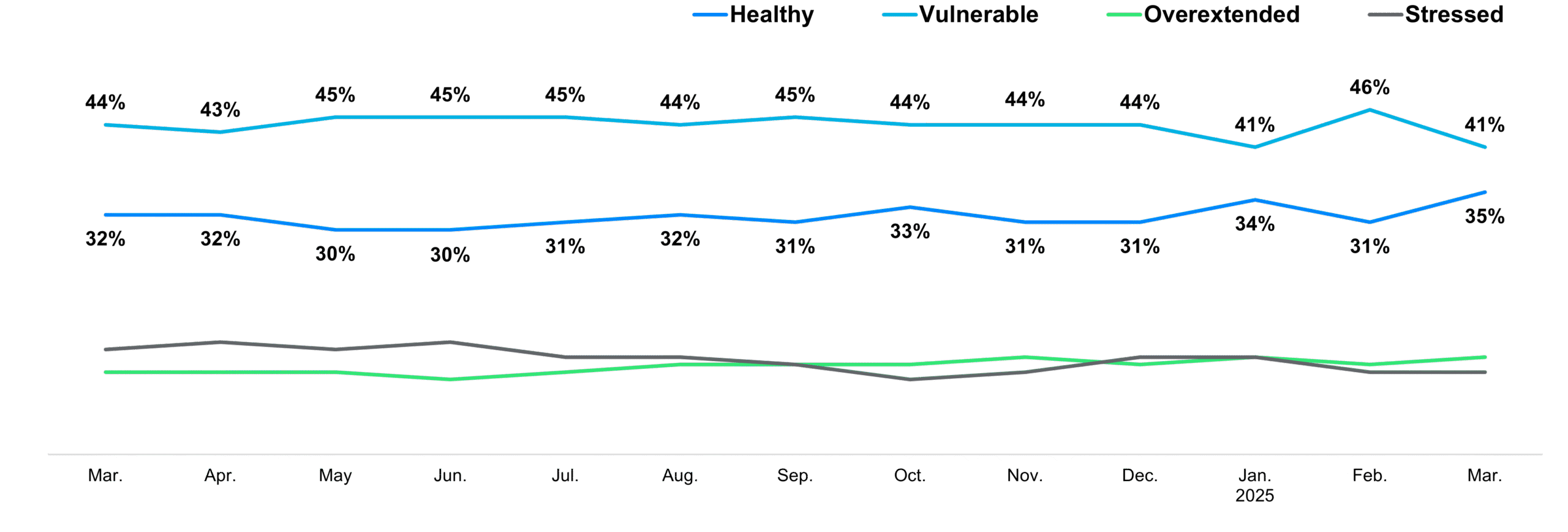
According to JD Power data, 35% of customers are financially healthy,[1] a new 13-month high. But even as customers seem to be gaining some ground on the financial health front, many are expressing uneasiness about their future finances.

Financial Health Gets Another Boost

The number of customers who are financially healthy increased to 35%, a 13-month high. As observed between January and February, this trend may not be long-lasting, but after financial health was stagnant for so long, the fact that there has been more movement of late could be seen as a positive development. 

Line Chart of J.D. Power Financial Health Status


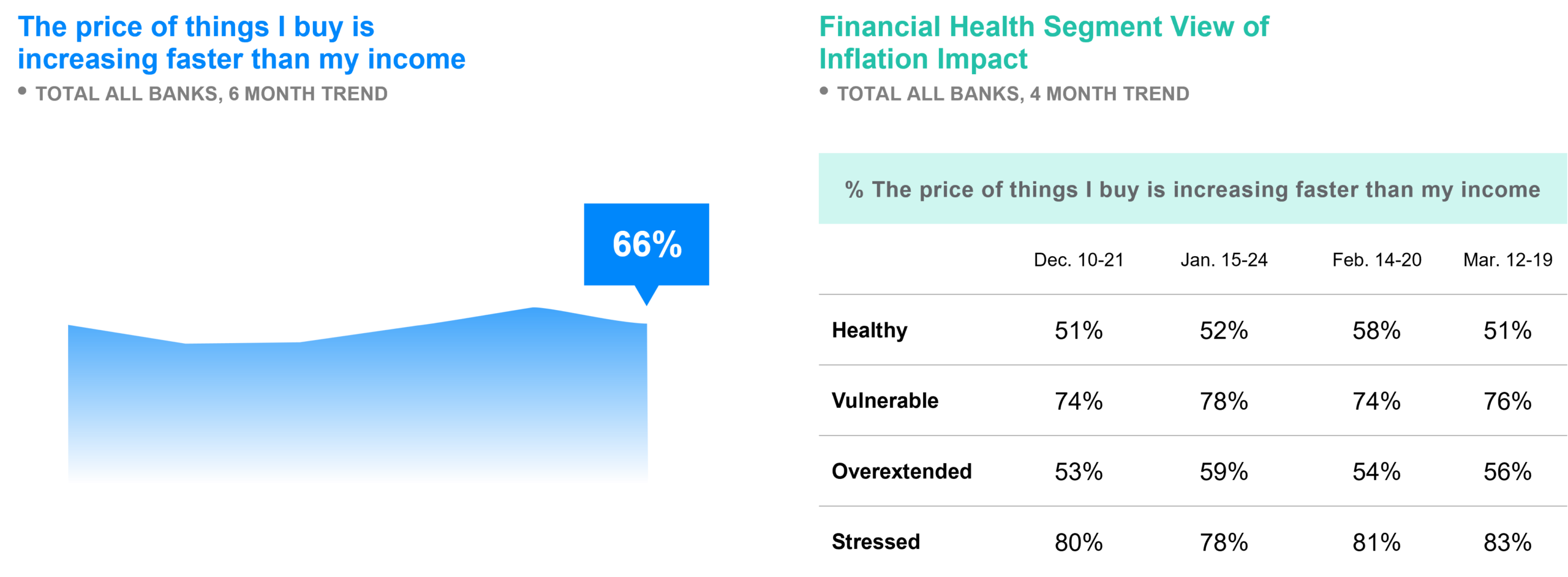
The percentage of bank customers who say the cost of goods is increasing faster than their income fell slightly to 66%. Stressed customers (83%) were most likely to say they are grappling with the cost of goods, up from 81%. Just 51% of healthy customers say they are having trouble keeping up with the cost of goods, down from 58%. 


Survey Results: Tracking Consumer Recognition of Inflation. Results described below.


Tough Times Ahead?

Less than half (43%) of customers say their current financial situation is stable and secure. That rate is virtually identical for customers under 40 and over the age of 40 (42% vs. 43%, respectively). 

Survey Results: How much do you agree your current financial situation is stable and secure. Chart data explained below.


Conversely, 41% believe their financial situation is at risk of getting worse in the next three months. While stressed customers (45%) were most likely to agree that their finances are at risk, healthy customers (42%) are not far behind.

Survey Results: How much do you agree that your financial situation is getting worse in the next three months. Data described below.


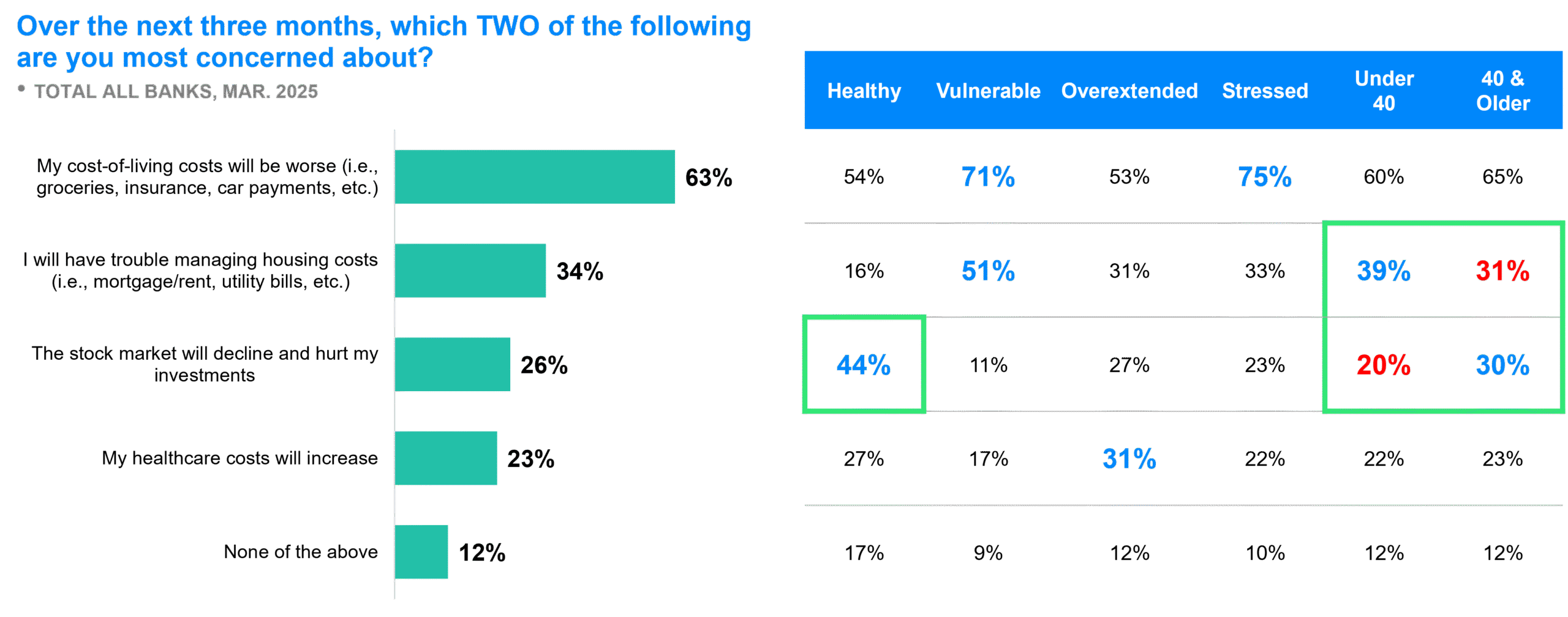
When asked about the root of their fears, 63% believe that their cost of living will be worse in the next three months, while 34% say they will have trouble managing housing costs, and 26% say the stock market will decline and hurt their investments.


Survey Results: Over the next three months, which TWO of the following are you most concerned about? Data described below.


Rising to the Challenge

Customers have been operating under the specter of another economic downturn for years. And while that has never fully materialized, the most recent events have certainly sparked some concern. That is enough to get many customers wondering if this is finally the other shoe getting ready to drop.

As the U.S. sits down with various countries to negotiate these tariffs, those fears may soon be quelled. But regardless of the specifics of the next several months, one thing is certain: Customers will likely seek counsel in the entities they know best. Banks need to be prepared to step up in times of uncertainty and help customers navigate these unpredictable times. Those that can help will enjoy better customer relationships and financially healthier clientele. 


Find out More

This Banking and Payments Intelligence Report is based on responses from 4,000 retail bank customers nationwide and was fielded in March 2025. It was authored by Jennifer White, senior director of banking and payments intelligence at JD Power. Please contact us at the numbers below to connect with Ms. White or to learn more about the underlying research.


Media Contacts

Brian Jaklitsch; East Coast; 631-584-2200; [email protected]

Geno Effler, JD Power; West Coast; 714-621-6224; [email protected]
 

[1] JD Power measures the financial health of any consumer as a metric combining their spending/savings ratio, creditworthiness, and safety net items like insurance coverage. Consumers are placed on a continuum from healthy to vulnerable.

With the Dow Jones Industrial average heading toward its worst April since the Great Depression and the S&P 500 down about 13.9% from its peak in mid-February, following the introduction of a sweeping set of tariffs on imported goods, U.S. investors are understandably concerned about their portfolios. While recent suspensions of some tariffs may have prevented further market declines for now, the continued sense of uncertainty persists. Exactly how serious is investor concern, and how is it affecting their experience with their financial advisors and wealth management firms?

This JD Power Wealth Intelligence Report analyzes data from the JD Power Financial Services U.S. Investor Pulse Survey, which was fielded on April 15 and April 16 to take the pulse of investors in the United States as they navigate this period of market volatility.

Investor Confidence Shaken by Tariffs

On April 2, the Trump administration unveiled a set of tariffs on all imports into the country, and even higher tariffs on goods from about 60 countries or trading blocs that have a high trade deficit with the U.S. While markets had been bracing for tariff action, the scale of the announcement caught many by surprise, and markets reacted sharply, with the S&P 500 dropping more than 10% in the two days following the announcement.

That sudden spike in volatility has put many investors on edge, with many anticipating a tough road ahead as they continue to navigate this period of economic uncertainty. Overall, 56% of investors said: “this is the toughest investment climate I’ve experienced,” while 33% said they’ve experienced worse and 11% were not sure.

Survey Results: Is this the most challenging investment climate you've experienced in your lifetime

When asked whether the tariff news had shaken their confidence in their investments, 40% of investors said they believe the tariffs are hurting their portfolios and making them rethink their strategy. Another 34% said they were not sure, but they were worried about the potential effects of the tariffs. Just more than one-fourth (26%) of investors said they don’t believe the tariffs will affect their investments.

Survey Results: Are tariffs shaking your confidence in your investments? Results described below.

A total of 69% of investors surveyed work with a financial professional (34%) or dedicated financial advisor (35%) to manage their investments, while 25% manage their portfolios on their own and 7% have someone else in their family who looks after their investments. Across the board, investor confidence is highly correlated with professional guidance. Those who work with a dedicated financial advisor are least likely to say that the tariff news is causing them to rethink their strategies, while those who trade/invest on their own without any professional help are most likely to be rethinking their portfolios right now.

Chart titled


Quantifying the Effect of Tariffs on Investor Portfolios

When it comes to assessing the short- and long-term effects of the tariffs, 41% of investors believe they will negatively affect their portfolios during the next 12 months and 32% believe they will negatively affect their portfolios during the next five years. Interestingly, 49% of investors believe tariffs will either have a positive effect or no effect at all on their portfolios in the next 12 months and 52% believe the effects will be positive or neutral in the next five years.

Survey Results: What impact do you think tariffs have on your investments in the next 12 mos.?Survey Results: What impact do you think tariffs have on your investments in the next 5 years?


Seeking Reassurance from Professionals

The lion’s share of investors have received proactive outreach from their advisors in response to the tariffs, with 57% of advisors reaching out via “low-touch” methods such as text messages, emails and letters, and 56% reaching out via “high-touch” methods, such as phone calls, video conferences and in-person meetings. In some cases, advisors reached out via both high-touch and low-touch methods. Despite this widespread multichannel outreach, 18% of investors said they have received no contact from their financial advisors following the tariff announcement. 

Survey Results: Has your financial advisor communicated with you recently about the tariffs and your investments? (select all that apply)

Some of those advisor interactions were more effective than others. The majority (52%) of investors said they were reassured by their advisors and believed they were well-guided through this period of volatility, but 31% said they were uncertain and did not feel like they had enough support. Another 7% said they were frustrated and not getting the guidance they need, and 10% were unsure.

Survey Results: How do you feel about the support you receive from your financial advisor in today’s unpredictable market?


Among self-directed investors who currently trade/invest on their own without any professional help, 40% indicated they were “probably likely” (27%) or “definitely likely” (13%) to work with an advisor in the next 12 months. That number rises to more than half of younger self-directed investors, including Millennial[1] and Gen Z respondents.

How likely are you to use a financial advisor in the next 12 months

When it comes to taking action in response to the tariff-related volatility, 35% of investors said they are holding off until the market stabilizes, 28% said they are moving into safer assets such as bonds, cash and gold and 25% said they are diversifying their portfolios to spread risk.

Survey Results: What two steps are you taking in response to current market turmoil?


Crisis Breeds Opportunity

Market shocks like the one we’ve been experiencing throughout the month of April create a moment of truth opportunity for investment professionals to demonstrate their ability to guide clients through a rational, practical process that is not overly swayed by emotion or fear. So far, in response to tariff-related market activity, advisor performance managing those emotions has been mixed. While a little more than half of investors feel like they are getting the guidance they need, there are a lot of people out there right now in a full-blown panic. Advisors need to communicate frequently and effectively to help their clients through these types of challenging market moves.


Find out More

This Wealth Intelligence Report is based on responses from 1,190 investors with at least $100,000 in investable assets. It was authored by Mike Foy, managing director of the wealth management practice at JD Power. Please contact us at the numbers below to connect with Mr. Foy or to learn more about the underlying research.


Media Contacts

Brian Jaklitsch; East Coast; 631-584-2200; [email protected]

Geno Effler, JD Power; West Coast; 714-621-6224; [email protected]
 

[1] JD Power defines generational groups as Pre-Boomers (born before 1946); Boomers (1946-1964); Gen X (1965-1976); Gen Y (1977-1994); and Gen Z (1995-2007).


Despite ongoing financial strain, customer satisfaction with retail banks is on the rise. New findings from the JD Power U.S. Retail Banking Satisfaction Study reveal how banks are adapting to consumer needs and building trust. Jennifer White, Senior Director of Banking Intelligence, shares the latest trends. 

Rising Satisfaction Amid Financial Strain
Even though consumers are facing economic hardships—reflected in declining deposits and investment amounts—overall satisfaction with their banks has increased. Consumers are more likely to return for additional products, and Net Promoter Scores (NPS) have improved. Despite the challenging financial environment, customers are finding value in their banking relationships.

Banks Are Rising to the Challenge
“Banks are spending more time helping customers manage their financial lives in a way that goes well beyond routine transactions,” White explained.

Building on this positive sentiment, banks have been investing heavily in digital tools and personalized services to support customers in managing their finances. Features like budgeting tools, savings goal trackers, and proactive alerts in mobile apps are helping consumers feel more empowered to navigate their financial situations. These efforts are a key reason behind the increasing satisfaction scores.

Tackling the “Three F’s” (Fees, Fairness, and Fraud)
However, consumer concerns about fees, fairness, and fraud persist. Despite these challenges, banks have been taking necessary steps to address these issues. Increased transparency around fees, enhanced fraud protection measures, and efforts to ensure fair treatment are helping build greater trust with customers. While there’s still work to do, these improvements are contributing to more positive customer experiences.

Declining Deposits
The study also finds that the average deposits held by consumers at their primary bank continue to decline. With 33% of consumers reporting less than $1,000 in deposits, the divide between those with significant savings and those struggling to save is widening. This highlights the financial strain many consumers are facing and presents a challenge for banks in providing accessible financial solutions.

Financial Advice Is Gaining Traction—But Awareness Is Still a Hurdle
More customers are recalling their banks’ advice and guidance—and many are taking action. Still, banks face challenges in cutting through the noise.

“The leak is still really occurring at just getting customers’ attention,” White said. “That, at the core, is about the volume of messaging, the spread of the messaging over a calendar year. It’s about making sure that the content is personalized.”
Banks that succeed here are integrating guidance across channels—from in-branch conversations and call centers to in-app banners and automated savings nudges.

Whether through a mobile app or in-person interactions—customers feel more supported in their financial decisions, contributing to their overall satisfaction.

What’s Next for Retail Banking?

The findings from this year’s study make one thing clear: to maintain long-term customer loyalty, banks must continue to:

  • Invest in digital tools that enable consumers to manage their financial lives with ease and confidence.
  • Enhance transparency around fees, fraud protection, and fairness to foster trust.
  • Provide personalized financial advice that empowers customers to make informed financial decisions.

As the banking landscape continues to evolve, these findings underscore the importance of banks acting as trusted partners in helping customers manage their financial health and navigate uncertain times.

Read the JD Power 2025 U.S. Retail Banking Satisfaction Study press release for more key findings.

Read the Press Release

Banking and Payments Intelligence Report
March 2025

As Financial Health Declines, Customers Try to Parse How New Tariffs Will Affect their Spending

As the inflation rate dipped below 3% in February, a whole new financial landscape has emerged for bank customers in the United States in light of new tariffs on foreign imports.

Earlier this month, the United States imposed a new 25% tariff on imports from Mexico and Canada. Accordingly, customers are trying to figure out exactly what that will mean for their finances, particularly those who are struggling.  

According to JD Power data, 31% of customers are financially healthy,[1] a rate at which customers have been largely stuck since 2024. And even though the headline inflation rate has come down, many customers are still saying it affects their day-to-day decisions. Could tariffs start to have the same kind of effect?

Financial Health Returns to Baseline    

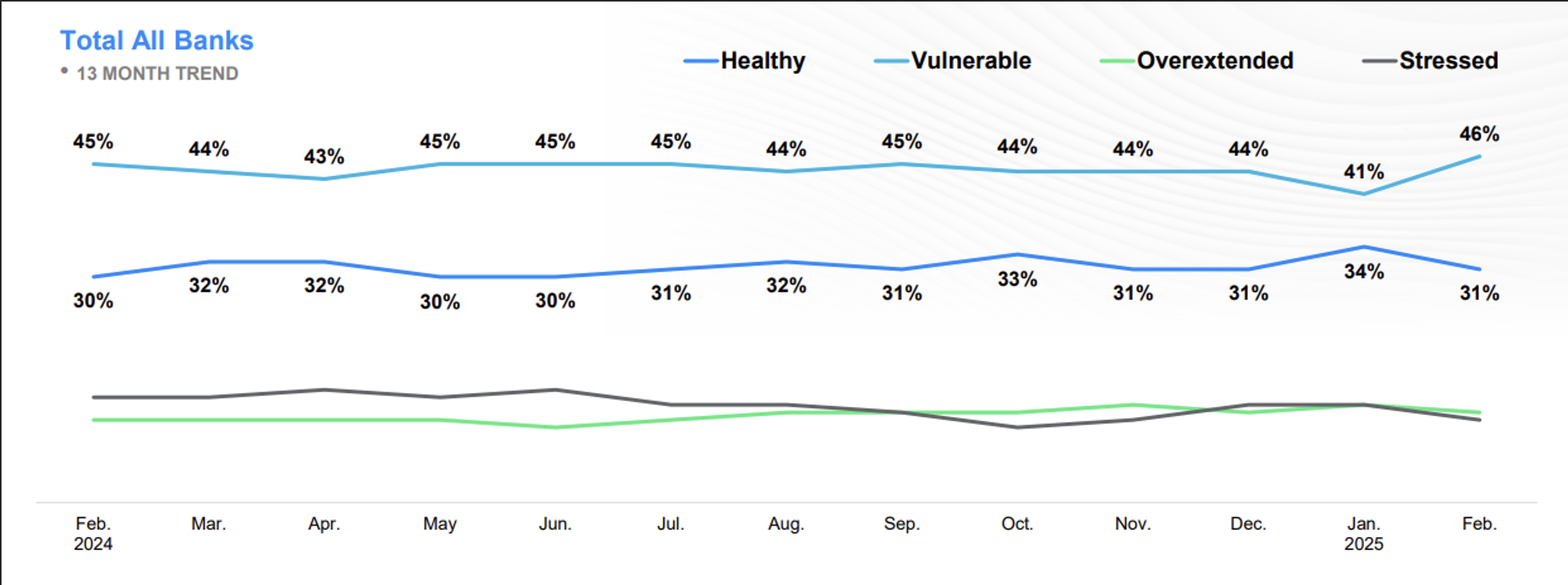
After a slight upward swing, the number of customers who are financially healthy returned to 31% in February, while 46% of bank customers were in the vulnerable category. The rate of vulnerable customers represents a 13-month high.

Total all banks trends chart

The percentage of bank customers who say the cost of goods is increasing faster than their income rose to 67%. Healthy customers represented the biggest increase, up to 58% from 52% last month, a sobering metric that could portend a further decline in customer health.

Tariff Trouble?

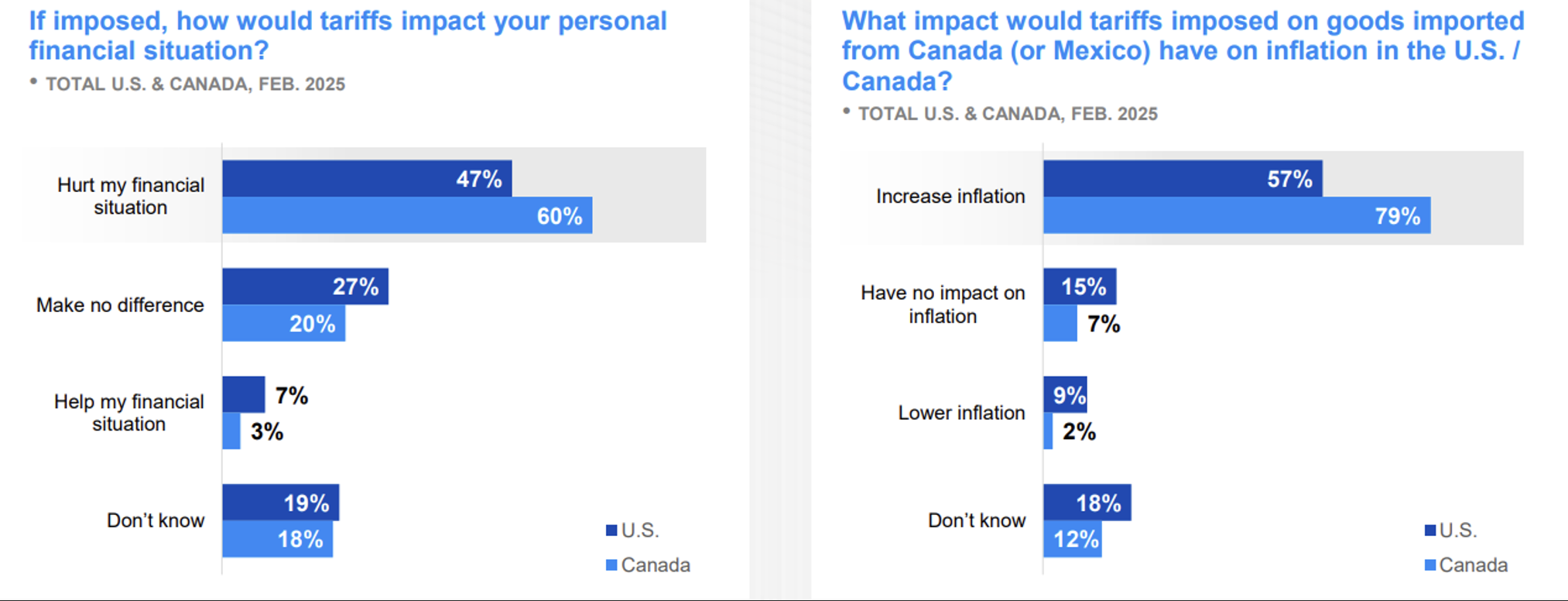
Prior to tariffs taking effect on March 6, less than half (47%) of U.S. bank customers said that these tariffs would hurt their financial situation, while 27% said it would make no difference and 7% said it would help their financial situation. Nearly one-fifth (19%) of customers said they did not know. Meanwhile, bank customers in Canada had a more pessimistic view, as 60% said tariffs would hurt their financial situation and just 20% said they would make no difference. Eight in 10 (79%) customers in Canada said that tariffs would increase inflation, while 57% of U.S. customers agreed. Interestingly, 9% of U.S. customers said tariffs would lower inflation, compared with only 2% of customers in Canada. 

Tariff charts

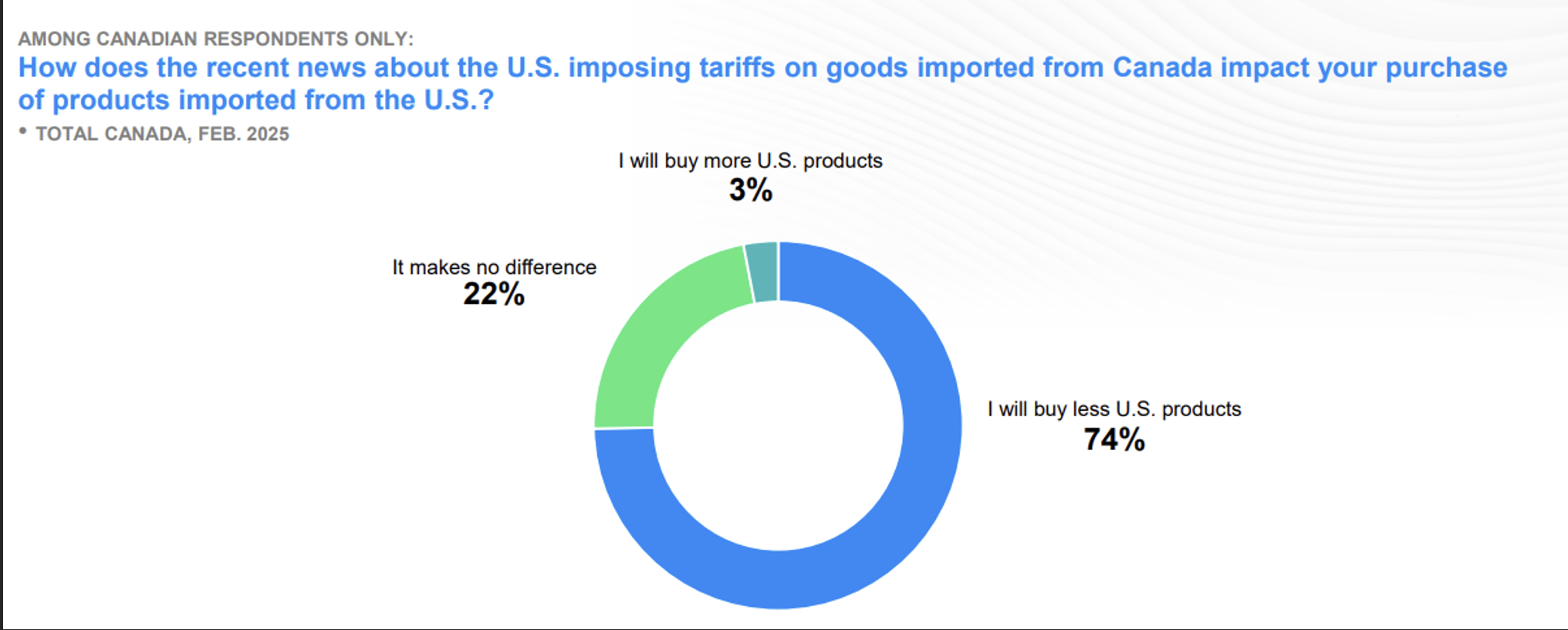
Regardless of how tariffs affect the economies of the U.S. and Canada, one thing seems certain: Bank customers north of the border plan to buy fewer American products. Nearly three-fourths (74%) of customers in Canada say they will buy fewer U.S. products in light of tariffs, while 22% say it will not make a difference in their purchasing decisions.

Tariff news chart

Navigating the Uncertainty 

As the U.S. begins to define carve outs for tariff exemptions, and companies rush to secure them for their products, it’s still unclear exactly what the end of result of these tariffs will look like. But for customers trying to find some certainty in a very fluid situation, banks have a chance to step in offer some stability.

Customers who are both dialed into the latest developments of this trade standoff and those that haven’t been paying attention are just as susceptible, and they’ll need guidance to get through it. Short of some momentary glimmers, the financial health of customers in the U.S. has been largely unchanged, even as inflation has fallen steadily since 2023. Banks that can keep their customers informed and help them chart a course through the clutter will stand to build better relationships.

Find out More

This Banking and Payments Intelligence Report is based on responses from 4,000 retail bank customers nationwide and was fielded in February 2025. It was authored by Jennifer White, senior director of banking and payments intelligence at JD Power. Please contact us at the numbers below to connect with Ms. White or to learn more about the underlying research.

Media Contacts

Brian Jaklitsch; East Coast; 631-584-2200; [email protected]

Geno Effler, JD Power; West Coast; 714-621-6224; [email protected]

[1] JD Power measures the financial health of any consumer as a metric combining their spending/savings ratio, creditworthiness, and safety net items like insurance coverage. Consumers are placed on a continuum from healthy to vulnerable.

Banking Customer Insights from JD Power Research

In today’s market, consumers have more banks to choose from than ever, making it harder for institutions to attract new customers, retain existing ones and build lasting loyalty. With 52%  of customers open to switching banks in the next 12 months, standing out from the competition with tailored strategies is more important than ever. To succeed, financial services marketers must engage current customers while also attracting new ones. This requires meaningful, actionable insights into customer preferences and behavior. 

“In a shifting financial landscape, unbiased data is the core of sound decision-making, providing an anchor of stability and a compass for navigating uncertain markets,” says Jennifer White, senior director of banking and payments intelligence at JD Power.

Unbiased customer insights help banks understand what matters most, allowing banks to craft more effective marketing strategies. Messaging should resonate with regional audiences while reinforcing the bank’s reputation as a trusted institution. By addressing the priorities of different customer segments, banks can fight attrition and strengthen their competitive position. 

Regional Variations in Customer Satisfaction 

A one-size-fits-all national approach can fall short in addressing local market differences—especially those around trust and reputation. JD Power research reveals that customers in the NY-Tri State, Southwest, Upper Midwest and California regions have lower-than-average scores on critical-to-success metrics. These include overall satisfaction; level of trust; likelihood to say they definitely will reuse the bank; and reputation. This regional performance gap is driven in part by a divide between those customers under age 40 and those over age 40. For example, customers in the NY-Tri State and California regions who are over 40 years old have high levels of trust for midsize banks and lower trust for national or regional banks. The reverse is true for those under 40 with Millennial1 and Gen Z customers having a lack of confidence in midsize banks and a preference for national or regional banks.  

Banks on both sides of the size equation must proactively highlight their reputation for satisfying customers to win new business and retain existing accounts. 

Marketing Strategies Based on Data-Driven Regional Insights  

Effective regional marketing requires a nuanced and informed approach with strategically tailored messages that speak to regional customer preferences. 

Regional marketing campaigns help banks to meaningfully engage customers, reinforce a reputation for exceptional customer satisfaction, and build lasting relationships that inspire retention.  

“Highly satisfied customers are the cornerstone of long-term success for retail banks,” White said. “By tailoring regional marketing strategies to highlight customer satisfaction, banks can strengthen connections with local customers and drive lasting loyalty.”

Marketers can make the most of regional consumer data with messaging that meaningfully addresses the concerns of regional banking customers. 

Emphasizing Reputation 

A bank’s reputation remains a top reason why customers select a bank. Marketers should highlight credible proof of performance and customer satisfaction to reinforce and promote their bank’s positive reputation in regional markets. By pairing marketing efforts with reputation management based on real-world customer satisfaction data, banks can more effectively communicate their trustworthiness, commitment to delivering a satisfying customer experience and brand value.

Developing Regionally Tailored Campaigns 

Banking customers in different regions have distinct priorities and expectations when choosing and working with a financial institution. To connect with customers effectively, banks must create tailored campaigns that address regional concerns, demonstrate their commitment to local markets and highlight how they meet customer needs.

Final Thoughts 

The banking landscape is changing rapidly. Staying competitive relies on leveraging every advantage. Credible third-party customer insights are more important to marketing efforts across the banking industry than ever before, especially for banks serving clients in a variety of regions and those competing with national players.

Customer insights from reliable sources are useful to banks looking to stand out in a competitive market and understand how they perform when compared with national and regional competitors. Data-driven rankings and recognitions also help consumers avoid exhaustive searches and piecemeal comparisons, saving time, and frustration, and giving a more accurate picture of available choices. 

The results of the JD Power 2025 U.S. Retail Banking Satisfaction Study are in. See which banks are setting the standard for excellence in each region. Read the press release now >

[1] JD Power defines generational groups as Pre-Boomers (born before 1946); Boomers (1946-1964); Gen X (1965-1976); Gen Y (1977-1994); and Gen Z (1995-2006). Millennials (1982-1994) are a subset of Gen Y.


The Buy Now Pay Later (BNPL) market continues its rapid expansion, solidifying its position as a preferred payment method for many consumers. In the latest JD Power Buy Now Pay Later Satisfaction Study, findings reveal not only an increase in BNPL usage but also critical insights into why consumers are turning to these payment solutions. This month, JD Power’s Miles Tullo sat down with Sean Gelles, Senior Director, Payments Intelligence,  to discuss the study’s key takeaways. 

BNPL is Surging 

One of the most striking findings from the study is the significant year-over-year growth in the percentage of consumers using BNPL usage.  BNPL was the payment method that grew the most in terms of the percentage of consumers saying they used it.  Usage was particularly strong during the holiday shopping season, with Gen Z shoppers leading the charge. “It was really surprising to see just how much BNPL surged—especially among younger consumers,” said Gelles. 

Why Consumers Choose BNPL 

While the primary appeal of BNPL remains its ability to defer payments, the study highlights another crucial factor: repayment terms. Consumers report that they appreciate the structured and predictable nature of BNPL repayment plans. 

“When we look at credit cards, deferred payment is an option there as well,” Gelles explained. “But interestingly, ‘repayment terms are reasonable’ doesn’t even rank in the top 10 reasons why people use credit cards. That tells us BNPL is filling an important gap in the market.” 

Defining the BNPL Market 

The Buy Now Pay Later Satisfaction Study examined both fintech-based BNPL providers—such as Klarna, Afterpay, and Affirm—and card-based installment plans from major credit card issuers. While fintech players have popularized BNPL at checkout, traditional financial institutions have entered the space by offering fixed payment plans that allow consumers to convert credit card purchases into structured installment payments. 

The Fintech Challenge: Building Long-Term Trust 

One of the key differentiators in satisfaction levels appears to be the longevity of the customer relationship. Traditional financial institutions have a built-in trust advantage, as their customers are often long-term credit card users. 

“The biggest advantage for card-based BNPL plans is their longstanding brand relationship with customers,” Gelles noted. “Many users of these plans have been with their banks or card issuers for years, which fosters greater trust and satisfaction.”

In contrast, many fintech BNPL users are either first-time or relatively new customers, making it harder for these brands to achieve high satisfaction scores. However, the study shows that customer satisfaction increases the longer consumers use a BNPL provider, indicating that fintech firms are making progress in building loyalty. 

What’s Next for BNPL? 

As BNPL continues to grow, both fintech and traditional financial institutions will need to refine their strategies to capture and retain consumers. The study’s findings suggest that trust and repayment flexibility will remain key differentiators in driving long-term satisfaction. 

With continued advancements in digital payments and shifting consumer preferences, the BNPL landscape is poised for even greater transformation in the years ahead. 

You can read the latest BNPL press release to learn more key findings and see how each brand ranks for overall customer satisfaction. 

Read the JD Power 2025 U.S. Buy Now Pay Later Press Release 

While the inflation rate climbed above economists’ expectations in January, the overall outlook for bank customers in the United States offers some modest optimism.

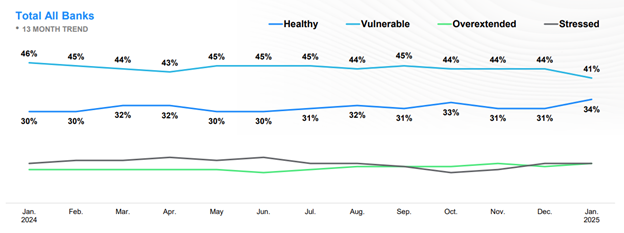
According to JD Power data, 34% of customers are financially healthy,[1] the highest rate in more than a year. While the improvement isn’t a massive leap by any means, it is an encouraging metric following the holiday season.

As some customers begin to find their financial footing, concerns persist about anything that could potentially set them back, particularly the risk of credit or debit card fraud. And for almost half of customers, debit card fraud casts a bigger shadow than unauthorized credit card purchases.

Financial Health Gets a Slight Boost                                                      

The number of customers who are financially healthy rose to 34% in January, while 41% of bank customers were in the vulnerable category. Both numbers reflect 13-month bests in their respective categories, albeit a modest improvement.


U.S. Bank Financial Health Trend February 2025


The percentage of bank customers who say the cost of goods is increasing faster than their income rose to 66%. Vulnerable customers saw an increase to 78% and over extended customers saw an increase to 59%, perhaps an indication that the improvements in financial health will not be long-lasting.


U.S. Bank Financial Health Are Card Providers Providing Enough Security February 2025


Security of Cards

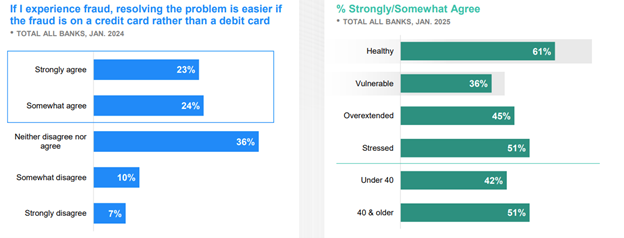
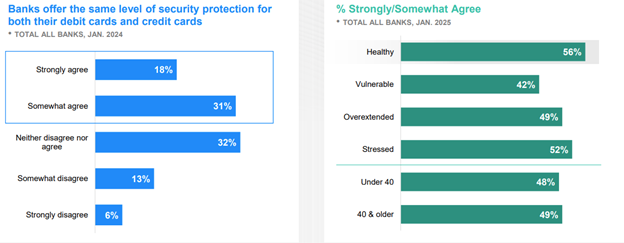
Almost half (49%) of customers say that banks offer the same level of security protection for both their debit and credit cards. This rate is highest among healthy (56%) and stressed (52%) customers.


U.S. Bank Financial Health Are Card Providers Providing Enough Security February 2025


When asked which type of fraud is easier to resolve—debit or credit card—nearly half (47%) of customers said their credit card was easier to manage. Whether that perception is true or not, it does chart a course for banks and/or card issuers that are looking to bolster confidence in their security. More messaging may be needed about the security of their debit cards and issue resolutions if/when those instances of debit card fraud occur.


U.S. Bank Financial Health Experience Debit or Credit Card Fraud February 2025


Safe and Sound

Whether customers’ financial health builds on this past month’s incremental gains or not, credit and debit cards play a big overall role in the overall picture. And with banks and issuers hoping to build confidence in the security of their products, more communication is needed around the safety of debit cards.

Customers need to feel secure to store card information, especially those who could have their financial situation go from bad to worse with even a minor incidence of fraud. Communicating that banks and issuers prioritize the same support around any incidence of fraud will undoubtedly boost utilization of debit cards, which may lead to better budgeting and customers paying lower interest rates. Time will tell if banks can effectively deliver this message.


Find out More

This Banking and Payments Intelligence Report is based on responses from 4,000 retail bank customers nationwide and was fielded in January 2025. It was authored by Jennifer White, senior director of banking and payments intelligence at JD Power. Please contact us at the numbers below to connect with Ms. White or to learn more about the underlying research.


Media Contacts

Brian Jaklitsch; East Coast; 631-584-2200; [email protected]

Geno Effler, JD Power; West Coast; 714-621-6224; [email protected]


[1] JD Power measures the financial health of any consumer as a metric combining their spending/savings ratio, creditworthiness, and safety net items like insurance coverage. Consumers are placed on a continuum from healthy to vulnerable.

A new year has arrived, but the same financial malaise persists. Inflation ticked up in December 2024 and the Consumer Price Index saw a 2.9% year-over-year increase, which is keeping bank customers in the United States on their heels.

According to JD Power data, 31% of customers are financially healthy[1], a rate that has largely remained unchanged since the summer. As a result, customers are trying to decipher new ways to get a handle on their finances, with many turning to banks in the hopes of a more holistic view of their finances. Part of that search includes an increased interest in open banking, which is the practice of banks securely exchanging financial information with other financial institutions or third parties, such as financial advice apps, digital payment processors and other service providers. 

Financial Health Remains Unchanged                                                 

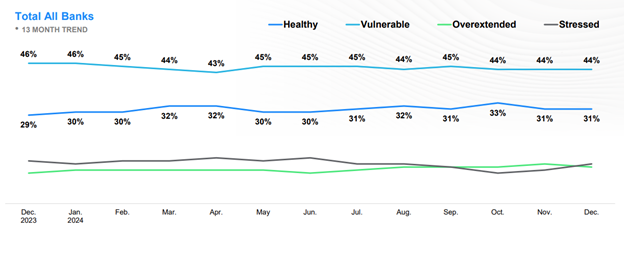
The number of customers who are financially healthy remained the same in December at 31%, while 44% of bank customers fall into the vulnerable category.

J.D. Power Financial Health Trend January 2025

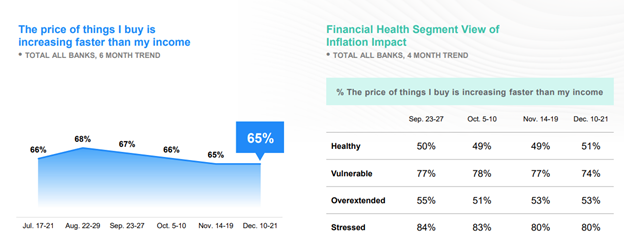
The number of bank customers who say the cost of goods is increasing faster than their income also remained steady at 65%. Vulnerable customers saw a slight decrease to 74%, while healthy customers actually rose slightly to 51% from 49%.

J.D. Power Cost of Inflation January 2025


A Holistic View

As customers continue to grapple with a tenuous financial landscape, many are expressing a bigger interest in seeing a complete picture of their finances in one place. One way to accomplish that is through more comprehensive financial aggregator tools. Overall, 41% of bank customers say it is extremely important for a bank’s mobile app to show the balances of their external accounts, up from 32% from May.

J.D. Power Financial Health Importance of External Bank Info in Mobile Apps January 2025

That interest has grown across all financial health segments, with stressed customers seeing the biggest jump in interest since the question was last asked in May 2024. Even older customers (40 and older) saw an increase of 9 percentage points.

J.D. Power Financial Health Importance of External Bank Info in Mobile Apps by Financial Health Type January 2025


Open for Business

The desire for more complete financial tools is indicative of an overall customer trend toward open banking. While historically, only customers and their banks have had access to their financial data, open banking is now enabling the development of new financial services products and offerings. By creating an easier flow of information from the bank to third parties, customers are finding improved ways to manage their money, make payments, and gain access to credit. With the practice gaining popularity with customers, the onus now shifts to banks to meet customers where they are and support better experiences—even when their customers are working with third parties.

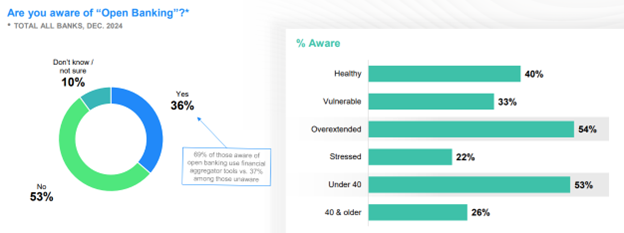
Overall, more than one-third (36%) of banking customers are aware of open banking, with overextended (54%) and younger (53%) customers most familiar with the practice.

J.D. Power Financial Health Opening Banking Awareness January 2025

There is also a strong relationship between open banking and financial aggregator tools. For example, customers who are aware of open banking are more likely to use financial aggregator tools and understand the value of these tools.


A Better Understanding

With many customers still stuck in the same financial predicaments for the better part of two years, many seem to have a genuine interest in new ways to get a handle on their finances, and a willingness to try new solutions. For banks, that means they’ll have to be receptive to customer desires and tailor their products to those needs. 

Open banking and better financial aggregator tools allow customers to glean complete insights into their finances and that is a vital component of understanding how to take the next step. Banks that can provide this intelligence stand ready to benefit from a more informed and, eventually, more financially healthy customer base.

Find out More

This Banking and Payments Intelligence Report is based on responses from 4,000 retail bank customers nationwide and was fielded in December 2024. It was authored by Jennifer White, senior director of banking and payments intelligence at JD Power. Please contact us at the numbers below to connect with Ms. White or to learn more about the underlying research.

Media Contacts

Brian Jaklitsch; East Coast; 631-584-2200; [email protected]

Geno Effler, JD Power; West Coast; 714-621-6224; [email protected]
 

[1] JD Power measures the financial health of any consumer as a metric combining their spending/savings ratio, creditworthiness, and safety net items like insurance coverage. Consumers are placed on a continuum from healthy to vulnerable.

Cracking the Code on Affluent Clients: Trust, Technology, and Opportunity

VIDEO: Financial Services Intelligence Update — January 2025

When it comes to affluent consumers, one thing stands out above all else: trust. It’s not just important—it’s the ultimate differentiator. As wealth transfers between generations and new technologies reshape the industry, JD Power’s latest research offers exclusive insights into how banks and wealth firms can meet—and exceed—the expectations of their most valuable clients.

In the newly released JD Power Affluent Client Trend Report, JD Power combines several benchmark studies to provide valuable insights into the affluent and emerging affluent customer base. Drawing on data from more than 250 financial institutions, we highlight key trends and strategies that can drive loyalty and growth with these valuable customers.

To explore how firms can better serve this critical demographic, JD Power’s Craig Martin, Executive Managing Director at JD Power, joined Miles Tullo, Managing Direct, for a deep dive into the evolving landscape of affluent clients.

Key Insights for Winning Affluent Clients’ Trust and Loyalty in 2025

  1. Trust Is Multifaceted: While banks earn high marks on transactional trust—ensuring secure, efficient daily operations—wealth firms excel in building holistic, goals-based relationships.
  2. Generational Wealth and Opportunity: Younger consumers represent untapped potential, but firms need tailored strategies to engage this demographic.
  3. Technology Meets Strategy: As artificial intelligence and digital tools transform the financial industry, aligning these innovations with human-centric approaches will be essential for success.

Understanding the Affluent Client

Craig Martin explains that affluent clients are not a monolithic group. Their behaviors, preferences, and trust levels vary across age groups and wealth tiers. While Baby Boomers typically have established financial relationships, younger affluent consumers represent a significant growth opportunity for both banks and wealth firms.

“Understanding the affluent consumer requires delving into the nuances of these groups and addressing what truly builds trust. It’s not just about satisfaction—it’s about creating loyal brand advocates,” Martin said.

Trust: The Cornerstone of Client Relationships

Trust emerged as a central theme in the conversation. The report reveals that wealth firms are generally more successful at establishing high trust levels than banks. Affluent clients have different trust expectations depending on whether they interact with a bank or a wealth manager.

“For banks, trust is often linked to transactional reliability—keeping data secure, offering seamless transfers, and maintaining technical soundness,” Martin explained. “For wealth managers, trust goes beyond transactions, requiring a focus on relationship-building and personalized advice.”

A Data-Driven Approach to Growth

The Affluent Client Trend Report offers more than just trends—it provides actionable insights. By analyzing the behaviors of over 10,000 consumers, the report outlines ways firms can:

  • Leverage AI and digital tools to personalize services.
  • Adapt strategies for generational wealth transfers.
  • Prioritize high-value opportunities in a competitive landscape.

Martin emphasized the need for strategic resource allocation: “Firms don’t have unlimited budgets or personnel. The challenge lies in determining how to prioritize investments in technology, people, and processes to meet the evolving needs of affluent clients.”

 When it comes to affluent consumers, trust is more than just a factor—it’s the key to winning their loyalty

Preview the Affluent Client Report 

The JD Power Affluent Client Trend Report is now available for preview. The report offers exclusive insights into the behaviors and expectations of affluent consumers, along with key trends and strategies for driving loyalty and growth. Preview the report today. 

Preview now: Affluent Client Trends Report Preview

Craig Martin is the executive managing director, dedicated to driving positive change in the financial services sector and helping clients achieve superior business outcomes by focusing on their customers. 
Craig’s insights have been featured in numerous publications addressing customer experience and the correlation between customer satisfaction and business success.

Miles Tullo is Managing Director of Financial Services at JD Power. He oversees client engagement with financial services clients in North America. Drawing from extensive experience in payments and lending, Miles brings valuable expertise to clients and contributes regularly to JD Power’s thought leadership initiatives.

As we approach the end of the year, the major storylines that have developed in the credit card industry are creating ripple effects through the entire financial landscape.

Even as inflation dropped to its lowest level since February 2021, customers are still trying to find their footing and they are leaning on their credit cards to help.

Using data from the JD Power 2024 U.S. Credit Card Satisfaction Study we have identified the biggest trends in the credit card industry this year and analyzed how customers are behaving in response to these trends. From late fees to card delinquencies to revolving card debt, here are three issues set to define the year ahead.

The Spirit of the Late Fee Cap            

This past March, the Consumer Financial Protection Bureau (CFPB) announced that it would be capping credit card late fees at $8 per occurrence. The news came as a welcome sign for customers. In the spring, 25% of credit card customers told JD Power that they had paid a late fee in the past 12 months, and 73% of those had paid more than $8.

But in May, the American Bankers Association (ABA) and U.S. Chamber of Commerce filed a legal challenge and a federal judge agreed, which blocked the CFPB’s plan to curb fees. The cap could be resurrected. In September, Former President Donald Trump made a campaign promise that, if elected, he would support a cap on credit card interest rates.

While the spirit of the rule seems consumer friendly, it’s worth noting that neither the late fee nor interest rate cap proposals would immediately affect the majority of U.S. cardholders. Only 18% of U.S. cardholders say they have paid more than an $8 late fee, and 24% of cardholders report having an interest rate above 10%. It’s likely these numbers are larger, as most cardholders don’t know such pricing details about their credit cards and may not be aware of even benefitting from such policy caps. Still, some think the policy will resonate with customers and as an early mover gesture. Notably, PNC and Wells Fargo have already begun reducing credit card late fees.

As is often the case, when one issuer finds success in a strategy, others follow. Keep an eye out for more issuers offering late fee caps to try to build goodwill with their existing customers while enticing new ones.

Are Card Delinquencies Really on the Rise?

While high consumer prices and inflation fatigue may make it seem like credit card payment delinquencies are on the rise, JD Power data finds that the level of revolving card debt and card late payment fees is flat year over year.

That said, cardholders do say they are having a harder time being able to pay their bills—credit card or other—on time now than they did in 2023 (ability to pay fell to 4.26 in 2024 vs. 4.29 in 2023 on a 5-point scale). While some brands are seeing their customers’ ability to pay bills on time fall significantly, brands with more financially healthy[1] customers and that have a single product focused on credit building are seeing improvements.

As issuers find more ways to attract desirable customers, some may opt to narrow their focus and tailor their marketing strategies to customers that are actively looking to consolidate or pay down their debt. Look for issuers to try to build awareness for their debt management tools as well, hoping to build engagement and bolster customer awareness and education.

Rich in Miles

After years of pent-up travel demand during the pandemic, customers are once again taking to the skies, and they’re doing so in record numbers. But after airline rewards credit cards came under attack at a May CFPB hearing, some analysts wondered if customers are actually racking up big credit card debt just to accrue airline miles.

According to JD Power data, 40% of airline cardholders have revolving debt, which is significantly below 51% all card average. Airline cardholders are also significantly more financially healthy (61% vs. 46% all card average) and are much more likely to say that their debt is completely manageable. Of course, there are exceptions, but by and large, airline cardholders tend to manage their finances relatively well.

It makes it clear why smaller carriers have an issue with bigger brands that can offer airline card miles: these types of customers are extremely attractive and they’re drawn to this perk. And while that may make it difficult for smaller carriers to compete in the marketplace for customers, it also places an onus on companies to find a way to match that kind of value proposition and offer a service that is as attractive as discounted airfare.

Finding the Opportunity

As issuers take appraisal of the developments of 2024, the experiences of the past 12 months offer a roadmap to new strategies for 2025. The marketplace is moving in a new direction, and a new breed of customers are prioritizing different things. How they are interacting with their credit cards, and what they hope to gain from a relationship with an issuer should influence these next steps.

Issuers that can digest this information and meet customers where they are will not only reap the benefits of increased customer loyalty and retention, but they will become more attractive in a very competitive marketplace.

Find out More

This Banking and Payments Intelligence Report is based on responses from 38,852 credit card customers nationwide and was fielded from June 2023-June 2024. It was authored by John Cabell, managing director of banking and payments intelligence at JD Power. Please contact us at the numbers below to connect with Mr. Cabell or to learn more about the underlying research.


Media Contacts

Brian Jaklitsch; East Coast; 631-584-2200; [email protected]

Geno Effler, JD Power; West Coast; 714-621-6224; [email protected]


[1] JD Power measures the financial health of any consumer as a metric combining their spending/savings ratio, creditworthiness, and safety net items like insurance coverage. Consumers are placed on a continuum from healthy to vulnerable.