Home & Retail Intelligence Report
January 2024
As Federal and Local Governments Weigh Gas Appliance Legislation, Do Consumers Have a Strong Preference for Gas over Electric?
Gas stoves have emerged as a hot button issue in political circles following a recent announcement by the U.S. Department of Energy’s Consumer Product Safety Commission, which discussed possible regulation of gas stoves, and moves by state legislators, such as those in California, Colorado, New York and Washington, to restrict the use of gas appliances in all new home construction.
Predictably, the mere suggestion that the government might insert itself into setting any kind of restriction of consumer choice unleashed a tidal wave of public opinion on the matter. From Vice President Kamala Harris unwitting going viral for a Thanksgiving photo in front of a gas stove to scientific studies analyzing the health risks associated with gas cooking, it seems everyone has something to say on the topic.
But how do the consumers—who are actually making purchase decisions—feel about gas appliances? In order to take the pulse of real-world consumers, JD Power examined data from the past three years of the JD Power U.S. Appliance Satisfaction Study to find out exactly who the prototypical gas appliance customer is, how happy they are with their existing appliances and how loyal they are to their cooking fuel of choice.
Mapping the Demographics of Gas Appliance Owners
When broken down into customer demographics, gas appliance owners are more concentrated in the Midwest and South portions of the country; more likely to live in suburban areas; and have a slightly higher average income ($93,467 vs. $92,942 for electric).
Gas appliance owners are also the most common among Boomers,1 who have the highest level of ownership when broken down by generations (40%). Generation X had the lowest level of ownership (33%). In 2021, 35% of customers purchased gas and 60% favored electric, which remained consistent through 2022. In 2023, there has been very little change with 36% purchasing gas and 59% electric. We also see a preference for electric among people who are single (60%) and divorced/separated (60%) versus those who are married (58%).
Loyalty Goes Both Ways
Loyalty patterns echo this consistency, with 38% of gas appliance purchasers expressing a definite intent to stick with gas, compared with 39% of electric appliance purchasers. Similarly, 48% of gas appliance purchasers would recommend their appliance brand, closely mirroring the 49% of electric appliance purchasers who feel the same way.
When it comes to user experience, 12% of gas users reported problems with their appliances, slightly lower than electric users (14%). However, satisfaction with energy efficiency tells a different story, with 89% of gas users and 91% of electric users saying their appliance is energy efficient.
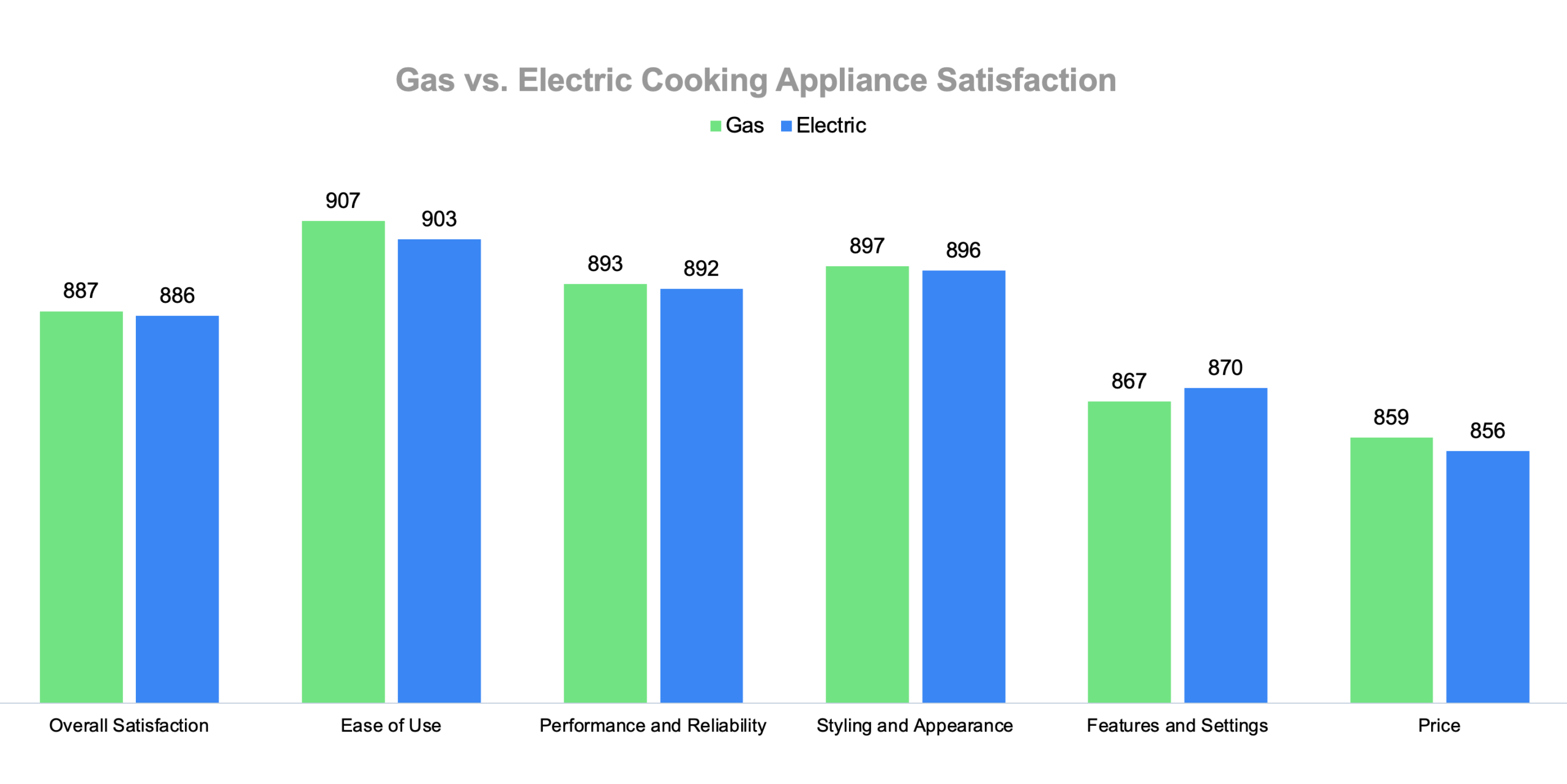
The debate over gas stoves extends to the customer experience, where satisfaction scores across various categories are remarkably close. Gas scores slightly higher (on a 1,000-point scale) in overall satisfaction ease of use, and styling, while electric edges ahead in features, settings and price.
The Domino Effect
While tighter regulation on gas appliances would obviously create big challenges for manufacturers, it could also alienate consumers who are loyal to their appliances and respective brands. While the debate around gas vs. electric appliances will likely continue, no widespread ban on gas stoves is likely to occur in the United States any time soon.
However, the regulatory landscape around sustainability initiatives is ever evolving and can pivot quickly. Just like the Inflation Reduction Act provided big incentives that have led to an explosion in battery investments, similar benefits could be built into future laws to spur the development of new appliance technology. As this landscape evolves, brands will need to stay apprised on how they can win new customers by staying ahead of the legislative curve, and trying to develop better technologies that will ultimately be more attractive to customers.
Find out More
This Home and Retail Intelligence Report is based on responses from the 2021, 2022, and 2023 JD Power Appliance Satisfaction Study. It was authored by Christina Cooley, senior director of home and retail intelligence at JD Power. Please contact us at the numbers below to connect with the team or to learn more about the underlying research.
Media Contacts
Brian Jaklitsch; East Coast; 631-584-2200; [email protected]
Geno Effler, JD Power; West Coast; 714-621-6224; [email protected]
1JD Power defines generational groups as Pre-Boomers (born before 1946); Boomers (1946-1964); Gen X (1965-1976); Gen Y (1977-1994); and Gen Z (1995-2004). Millennials (1982-1994) are a subset of Gen Y.