New electric vehicle (EV) sales in the Netherlands grew year on year in April. However, while plug-in-hybrids (PHEVs) proved popular, battery-electric vehicles (BEVs) sales struggled. Autovista24 content specialist James Roberts reports on a market facing challenges in 2026.

In April, a total of 15,826 new EVs, made up of BEVs and PHEVs, were sold in the Netherlands, according to the latest data from EV Volumes. This marked a 5.2% year-on-year increase, up from 15,040 units 12 months prior.

Despite this apparently positive trend, the country’s EV powertrain breakdown unearthed a stagnant marketplace. Between January and April, a total of 61,549 new EVs were sold in the Netherlands. This was down 3.1%, compared with the 63,513 sales recorded in the same period last year.

Sluggish BEV demand

Across Europe, many larger markets have seen a significant increase in BEV deliveries. In the Netherlands, however, April’s year-on-year improvement amounted to just 0.9%. This was achieved with 9,628 new sales, according to EV Volumes.

The first four months of the year confirmed the weakness of the country’s BEV market. In this period, 34,657 new all-electric models made their way onto the road, an 18.5% year-on-year slide.

Despite a smaller volume, PHEV sales rose 12.8% year on year in April. In total, 6,198 units were delivered, up from the 5,495 12 months prior. Four months into 2026, PHEV volumes were up year on year. A total of 26,892 sales provided a 28.1% lift.

Dutch EV drop part of bigger picture

The Netherlands’ wider new passenger car market is being impacted by broader economic factors. This includes rising new vehicle costs, as revealed by RAI Vereniging and BOVAG in their 2025 to 2026 report. They state that: ‘the average purchase price has risen to €50,110 due to the rise of larger and electric models.’

The market is also influenced by its fleet and company car channel, which accounts for a sizeable share of sales. Therefore, leasing dynamics and changes in taxation have a considerable impact on market behaviour compared with some other European markets.

‘For company cars, the reduced benefit-in-kind rate for BEVs remains supportive, especially given the importance of the fleet market in the Netherlands,’ stated Joanna Fabiszewska-Solares, market analyst at EV Volumes.

Across the first four months of 2026, BEV sales were down year on year in the Netherlands. This followed the phasing out of private EV subsidies, coupled with the removal of key tax incentives. This has increased EV ownership costs. Meanwhile, a pull forward of demand into late 2025, exacerbated by expiring tax benefits, weakened the base comparison in 2026.

‘From an EV perspective, BEVs continue to benefit from a reduced motor vehicle tax (MRB),’ added Fabiszewska-Solares. ‘Although the advantage is gradually being phased down until the full rate applies from 2030. PHEVs have already lost most of their tax benefits and are subject to the full MRB rate from 2025 onwards.’

In April, electrive reported on Dutch government plans to introduce a scrappage scheme. It looks to offer around €3,500 to low and middleincome buyers of used EVs who trade in older internal-combustion engine vehicles. Expected to launch in late 2026, the measure aims to boost EV uptake and affordability while accelerating the removal of higheremission cars.

Skoda on top in April

A total of 690 sales slotted the Skoda Elroq at the top of April’s best-selling BEV chart. This was the best result of 2026 so far for a model which led the Netherlands’ BEV market in 2025. It landed above the second-place Kia EV3, which also posted a volume high for the year with 527 sales.

Indicative of the Netherlands’ wider BEV market, both models witnessed year-on-year volume and market share declines in April.

The Elroq experienced a volume drop of 18.2% in the month. This eroded its overall monthly market share to 7.2%, down 1.6 percentage points (pp). Similarly, the EV3 witnessed a 39.6% slide in volumes. In turn, this resulted in a 5.5% share of the BEV market, falling 3.6pp.

Despite this stutter in April, both models sat well in the cumulative BEV top 10. Between January and April, the Elroq moved 1,687 units, placing it third with a 4.9% market share. The EV3 matched this market share, albeit with 1,705 sales, pipping the Czech car to second place.

Tesla leading the EV market

The Tesla Model Y ended 2025 as the third most popular BEV in the Netherlands, behind the Elroq and EV3. In April 2026, it saw 357 sales, taking fifth. However, more telling was its cumulative place in the rankings.

Between January and April, the US model shifted 1,979 units. This put it at the top of the all-electric sales charts with a 5.7% market share. It was joined in the cumulative top 10 by the Tesla Model 3, which sat sixth after four months of the year, tallying 1,111 sales.

Best of the rest

Market newcomer, the Toyota C-HR+ emerged as the Netherlands’ third best-selling BEV in April. In its third month recording deliveries, the compact SUV reached 390 sales, emerging as a potential disruptor.

The Volvo EX40’s pan-European appeal was reflected in the Netherlands. A 57.2% year-on-year volume lift equated to 360 units and a 3.7% market share, up 1.3pp. The Swedish BEV claimed seventh in the cumulative rankings, ahead of the Volvo EX30.

The combined total of the Renault 5 and Alpine A290 took seventh in April. Despite a 17.1% year-on-year drop, it continued a 17th consecutive month of triple-digit sales volumes. Four months into 2026, it took fourth with 1,267 units and a 3.7% market share.

April saw the Hyundai Inster claim eighth with 278 sales, followed by the Audi Q4 e-tron with 234 units. The latter underwent a 20.9% year-on-year drop in deliveries, whereas the Volkswagen (VW) ID.3 saw a 175.3% upswing to 223 sales, taking 10th.

Ford forges ahead with PHEV

The Ford Kuga led the Dutch new PHEV market in April. The venerable PHEV saw a 44.1% year-on-year volume increase in the month, its 448 sales carving out a 7.2% market share, up 1.5pp.

As a result, the Kuga was the best-selling PHEV after four months of 2026. It stayed ahead of the second-place Skoda Kodiaq iV. The Czech model chalked up 1,679 sales between January and April, despite a 23.5% drop in deliveries during April.

The VW Tiguan also underwent a double-digit year-on-year sales slide in the month. Its 309 sales were down by 18.5%, putting it third in April. It took the same position in the cumulative table, with 1,126 units and a 4.2% market share.

While one VW PHEV struggled in April, another made waves. The VW Tayron managed 279 sales with a 156.6% year-on-year uplift, putting it in fifth. It was followed by the Audi Q3 in sixth.

PHEV market newcomers make impact

In unison with many European PHEV markets, offerings from Chinese carmakers are emerging as major players in the Dutch sector. After four months of 2026, both BYD and Jaecoo models ranked higher than BMW and Mercedes-Benz PHEVs in the Netherlands.

April saw a monthly high for the BYD Seal U. Its 230 units marked a 75.6% year-on-year unit upswing. More significantly, it resulted in the mid-sized SUV claiming fourth in the Dutch PHEV rankings after four months of the year. Cumulative sales hit 1,060, ensuring a 3.9% market share.

Meanwhile, despite only moving 70 sales in April, the Jaecoo J7 ended up seventh in the cumulative order. It saw 906 sales and a 3.4% market share. Omoda is also starting to gain a presence in the Netherlands’ PHEV market. Four months into the year, the Omoda 9 saw 226 sales


New light-commercial vehicle (LCV) registrations in the UK recorded a second consecutive month of growth in May. This was supported by strong demand for electric vans. Andy Picton, specialist residual value analyst at Glass’s, examines the data with Autovista24 content specialist James Roberts.

The UK’s new LCV market recorded growth in May 2026, with registrations rising 3.6% to 23,620 units, SMMT data reveals. This marked the second consecutive month of improvement; the first time this has occurred since October 2024.

However, despite this increase, the performance across the first five months of the year remains slightly behind 2025. A total of 127,046 LCVs were registered between January and May. This was down 0.6%, compared with the 127,875 units recorded over the same period last year.

Market performance in May remained uneven across the different LCV segments. Pickup registrations continued to decline sharply, falling 57.7% to just 1,138 units. This reduced their market share to 4.8%, down from 11.8% a year prior.

Vans under 2 tonnes gross vehicle weight (GVW) saw registrations drop by 24.5%. Meanwhile, those weighing between 2 and 2.5 tonnes GVW recorded a delivery decline of 7.5%.

In contrast, the large-van segment, weighing between 2.5 and 3.5 tonnes GVW, recorded robust growth of 18.6%, reaching 17,380 units. These accounted for 73.6% of all registrations in May. Meanwhile, 4×4 registrations rose 16.2% year on year to 832 units.

Ford models retain LCV dominance

Ford remained dominant in the UK LCV market, with the Transit Custom and Transit securing the top two in May.

The Peugeot Partner claimed third, followed by the Volkswagen (VW) Transporter in fourth. The Maxus Deliver 9 completed the top five.

Further down the top 10, the Renault Trafic and Mercedes-Benz Sprinter took sixth and seventh, respectively. The Land Rover Defender ranked eighth, ahead of the Vauxhall Vivaro and VW Crafter in ninth and 10th places.

Spanning January to May, the Ford Transit Custom continued to lead with 19,570 units registered. It was followed by the Ford Transit with 9,679 units.

Electric van uptake grows but remains below targets

Battery-electric van registrations up to 4.25 tonnes GVW saw solid growth in May, rising 35.5% to 2,345 units. This equated to a market share of 9.8%, up from 7.6% in the same month of 2025.

Despite this progress, diesel still dominated the sector, accounting for 83.9% of all new deliveries. This underlines the enormity of the task ahead in transitioning to zero-emission vehicles (ZEVs).

Over the first five months of 2026, battery-electric LCV registrations reached 12,180 units, an increase of 15.9% year on year. This carved out an overall market share of 9.5%, an improvement on the 8.2% achieved in 2025. Yet the result was still significantly below the UK’s 24% ZEV mandate target for LCVs in 2026.

High upfront vehicle costs, rising energy prices and ongoing charging infrastructure challenges continue to limit faster adoption. This is despite an increasingly broad range of electric LCVs available.

Volkswagen leads electric LCV segment

VW headed the battery-electric LCV market in May, accounting for 35.3% of the registrations. Ford followed with a 25.6% share, while Kia placed third with 13.6%. Maxus and Renault completed the top five manufacturers for the month with 5% and 3.6%, respectively.

Between January and May, VW emerged as the leading battery-electric LCV brand, with a 27.2% share. Ford followed with a 25.6% hold of the market, while Kia took 17.6%.

By model, the VW ID.Buzz Cargo led the way, followed by the VW e-Transporter and Ford E-Transit Custom. The Kia PV5 and Ford E-Transit rounded out the top five.

Lower down the rankings, the Ford E-Transit took fifth with a 7.8% share of registrations. The Maxus eDeliver 9 followed in sixth with a 4.1% share. This was ahead of the Ford E-Transit Courier in seventh with 2.7%.

The Toyota Proace Electric ranked eighth with a 2% share, while the Mercedes-Benz e-Citan finished ninth with a 1.7% share. The Renault Master E-Tech completed the top 10, representing 1.6% of the market.

After five months, the Kia PV5 topped the electric van market, taking a 17.6% share. The Ford E-Transit Custom sat in second with 16.2%, closely followed by the VW ID.Buzz Cargo in third with 16.1%. The VW e-Transporter ranked fourth with an 11.1% share. The Ford E-Transit Courier completed the top five with 5.2%.

Hybrid segment expands rapidly

The plug-in hybrid (PHEV) segment also continued to grow. A total of 1,108 LCVs powered by the technology were registered in May, driven largely by Ford.

The manufacturer dominated this category, with the Transit Custom PHEV leading, alongside the Ranger and Transit Connect variants. VW and Toyota also contributed, with the Caddy PHEV and Corolla Commercial, respectively.

Between January and May, hybrid registrations reached 7,296 units, up 41.9% compared to the same point in 2025. Ford accounted for over 80% of this market, underlining its strong position in electrified LCVs.

Used market remains resilient

In the used LCV market, demand remained strong overall, supported by high buyer engagement at auction. Well-maintained, low-mileage vehicles with a full-service history continue to command the greatest interest and strongest prices.

However, a clear two-tier market is emerging. Older, high-mileage vehicles, particularly those in poorer condition, are proving harder to sell. This is unless priced competitively or improved through refurbishment.

Retail demand showed some softness in May. The influence of bank holidays, school half-term periods, favourable weather and wider economic uncertainty all likely played a part.

Auction activity increases in May

Auction activity strengthened notably in May, with volumes rising by 31.3% compared with April. Average vehicle age fell by 2.2 months to 69.9 months, while mileage declined to 76,583 miles from over 82,500 miles a month earlier.

Average sale prices increased by 6.3% to £8,278 (€9,594). However, first-time conversion rates softened, slipping 2.4 percentage points (pp), to 74%, leaving them 5.7pp below the level recorded a year ago.

Euro 6 vehicles continued to dominate auction sales, accounting for 87.2% of transactions. Meanwhile, Euro 5 models made up 9.5% of the total, down from April.

Medium vans remained the most in demand with a 37.8% share, followed by large vans at 29.1%, and small vans at 21.1%. Pickups and 4x4s accounted for 12% of sales, gaining 0.8pp month on month, and achieved the highest average values at just over £13,550, around £2,300 higher than in April.

Large vans continued to cover the greatest distances, averaging 89,089 miles, up by more than 4,300 miles month on month. This segment also achieved the strongest first-time conversion rate at 77.8%, in contrast to the 4×4 category, which recorded the lowest at 67.7%.

Demand rises for used electric vans

Interest in used battery-electric LCVs at auction is increasing. This looks to be supported by improved market understanding and greater transparency around battery condition. The inclusion of battery health data is helping buyers make more informed purchasing decisions.

This growing confidence translated into a 37% rise in used sales during May. The average age of vehicles sold increased slightly to 38 months, while mileage rose to 21,917 miles. Despite this marginally older and higher-mileage profile, demand for well-presented stock remained strong.

Average sale prices climbed by 3.8% in May to just under £10,300. First-time conversion rates improved sharply to 87%, up from 84.1% in April.

Medium-sized battery-electric vans dominated proceedings, accounting for more than two-thirds of all sales, with small vans taking a further 29%. Small vans also recorded the highest average mileage at close to 23,450 miles, while medium vans delivered the strongest values at just under £11,400. Large battery-electric vans achieved a perfect first-time conversion rate of 100%.

Only 3% of all-electric models sold during the month were older than six years. This highlights the relatively young profile of stock entering the used market.

Retail supply stable but under pressure

The number of used LCVs available in the retail market remained broadly unchanged in May at just under 42,300 units. However, supply was down significantly year on year, falling by nearly 12.7%.

Diesel models continued to dominate listings, accounting for 90.3% of all vehicles on sale. Battery-electric vans represented 5.8% of the market, ahead of PHEVs at 2.2% and petrol models at 1.7%. Manual transmissions remained the preferred choice, featuring in 66% of listings.

Panel vans made up the majority of available stock at 56.9%, while 4×4 vans and pickups accounted for 16.8%. Crew vans represented 9% of listings, followed by minibuses at 3.7%, with dropsides, Lutons and tippers each making up smaller shares.

Meanwhile, 41.1% of vehicles had covered 30,000 miles or less, while 29.2% fell between 30,000 and 70,000 miles. At the higher end, 13.3% had exceeded 100,000 miles.

Pricing remained weighted towards the upper brackets, with 43.1% of vehicles listed at £20,000 or more. A further 38.4% were priced between £10,000 and £20,000, while 15% sat in the £5,000 to £10,000 range. Only 3.5% were listed below £5,000. In total, 74.2% of adverts displayed prices excluding VAT.

White continued to dominate as the most popular used LCV colour, accounting for 47.6% of listings. Grey followed at 18.6%, with black taking 11%, and silver following with 9.6%. Then came blue at 6.4%, and red with 2.1%.

The average vehicle age in the retail market edged up to 56 months. Meanwhile, average mileage fell slightly to just over 55,650 miles. This reflects the underlying demand for younger, lower-mileage stock.

The UK new-car market saw another month of registrations growth in May. But while battery-electric vehicles (BEVs) lead the way, are mandated targets becoming too optimistic? Autovista24 special content editor Phil Curry examines the numbers.

The UK’s new-car market saw another strong performance in May, as its run of growth extended into a sixth month.

The latest data from the SMMT shows 160,662 passenger cars joined the country’s roads in the month. This was a 7.1% increase year-on-year, equating to an additional 10,592 units based on Autovista24 calculations.

According to the SMMT, the growth was driven by a resurgence in private buyers. This segment of the market saw a 17.2% increase in deliveries, as customers responded to increasing competitive offers from a growing range of brands.

This led to a 6.4% rise in model choice year on year. Within this, the number of BEVs available between January and May increased by 25.6%. In May 2026, a total of 21 additional models received at least one registration compared with a year prior. In total, 31 new BEV models have received registrations across the first five months of the year.

Brands such as Aion, Changan, Chery, Chevrolet, Geely, Mitsubishi and Skywell all saw deliveries in May, with no registrations 12 months prior. The UK’s automotive market is diversifying, and this choice is likely helping to drive growth in the private sector.

Fleet demand grew more modestly, rising by 1.8%. The market still accounted for 57.1% of all registrations. The smaller business sector declined by 18.8%. However, this equated to a drop of just 720 units, according to Autovista24 calculations.

After five months of the year, the UK market stood 8.7% larger than it had at the same point in 2025. With 924,763 registrations, it is well on course to end the year up overall.

BEVs fly as targets remain distant

The UK market was buoyed by the performance of electric vehicles (EVs). Made up of BEVs and plug-in hybrids (PHEVs), the market saw a 30.5% uptick in registrations during May. With 66,098 deliveries, the sector achieved a 41.1% market share, up 7.4 percentage points (pp) year on year. This meant the gap between EVs and internal-combustion engine (ICE) models continued to narrow.

BEVs led the way in May, with the best growth of any powertrain . With 43,931 registrations in the month, they achieved a 34.2% jump year on year. This led to a 27.3% share of the monthly new-car total, a rise of 5.5pp. This was also the all-electric market’s biggest monthly share of 2026.

After five months, BEVs have seen registrations increase by 24.3% to 220,629 units. The powertrain’s momentum has ramped up throughout the year, following small increases in January and February. However, its 23.9% market share, while up 3pp, is still far below the 33% required by the zero-emission vehicle (ZEV) mandate.

So, it seems likely that a major intervention from carmakers or the government is needed to meet targets. According to forecast data published in March by EV Volumes, the UK will see 2,061,866 units registered in 2026. For BEVs to represent 33% of the market, the powertrain would need to see over 680,000 deliveries to customers across the 12 months of the year.

Therefore, almost 460,000 additional registrations are needed between June and December. Based on Autovista24 calculations of available SMMT data, in that period of last year, 295,861 BEVs were delivered. Therefore, across the seven-month period, the technology would need to see an increase of 55.4% in registrations.

Pressure builds on carmakers

Carmakers can use various flexibilities drawn into the legislation to help meet their own mandated targets. However, should the UK not meet the 33% share requirement overall, it would be the third successive year that targets have not aligned.

The SMMT highlighted that the widening gap between government expectations and consumer demand is increasing pressure on carmakers. Many of these are having to absorb the rising costs of compliance.

Adding to this pressure was the seventh Carbon Budget, recently published by the UK government. According to the Climate Change Committee, electric models will make up 95% of the UK’s new car and van sales by 2030. The committee reported that the falling cost of batteries will propel the move to electric. This would allow BEVs to reach price parity with comparable petrol and diesel cars between 2026 and 2028.

The SMMT highlighted that this is an ambition well beyond the ZEV mandate requirement of 80% for the car market, and 70% for light-commercial vehicles. The industry body also noted that achieving this share would require a tripling of EV demand in three years. They commented that this is highly unlikely under current outlooks.

‘If such targets are to be credible, then equally ambitious fiscal and investment support would be essential. A holistic review of the transition is urgently needed,’ stated the SMMT.

UK PHEV slowdown begins?

Although strong, registrations of PHEVs slowed in May. For the first time this year, the delivery increase came in under 40%. The 22,167-unit total equated to a 23.9% rise year on year. This was still good enough for a 13.8% market share, up 1.9pp compared to May 2025.

The performance between January and May meant that despite the slight slowdown, PHEVs have still seen a 41.8% increase in the five-month period. With 121,430 units delivered, the technology accounted for 13.1% of the overall market, a 3pp jump year on year.

Adding these figures to the BEV tally, EV numbers have improved by 30% in the first five months of 2026. The powertrain group accounted for 37% of the new-car market, a rise of 6.1pp compared to 12 months prior.

HEVs lose ground

The SMMT counts the hybrid market differently from other European automotive authorities. Mild hybrids (MHEVs) are merged with their respective petrol and diesel counterparts, leaving full hybrids (HEVs) as a standalone segment.

In May, HEVs achieved a minimal volume increase of 1.8%. According to Autovista24 calculations, this equated to an additional 368 units taking to UK roads.

The result meant that, in terms of market share, HEVs fell behind PHEVs for the second month in succession. Their 12.9% hold of the overall total was 0.7pp down year on year, as other powertrains saw greater improvement. The gap between the two hybrid types grew to 0.9pp, having sat at 0.6pp in April’s monthly figures.

HEVs have seen growth in every month of 2026. However, coming up against strong volumes from 2025 means a slower trajectory of improvement. Meanwhile, PHEVs are performing well, but against lower figures from last year.

This meant that after five months, HEVs have kept their lead against PHEVs. Volumes were up 7.2%, with 131,802 units. This was good enough for a 14.3% hold of the market, even though this was 0.2pp down year on year. The figure was also just 1.2pp up on the PHEV market share.

Adding HEVs into the EV figures, the electrified sector saw a 22.3% improvement in May. Its share of 54% meant it outpaced ICE for the third consecutive month. Between January and May, electrified registrations grew 22.7%, and held 51.2% of the UK market, up 5.8pp.

Petrol leads in the UK

Petrol continued to lead the UK market in May. Combined with MHEVs, the powertrain saw 66,223 registrations in the month. This was, however, a 7.1% decline compared to the same period last year.

The fuel type managed to secure 41.2% of the overall market in the month, a drop of 6.3pp. However, it remained the dominant technology, with a 13.9pp lead over BEVs.

In the first five months of the year, petrol has seen a slight decrease of 2.5% to 406,453 units. This equated to 10,358 fewer models taking to UK roads, according to Autovista24 analysis. Yet with a 44% share, it remained the leading choice with new-car buyers. This was down 5pp compared to five-month period in 2025.

It may take some time for other powertrains to topple the petrol market in the UK. Combined with MHEVs, it remains a formidable force. Yet the gap to BEVs, the second-best choice, has closed since January. In the first month of the year, it was a 27.1pp chasm. Between January and May, the gap was 20.1pp.

Meanwhile, diesel saw 7,622 deliveries in May, a drop of 2.2%. Its 4.7% share was 0.5pp down, as it remained the least-popular fuel type. After five months, diesel suffered a 7.4% decline in volumes to 44,449 registrations, with its 4.8% share down 0.8pp.

Combining the two powertrains, the ICE market fell 6.6% in May. The powertrain group’s 73,845 registrations equated to a 46% market share, down 6.7pp, as it lagged behind electrified totals.

After five months, ICE deliveries have dropped by 3%, with 450,905 registrations. This equated to a 48.8% market share, down by 5.8pp.

New light-commercial vehicle (LCV) sales enjoyed positive year-on-year growth in April as electric van demand increased hand in hand. However, zero-emission vehicle (ZEV) mandate targets remain a distant goal. Andy Picton, specialist residual value analyst at Glass’s, considers the trends with Autovista24 web editor James Roberts.

According to SMMT data, new LCV registrations grew in April by 6.8% year on year. In total, 21,716 vans, chassis, pickups and 4x4s joined UK roads for the first time.

Behind this encouraging overall growth, market performance was mixed. Pickup demand slumped 57.4% to 1,166 units. This ensured volume declines in 11 of the past 12 months, since the changes to benefit-in-kind (BIK) rules. Vans under 2 tonnes gross vehicle weight (GVW) declined 14.4%, while those between 2 and 2.5 tonnes GVW dropped 20%.

On a positive note, the 4×4 sector registered 1,024 units, up 81.6% on April last year. Meanwhile, the large van sector saw demand for vans and chassis weighing between 2.5 and 3.5 tonnes GVW grow by 28.5% over the same period. These 15,561 units accounted for 71.7% of all units registered during the month.

Despite this, the latest registration forecast for 2026 has been revised downwards again. 314,000 units are expected to be delivered this year, down 1,422 units from 2025. The forecast is also 7,000 units down on the first quarter outlook.

Battery-electric vans weighing to 3.5 tonnes are expected to rise from 28,000 units to 35,000 units. This would equate to a 25% increase and a 11.1% market share. This figure, though, remains less than half of the ZEV Mandate ambition.

Wider UK LCV growth

More generally, the latest 2025 Motorparc data covers the overall number of LCVs in use on UK roads. These figures reflect a robust vehicle fleet. However, the move towards zero-emission targets remains sluggish.

Van volumes grew to record levels, up by 1.4% to 5,175,598 units. The most popular vans on the road were the Ford Transit Custom with 554,581 units, followed by the Ford Transit, at 495,971 units. The Volkswagen (VW) Transporter followed with 379,185 units. Of all vehicle types, LCVs have shown the strongest long-term growth, up 29.2% since 2015.

Within the overall total, battery electric vans grew by 34.6% to exceed 100,000 for the first time. In total, 113,256 all-electric models are now in operation across the country, making up 2.2% of LCVs in service.

By region, more LCVs are owned in the South-East than in any other part of the country at 918,991 units, making up a 17.8% share. Of that number, 3.2% were battery-electric vans. This was the highest all-electric share of any region, followed closely behind by the London area with 3.1%.

Ford tops April’s LCV rankings

April saw Ford claim the top two positions, with the Transit Custom and the Transit respectively. The Mercedes-Benz Sprinter took third, the Renault Trafic ended the month in fourth and the Peugeot Partner placed fifth.

The VW Transporter finished sixth, registering 957 units, ahead of the Vauxhall Vivaro in seventh with 952 deliveries. Then came the Land Rover Defender in eighth with 759 units. The Citroen Berlingo secured ninth with 709 units and the Kia PV5 completed the top 10 with 586 units.

April’s electric LCV market analysis

Battery-electric van registrations up to 4.25 tonnes GVW was up 44.7% in April. The 2,439 units sold resulted in a monthly market share of 11.1%, up from 8.3% 12 months prior. However, nearly 83% of all vehicles registered in the month were diesel, highlighting the scale of the task at hand in transitioning operators to ZEVs.

Across the first four months of the year, 9,835 units have been registered, up 12% compared to the same period of 2025. This ensured a 9.4% market share, well below the ZEV mandate target of 24% for this year.

Electric LCV sales by brand

Ford accounted for over a quarter of all new battery-electric vans registered in April. Kia followed behind with 24%, and VW in third with a 22.9% share. Some distance behind was Maxus in fourth with a 6.1% market share and Vauxhall in fifth with a 5.5% hold.

Further down the list, Toyota claimed sixth position with 106 units and a 4.3% market share. Meanwhile, Mercedes-Benz finished seventh with 91 registrations and 3.7% of the market. Renault ended the month in eighth, selling 72 units, and with it, a 2.9% market share. Farizon claimed ninth with 26 units and a 1.1% hold. Citroen rounded out the top ten, registering 16 units and taking a 0.6% market share.

By range, the Kia PV5 led the way for the second month running, accounting for 24% of all battery-electric vehicle (BEV) registrations. The Volkswagen ID. Buzz Cargo followed with a 15.4% hold. Meanwhile, the Ford E-Transit Custom and e-Transporter ended up third and fourth, with shares of 15% and 7.5%, respectively. The Ford E-Transit claimed fifth, with 7% of all registrations.

Lower placed rankings saw the Vauxhall Vivaro Electric and the Maxus eDeliver 9 finish joint sixth with 109 units. The Ford E-Transit Courier was eighth with 100 units and the Mercedes-Benz e-Citan was ninth with 62 units. Completing the top 10 was the Renault Master E-Tech with 57 units sold.

The plug-in hybrid (PHEV) van segment saw five different manufacturers register a combined 1,033 units. Ford led the way with 484 Transit Custom vans, 198 Ranger pickups and 122 Transit Connect PHEVs. Toyota followed with 124 Corolla Commercial vans, ahead of 98 VW Caddy PHEV vans. Dacia registered six Duster Cargo vans and LEVC delivered one new VN5 van.

Between January and April, of the 6,188 hybrid LCVs registered, Ford claimed a dominant 83.4% market share. Toyota followed with a 10.6% share, ahead of VW with a 5.8% hold.

Used LCV market overview

The anticipated influx of de-fleeted stock from fleet, rental and finance providers following the March plate change did not materialise. These vehicles are likely to start being de-fleeted in the next month or so.

Good quality stock is still available, with elevated levels of buyer engagement at most auctions. Sub-two-year-old offerings can struggle against competitive deals for new ‘26-plate vehicles.

Despite this, two-to-four-year-old ready-to-retail stock with typically less than 70,000 miles continues to attract plenty of attention. Buyers are willing to pay strongly for the right vehicle and a full-service history. Additionally, there has been strong interest in older, higher-mileage stock offered in fair condition and realistically priced.

Stock age increased in April

Factors such as ageing stock in poorer condition meant a drop in the number of vehicles sold at auction in April. The Easter holidays and good weather also influenced the decline in sales.

Overall average age increased from 69.7 months to 72.1 months. Average mileage also increased, rising from 73,206 miles to 82,548 miles. Elsewhere, first-time conversion rates worsened by 2.8% to 76.4%, 3.4% lower year on year. Finally, average sales prices fell by nearly 9% over the month

Euro 6 vehicles accounted for 85.3% of sales in April. Euro 5 sales made up 11.4%, up 0.6% on March. Medium vans led demand with 36.8% of sales, followed by large vans at 29.5%, and small vans 22.3%.

The 4×4 Pickup sector took 11.2% of the market, an increase of 0.5% on March. This sector commanded the highest average sales price at just under £11,250 (€12,984). This was a £3,250 decrease on the average paid in the previous month.

Large vans covered more distance than any other LCV type in April at an average of 84,734 miles. This was up 13,735 miles compared to March. The small van sector returned the highest first-time conversion rate at 79.5%, while the lowest was achieved in the 4×4 sector at 71.1%.

Increase in used electric LCV demand

Despite the prevailing preference for petrol and diesel, there has been a noticeable increase in the volumes of used electric LCVs available at auction. Of those sold, many have cited the inclusion of battery health data in the vehicle description as a big step forward. This is giving consumers a more informed picture during transactions.

Electric van performance in April was mixed. On the one hand, overall sales fell by a third. However, those that sold were a lot younger and with significantly fewer miles. Average stock age nearly halved from 69.5 months to 35.8 months. Meanwhile, average mileage fell from 51,166 miles to 20,712 miles.

This younger age-mileage profile resulted in the average sale prices rising by £4,000, from just under £5,900 to nearly £9,900. First-time conversion rates rose nearly 10%, from 74.3% to 84.1%. Sales of medium-sized electric vans proved popular, accounting for 55.5% of all sales in the month. Small vans took a 41.3% share and large vans made up 3.2% of overall transactions.

The highest mileages were covered in the large van sector, averaging over 74,850 miles. The lowest mileage was recorded in the medium van sector at 16,500 miles. Medium-sized electric vans attained the highest average sales price at over £11,500, while the highest first-time conversion rate of 100% was achieved in the large van sector. 44.4% of all electric vans sold in April were between two-to-four years of age.

Retail increases recorded

The number of used vehicles observed for sale in the retail market in April increased by 3% to just over 42,400 units.

Diesel models made up the bulk of those on sale at 90.7%, up 1.1% on the previous month. Battery-electric LCVs accounted for 5.3%, ahead of PHEVs 2.1% share, and petrol’s 1.6% hold. LCVs with manual gearboxes accounted for 66.4% of retail sales.

Panel vans accounted for 56.1% of all LCVs on sale, 13.4% were 4×4 pickups, and 9.2% were crew vans. Minibuses made up 3.9% and dropsides claimed a 1.7% share. Luton vans and tippers represented 1.7% and 1.5% of sales, respectively. Of all the LCVs on sale, 40.8% had mileages of 30,000 miles or less. 29.0% had mileages between 30,000 miles and 70,000 miles, while 13.5% had mileages above 100,000 miles.

43.5% of vehicles listed were priced at £20,000 or more, 38.1% were priced between £10,000 and £20,000, while 14.8% sat in the £5,000 to £10,000 range. Vans priced below £5,000 accounted for 3.6% of the market. Just over 73.8% of all adverts showed the vehicle on sale for a price excluding VAT.

White vans led in popularity, accounting for 47.9% of all listings. Grey represented 18.4% of sales and black took a 10.8% share. 9.7% of all vans listed were silver, 6.2% were blue and 2.1% were red. The average vehicle age for April increased by three months to 55 months. Average mileage also rose, up 6.5% to just under 56,200 miles.

With another month of new-car registrations growth in Germany, one force appears to be driving the market forward. But how are powertrains and brands performing in the country? Tom Hooker, Autovista24 journalist, explores the figures. 

Deliveries of new cars in Germany rose by 2.7% year on year in April, reaching 249,163 units. According to KBA data, private buyers helped drive this growth. Registrations in this sector climbed by 8.2% to 88,182 units.  

However, private buyers accounted for 35.4% of the market last month, compared to the commercial sector’s dominant 64.6% share. This meant that the latter’s 0.2% decline had a bigger impact on the overall market’s performance. 

Varying results were also seen across different passenger car segments in April. SUVs, the most popular body type, saw 13.5% increase in registrations. The compact class was the second-best-selling sector, despite a 12.9% decline. Then came small cars, which enjoyed a 12.1% improvement. 

Between January and April, the entire new-car market grew by 4.5% to 948,567 units. Germany has experienced only one monthly decline in 2026, and only two drops in the last 12 months. So, despite current headwinds affecting the new-car market, demand has remained resilient. 

Broken down, both the private and commercial sectors saw a 5.3% increase after the first four months of 2026. The former accounted for a third of the overall volume. 

Growing private BEV market 

Private demand has also increased in the battery-electric vehicle (BEV) market. This has been influenced by many factors, including a growing range of model choices for buyers. Rising fuel prices have also had a noticeable impact on demand, according to the ZDK

‘Private customers are now relying on BEVs to the same extent as fleet customers have done in the past. Drivers appreciate the increasing product range on the one hand, and the near cost parity in the entry-level segments on the other,’ explained VDIK president Imelda Labbé.  

‘Affordability is decisive for the acceptance of electric vehicles (EVs). This also applies to operating costs, where we see a cost advantage for EVs at present,’ she stated. 

Meanwhile, private buyers are still awaiting the activation of the country’s new EV incentives. The scheme was announced at the start of the year, with retroactive applications eligible back to 1 January. While users will be able to apply for support online, the portal will not open until May. 

Yet industry experts believe that the gap between the programme’s announcement and activation has not hindered demand. 

‘If we had normal market conditions, then the demand for EVs would probably not be as strong as it is currently. The fact that the purchase premium is not yet officially on the market does not even have a negative effect. Many customers plan for the bonus and expect to get this financing,’ said ZDK president Thomas Peckruhn

‘It is now crucial that the framework conditions develop reliably. Then, the market will continue to support the ramp-up under its own steam,’ he highlighted. 

Bigger slice for BEVs 

As more private buyers opt for BEVs, the technology’s slice of the new-car market continues to improve. It took a 25.8% share in April, up from 18.8% at the same time last year. With 64,350 deliveries, the powertrain saw a surge of 41.3% year on year. 

BEVs were the country’s second most popular powertrain in the month, 4.4 percentage points (pp) ahead of petrol in third. The technology was just 2.4pp behind the market share of hybrids, made up of full and mild versions. 

It also marked one of the largest shares for BEVs, alongside August 2023 and December 2022. However, these months were influenced by a pull-forward effect before subsidies were ended or reduced.  

With an increasing share, BEV performance is becoming more important to wider new-car market growth. Excluding the powertrain from last month’s figures results in a 6.3% year-on-year decline. 

BEVs recorded the same 41.3% year-on-year improvement between January and April, equating to 223,980 units. All-electric models made up 23.6% of total deliveries in the first four months of the year, up 6.1pp compared to the same period in 2025. 

PHEV market slowing? 

On the other hand, plug-in hybrid (PHEV) demand appeared to be slowing. Deliveries increased by 13.3% in April to 27,546 units. This followed a similar 13% year-on-year uptick in March.  

However, both improvements were lower than any monthly growth recorded in 2025. The technology is struggling when compared with its strong performances from last year. 

Yet as other powertrains see either smaller growth or overall decline, PHEVs’ market share continues to steadily increase. It grew by 1.1pp to 11.1% in April, while in the cumulative figures, it rose by 1.2pp to 10.9%. This was due to a 17.6% improvement in registrations to 103,660 units.  

Combining BEV and PHEV figures, EV deliveries increased by 31.6% in April to 91,896 units. This translated to a 36.9% share, up 8.1pp year on year. It also marked the grouping’s highest share since August 2023. Between January and April, the EV share reached 34.5% as volumes grew by 32.9% to 327,640 deliveries. 

Petrol market in peril 

As EV growth continued in April, so did the contrasting decline of internal-combustion engine (ICE) deliveries. The powertrain group, which includes petrol and diesel, saw a 17.8% year on year drop to 85,857 registrations. Its grip on the market consequently loosened from 43% to 34.5%, 2.4pp below EVs. 

Petrol had the poorer performance last month, suffering a 20% slump to 53,420 units. Its share fell from 27.5% to 21.4%. Meanwhile, diesel recorded a 13.8% delivery decline to 32,437 units and a 2.5pp drop in share to 13%. 

After four months of 2026, ICE volumes dropped by 14.1% to 341,226 registrations. The grouping captured 36% of the overall market, down 7.8pp year on year. While it remained ahead of EVs by 1.5pp, this could soon change if current performances continue. 

Broken down, petrol suffered the bigger decline of 17.2% between January and April, to 212,478 units. With its 22.4% share, the fuel type sat 6.8pp below hybrids. In comparison, the deficit stood at 0.3pp during the same period of 2025.  

Diesel endured a shallower 8.4% drop between January and April to 128,748 deliveries, as its share fell by 1.9pp to 13.6%. 

Hybrid’s stability stays dominant 

Between soaring EV sales and slumping ICE demand, hybrid volumes have remained comparatively stable in 2026. April saw a 4.2% increase to 70,207 units, giving it a 0.4pp rise in share to 28.2%. However, despite leading the market, this was its lowest hold of 2026 so far, as BEVs inched ever closer. 

Hybrid registrations rose by 6.6% in the first four months of the year, reaching 276,773 units. The technology represented 29.2% of overall volumes, up from 28.6%. 

Adding hybrids to the EV total, the electrified market continued to tighten its grip on new-car sales. The grouping made up 65.1% of deliveries in April, thanks to a 18.1% rise in volumes. In the year-to-date, electrified volumes increased by 19.4%, as the grouping accounted for 63.7% of the market total. 

Audi’s strong April 

Like powertrains, breaking down the new-car market by brands showed contrasting results within the top 10 best sellers.  

In fifth, Audi saw a strong year-on-year gain of 19%. Fellow Volkswagen (VW) Group brand Škoda posted a 12.2% improvement in fourth.  

Conversely, SEAT suffered a 13.9% slump in seventh, ahead of Hyundai, which recorded a 6.1% year on year gain. VW, Germany’s most popular brand, endured a 6.7% delivery decline. 

Ford recorded an 18.5% decline in ninth, followed by a 9.9% drop for Fiat, which rounded out the top 10. Elsewhere in the Stellantis stable, Opel posted a 6.6% delivery increase in sixth. 

Mercedes-Benz enjoyed a year-on-year improvement of 4.9% as it sat second, while new BMW volumes fell by 0.5% in third. 

Yet the fastest-growing brands in April all came from outside the top 10 best-sellers list. With 4,705 units, BYD posted a 200.4% year-on-year improvement to 4,705 registrations. This was bested by Tesla’s 255.8% surge, despite a lower delivery total of 3,149 units. Meanwhile, Leapmotor saw an even greater improvement of 331.5% to 1,355 deliveries. 

What happened to passenger car and light-commercial vehicle (LCV) registrations in the EU during the first quarter of 2026? Which brands proved most popular? Tom Geggus, Autovista24 editor, reveals all in the Automotive Update podcast.

In this episode, an exploration of the latest ACEA data covering registrations of different powertrains and brands in the EU. Spanning the first quarter of 2026, Autovista24 zeroed in on volumes of new passenger cars and LCVs. Also, a look at the UK’s ageing car parc, plus an overview of which brands are seeking to set up shop in the EU. 

Subscribe to the Autovista24 podcast and listen to previous episodes on SpotifyApple and Amazon Music.

EU new-car market springs forward

According to ACEA, registrations of new passenger cars increased across the EU by 4% in the first quarter of 2026. Amid a strong March, electric vehicle (EV) growth was fostered by various incentives, purchase schemes, and tax benefits.

During the first quarter, combined battery-electric vehicle (BEV) and plug-in hybrid (PHEV) registrations increased by 31.5% year on year.

Hybrids, including full and mild versions, remained the EU’s preferred new-car powertrain. Combined, hybrids, BEVs and PHEVs accounted for over two-thirds of the total EU new-car market between January and March.

Meanwhile, deliveries of internal-combustion engine (ICE) vehicles, including petrol and diesel models, fell by 17.6% year on year.

EV adoption boosts new EU LCV growth

In the EU’s new LCV market, diesel deliveries dropped by 0.8% in the first quarter of 2026, ACEA data revealed. Despite this, with a dominant 288,484 units, diesel made up 80% of all LCV registrations up to 3.5 tonnes.  

Although diesel power remains the backbone of the EU’s new-LCV market, demand for electrified models has grown. Combined deliveries of new BEVs and PHEVs increased by 42%.

Additionally, hybrid vehicle registrations rose by 42.1%. This gave EVs a 12% share of the EU’s new LCV market, and hybrids a 3.5% slice.

EU’s leading automotive brands in 2026

Volkswagen (VW) recorded the largest unit volume of any singular brand in the EU across the first quarter of 2026. It took a 10.4% share of the EU passenger car market. However, this was down from 11.2% compared to the same point last year.

Skoda claimed the second largest market share at 6.8%, up from 6% in the first quarter of 2025. Meanwhile, Fiat gained a 0.8 percentage point (pp) increase in market share, to 3.5%.

BYD saw a significant 1.1pp increase in market share to 1.8%. It also recorded the largest growth in registrations in the first quarter, up 169.7% year on year.

Notably, around 120,000 first-quarter registrations were not tied to a specific brand. This likely reflects registrations from newer entrants, such as Xpeng, Omoda, and Jaecoo. These marques have made a strong showing in the EU recently. Overall, this group grew sales by 65.3% year-on-year, raising its market share from 2.7% to 4.3%.

Latest UK car parc make up

Vehicle volumes on the UK’s roads reached a record 42.5 million units last year, according to the SMMT. This marked a 1.4% increase, compared with 2024. There were nearly 36.7 million passenger cars, up by 1.4%, a fourth consecutive year of growth.

Fleet renewal continues to push electrification, with roughly one in 22 vehicles emitting zero emissions. In another new record, almost 1.8 million BEV passenger cars were in use, up 34.7% year on year.

UK drivers are holding on to their cars for longer amid cost-of-living pressures. The average age of cars on the country’s roads was 9.7 years in 2025, up from 9.5 in 2024.

European home for Chinese OEMs?

Several Chinese carmakers are reportedly seeking locations to manufacture vehicles in Europe. According to Reuters, Hongqi is in talks with Stellantis to use its plants in Spain to build its models. 

Meanwhile, Bloomberg reported that Dongfeng representatives have visited Stellantis plants in Spain, France, Italy and Germany. SAIC-owned MG is considering a production location in Spain, Bloomberg also revealed.

Producing models within the EU could help companies like these navigate the bloc’s import tariffs. Use of existing infrastructure could also lower manufacturing costs. 

The EU’s new light-commercial vehicle (LCV) market managed modest growth in the first quarter of 2026. This was boosted by an increase in electric vehicle (EV) demand, as diesel’s dominant grip weakened. Tom Hooker, Autovista24 journalist, unpacks the data.

New LCV registrations in the EU grew by 2.3% year on year in the first quarter of 2026. According to ACEA, a total of 360,648 new LCVs took to the EU’s roads. This signalled a rebound for the sector after an 8.8% delivery decline in 2025.

This growth was enabled by surging registrations of new EVs, including battery-electric and plug-in hybrid technologies. Hybrid LCVs, made up of full and mild-hybrids, also saw strong delivery improvements. This came as diesel volumes stagnated.

Shifting LCV powertrain shares

After a 12.8% slump in registrations during 2025, diesel’s first-quarter result in 2026 could be seen as positive.

Deliveries dipped by 0.8% in the first quarter of this year, with 288,484 units ensuring a dominant 80% market share. However, this was down 2.5 percentage points (pp) year on year, and a 0.7pp drop from its overall 2025 share.

Meanwhile, petrol represented 3.7% of overall volumes. This was down from the fuel type’s 5.2% hold during the first quarter of 2025. Deliveries slumped by 27.1% year on year, with 13,267 new models taking to EU roads.

Combining diesel and petrol volumes, internal-combustion engine sales continued to control the LCV market. This was despite a 2.3% decline in deliveries, plus a 4pp drop in share to 83.7% during the first quarter.

Electrified LCV momentum

EV registrations soared by 42% in the first quarter, reaching 43,441 units. Without this result, the EU’s new LCV market would have fallen by 1.4% year on year between January and March. The powertrain group accounted for 12% of total deliveries, up from 8.7% in the first quarter of 2025.

Hybrid volumes enjoyed a similar year-on-year increase of 42.1%. Yet this was based on a lower figure of 12,636 units. Hybrid-powered LCVs represented 3.5% of all LCV registrations, up 1pp compared to one year prior and just 0.2pp behind petrol.

Adding hybrid deliveries to the EV total, the electrified LCV market saw deliveries increase by 42%. This meant the grouping took a 15.5% market share, up from 11.2% during the first quarter of 2025.

Diverging national LCV results

Across the EU’s 27 member states, LCV registrations saw varying results in the first quarter. In total,18 markets enjoyed growth, including France, the biggest new LCV market between January and March. The country posted a 3.7% year-on-year increase to 88,609 units. This result contrasted with its new-car market decline.

Furthermore, 12 markets achieved double-digit improvements, such as Spain, which recorded the third-highest number of new LCV deliveries. Volumes surged by 13% year on year in the country, with 48,176 units delivered. This proved even more impressive than its new-car market growth during the same period. Poland also achieved a strong result, with a 11.2% increase to 18,113 registrations.

Many four-digit markets also saw notable performances. This included 34.7% growth in Greece. Slovenia, Ireland and Sweden enjoyed improvements of 19.4%, 17.5% and 15.4%, respectively. New LCV sales rose by 15% in Luxembourg, 13.3% in Czechia, and 12.4% in Austria.

Conversely, nine countries suffered delivery declines, such as Germany, the EU’s second biggest new LCV market. Volumes fell by 9% year on year to 57,886 units. This came as Germany’s new-car market enjoyed a strong start to the year.

Additionally, LCV registrations dropped by 1.7% to 46,883 units in Italy, the bloc’s fourth biggest LCV market. Meanwhile, its new-car market recorded growth of 9.2% in the first quarter.

Even steeper declines were recorded in Finland and the Netherlands. The two countries saw double-digit drops of 15.5% and 12.5%, respectively. Hungary also endured a 10% slump year on year.

Fleets flocked to Flotte in Germany, with industry experts taking to the stage to share vital insights. Autovista24 editor Tom Geggus finds out what happened at the event in the latest Automotive Update podcast.

In this episode, Dr Christof Engelskirchen, chief economist and director of professional services, Europe, JD Power, shared his Flotte insights. This includes electrification, the role of fleets, and the opportunities and risks for these businesses.

Subscribe to the Autovista24 podcast and listen to previous episodes on SpotifyApple and Amazon Music.

Fleets and Flotte

Taking place between 25 and 26 March in Düsseldorf, Germany, Flotte welcomes Germany’s fleet industry experts and decision makers.

Among them was a team from JD Power, including Dr Christof Engelskirchen, who gave a presentation at Flotte. His session was titled ‘E-mobility in the headwinds – fleets as a beacon of hope and risk factor’. Speaking with Autovista24 editor Tom Geggus, he outlined some of the major points from this presentation.

Of all the topics that could be presented to a room full of fleet professionals, one stood out: electrification. Fleets play an important role in the push towards electric vehicles, while the technology presents big risks and opportunities.

Fleets behind the steering wheel

In major EU new-car markets, electrification continues to be a subject in the headlights. Battery-electric vehicles (BEVs) currently make up under 30% of new-car registrations in each of Germany, France, Italy and Spain, according to ACEA.

‘That is a long way to go when you consider what the EU has been prescribing, which used to be a 100% tailpipe CO2 emission reduction by 2035 and is now becoming a 90% reduction,’ Engelskirchen said. ‘So, we have that gap that needs to be bridged.’

One of the biggest markets in the region, contributing heavily to the powertrain development, is Germany. With a large fleet industry making a significant proportion of registrations, these businesses will be vital to electrification.

Weighing things up at Flotte

There are sizeable opportunities for fleets within this transformation. Engelskirchen outlined that one of the biggest opportunities is the additional volume that is running through leasing companies and banks.

Other buyers, such as private consumers and other companies, may not want to hold BEV asset risks. But this is not a result of disliking the powertrain. It is because it is not their core business to manage asset risks. Instead, this is the business of banks and leasing companies, Engelskirchen outlined.

Leasing companies are now shifting their portfolios from what was 95% internal-combustion engine vehicles towards a greater balance. By 2035, it is conceivable that these fleets will have changed massively in favour of BEVs. However, this transition brings about its own risks.

‘You do need to get your head around the different residual value and depreciation profiles of electric vehicles. It is very dynamic,’ said Engelskirchen. ‘It certainly requires additional variables to consider in your risk management.’

Commercial fleets have access to more accurate data, stronger system integration, and advanced artificial intelligence (AI) applications. How exactly will this improve efficiency and enhance fleet decisions? Autovista24 journalist Tom Hooker investigates.

The face of global light-commercial vehicle (LCV) fleets is changing rapidly and becoming increasingly technological. Today, fleets have multiple data points, software systems and AI tools at their disposal.

At this year’s Commercial Fleets Summit 2026, industry experts focused on the different ways these technologies can benefit businesses. This ranged from enabling predictive maintenance to AI-based driver coaching.

However, unless developments like these actually resolve key fleet concerns, they will remain inconsequential. So, can a more connected fleet really improve on important metrics such as return on investment (ROI), productivity and uptime?

Fleet productivity and the wider ecosystem

For some, the future of connected fleets is about much more than the vehicle itself. ‘Today is not about having the best van. It is about having the integration of the whole system,’ explained Jeronimo Saiz, head of fleet operations at Kia Europe.

‘You need to look at not only purchasing the van, but also having the telematics, a fantastic upfit and the best financing partner. It is a huge advantage. You are going to save money with energy consumption, route planning, how and where you service the vehicle, and how you forecast,’ he added.

From left to right: Ben Varey, commercial fleet expert at Nexus Communication. Jeronimo Saiz, head of fleet operations at Kia Europe. Thomas Herzog, head of key account management international, MAN Truck & Bus AG. Thomas Unger, chief marketing officer at Sortimo. Steven Schoefs, head of strategic relations at Nexus Communication

For this advantage to come to fruition, fleet connectivity across the whole ecosystem is vital. Telematics partners, maintenance partners, and the vehicle itself all need to work together. However, for many, that potential is yet to be realised.

‘Most of the large fleets are not yet fully connected. We are not getting the very best out of what we could. Connectivity, together with AI, should drive savings, more efficiency and better fleet management,’ projected Saiz.

Yet any advantages may not just appear in the balance sheet. With the help of AI, a more connected LCV fleet may present other material benefits.

‘When you talk about normal wear and tear, this is what I think could be the biggest advantage of AI, to reduce [unnecessary] stops,’ highlighted Thomas Herzog, head of key account management international, MAN Truck & Bus AG.

‘Yes, we make revenue in our workshops. But if we can reduce it and help to have the van only stop working once per year, then that is beneficial for all of us,’ he added. ‘What we are facing is the chance with AI to escape from routine work and daily routines to have more time and capacity to interact with customers.’

AI agents in fleets

Some of the most advanced fleets are using AI to help operations. However, the effectiveness of these agents is still reliant on data from the field.

‘How do we see fleet management in the future? At the centre, there should be an AI agent that brings the data of various systems together,’ stated Fabian Seithel, associate vice president of sales and business development EMEA at Geotab.

Fabian Seithel, associate vice president of sales and business development EMEA at Geotab

‘Today, data is siloed far too much. That makes it very difficult for AI to act. A lot of it depends on input. So, the future should be an AI agent acting independently but supervised by a fleet manager who sets the tone for the agent,’ he commented.

A clear shift

This marks a clear shift away from using multiple telematic systems and towards more unified and automated operations.

‘Telematics started with track and trace a long time ago. Then it moved to data extraction: I want to know the fuel level [of a van in my fleet] or a fault code. But now, we are in the AI-powered phase,’ Seithel said.

These systems can observe, plan, act and evaluate. For fleets, this means they can identify a problem, decide what to do and trigger the next step.

Seithel cited maintenance as a clear example, outlining Geotab’s analysis of data from 5.8 million vehicles. The aim was to understand breakdown patterns and engine faults, providing an actionable risk model for fleets.

‘So, we quantify the risk of breakdown, such as 50%, then a fleet can use those predictions. Some fleets are more risk averse then others. For example, maybe in December, a delivery fleet takes the risk of a 50% breakdown to get as many parcels out as possible. We cannot drive the decision, but we can quantify the risk and explain it using contextual data,’ he explained.

Another use case presented was a video-based AI coach. Observing driver behaviour, the coach could give instructions in real-time. For example, it can suggest removing a distraction or taking a break.

Goldmine of fleet data

Some experts argued that a major issue commercial fleets face is getting concrete value from multiple data points.

‘Every fleet is sitting on a goldmine of data. The issue we have across the industry is getting the value out. That data is a challenge for us, because the industry keeps calling what we call faster clipboards,’ said Danielle Walsh, founder and CEO of Clearly.

‘Back in the day, we held a physical clipboard and wrote down what was wrong with our fleet and how it could be managed. We then moved to the electronic age, putting data into a spreadsheet or an electronic form,’ she said.

‘That moved into the connected age, with a lot of connectivity, and we created dashboards or spreadsheets in the cloud. Now, we are in the intelligence era, and we are stuck,’ Walsh stated.

She highlighted that on paper, a vehicle may appear to be in an acceptable condition. Yet, once maintenance, fuel, and finance data are combined, the story can change. Perhaps the vehicle needed servicing, not replacement, for example.

‘You can do three things when you connect your data. First, you can see what drives your cost. Is it across driver behaviour, the maintenance or the asset? Second, you know when to replace the asset, not when the lease says so. Instead, drive the decision by data. Third, make decisions on data, not policy,’ said Walsh.

Ultimately, better fleet data should not just confirm prior assumptions but inform what decisions are made.

Tactical fleet electrification

After fleet managers discover the recommended outcomes, the next step is to act. However, when it comes to electrification, there are barriers to overcome in building confidence in these decisions.

‘The fleets responsible for ordering the vehicles have environmental, social and governance (ESG) targets, net-zero targets, or regulations asking them to electrify faster,’ outlined Alfred Richard, co-founder and CEO of Nelson.

Alfred Richard, co-founder and CEO of Nelson

‘However, you have an operations manager slowing down the entire process because they are afraid of the productivity loss. How do you convince managers at the head office level and site level?’ he questioned.

The solution may be connected fleet software. With more transparency and openness, the gap between aspirational fleet managers and hesitant site teams could be bridged.

Before making decisions, Richard argued that fleets need to simulate real-world scenarios using a digital twin. Driver profiles, charging needs and route patterns all matter.

‘Simulation is a powerful thing. When you know what is happening, when you can control your current usage, you may anticipate what comes next. Thanks to all the existing data layers, you can build a digital twin of your fleet and simulate scenarios,’ he said.

This can also help avoid oversimplified fleet strategies. Richard warned that when talking about the transition to electric LCVs, there is no one-size-fits-all solution.

‘You can run scenarios on the digital twin and see what the priority is. The goal is to know your fleet’s EV suitability at a global scale, but also have information driver by driver. It is not about electrifying everyone. It is about electrifying the suitable drivers,’ he said.

Connected fleets are moving into a more active and autonomous phase. Fleet managers still want control, but less clutter. Accessing actionable insights coming from one unified source will be key. Those who can achieve this will have a distinct advantage over others.

What can be expected from the much-anticipated Industrial Accelerator Act (IAA)? Plus, an exclusive report from the Commercial Fleets Summit. Tom Geggus, Autovista24 editor, presents the Automotive Update podcast.

This episode takes a look at the recently unveiled IAA and what it could mean for the European automotive industry. Also, Autovista24 journalist Tom Hooker dials in from the Commercial Fleets Summit, hosted in Brussels.

Subscribe to the Autovista24 podcast and listen to previous episodes on SpotifyApple and Amazon Music.

EU reveals the Industrial Accelerator Act

The European Commission has proposed the long-anticipated Industrial Accelerator Act. Central to the legislation is the enhancement of localised EU industrial competitiveness and promotion of low-carbon production methods.

The IAA aims to increase local value creation and strengthen the region’s industrial base. This comes amid perceived unfair global competition and dependencies on non-EU suppliers. The act will look to boost manufacturing’s share of EU GDP to 20% by 2035. However, the IAA also outlines that the EU should remain open to outside investment.

Q&A published by the European Commission highlighted that low-carbon requirements will be created for steel and aluminium used by the automotive industry. ‘Made in the EU’ standards will also apply to aluminium. Provisions will also apply to electric vehicles and their components. 

The proposal builds on previous EU legislation, further streamlining the deployment of clean technologies across numerous European industries. For the automotive sector, the proposal follows last year’s Automotive Package announcement.

The IAA will be negotiated by the European Parliament, and the Council of the European Union, before its adoption. 

Commercial Fleets Summit reveals

The Commercial Fleets Summit is a two-day international event held in Brussels. It focuses on a wide range of key issues and trends impacting the global commercial vehicle sector.

Several key themes have already emerged at this year’s event, centred specifically on light-commercial vehicles. These included environmental regulation, fleet electrification, plus the incorporation of connected vehicles and use of artificial intelligence (AI). In terms of electrification, discussions centred on issues surrounding charging infrastructure efficiency.

‘There is less talk about if fleets are going to electrify. Instead, it is more about how fast, and how they are actually going to achieve that,’ stated Autovista24 journalist Tom Hooker, from the event.

‘Charging infrastructure is being seen as both a bottleneck and an opportunity. You then obviously have the interaction with the electricity grid, and this is certainly emerging as a new consideration,’ he added.

The event also touched upon the future for commercial fleets. Looking ahead, these could be further integrated with digital ecosystems, with brand loyalty becoming less of a factor. Instead, digital-led frameworks could become increasingly important when selecting vehicle type and brand. Additionally, technology and AI will play an increasingly crucial role.

‘I think one of the first AI use cases will be helping fleet operators to manage and reduce fuel costs,’ Hooker said. ‘This, in turn, is having a high return on investments in some other areas. One thing I think I will hear more about later, is route optimisation and energy efficiency gains.’

What automotive trends have fleets navigated this year? What do these companies need to prepare for ahead of 2026? Tim Wellman, enterprise sales director at Autovista Group, answers these questions and more with Tom Geggus, editor of Autovista24.

How have fleets been performing this year? What are their big takeaways from 2025?

This year has been reasonably positive for fleet customers in general. Certainly, the post-pandemic supply shortages are well behind us, and new vehicle availability seems reasonable.

I do see some movement in terms of who is taking market share in the fleet sector. We have seen some changes across selected fleet companies throughout 2025. But overall, the fleet sector seems a reasonably positive segment.

Supply chains have been back in the news with the potential disruption of Nexperia chips, causing carmakers some alarm. Has it also concerned fleets?

Fleet clients predominantly source their vehicles via OEMs. So, any manufacturer lead concerns will naturally impact fleet suppliers. Constriction on supply chains due to the Nexperia chip shortages will inevitably wash through to fleet operators.

The COVID-19 pandemic was a huge lesson for the whole industry in terms of supply chains. How have fleets tried to prepare themselves for disruptions ahead?

Post pandemic, we have seen significant valuation volatility, and the push and pull of supply and demand are playing their part.

There certainly has been some stabilisation post pandemic, but not across all fuel types. There are still prominent spikes evident in our data when comparing battery-electric vehicles (BEVs), internal-combustion engines (ICEs) and plug-in hybrids (PHEVs). This typically varies by each European market.

Fleet providers definitely have an appetite for data insights and intelligence around valuation movements. This is unsurprising given the overarching financial and regulatory frameworks mandating responsibility for the asset portfolios under their care.

Fleets boosted by BEVs?

Speaking of regulation, electrification has been a big deal for fleets. Do you think BEVs have provided them with positive results? What has the reality been of defleeting these models?

The onward march to carbon net zero is critical, and fleets take up around 60% of new vehicle registrations across Europe. So, this is naturally going to be a BEV route to market for many consumers and businesses.

Many all-electric registrations throughout Europe are driven by government grants, but also by advantageous breaks in company car taxation. This drives the adoption of cleaner, greener vehicles superbly well.

However, there are some headwinds that interlace with all of this in terms of the used BEV market. While we see good numbers of all-electric registrations being driven to market by legislation, that does not exist for second-ownership. This is having a material impact on resale values that are under constant pressure.

We have seen residual values (RVs) for BEVs impacted quite heavily this year, certainly in some European markets. Is there anything that fleets can do when it comes to observing those values?

Every fleet operator needs to understand the month-to-month valuation movements in their asset portfolio. With the relevant insight and intelligence across those asset portfolios, fleet operators can make informed decisions on whether to extend the leasing agreements or look to remarket assets sooner.

We are seeing an emerging trend among more fleet operators. They are now looking very closely at their remarketing efforts. Where it is evident, there is a disparity in resale values across European countries. It may be the case that a given tranche of vehicles may afford a better remarketing price in a neighbouring market.

So, being acutely aware of valuation trends across borders, particularly throughout Europe, is really important. If you are seeing potential BEV losses in France, for instance, you may be able to mitigate some of those losses by remarketing in Germany or Spain.

Attentive fleet managers are looking to those neighbouring markets to optimise their remarketing revenues and alleviate unplanned losses.

New brand boom for fleets?

Europe has seen the entrance of new brands over the last few years. Are these newcomers going to see a spike in fleet purchases given their affordability and advanced technology? Or are established brands going to hold firm?

We know some of the Chinese brands coming to market are doing so very professionally, with some fantastic products. These products will naturally challenge some of the established, traditional OEMs.

There are only so many consumers and businesses across Europe that are going to purchase cars. This means there will be fluidity in which brands these people gravitate towards.

One thing that will always remain fundamental in the fleet, finance, and leasing sectors is the importance of both RVs and cost new prices. A strong brand with robust RVs is better positioned to compete across European markets, standing firm against other OEMs.

Ultimately, list price and RVs are critical factors that drive competitiveness and long-term performance.

One technology we have seen become increasingly prevalent is advanced driver-assistance systems (ADAS). Are fleets demanding this kind of technology, or is it just an added cost?

There is an important balance to consider here. As a responsible employer, there is a duty of care owed to company car drivers and vehicle owners.

Providing a vehicle equipped with ADAS not only supports that duty of care but also demonstrates a commitment to protecting employees in the best way possible.

While there may be additional costs associated with this, the value of safeguarding employees while they are on the road representing the business is significantly greater.

Health and safety considerations within fleet management are central to this approach. Enhancing vehicle safety features remains a key component of responsible fleet operations.

How can fleets prepare for 2026?

What do you think are the biggest challenges for fleets in 2026, and what are the greatest opportunities for them?

In terms of the biggest challenge, we are seeing a huge uptick in BEV fleet adoption. We have already discussed the value volatility of used BEVs. We have also got new battery technologies and competitive entrants coming to market.

There will always be some downward pressure on older batteries being surpassed by newer technology. We will also see positive adoption of challenger entrants.

The RVs of all-electric models will continue to come under pressure in the foreseeable future. With that in mind, this will certainly be one of the biggest challenges for fleet companies in 2026 and potentially for years to come.

The biggest opportunity in these scenarios is being as agile as possible; Looking at new strategies for remarketing these BEVs and ensuring that any fluidity in those residual values is managed in the best way possible. I think fleet companies that are agile, reactive and keep a very close eye on what is going on in the market will fare best.

From repair to solid-state advancements, electric vehicle (EV) batteries are a complex equation for fleets. How can these businesses better understand and work with the technology? Autovista24 journalist Tom Hooker assesses the latest battery advancements.

The battery-electric vehicle (BEV) share has grown across Europe this year. In major new-car markets such as France, the fleet sector is a driving force behind electric registrations. Fleet-oriented incentives have helped encourage uptake, as in Germany.

This shift makes it vital for those in the sector to understand the batteries powering their vehicles. In turn, they can make smarter purchasing decisions, optimise maintenance and retain the highest profit margins when defleeting.

Cloud-based battery management

Digital battery health certificates and data can provide clarity for both private consumers and fleets. It can also help increase transparency, streamline remarketing and maximise residual values.

From February 2027, EV batteries sold in the EU must have a Battery Passport. The digital identity will be similar to a vehicle logbook, where battery charge cycles, energy efficiency and degradation trends must be included.

How can fleets stay informed until then? One solution is a cloud-based battery management solution that supports the resale of EVs.

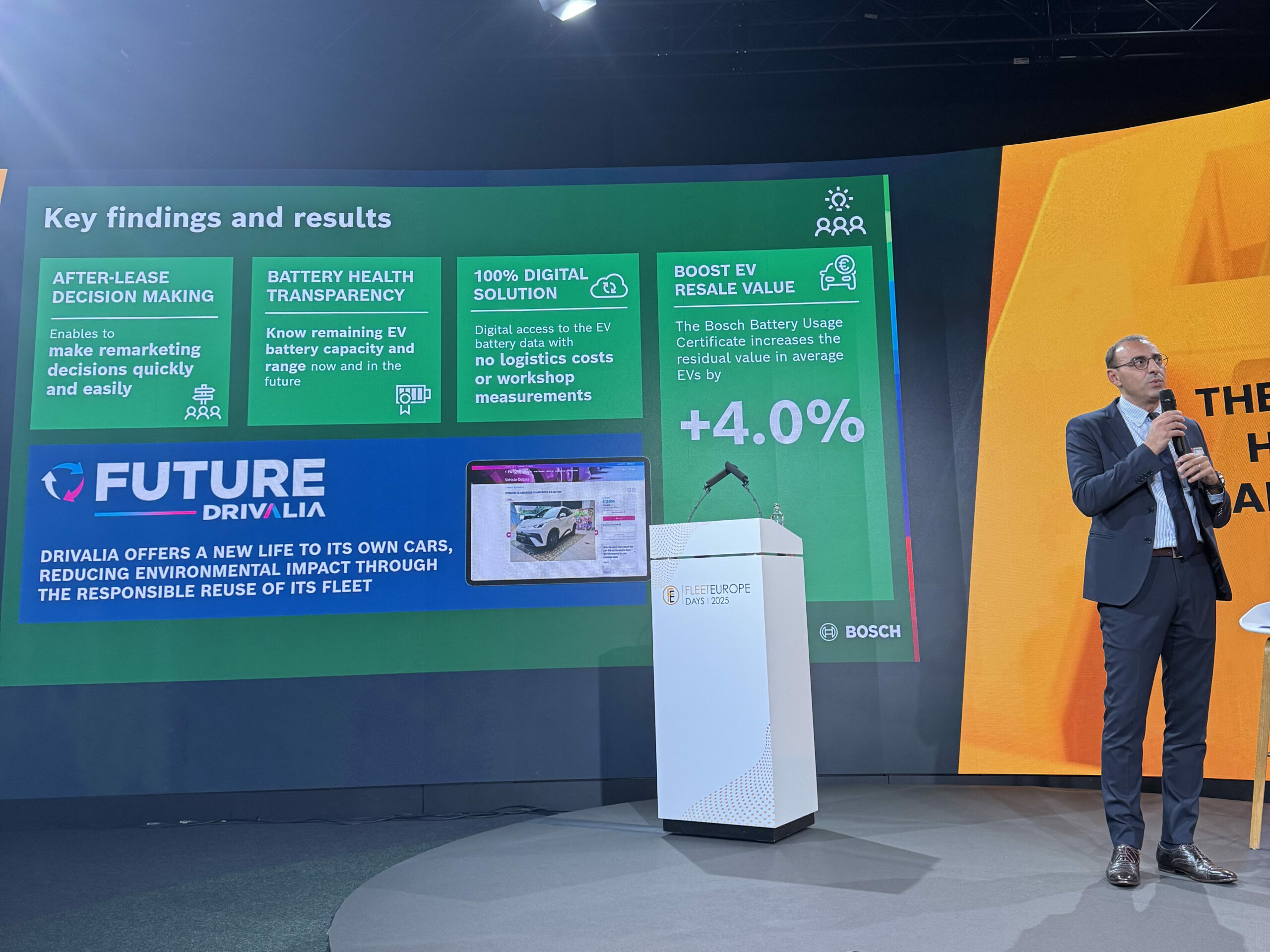
‘Together as leaders in mobility and technology, we have the unique opportunity, especially for EVs, to use remarketing and the right point of resell to make not only a transaction out of it but make it a data-driven business model,’ outlined Christiane Soppa, director of business development at Bosch, at Fleet Europe Days.

Bosch conducted a pilot programme together with European mobility and car rental company Drivalia. This involved monitoring the data of approximately 100 vehicles between January and June 2025.

‘The heart of an EV is the battery. So, we took the heartbeat of the EV and put it online. The target was to take away the EV friction we have in remarketing. We looked at stress factors and anomalies based on very simple data,’ explained Soppa.

Roberto Sportiello presenting at the Fleet Europe Days 2025.
Drivalia CEO Roberto Sportiello.

From transaction to database

There are three steps to the process. Once the EV is connected, data can be collected. Bosch was able to track battery temperature, voltage, charging behaviour and driver usage. This provided a real-time picture of the power-storage unit.

Second, a cell-by-cell digital twin of the battery was created in the cloud. This combined AI machine learning with data taken from 150,000 vehicles tracked by Bosch worldwide to regularly review its algorithm. Third, the system detected anomalies and any battery issues.

‘The twin can completely monitor the battery. By spotting issues very early, you can redesign the right point of resell. We take the battery measurements, the state of health and anomalies before the decision point when you sell the car, not afterwards,’ she stated.

‘That is turning remarketing from a transaction to a database strategy. As a fleet manager or a leasing company, this is changing everything, because you suddenly get into the driver’s seat,’ Soppa continued.

Bosch was also able to produce a certificate at any time, revealing driving behaviour, anomalies, and charging history.

‘You could even use this data to discuss with your clients early, to change their behaviour. Decision making is not a best guess or dependent on lifetime and mileage anymore. It is based on data. What we see from all the pilots we did in the past years, in Bosch and all the data we have, sales can be boosted by up to 4% on average for resale,’ she commented.

However, Soppa highlighted that this requires monitoring of the battery to optimise the point of resale.

‘This is a very important digital platform that will permit the company more in the future to retrieve and collect data from the fleet, and let the company adjust it as best as possible,’ highlighted Drivalia CEO Roberto Sportiello.

Is battery repair the solution?

While Bosch’s tool can be used to boost resales, another way to maximise profit margins within a fleet is to reduce maintenance costs. So, what options do fleet managers have in this instance?

According to Gablini Automotive Group, the cost of repairing a battery pack is around 80% lower than replacing it. This makes battery repair more financially attractive while supporting circular economy goals.

‘To be sustainable, we cannot throw away a 10-year-old vehicle. We should keep it on the road. Because, if we throw it away, the environmentally friendly behaviour of EVs will not be there anymore,’ stated Daniel Pataki, general manager of Gablini Automotive Group, at Fleet Europe Days.

Daniel Pataki presenting at Fleet Europe Days 2025.
Gablini Automotive Group general manager Daniel Pataki.

‘The question is if we can repair the battery packs in case of any failure, because OEMs are not interested in selling battery packs. They are interested in selling new vehicles,’ he said.

Pataki explained how demand for battery repair is growing. As old EVs are getting cheaper, people are beginning to use them as an entrance point to the EV sector. However, he highlighted that an EV with a faulty battery has a resale value of close to zero.

Repair constraints

Pataki presented a diagram of a dismantled EV battery pack. He explained that if one cell has a lower voltage than the rest, this affects the entire battery’s performance. By replacing the module containing that cell, the EVs’ range will improve. The battery management system and thermal management system can also be replaced.

‘If one sensor gets broken in a battery pack and you cannot repair it via the OEM, you should replace the battery pack due to the fault of a €10 sensor. This is not sustainable. You should be able to repair this,’ said Pataki.

However, he explained that there are some constraints. There are still no standard criteria for technicians looking to repair high-voltage batteries. Pataki said that OEMs do invite technicians to their headquarters to get a certificate.

‘According to our experience of more than 12 years, 85% of faulty battery packs were economically repairable. That means only 15% of the battery packs coming to us needed to be replaced,’ he noted.

Pataki pointed out that buying parts from the OEM will mean reduced margins compared with individual battery repair. For a 14-hour job, a profit margin of around 40% to 60% can be achieved Pataki calculated. He highlighted that the solution opens up profit potential within the after-sales process.

‘You will provide sustainability. You will gain customer satisfaction because all customers will come back to you for battery repair. We can reduce waste, we can extend the lifespan of vehicles, we can have high-margin jobs in the workshop, and we can make the customer happy,’ outlined Pataki.

Battery market domination

So, the fleet sector needs to be aware of current battery developments, such as real-time data analysis and battery repair. However, it is equally important to know what to expect in the future.

Currently, the EV market is dominated by lithium iron phosphate (LFP) and nickel manganese cobalt (NMC) batteries. From January to August 2025, these two chemistries accounted for over 90% of the megawatt-hours installed across the global passenger car market, according to EV volumes data. However, the market’s composition could change over the next few years.

Mix and match approach

‘What we see is quite a detailed chemistry layout. In the US, you have the nickel cobalt aluminium (NCA) component that is mainly used by Tesla. While in Europe, you have NMC batteries. In China, you have the majority of vehicles or batteries that are LFP batteries,’ said Octavian Chelu, advisory director at Frost&Sullivan at Fleet Europe Days.

‘You might think the picture is quite clear. The US, Europe and China use a certain technology. It is not that easy. When we look towards the future, what we see happening mainly is the fact that carmakers are going to match certain batteries, technologies and chemistries depending on the type of vehicle and its use, he added.’

‘Carmakers are going to try to mix and match from now on. This is something that is going to be keeping revenue from the remarketing business because it needs to juggle very well between different types of technologies, different battery markers, the degradation of those batteries and how much the residual value is going to be impacted by all of that,’ Chelu explained.

‘We have NMC and LFP; those are the main two technologies being used today. However, we also see a lot of heavy research and development, encouraged by all major governments worldwide, because they want to break dependencies,’ Chelu highlighted. ‘We are trying to find alternatives, so that our batteries and our vehicles are not going to be dependent on one source,’

The next battery technologies

Chelu explained that sodium-ion batteries are the next technology being tested. In China, the first vehicles using this technology have already been seen. There are also solid-state batteries in development. However, he believes both chemistries will not completely wipe out LFP’s market share.

‘We are still going to be dependent on precious materials for quite a while. There are pluses and minuses with all these new technologies,’ he said.

Chelu estimated that in the future, sodium-ion batteries are likely to be 30% to 50% cheaper than their LFP counterpart. They also perform extremely well in cold temperatures. This means vehicles using the chemistry can have better charging cycles.

However, sodium-ion batteries have a lower energy density than LFP units. So, models using the chemistry instead of LFP on a like-for-like basis will have less range. Yet, this does mean the emerging technology is slightly safer, due to it being less reactive.

Chelu noted the emerging technology could be well-suited to last-mile deliveries, but less so for long-range vehicles.

Meanwhile, solid-state batteries are safer and more stable than LFP ones, with no flammable liquid electrolyte. Chelu also pointed to a higher energy density, enabling longer distances and faster charging. However, the new technology will be much more expensive to begin with.

‘Sodium-ion is the next to come in line, not to replace LFP batteries, but as a new technology. Solid-state batteries are not going to happen before 2028 and probably will be fully commercial by 2030,’ Chelu concluded.