How did residual values (RVs) perform across major European markets in May? How did this influence outlooks? Plus, where are public electric vehicle (EV) charging stations getting a boost? Autovista24 editor Tom Geggus talks through the data in the latest episode of the Automotive Update podcast.
Autovista24 journalist Tom Hooker appears in this week’s podcast episode to discuss value retention trends from seven European used-car markets. Drawing on expert insights, he outlines what to expect in the years ahead.
Then, an exploration of EV Volumes’ latest data on public EV charging infrastructure covering 75 different markets. The duo then considers how the pace of growth was directed by different countries.
May’s Monthly Market Update reveals value declines as a percentage of retained list price (%RV) after 36 months and 60,000km. Meanwhile, new-car list prices rose year-on-year. This trend was recorded in the used-car markets of Austria, France, Germany, Italy, Spain, Switzerland and the UK.
Compared with May 2025, %RVs saw the greatest drop in Italy, where values fell by 3.7 percentage points (pp) to 44.4%. Meanwhile, the smallest decline was recorded in Austria, with a 0.7pp fall to 46.6%. Regional experts also forecast one of the smallest year-on-year drops by the end of 2026.
In contrast, the outlook for Italy foresees the steepest %RV descent of the seven recorded markets. But it is the only location where values are expected to increase once more by 2028. Most other markets expect to see marginal declines by that point.
Electric automotive infrastructure
Public EV charging infrastructure continued to record year-on-year growth in May, according to the latest data from EV Volumes. This details the number of locations a particular connector type can be found. This more accurately reflects the variety of chargers the public has access to.
While there was a year-on-year jump of 25.2% in the number of plug-in points, this confirmed a consistent slowdown. The pace at which new infrastructure has been installed has eased from 81.8% in May 2023.
Representing 83.1% of all charging locations recorded by EV Volumes, China has been a major driver of this result. Following a 110% year-on-year plug-in point expansion in May 2023, this rate decreased consistently to 28% in May 2026.
To put the country’s share into perspective, the next biggest infrastructure location was the Netherlands with a 2.7% share. Other leading locations from Europe included Germany, the UK and France.
More broadly, 524,923 stations were tallied by EV Volumes in Europe, up 15.7% year on year. Meanwhile, the US accounted for 1.8% of recorded plug-in points, with 88,050 locations. This equated to a growth of 7.7% compared with the previous May.
Residual values (RVs) continued to normalise in Europe’s major used-car markets during May. But how does this relate to new-car list prices? Autovista24 journalist Tom Hooker explores the latest trends.
The downward RV trend across Europe’s major used-car markets showed no signs of stopping in May.
RVs as a percentage of retained list price (%RV) after 36 months and 60,000km fell year-on-year across all observed markets. This includes Austria, France, Germany, Italy, Spain, Switzerland and the UK. Furthermore, this decline is expected to continue into 2027 and 2028 for all markets, except Italy.
However, as %RVs followed a uniform pattern across the seven observed countries, new-car list prices did as well. The metric rose year on year, placing further downward pressure on %RVs.
Soaring prices meet slumping values
The three countries with the biggest list price increases were the only ones to see absolute RVs rise. The most pointed example of this was seen in Switzerland. The market witnessed a 7.7% year-on-year increase in list prices to CHF 64,632 (€70,934). Meanwhile, absolute RVs also rose by 4.1% to CHF 27,014.3.
This RV metric saw an even bigger increase of 4.7% in Austria to €22,456.1. List prices grew to €48,190, up 6.3% compared to May 2025. Meanwhile, Spain observed a 4.6% rise in list prices, reaching €37,367, as absolute RVs climbed 2% to €20,357.7.
Conversely, Italy suffered the largest absolute RV drop, with a 6.3% slump year on year to €17,625.7. This was accompanied by the largest %RV decline across the observed markets. The metric plummeted by 3.7 percentage points (pp) to 44.4%. Meanwhile, list prices increased by 1.6%.
The UK endured the second-largest fall in %RVs, down 3.2pp to 47.6%. Absolute RVs in the country also fell by 4.5%, as list prices grew by 1.9%. France and Germany suffered a decline in both %RVs and absolute RVs, too, alongside rising list prices. However, these changes were more marginal.
Austria’s ongoing value retention pressure
Pricing dynamics softened further in Austria during May. The average trade RV of 36‑month‑old cars at 60,000km declined slightly to €22,456.1. This was down 0.6% month on month, but still 4.7% higher year on year.
‘In May, %RVs fell to 46.6%. Compared to the previous month, this represented a 0.3pp decline and translated to a 0.7pp drop year on year. This highlighted ongoing pressure on value retention,’ said Robert Madas, regional head of valuations.
Full hybrids (HEVs) retained the highest trade value at 50.2%, followed by petrol cars at 49%. Then came diesel models with 46.8% and plug-in hybrids (PHEVs) with 43.8%. Battery-electric vehicles (BEVs) improved by 0.8pp compared to April but still held the lowest %RV once again at 39.3%.
The RV outlook remains broadly unchanged. %RVs are forecast to decline gradually over the coming years as supply normalises further. A 0.6% year-on-year decline is forecasted in December 2026, followed by a 0.7% decrease in December 2027.
Slight RV decline in France
‘In France, %RVs decreased slightly in May compared to April. This was mainly driven by PHEVs and BEVs. It is also worth noting that there was a marginally less expensive basket this month,’ noted Ludovic Percier, senior RV analyst for France.
Absolute values of petrol-powered cars dropped slightly compared to April, as they held value well until the middle of 2025. Meanwhile, other powertrains experienced larger decreases. Petrol is still offered as a new vehicle by many manufacturers, while diesel engines are becoming rarer.
‘Diesel-powered cars saw %RVs almost stabilise compared to last month. This is because people are still demanding diesel vehicles on the used-car market. Meanwhile, companies have switched from diesel models to BEVs and PHEVs over the last couple of years. This means the number of new diesel registrations has shrunk,’ said Percier.
HEVs recorded a month-on-month increase in absolute RVs in May. The result was caused by increasing petrol prices and more premium HEV offers on the used-car market. This could be seen in May with a more expensive basket.
Overall, used HEVs remain in demand in France, but carmakers cannot risk adding large price premiums to these models. This would jeopardise their value retention.
Unbalanced offer and demand for PHEVs
‘PHEVs continued to see RVs fall as the supply and demand on the used-car market remained unbalanced. The already established situation continues to impact used-car prices, after many vehicles in previous years were sold to fleets on the back of fiscal advantages,’ explained Percier.
Combined with a high list price on the new-car market, this explains the low RVs. PHEVs offering an electric-only range of below 60km have been most affected. The technology recorded the second-lowest %RVs in May, retaining 47.1% of its list price after three years and 60,000km on average.
BEV %RVs also decreased in May. All-electric models held 35.2% of their value, compared to the 50.1% retention recorded in the overall market.
‘The technology is evolving quickly, now offering higher ranges compared to older models from three years ago. Furthermore, the social leasing scheme for new cars is not helping used-car sales. This is because people can get great deals on new BEVs instead of buying the ones available on the used-car market,’ highlighted Percier.
‘Larger segments will be increasingly impacted in the future, as company and fleet vehicle users benefit from fiscal advantages. These vehicles will come to the used-car market in early 2028,’ he projected.
Mixed market in Germany
Overall, the German used‑car market showed a mixed picture in May, with continued pressure on RVs. After slight price decreases in April, pricing dynamics also remained under pressure last month. The average trade RV of a 36‑month‑old car at 60,000km declined to €21,091.5. This was down 1.1% month on month and 1.7% lower year on year.
‘In retention terms, %RVs fell to 46.1%. This marked a 0.2pp decline compared to April and a more pronounced 1.7pp drop against May 2025. The result highlighted continued weakening in value retention,’ stated Madas.
List prices also softened further, averaging €45,786 in May. This represented a 0.7% month‑on‑month decline. However, prices remained 1.9% higher than a year earlier, which still provided some support to absolute RV levels.
By powertrain, petrol cars continued to lead with a %RV of 47.5%, followed closely by diesel at 47.3% and HEVs at 46.9%. PHEVs held on to 42% of their value, while BEVs remained with the lowest %RV at 36.9%. This remained in line with the powertrain gap observed throughout 2025.
‘Looking ahead, gradual downward pressure on %RVs is still expected as supply normalises further,’ forecasted Madas.
By the end of 2026, %RVs are projected to decline by 1.9% compared with December 2025. Pressure is predicted to ease somewhat in 2027, with a smaller decline of 0.9% expected. This indicates ongoing RV strain, driven by recovering supply, normalising demand, and elevated list prices.
Slowdown in Italy
‘Over the past months, the Italian used-car market has shown signs of a slowdown. This forms part of a negative trend that has been observed in recent years,’ outlined Marco Pasquetti, cluster head of forecasting for Spain and Italy.
Trade %RVs declined by just 0.2pp in May compared to the previous month. However, they remain significantly lower than a year ago.
‘Our analyses indicate that the decline will continue in the coming months, albeit at a progressively lower intensity. The trend suggests a gradual move toward a stabilisation phase. We estimate that the market needs approximately one more year to reach a new equilibrium, with normalisation expected by 2028,’ said Pasquetti.
For certain powertrains, particularly PHEVs and BEVs, this process already appears to be underway. Following a period of sharp corrections, the pace of %RV decline has eased considerably.
‘Compared to April, PHEVs recorded a decrease of 0.3pp, while BEVs remained broadly stable at 28.3%. Considering these dynamics, the 2026 RV outlook has been revised. A year-end decline of 2.8% for PHEVs and 0.9% for BEVs compared to December 2025 is forecast,’ projected Pasquetti.
A different picture emerged for HEVs, which experienced a more pronounced decline than expected. The technology suffered a 4.7pp year-on-year %RV drop and a 0.5pp fall compared to April. Despite this, HEVs remain one of the most resilient powertrains in terms of RV retention.
Spain’s growing interest in electrification
‘Spain’s automotive market maintained a positive trend throughout April. Passenger car registrations increased by 8.5% compared to the same month in 2025, once again surpassing the 100,000-unit mark,’ commented Ana Azofra, regional head of valuations and insights.
This growth continues to be boosted by electric vehicles (EVs), including BEVs and PHEVs. The powertrain group saw a 42.6% rise in registrations during April. In the first four months of the year, BEV and PHEV models accounted for 21% of total registrations, up 6.3pp year on year.
Across sales channels, growth was widespread. The private channel saw the best improvement of 11.2%, followed by companies up 9.2% and rentals up 3.7%. Overall, new-vehicle deliveries continue to reflect a still dynamic demand environment across the sector. As in previous months, this growing interest in electrification is also evident in the used-car market.
Regarding used-car transaction prices, absolute RVs recorded a slight fall of 0.8%. This meant, on average, the metric stood at €20,357.7 for a three-year-old used car at 60,000km.
‘Petrol vehicles followed a similar trend, while diesel models showed a steeper drop of 1.4%. This latter result reflected softer demand for this type of powertrain, which can be linked to rising fuel prices. However, the impact is milder in Spain than in other markets, thanks to government subsidies covering part of fuel costs,’ highlighted Azofra.
‘HEVs showed the same trend as the overall market in May, with BEVs following a similar pattern. However, PHEVs saw a 1.4% decline compared with the previous month. This was more influenced by lower-priced models entering the used-vehicle supply and sales mix than by a price adjustment,’ she noted.
Stable used-car market in Switzerland
The Swiss used‑car market showed signs of stabilising in May when it came to absolute RVs and value retention. After another decrease in April, %RVs showed a modest recovery in May.
‘The average %RV of a 36‑month‑old car at 60,000km increased to 41.8%, representing a 0.4pp rise month on month. Nevertheless, compared with May 2025, %RVs were 1.5pp lower, highlighting that underlying depreciation pressure remains significant,’ said Madas.
In absolute terms, trade RVs rose to CHF 27,014.3, up 1.8% month on month and 4.1% higher year on year. This was supported by continued increases in new‑car pricing.
‘List prices climbed to CHF 64,632, representing a 0.7% month‑on‑month increase and a 7.7% rise year on year. This reinforced the upward price environment,’ stated Madas.
HEVs retained the most value of any powertrain in May by far at 46.6%. Then came petrol-powered cars at 43.1%, diesel-powered models at 41.2% and PHEVs at 39.8%. BEVs continued to be the worst-performing powertrain despite some recovery from April, holding only 36% of their original list price.
Looking ahead, the residual‑value outlook remains unchanged. %RVs are expected to decline gradually as the market continues to normalise. %RVs are forecast to decrease further in the coming years, but at a slower pace. By the end of 2026, %RVs are expected to fall by 1.5% compared to December 2025. A further year-on-year drop of 0.5% is anticipated in 2027.
UK’s varied powertrain performance
‘The UK’s used car market demonstrated consistency in May. The average %RV of a three-year-old car remained broadly level at 47.6% of list price, up 0.1pp from April,’ said Jayson Whittington, regional head of valuations for the UK.
May’s dashboard shows a big variation in powertrain performance. Petrol cars improved, with %RVs rising 0.4pp month on month to 49.1% of list price. Diesel values softened, with RVs falling 2pp to 56.3%. Even after the drop, diesel retained the highest %RV in May.
Meanwhile, electrified technologies saw mixed results. HEVs were stable, edging down 0.1pp to 51.6%. PHEVs weakened by 0.6pp to 43.9%. BEVs dipped 0.3pp to 34.4% and were 3.1pp down compared to May 2025. This reflects the growing volume of BEVs entering used car channels.
Year on year, the market was lower across most fuels, with overall %RVs down 3.2pp. The exception was diesel, which was up 3.3pp versus last May.
‘Recent wholesale activity suggests trading conditions are beginning to slow, likely increasing inventory and leading to a gentle easing in RVs, which is typical behaviour as we approach the summer months,’ concluded Whittington.
How have new electric vehicle (EV) sales performed in the first quarter across different regions? What about major European used-car markets? Autovista24 journalist Tom Hooker breaks down the trends in the Automotive Update podcast.
One country appeared to define the results of the global new EV market in the first quarter, but which one? How did the other markets perform? Plus, what happened in major European markets, and how did the different powertrains perform? Listen to the latest episode to find out.
Sales of new battery-electric vehicles (BEVs) and plug-in hybrids (PHEVs) fell globally in the first quarter, EV Volumes’ data reveals. PHEVs, including extended-range electric vehicles, took an 18.7% tumble compared with the first quarter of 2025. Meanwhile, BEVs were only down by 1.6%.
This meant the entire new EV market saw sales decline by 7.6% year on year between January and March. This was driven by a 28.6% decline in China, where 46.4% of all plug-in vehicles were sold in the first quarter.
The US also saw sales fall, down 32.9% year on year. But even as the world’s second-largest volume EV market, it accounted for only 6.2% of plug-in deliveries.
Europe’s EV sales
Europe saw new EV sales increase in the first quarter, up by 28%. This was thanks to some positive regional performances from the likes of Germany, the UK and France. EV sales grew by 33.7% in Germany, 25.2% in the UK and 40.8% in France.
Across Europe, BEVs drove EV sales acceleration in the first quarter. In total, 725,375 all-electric cars were delivered, up 25.4% year on year. This meant the powertrain accounted for over two thirds of all new electric vehicle sales in Europe.
Used-car trends
While new EVs enjoyed a positive first quarter in Europe, the powertrains accounted for a marginal number of used-car transactions. Major used-car markets with powertrain breakdowns revealed how internal-combustion engines (ICE) remain dominant.
In March, France saw used diesel cars account for 42% of transactions and petrol 38%. In Spain, diesel made up 47.8% of used sales in the first quarter and petrol 35.8%. In the UK, petrol remained the most popular used powertrain, making up 56.9% of volumes, while diesel represented 31.2%.
While ICE remained on top, many of these markets saw sales of the fuel types decline year on year. As more used EVs become available, increasing the number of choices for buyers, well-priced models will stand out. With fuel prices remaining high, affordability will be an important consideration before purchase.
There were some mixed results for the big five used-car markets in Europe. But which countries impressed, and which have work to do as 2026 progresses? Autovista24 special content editor Phil Curry analyses the latest figures.
Europe’s big five used-car markets saw mixed results in the first quarter of 2026. Two markets experienced growth, one remained stable, and two suffered declines.
It was the smaller markets of Spain and Italy that saw the best results between January and March. Meanwhile, the UK suffered a slight decline that brought an end to 12 quarters of growth. Both Germany and France struggled, the latter seeing results mirror its new-car market woes.
Most of the big five used-car markets suffered a decline in transactions during January. This weighed on their quarterly result, with only. Spain and Italy, offsetting the losses after subsequent monthly sales improvements. In comparison, all five used-car markets grew in 2025. This means the UK, Germany and France will be hoping fortunes improve in the coming quarters.
The results also show internal-combustion engines (ICE) continue to dominate in countries where different powertrain figures are reported.
This contrasts with new-car market trends. Buyers appear to be turning to used cars, as supplies into new channels dwindle. However, there are signs of a shift in powertrain dynamics, as used transactions of petrol and diesel begin to slide.
Spain impresses again
Spain saw the best result of Europe’s big five used-car markets in the first quarter of 2026. Yet the period was not without its struggles. Figures published by GANVAM, and analysed by Autovista24, show the market grew by 2.9% between January and March. In total, 531,767 models changed hands in the period.
The year got off to a difficult start. January saw a 6% slip, with 157,776 transactions. This equated to 10,115 fewer models in the month.
However, February saw a slight recovery. With 177,150 units changing hands, this was a 4.3% year-on-year rise. The 7,334 extra transactions cut into the deficit created by January’s poor showing.
March then pushed the country’s used-car sector back into positive territory. With 196,841 transactions, figures increased by 10%, according to Autovista24 analysis. This was an increase of 17,916 sales, giving the quarter a rise of 15,095 models changing hands.
Used-car EV share increases
According to GANVAM, sales of battery-electric vehicles (BEVs) are gaining ground in Spain’s used-car market. The industry authority reported that 8,886 all-electric models were sold between January and March, a 48.8% rise. Meanwhile, sales of plug-in hybrids (PHEVs) rose by 51.3%, reaching 13,710 units.
The association stated that electric vehicles (EVs) made up 4.2% of the total transactions in the first quarter. This was up from plug-in’s 2.9% share recorded a year prior.
As this increase continues, sales of ICE models are declining in Spain. Although diesel accounted for 47.8% of all transactions, it recorded a drop of almost 6%. Meanwhile, petrol sales fell by 1.3%, reaching a share of 35.8% in the quarter.
The industry association also highlighted that the Spanish used-car market is being driven by growth in newer models. Passenger cars up to five years old grew by 10.4% in the first quarter. The age group represented more than 27% of the total volume.
Meanwhile, vehicles over 15 years of age saw a 1.7% decline. These older models do, however, still account for four in every 10 transactions.
The country’s Sustainable Mobility Law could help in Spain’s desired transition to a younger vehicle fleet. The legislation has not yet been fully implemented by the Spanish government. It would incentivise the removal of the oldest and most polluting vehicles from circulation.
‘This would not only contribute to accelerating the achievement of emissions reduction targets, but also to reducing the average age of the fleet, with the important benefit that this implies for road safety,’ GANVAM stated.
Italy bounces back
After a disappointing start to the year, Italy’s used-car market bounced back to end the quarter on a positive note. Based on data from ANFIA, a total of 1,503,591 transactions took place in the period. This was a 1.8% increase compared to the same three months of 2025.
The result looked very different after January. With 444,303 sales, the market ended the month down by 5.8%. This represented 27,594 fewer transactions, according to Autovista24 analysis. The result was the first decline in the used-car market since May 2025.
However, this negative trend did not continue. In February, 506,696 models swapped hands, a 2.2% increase. Yet this additional 10,724 units could not make up for the loss in January.
But March proved to be the quarter’s saviour. With 552,592 transactions, Italy’s used-car market saw a monthly jump of 8.5%. The extra 43,105 models changing owners pushed the quarter into a positive result.
Italy’s automotive market will be hoping to ride this wave of improvement into the rest of the year.
UK sees growth streak end
The UK’s used-car sales market did not get off to the best start in 2026, with transactions remaining relatively stable after the first three months of the year.
According to the latest figures from the SMMT, a total of 2,016,232 transactions took place between January and March. This was a 0.2% decline compared to the first quarter of 2025.
The drop equated to just 4,758 fewer used-car sales in the period, based on Autovista24 calculations. The result ended a 12-quarter growth streak that dated back to the first three months of 2022.
The year got off to a good start, with January seeing a 1.7% increase in used-car sales volumes year on year. In total, 670,797 passenger cars changed hands in the month, a rise of 11,115 units. The UK was the only one of the big five European markets to see growth in the first month of the year.
However, February set a tone for the period. With 652,190 transactions, this was a 0.1% increase, with just 407 extra units compared to the second month of 2025.
March was the worst-performing month of the quarter. Volumes fell by 2.3%, wiping out the efforts from the first two months of the year. The 693,245 sales were down by 16,280 units compared to the same period in 2025. Yet last year saw the best March result since 2017, providing a high benchmark for the 2026 results to live up to.
Record results for BEVs
BEVs saw the biggest jump in used transactions year on year. The powertrain saw an increase of 32% compared to 2025 in the UK, as 86,943 models moved to new owners. This represented a 4.3% share of total used-car volumes, up from 3.3% a year prior.
Full hybrids also saw strong growth in the quarter, up 29.6% with 128,039 transactions. This was enough for a 6.4% share, according to Autovista24 calculations.
But it was not all plain sailing for electric models. Sales of PHEVs fell by 14.9%, the steepest decline of any fuel type. However, this was based on a smaller figure of 20,021 transactions between January and March 2026. PHEVs took a 1% market share.
Petrol remains the most popular fuel type when it comes to used-car transactions. Their sales remained fairly stable in the first quarter of the year, with a 0.2% dip. In total, 1,147,969 models changed hands, a fall of just 2,159 units. The powertrain made up 56.9% of the total volume.
Diesel saw a 7.3% fall in transactions, with 629,987 models finding new owners in the three-month period. With a 31.2% market share, the fuel type is still a popular choice amongst buyers.
‘The UK’s used-car market remained flat in the first quarter, held back by weakness in March in comparison with a very strong performance in 2025,’ commented SMMT Chief Executive Mike Hawes. ‘Better news is the record demand for used electric vehicles, as growing choice from manufacturers feeds through into the second-hand market.’
Germany experiences used-car struggles
Germany’s used-car market struggled during the first quarter of 2026. This is despite the country seeing its best monthly transaction figure in almost five years.
In total, 1,609,677 passenger cars changed hands in the first three months of the year. This was a 1.6% decline compared to the same period in 2025, according to Autovista24 analysis of available KBA data.
Much of this loss can be attributed to a poor market performance in January. During the first month of the year, 504,170 transactions took place, a 10.5% drop year on year. This equated to 59,369 fewer units moving to new ownership. February was also a poor month, with the 500,119 unit volume down by 3.5%.
However, the market was able to bounce back in March. The 605,378 transaction total was the highest monthly volume since July 2021. This provided a 9.1% boost, although the additional 50,439 units were not enough to overcome earlier losses.
This performance contrasts with Germany’s new-car market, which saw registrations soar by 5.2% in the quarter. So, the market will be hoping that used-car transactions can gather pace in the remaining months of the year.
France suffers in first quarter
The worst-performing used-car market in Europe’s big five during the first quarter of the year was France. The country’s entire automotive market appears to be struggling, with neither new nor used-car volumes able to record growth.
According to figures from AAA Data, analysed by Autovista24, the country’s used-car transactions fell 2.5% between January and March. In total, 1,330,153 models changed hands, a fall of 33,582 transactions compared to the same period last year.
Like other markets, France was undone by a particularly disappointing January. However, it was unable to recover, despite better performances in February and March, leaving it at the bottom of the big five pile.
The first month of the year saw used-car sales fall 9.6%, with 413,525 models finding new owners. This was a drop of 44,145 sales year on year. February remained stable, with a 0.1% rise as 439,649 transactions took place, 301 more than the second month of 2025.
March continued this upward trend. With 476,979 sales, the used-car market grew 2.2%. Despite this, the additional 10,257 transactions were not enough to push the market into a positive result for the quarter.
The French new-car market also experienced a 2.1% drop in volumes during the period. Therefore, the country will be hoping for better results in the rest of the year.
ICE domination drives used-car decline
According to AAA Data, January’s result was due to a sharp decline in ICE transactions. Petrol fell by 14%, as the fuel type held a 38% market share. Diesel sales dropped 12%, with a 44% share of total volumes. The weight of these powertrains in the market, therefore, dragged overall figures into a drop.
In February, ICE volumes continued their decline, as petrol transaction dropped 4%, while diesel fell by 3%. At the same time, sales of BEVs increased by 23%, reaching a 4% market share in the month.
Meanwhile, PHEVs saw a 21% rise in models changing hands, reaching a 6% share of volumes. This, AAA Data states, represents a slow shift in the powertrain dynamic of the French used-car market.
In March, used BEVs saw a 47% jump in volumes, maintaining a 4% market share. Meanwhile, diesel transactions fell 4%, although the powertrain still accounted for 42% of the market. Petrol sales fell 2%, taking a 38% hold overall.
Leasing is also making inroads into the used-car market in France. It reached 5.1% of total transactions in March 2026 compared to only 2.7% in March 2021.
According to AAA Data, several factors explain this rise in leasing. These include the high prices of recent cars and the ever-increasing availability of cars from a previous lease agreement in the used-car market. The rise of electrified cars and the continued development of used-car purchases by companies are also playing their part.
Which models were the fastest-selling in key European used-car markets? What happened with other demand indicators for used cars? Autovista24 special content editor Phil Curry discusses all this and more in the Automotive update podcast.
This episode takes a deep dive into key European used-car markets, including the performance of residual values (RVs). Also, how is Australia adapting its electric vehicle (EV) incentives for the coming years?
Fastest-selling used cars
The latest Autovista24 Monthly Market Update revealed that trade RVs remained broadly stable across Austria, France, Germany, Italy, Spain, Switzerland and the UK. While there was an overall trend of decline compared with March, value drops were mostly marginal.
The data presented in the latest report also revealed which models were the fastest selling in each market. This is based on the average days to sell, between a car entering the market and finding a new owner.
Both the Tesla Model Y and Cupra Formentor topped local used-cars charts in two of the seven analysed markets. The US model moved quickly in Austria and Germany, while the Spanish brand topped the French and UK tables.
The Dacia Sandero placed in the top five of four markets, topping the chart in Spain. In Italy, the Toyota Yaris Cross led the fastest-selling cars table. The Japanese model also placed in the top five for Austria and Spain. The SEAT Leon topped the market in Switzerland, the only market where it appeared in the top five.
Other notable performances included the Volkswagen Polo, which appeared in the tables of Austria, France and the UK. Toyota continued to prove popular, with its Corolla appearing as one of the fastest sellers in France and Spain. The Toyota Yaris also made the top five in France and Italy.
Can electric cars benefit from rising prices?
ACEA has argued that energy market volatility is strengthening the case for accelerating away from fossil fuels in road transport.
‘A technology-neutral decarbonisation strategy that embraces electrification and includes renewable fuels is essential. It is key to safeguarding Europe’s resilience, protecting consumers from price and supply shocks, and delivering a successful transition to climate‑neutral mobility,’ commented Sigrid de Vries, ACEA Director General.
The industry body has indicated a need for policy action in two areas. This includes making electricity the most affordable source of energy. Achieving this requires lowering the cost of energy used to charge EVs. This can help drive consumers and businesses into zero-emission transport.
ACEA also suggested that renewable fuels should be incentivised, based on their carbon content. Short-term measures to lower fuel prices do not currently distinguish between fuels based on their makeup.
Australia extends EV incentives
The Australian government has extended its EV incentive programme. The Electric Car Discount (ECD) was first introduced in 2022 and will be rolled out in three phases. The scheme offers a tax rebate when employees use salary sacrifice to cover the leasing costs of an EV.
Government analysis revealed the programme led to an estimated 64,000 additional battery-electric vehicle (BEV) sales between 2022 and 2025.
Phase one of the extension will run until the end of March 2027. This will extend exemptions from the country’s Fringe Benefits Tax (FBT) on the portion of salary used to pay leasing instalments.
The second phase will run from 1 April 2027 to 1 April 2029. During this time, the FBT exemption will only apply to EVs with a purchase price of up to AUS $75,000 (€46,252). This measure aims to encourage manufacturers to offer more affordable BEVs in the Australian market.
EVs costing more than AUS $75,000, but below the luxury car tax threshold, will qualify for a 25% discount on payable FBT. The third phase starts on 1 April 2029, when all EVs below the luxury car tax threshold will qualify for a 25% discount on payable FBT.
Residual values (RVs) remained broadly stable across European used-car markets in April. But what did other metrics reveal in Austria, France, Germany, Italy, Spain, Switzerland, and the UK? Autovista24 editor Tom Geggus examines the market data.
Passenger car values in key European markets remained relatively stable in April. While there was an overall trend of decline compared with March, value drops were mostly marginal.
The UK saw the largest decline in absolute RVs, down 2.3% month on month to £15,460 (€17,924). With the exception of Austria’s 1.8% fall to €22,623, nearly all other observed markets recorded drops under 1%. Spain was even able to record a 0.9% increase in absolute RVs compared with March.
RVs presented as a percentage of retained list price (%RV) after 36 months and 60,000km also remained stable in April. Compared with March, the UK once again saw the largest drop, from 48.4% to 47.4%.
Declines in %RVs were more substantial compared with April 2025. Italy recorded the largest decline, down 3.8 percentage points (pp) to 44.6%. Meanwhile, all markets saw list prices and active-market volume indices (AMVI) climb year on year, putting pressure on %RVs.
Austria sees more momentum
Austria’s sales‑volume index (SVI) for two‑to‑four‑year‑old passenger cars continued its upward trend in April. The metric increased by 11.7% compared with March, while demand was 12.2% higher year on year.
‘This underlined a clear improvement compared to early 2025 and confirms that market momentum has only strengthened,’ said Robert Madas, regional head of valuations.
Supply conditions eased slightly. The AMVI fell by 1% month on month. Nevertheless, stock levels remained 1.2% higher than a year earlier. This indicates that supply remains broadly balanced and above last year’s level despite the marginal monthly contraction.
Turnover speed improved again in April. The average time needed to sell a used car declined to 66.5 days, a month-on-month improvement of two days. Compared with April 2025, however, turnaround times were 1.7 days longer.
Full hybrids (HEVs) took the lead in turnover speed at 53.1 days, marking a significant improvement compared to March. The Toyota Yaris was a major motivating factor behind this trend. Then came diesel models, needing 63 days to sell on average.
This was followed by battery-electric vehicles (BEVs) at 67.7 days, after a significant improvement compared with March. Next were petrol cars, taking an average of 68.5 days to sell, and plug-in hybrids (PHEVs) at 73.1 days.
Softer pricing dynamics
Pricing dynamics softened in April. The average absolute trade RV of 36‑month‑old cars at 60,000km declined to €22,623. This was down 1.8% month on month but was still 5.4% higher than in April 2025.
Meanwhile, %RVs fell to 46.9% in Austria. This was down 0.4pp on March and 0.7pp on April last year, highlighting renewed pressure on value retention. List prices also edged lower, averaging €48,278 in April. This represented a 0.9% month‑on‑month decline, though prices remained 7.1% higher than a year earlier.
HEVs retained the highest %RV at 51.1%, followed by petrol cars at 49.6%. Then came diesel models with 46.9% and PHEVs with 44.2%. BEVs held the lowest %RV once again, at 38.5%.
Austria’s RV outlook remains broadly unchanged. %RVs are forecast to decline gradually over the coming years as supply normalises further. In December 2026, a 0.5% year-on-year decline is forecast. A 0.7% decrease in 2027 is expected to follow.
Value stability in France
RVs were stable in France during April, maintaining the levels recorded at the end of 2025. A slightly more expensive basket contributed to lower trade %RVs. The average number of days needed to sell a 24-to-48-month-old car was stable overall as well.
Values of petrol-powered models followed the general market trend. The fuel type has seen mostly stable RVs, even as other powertrains experienced larger decreases. Additionally, petrol cars are still widely offered by many manufacturers while diesel cars are becoming rarer.
‘After seeing values fall marginally in previous months, diesel-powered cars saw RVs pick up slightly in April. The fuel type is still in demand on the French used-car market, even as new sales fall,’ commented Ludovic Percier, senior RV analyst for France.
HEVs saw absolute trade RVs remain stable in April. More manufacturers are now featuring the technology in their model lineups. There are increased numbers of these powertrains in the used-car market, with most new entrants coming from mainstream brands.
Toyota has consistently led the French used HEV market, with model reliability boosting RVs. Overall, used HEVs are still in demand in France, but carmakers cannot risk increasing their price premiums. This would jeopardise the value retention of these models.
Supply and demand imbalance
PHEV values kept falling in April as supply and demand on the used-car market remained imbalanced. Previously, new PHEVs with high list prices were sold to fleets on the back of fiscal advantages. This continues to negatively impact the value retention of these used models as they come back to market. Vehicles offering an electric-only range of below 60km have been most affected.
PHEVs were the second slowest-selling powertrain in April, taking 69.1 days on average. This increased compared to March, as more models came back from leasing with smaller electric ranges than newer models.
BEV values were stable. The technology is evolving quickly, with driving ranges extending compared to models from three years ago.
On average, BEVs spent 80.3 days in stock during April, compared with the market average of 66.6. The powertrain retained 35.6% of its new car list price after 36 months and 60,000km. This was compared to the overall market’s 50.2%.
France’s social leasing programme is not helping used-car sales, as buyers opt for new models instead of pre-owned ones. The upper segment will be more impacted in the future as company and fleet vehicle users benefit from fiscal advantages. These vehicles will come to the used-car market in early 2028.
Market liquidity improves in Germany
Used‑car demand in Germany continued to improve in April, building on the recovery seen in the first quarter.
The SVI increased by 9.7% compared with March. However, the demand metric remained below last year’s level, with the index 5.5% lower year on year. This indicates that underlying market activity has not yet fully returned to 2025 levels.
‘Supply conditions strengthened further,’ explained Madas. ‘The AMVI was up by 2.9% month on month. Compared to April last year, stock availability was 28.6% higher, confirming a pronounced rebuild in supply and continued market normalisation.’
Market liquidity improved again in April. The average number of days needed to sell a used car fell to 62.7 days. This was an improvement of 1.2 days month on month and 0.9 days year on year. This suggests that turnover conditions are gradually strengthening despite softer year‑on‑year demand.
Looking at powertrain performance, BEVs were again the fastest-selling technology, taking 58.4 days to leave forecourts. Then came PHEVs at 58.9 days. Diesel cars followed at 61 days, while petrol-powered cars took 66.1 days to sell. HEVs sold the slowest, at 67.3 days.
Supply expected to normalise
RVs remained under pressure. After 36 months and 60,000km, %RVs fell to 46.3%. This was down 0.2pp month on month and 1.3pp year on year. Absolute trade RVs also decreased to €21,319, down 0.9% month on month, but still 0.4% higher year on year.
Meanwhile, list prices softened slightly, averaging €46,093 in April. This represented a 0.5% month‑on‑month decline. However, prices remained 3.3% higher than a year earlier, continuing to support absolute used‑car values despite falling retention rates.
Looking ahead, gradual downward pressure on %RVs is still expected as supply normalises further. By the end of 2026, %RVs are projected to decline by 1.6% compared with December 2025.
Pressure is predicted to ease somewhat in 2027, with a smaller decline of 0.9% expected. This indicates ongoing RV strain, driven by recovering supply, normalising demand, and elevated list prices.
Italy sees seasonal pattern
‘Used car RVs fell in Italy during April. %RVs reached 44.6%, down 0.4pp compared with March. This reflected a seasonal pattern that was broadly in line with expectations,’ highlighted Marco Pasquetti, cluster head of forecasting for Spain and Italy.
Compared with April 2025, %RVs were down by 3.8pp. This was stable on March’s Monthly Market Update, where values also dropped by 3.8pp year on year to 45%.
Average days‑to‑sell for used cars reached 55.4 days, improving by 3.4 days compared with March. However, turnover remained marginally slower than a year ago, with an increase of 1.1 days. Apart from the Dacia Sandero, four of the five fastest‑selling models came from Toyota. Each averaged around 30 days on market.
An analysis of listings across online marketplaces points to a phase of relative stabilisation. The SVI did continue to edge lower. However, the 1.5% month-on-month contraction remains limited and does not indicate a material deterioration in underlying demand.
Encouraging signals emerged from electric powertrains. For the first time since values began declining in 2024, the pace of depreciation slowed for PHEVs and BEVs.
%RVs of all-electric cars slid by 0.1pp compared with March, while PHEVs fell by just 0.2pp. This compares with a market average drop of 0.4pp. In contrast, LPG was the weakest performer, recording the sharpest decline at 0.6pp.
Spain sees EV interest
Spain’s new-car market continues to grow at a steady pace despite the ongoing global situation. Specifically, sales in March rose by 11.7% compared with March 2025, and year-to-date growth stands at 7.6%.
Electric vehicles (EVs), covering BEVs and PHEVs, powered this growth. The powertrain grouping saw registrations increase 62.2% year on year. This meant EVs accounted for roughly a fifth of the new-car market in the first quarter.
More competitive pricing and the incentives offered by the country’s Auto+ Scheme have helped spur this increasing interest in EVs. Rising fuel prices and improvements to infrastructure have also helped to shrink the barriers to demand.
This growing interest in electrification is also evident in the used-car market. Transactions of used PHEVs grew by 51.3% while BEVs saw an increase of 48.8% in the first quarter. However, EVs still only accounted for 4.2% of Spain’s used-car market in the period.
More affordable models
‘This demand is not clearly reflected in the average EV transaction price,’ explained Ana Azofra, regional head of valuations and insights. ‘The mix of used cars on offer now features a greater proportion of entry-level models. There are also more models from Chinese brands with highly competitive pricing strategies.’
PHEVs remained virtually unchanged at €28,329 for a three-year-old car at 60,000km. Meanwhile, BEVs experienced a slight drop compared with March, down to €24,379.
Petrol cars saw their RVs rise by 0.8% compared with the previous month, while diesel car values fell by 0.2%. In contrast, HEVs showed no signs of slowing down and led the way once again with a 1.2% increase in their average transaction value. Unsurprisingly, the powertrain also occupied several places in the fastest-selling models ranking.
The Dacia Sandero took first with an average turnover of 42.4 days, compared with the market average of 74.3. The Sandero was followed by the Toyota Yaris Cross and the Cupra Formentor.
Positive market trend in Switzerland
Following a recovery in February and March, used‑car demand in Switzerland continued to improve in April. The SVI rose by 3.3% month on month. Demand was 2.1% higher compared to April 2025, confirming a gradual but sustained recovery following weakness in January.
Supply conditions eased slightly. The AMVI declined by 1% compared with March. However, the index was up 4% year on year. This indicates that stock availability exceeded last year’s level despite the recent monthly dip.
%RVs continued to decline in April. The average %RV for a 36-month-old car at 60,000km dropped to 41.3%. This marked a month-on-month decline of 0.2pp and a sharper year-on-year drop of 2.4pp. This highlights persistent depreciation pressure in the Swiss used‑car market amid elevated supply and rising prices.
HEVs retained the most value of any powertrain in April at 46.2%. Then came petrol-powered cars at 42.6%, diesel-powered models at 40.9% and PHEVs at 39.2%. BEVs continued to be the worst-performing powertrain, holding only 35.6% of their original list price.
Absolute trade RVs decreased slightly to CHF 26,543 (€28,940), down 0.6% month on month, but remained 2% higher year on year. List prices edged lower, averaging CHF 64,192, a 0.2% month‑on‑month decline, while remaining 7.8% higher than a year earlier.
Used-car market speeds up
‘Market liquidity improved noticeably in April,’ revealed Madas. ‘The average time needed to sell a used car dropped to 73.3 days, representing a 3.1‑day improvement month on month and a 1.2-day improvement year on year.’
HEVs sold fastest at 56.7 days, followed by BEVs at 68.3 days and by petrol cars at 71.4 days. This was followed by diesel cars at 79 days. PHEVs took the longest to leave forecourts at 88 days.
Looking ahead, %RVs are forecast to decrease further in the coming years, but at a slower pace. By the end of 2026, %RVs are expected to fall by 1.5% compared to December 2025. A further 0.5% drop is anticipated in 2027.
Demand improves in UK
The April 2026 Monthly Market Dashboard showed that demand improved in the UK’s used-car market. This was even as %RVs softened across most fuel types.
Month on month, the average %RV of a three-year-old car at 60,000km slipped by one percentage point to 47.4%. However, compared to 12 months earlier, it was 3.4pp lower.
Value retention performance weakened across most fuel types in April. BEV %RVs fell to 34.6%, down 1.7pp compared to March. PHEV values declined by 1pp to 44.5%. Petrol values eased by 1.2pp to 48.7%, and HEVs also dropped 1.2pp to 51.7%. Diesel values strengthened, rising 1pp to 58.3%.
Market-wide retail activity strengthened with the SVI indicating that transactions increased by 6.3% compared to March. The AMVI confirmed a 10.6% month-on-month increase in the volume of cars advertised on dealer forecourts.
The UK’s new-car market often sees delivery spikes in March and September, as new registration plates are released. This can affect supply into the used-car market as buyers wait for their new-plated vehicles.
‘This increased level of stock likely resulted from March’s plate-change,’ commented Jayson Whittington, regional head of valuations for the UK. ‘Nevertheless, the time it took dealers to sell a used car improved, dropping to 32.8 days on average. This marked a reduction of 5.6 days compared to March.’
Average days to sell varied notably by fuel type. Petrol and HEVs were the fastest movers, taking 31.4 and 31.7 days respectively, reflecting strong consumer demand. BEVs followed at 34.8 days, indicating steady turnover. PHEVs took longer to sell at 38 days, although they still experienced a 2.4-day improvement compared to March. Diesel vehicles took the longest amount of time to sell, averaging 40.3 days.
Price differences between European used-car markets are creating cross-border sales opportunities for dealers, especially for electric vehicles (EVs). However, after identifying these opportunities, utilising them efficiently and at scale can present a challenge. Tom Hooker, Autovista24 journalist, explores the topic at this year’s Used Vehicle Retail Summit.
Different European used-car markets can see varied metrics in terms of pricing, stock days and residual values (RVs). This regional difference also applies to EV demand, which is seeing variable adoption rates across the continent.
For example, the average trade RV of 36-month-old battery-electric vehicles (BEVs) at 60,000km diverged between neighbouring countries in March. According to Autovista24’s Monthly Market Update, this value sat at €16,371 in France, while in Spain, BEV RVs stood at €24,553.
The average number of days needed to sell a two-to-four-year-old BEV also experienced contrasting results across Europe in the month. The turnover rate was 84.2 days in France, compared to an average of 58.8 days in Germany.
In this context, cross-border remarketing can unlock potentially untapped value. It allows sellers to capitalise on locations where EV demand is greater, prices are higher, and stock days are lower. It also presents an opportunity to move models away from a market experiencing stagnating demand or oversupply.
Cross-border opportunities
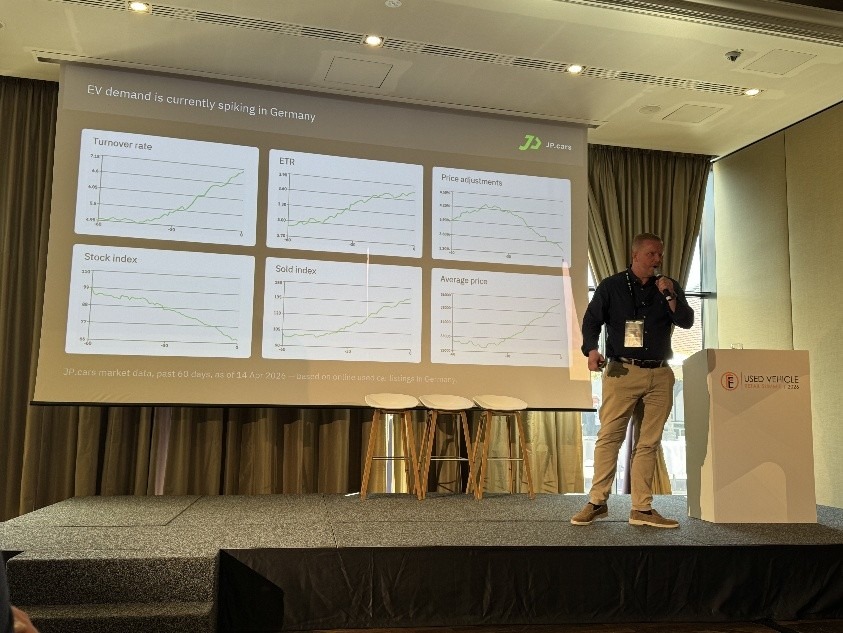
‘Supply and demand levels in every single market are continuously evolving and changing. It is simply impossible to manually monitor supply and demand for each market continuously. You need technology,’ outlined Jan-Willem Seeder, founder and CEO of JP.Cars, in his presentation.
‘If you are not using technology, you are always reacting to the market. The concept of supply, demand and marketability is not so complex. The complexity is seeing and monitoring it in real time,’ he noted. Continuously evolving supply and demand can cause different outcomes in each country, even for the same model.
Seeder stated that in Germany, all the signals clearly show that [EV] demand significantly outpaced supply. Turnover rates increased, stock indexes dropped, selling indexes rose significantly, and prices went up as well,’ stated Seeder.
Jan Willem Seeder, founder and CEO of JP.Cars.
‘If you must buy a BEV in Germany, given these signals, I can imagine it is a very tight market today,’ he said. ‘The question might be, where can I source these cars? Maybe there are markets with other supply and demand ratios across Europe where you could potentially buy similar cars.’
He recognised that there are markets in Europe where supply and demand ratios are different from those in Germany. There could be buying opportunities in numerous markets where buyers could source vehicles.
‘If you have purchased cars for 100 years from a single source in Germany, and that source is providing you with EVs, you will have a very hard time. The market is not local anymore; the market is international,’ he commented.
Optimising cross-border adverts
Rolf Westgeest, founder of Eurostocks, focused on how cross-border transactions operate on classified marketplace portals. These online platforms allow buyers to search listings and contact sellers directly, rather than purchasing through the platform.
‘There are two things in cross-border trade you can do as a car dealer or retailer. You can go on the auction side with lower prices and fast sales. Or you can go to the classified marketplace portals. It is a higher price, but it could be slower sales of 30 days, 90 days or one year.’
So, if dealers want to benefit from these higher prices, they will need to navigate potentially slower sales. Westgeest highlighted multiple areas where dealers can improve.
From left to right: Rolf Westgeest, founder of Eurostocks. Michel van Roon, founder and co-owner of Novatrade24.
Westgeest explained that having adverts appear at the top of search queries can help tackle delays. Photo quality and selection can make a big difference in achieving a high search ranking. The number of reviews under a dealer’s profile is also important. Using analytics provided by the portals can help optimise every advert, too. Despite all this, lead response times can often be the deciding factor.
‘After one hour, 50% of the leads are lost because they are already in a conversation with somebody else. In these portals, people send multiple emails to different dealerships selling the same cars. The first one to respond can make the appointment and win the sale,’ Westgeest told the audience.
Overall, Westgeest highlighted that cross-border sales do not need to be difficult, especially when using marketplace portals. Dealers will see the best results if they choose the right cars, tools, and strategies for online advertising.
Cross-border risks
Alongside benefits, cross-border used-vehicle sales can also come with some legal risks. This can include unintentional participation in value-added tax (VAT) fraud schemes or money laundering ploys. Michel van Roon, founder and co-owner of Novatrade24, explained that this possibility has caused dealerships to hold back.
‘By not participating [in cross-border sales] dealerships leave money on the table, because they are afraid of getting trapped into these schemes. If you want to step into that game, you need to know the rules. You must keep in mind that the tax authorities will have one question. Did you know or could you have known that your buyer was a criminal?’ outlined van Roon.
From left to right: Michel van Roon, founder and co-owner of Novatrade24. Rolf Westgeest, founder of Eurostocks.
Van Roon then outlined the evidence dealers must provide to apply the 0% VAT rate when exporting vehicles. The information and research required is extensive. He also noted that the person responsible for this in a dealership is usually a salesperson.
‘If you look at how much time you take in getting leads, a salesperson should not chase documents. They should chase leads. That is their job. So, if you look at this cross-border trade process, it is full of friction,’ he commented.
Is cooperation the key?
Van Roon suggested that dealerships in the automotive industry cooperate on this issue. To solve it, digital platforms can be used to simplify cross-border vehicle trading.
These platforms manage the legal, administrative, and transaction processes between buyers and sellers in different countries. This can make dealers more confident when participating in cross-border sales. It can also increase trust between dealers, tax authorities and banks.
‘Cross-border compliance does not need to hold you back from doing the trades you need to do to get the best results. But beware of the consequences and requirements,’ warned van Roon.
Together, these sessions highlighted a clear opportunity in the European used-car market. Price fragmentation, especially among EVs, is creating significant opportunity for sellers. However, only those with the right tools and processes to act across borders stand to benefit.
What are the big takeaways from the Used Vehicle Retail Summit? Which electric vehicle (EV) markets stood out in the latest EV Volumes data? Tom Geggus, Autovista24 editor, investigates in the Automotive Update podcast.
In this episode, Autovista24 unpacks the Used Vehicle Retail Summit, with insights from journalist Tom Hooker. Plus, analysis of global EV sales results from China, Europe and Australia.
This year’s Used Vehicle Retail Summit explored the past, present, and future state of the retail sector. The event focused on EVs and how an influx of plug-in vehicles entering the used-car market can be handled.
Key topics included EV adoption trends and changing consumer expectations, plus retail’s digital acceleration. Other important considerations included operational optimisation, plus building confidence in battery-electric vehicle (BEV) resale.
New dealer strategies, cross-border sales and battery state of health (SoH) reports all emerged as keenly discussed issues.
EV retail focus
Surging used EV sales were a major talking point. Speakers highlighted the significance of dealers cementing their EV strategy as soon as possible. This includes calming consumers’ EV concerns with SoH data and exploring battery repair instead of replacement.
For consumers, the average car-buying journey is shortening. This may be a result of more online-based purchasing processes and an increase in AI-powered research. Used-vehicle buyers are also demonstrating higher brand switching behaviour than new-car buyers, speakers revealed.
Overall, a mix of online and in-person channels is now the preferred buying process. Information gathering is now largely digital, yet viewing the vehicle still needs to be in-person for many. Speakers identified opportunities to improve the buying journey, as technology can be used to help. However, personal relationships still play a critical role.
Easing retail consumer concerns
Within an evolving buying process for consumers, dealers, and certified pre-owned portals, more battery health data is now available. To make this easy to understand for buyers, some portals are recalculating vehicle range using SoH reports.
Meanwhile, cross-border sales are a notable opportunity to boost dealer profitability, something which is particularly apparent for BEVs. One speaker highlighted that all-electric cars could see significant fluctuations, with cycles as short as 60 days in one market.
Declining EV sales
According to data from EV Volumes, BEV and plug-in hybrid (PHEV) sales declined across major new-car markets in February. China was a major influencer of this trend as it saw EV sales fall year on year. Nearly half of all new EV sales took place in the country across the first two months of 2026.
The US new EV market also fell between January and February. Conversely, some European countries, such as Germany and the UK, saw BEV and PHEV sales increase. Meanwhile, the Australian new EV market continued to grow.
How will new-car markets transform over the course of 2026? Plus, what is happening with used-car supply and demand in Europe? Autovista24 editor Tom Geggus finds out in the latest Automotive Update podcast.
In this episode, Autovista24 reviews the latest JD Power webinar, which explored Europe’s new-car outlook. Plus, a look into the latest residual value (RV) trends in the continent’s used-car market.
The session covered Europe’s new-car market outlook from 2026 to 2040 across multiple powertrains. Panellists also delved into the bloc’s diverging electric vehicle (EV) adoption and the factors behind it. Plus, the webinar reviewed upcoming technologies and emerging brands expanding across the continent.
Attendees were asked how much they thought Europe’s new-car market would grow, or shrink, by the end of this year. 40% of respondents expected a year-on-year improvement between 0% and 2% compared to 2025.
This matched the latest EV Volumes forecast, which projected a 0.2% increase in its March update. However, this was reduced from the 1.5% growth forecast in its December report.
The March update also projected overall growth for European light-vehicle sales, which includes new cars and light-commercial vehicles. In 2026, a year-on-year increase of 0.1% is forecast, down from 1.7% in the previous report.
The panel also discussed varying EV adoption rates in the bloc. They identified key structural differences that are either limiting or assisting plug-in uptake.
Furthermore, the experts showed how, in some instances, EVs are closing the price gap to internal-combustion engine models. This comes as the choice of small EVs on the new-car market continues to widen.
In Austria, France, Germany, Italy, Spain, Switzerland and the UK, values are expected to decline by the end of 2026. However, these drops are expected to be slight.
A drop is also projected across all observed markets in 2027. This is the case in 2028 as well, except for Italy, with marginal growth forecasted.
RVs became inflated during the COVID-19 pandemic when supply was low, but demand was high. As these drivers balanced out, values underwent a period of normalisation.
In March 2026, the active-market volume index (AMVI) for 24-to-48-month-old used cars showed year-on-year growth in every observed market. When compared to February 2026, only the UK suffered a marginal downturn, with a slight 1.1% dip in supply.
The sales-volume index (SVI) of 24-to-48-month-old cars also increased compared with March 2025. This trend occurred in six of the seven observed markets, except for Italy, which recorded a 1.1% decline. Month-on-month results were more mixed, as single-digit drops were recorded in France, Italy and the UK.
If supply continues to outpace demand, RVs will face increased pressure, with more units available and fewer potential buyers.
Are levels of supply and demand balanced across major European used-car markets? Alongside regional experts, Autovista24 editor Tom Geggus explores the data from March in the latest Monthly Market Update.
There were positive developments in both supply and demand across many major European used-car markets during March. Key performance indicators, including the sales-volume index (SVI) and the active-market volume index (AMVI) in many countries, reveal an emerging balance.
Cars 24 to 48 months old saw dealership sales increase compared to February in four of the seven observed markets. While changes in France and Italy were marginally negative, the UK saw a double-digit decline. However, the country also saw one of the biggest stock day improvements, with cars taking less time to sell.
Changes in the SVI were more uniform across markets when compared with March 2025. Only Italy saw the indicator drop, with a small 1.1% fall. Meanwhile, Germany, the UK and Spain all recorded double-digit increases.
Five of the seven observed markets saw year-on-year AMVI growth, exceeding the SVI performance as more used-car adverts appeared. This reveals a normalisation in supply, which was mirrored in the month-on-month results. Only the UK saw a downturn within this comparison.
So, many major used-car markets are seeing greater balance in the supply and demand of used cars. However, if supply outpaces demand, residual values (RVs) will feel greater pressure as stock levels exceed the number of buyers.
Austria sees stronger turnover
Austria’s SVI for two‑to‑four‑year‑old passenger cars continued to improve in March. After a strong rebound in February, the metric increased by 7.1% month on month. Compared with March 2025, the SVI was 3.2% higher, marking an improvement from the year‑on‑year decline reported in February.
The AMVI also edged slightly higher. It recorded a 1.7% month‑on‑month increase and a 3.7% year-on-year rise. This confirmed that stock was above last year’s levels.
‘Turnover strengthened noticeably in March,’ highlighted Robert Madas, regional head of valuations. ‘The average time needed to sell a car dropped to 69.7 days, a significant seven‑day month-on-month improvement. Compared to March 2025, days to sell were broadly stable.’
Diesel models took the lead in turnover speed again, with an average of 65.2 days to sell. This was followed by petrol cars taking an average of 70.6 days to sell. Then came plug-in hybrids (PHEVs) at 73.5 days, followed by battery-electric vehicles (BEVs) at 75.7 days. This was a significant improvement of 13.1 days from last month. Full hybrids (HEVs) took the longest time to sell at 79.4 days.
Pricing dynamics showed slightly increasing developments. The average trade RV of 36‑month‑old cars at 60,000km increased to €23,070, up 2.1% month on month and 7.8% year on year.
Structural depreciation pressures
RVs as a percentage of retained list price (%RV) improved to 47.3%, up 0.2 percentage points (pp) compared to February. Year on year, %RVs decreased by 0.7pp, pointing to ongoing structural depreciation pressure amid rising supply and normalising demand. List prices remained at elevated levels, climbing to an average of €48,765, an increase of 1.8% month on month and 9.3% higher year on year.
HEVs retained the highest trade value at 50.5%, followed by petrol cars at 49.4%. Then came diesel models with 48.2% and PHEVs with 45.4%. BEVs held the lowest %RV once again, at 37.7%.
‘The RV outlook remained broadly unchanged. %RVs are forecast to decline gradually over the coming years as supply normalises further,’ Madas said.
In December 2026, a 0.5% year-on-year decline is forecast. This decline is expected to accelerate to 0.7% in 2027, indicating a slow but steady downward trajectory in retained values. This is consistent with a market that is more balanced and less supply-constrained than in recent years.
France sees RV bounce
‘RVs fell slightly in France during March, compensating for the slight increases recorded in previous months,’ explained Ludovic Percier, senior RV analyst for France. ‘This brought the overall RV trend back to levels seen in November 2025.’
Petrol-powered car values decreased marginally but were stable compared with November 2025. Overall, the fuel type has seen a level RV performance, while other powertrains experienced larger decreases. Additionally, petrol is still offered by many manufacturers while diesel models are getting rarer.
Diesel recorded a slight RV fall in March but still did better than at the end of 2025. The fuel type continues to see demand in the used-car market. Fleets are also not buying as many new diesel-powered cars as they have previously.
HEVs saw a small value drop last month. The powertrain has been gaining popularity among manufacturers as they offer more models with the technology. This means more HEVs on the used-car market, with most of these new entrants being from established brands.
Toyota continues to lead the way on the used HEV market. In recent months, three Toyota models have appeared in the top five fastest-selling ranking for the powertrain. Overall, used HEVs are still in demand in France, but carmakers cannot risk adding big price premiums to these models. This would jeopardise their value retention.
PHEV supply and demand imbalance
The supply and demand for PHEVs remains imbalanced. In previous years, many vehicles were sold to fleets on the back of fiscal advantages, with a high list price on the new-car market. This strategy explains such low RVs. Vehicles offering an electric-only range of below 60km have been most affected.
PHEVs were once again among the slower-selling used cars in France. There was a decline in average days to sell in March as more of these models came back from leasing. Compared with newer PHEVs, the electric range of these older units is not as substantial. Larger electric ranges have supported the value retention of more recent plug-in hybrids.
BEV values were stable after months of declines. Three years ago, models were being launched with greater ranges. The impact of this can now be seen on the used-car market, with these cars retaining slightly more value.
BEVs from lower segments with smaller list prices and lower ranges have been impacted more by the environmental bonus and the social leasing scheme. Upper segments have not yet been affected by the fiscal advantages for fleets. Those vehicles will come to the used-car market in early 2028.
‘BEVs continued to struggle, spending 84 days on average in stock, compared with the overall market average of 66. The powertrain also retained 35.6% of its new car list price after 36 months and 60,000km in March. This was compared to the overall market’s 50.7%,’ Percier outlined.
Increased used-car demand in Germany
Used‑car demand in Germany increased again in March following a strong rebound in February. The SVI rose by 28.8% month on month. Demand remained well above last year’s level, with the SVI 32.4% higher year on year, indicating a stronger market than in early 2025.
‘Supply conditions also continued to stabilise,’ said Madas. ‘The AMVI was up slightly by 0.9% month on month and 21.2% higher year on year. This confirms a further expansion of available stock and ongoing normalisation of used‑car supply.’
The average number of days needed to sell a used car hit 65.5 days, a 2.8‑day improvement month on month. However, this was 3.9 days longer than a year ago, signalling that despite improved turnover, the market remains slower.
Looking at powertrain performance, BEVs were the fastest-selling technology, taking 58.8 days to leave forecourts. Then came PHEVs at 62.4 days. Diesel cars followed at 64.5 days, while HEVs took 66.4 days. Petrol-powered cars sold the slowest, at 68.6 days.
RVs still under pressure
RVs remained under pressure in the country, as %RVs fell to 46.5%. This was down 0.3pp month on month and 1.1pp year on year. Absolute trade RVs also decreased to €21,532, a 1.4% decline month on month, though still 1.1% higher year on year.
‘Meanwhile, list prices dipped to €46,345, down 0.6% from February, but remained 3.6% higher compared to a year ago. This continued a long‑term upward trend in new‑car pricing,’ Madas commented.
By fuel type, petrol-powered cars continued to lead with a %RV of 48%, followed closely by diesel at 47.8% and HEVs at 47.2%. PHEVs held on to 43.1% of their value, while BEVs remained the lowest at 37.1%, maintaining the powertrain gap observed throughout 2025.
Looking ahead, gradual downward pressure on %RVs is still expected as supply normalises further. By the end of 2026, %RVs are projected to decline by 1.6% compared with December 2025. Pressure is predicted to ease somewhat in 2027, with a smaller decline of 0.9% expected. This indicates ongoing RV strain, driven by recovering supply, normalising demand, and elevated list prices.
Weaker Italian market?
‘The Italian used-car market continued to show signs of weakness in March. This confirmed a negative trend which has been persistent for several months,’ explained Marco Pasquetti, cluster head of forecasting for Spain and Italy.
The SVI indicates overall demand stability. Levels were slightly lower than both February 2026 and March 2025, but the drops cannot be considered particularly significant.
As for sales pace, the average days to sell stood at 59.1 days. This marks an increase of 1.7 days compared to the previous month, yet still 6.4 days fewer than in March 2025.
Based on the latest figures, the outlook for the end of 2026 remains negative. Compared with 12 months ago %RVs were down. Levels fell from 48.8% in March 2025 to 45% a year later.
PHEVs saw the most pronounced %RV drop, down 5.2pp to 39.1%. BEVs also saw value retention fall, down 2.7pp to 28.3%, confirming a general cooling in demand for electric powertrains.
Spain regains momentum
‘After a more subdued January, the Spanish new-car market appears to have regained the momentum it ended 2025 with,’ said Ana Azofra, regional head of valuations and insights. ‘In February, 97,082 units were registered, representing a 7.5% year-on-year increase, confirming the market’s positive trend.’
Electric vehicles (EVs) continued to be the main driver of sales, with registrations increasing by 21.6% year on year. This meant BEVs and PHEVs took a 21.6% market share in February.
This momentum is expected to increase once the regulatory framework of the new Auto+ Plan is announced. It will not only incentivise the purchase of BEVs and PHEVs but also the installation of home charging points. In addition, rising fuel prices are likely to further increase interest in EVs.
Stable used-car market
‘Used‑car sales have not followed the same trend in the first few months of the year. The market currently appears more stable,’ said Azofra. ‘Transaction prices have remained broadly stable, having changed by approximately €10 since February’s report.’
Specifically, the average price of a typical three-year-old used car at 60,000km, traded between professionals, is just under €20,342. This resilience means prices remain 2.4% above the level recorded in March 2025. As recorded by the AMVI, a 6.8% increase in supply is helping support price stability.
However, performance varied by powertrain. Petrol, diesel and HEV models have seen positive value retention, while BEVs and PHEVs recorded marginally negative adjustments. Month on month, the absolute RVs of PHEVs dipped by 0.6%, while BEVs experienced a larger fall of 2.4%. However, both powertrains saw levels remain well above those recorded in March 2025.
Despite these minor adjustments, significant declines are not expected. This follows the improvement of a key-performance indicator in March: the number of days needed to sell a used car. The current average time stands at 78.8 days, ranging from 86.2 days for BEVs to just 69 days for full hybrids.
As a result, the ranking of the fastest‑selling models in March was led by the Toyota RAV4. Leading the HEV category, it took only 13.2 days to sell. It was followed by the Hyundai Ioniq and Hyundai Kona, with 41.2 and 42.8 days, respectively.
Switzerland sees demand improvement
Used‑car demand in Switzerland continued to improve in March following a recovery in February. The SVI rose by 1.3% month on month. Compared with March 2025, this key-performance indicator for demand was 2.4% higher. This confirmed a growing trend after the disruption seen at the start of the year.
Supply conditions also improved slightly. The AMVI was up 0.8% month on month and 3% year on year. This indicates that stock remains above last year’s levels, supporting broader market stability.
Madas confirmed that: ‘%RVs continued to decline in March. The average %RV for a 36‑month‑old car at 60,000km dropped to 41.5%, representing a 0.2pp decline month on month and a 2.6pp decline year on year. There is persistent depreciation pressure in Switzerland, driven by rising list prices and more balanced supply and demand.’
HEVs retained the most value of any powertrain in March by far at 46.7%. Then came petrol-powered cars at 42.9%, diesel-powered models at 41.3% and PHEVs at 39.4%. BEVs continued to be the worst-performing powertrain, holding only 35.5% of their original list price.
Slower value descent forecast
Absolute trade RVs increased slightly to CHF 26,716 (€29,036). This was up 0.9% compared with February, and 2.4% higher than a year ago. Rising list prices continue to support absolute used‑car values despite the downward movement in %RVs. List prices climbed to CHF 64,368, a 1.3% month‑on‑month increase and a strong 9% rise year on year.
The average time needed to sell a used car stood at 77.8 days. This was a marginal improvement of 0.1 days month on month and a stronger 0.5‑day improvement year on year. This indicates that turnover is holding up reasonably well despite ongoing value pressure.
BEVs sold fastest at 73.4 days, followed by petrol cars at 76.4 days and by HEVs at 78.2 days. This was followed by diesel cars at 79.7 days. PHEVs took the longest to leave forecourts at 88.8 days.
‘Looking ahead, %RVs are forecast to decrease further in the coming years, but at a slower pace,’ Madas outlined. ‘By the end of 2026, %RVs are expected to fall by 1.5% compared to December 2025. A further 0.5% drop is anticipated in 2027.’
UK feels plate-change effect
‘RVs in the UK continued to trend downwards in March, albeit marginally,’ said Jayson Whittington, regional head of valuations for the UK. ‘RVs presented as a percentage of retained list price after 36 months and 60,000km declined by 0.7pp compared with February.’
Petrol and PHEV values saw the biggest declines in the country, down by 0.6pp and 0.7pp, respectively. Meanwhile, BEVs bucked the downward trend with a 1.1pp rise. However, it is important to remember that the month’s plate-change effect can mask true market performance.
In March, a car registered three years ago will display a 23 plate, yet in February, a three-year-old car would show a 72 plate. This plate distinction commands a higher value in the region of 3pp. So, without the plate-change effect, there would have been a greater decline compared to February. A direct comparison with March 2025 shows market-wide %RVs fell by 2.8pp.
Across all powertrains, vehicles averaged 39.5 days to sell, improving by 6.5 days month on month. BEVs once again recorded the fastest turnaround at 33.9 days.
Sales activity softened. The SVI dropped by 11.3% compared to February. Most fuel types experienced a significant reduction, except for BEVs, which recorded a 3.6% increase.
The overall AMVI showed a marginal advert reduction of 1.1%, which indicates reasonable supply stability. The volume of BEVs increased this month by 13.6%, as dealers took advantage of the increasing popularity of the powertrain. Overall, March brought improved stock turnover but weaker RV performance in the UK. It will be interesting to monitor vehicle supply in the coming weeks. Part exchanges and lease de-fleets generated by March’s plate change will begin hitting retail forecourts.
Residual values (RVs), presented as a percentage of retained new-car list price (%RV), kept sliding in Europe during February. But is this descent slowing, and what comes next? Autovista24 editor Tom Geggus unpacks the data with regional experts.
The average retained value of a 36-month-old car at 60,000km dipped again across many European used-car markets. In February, Austria, Germany and Switzerland saw new lows compared with the last 12 months.
Meanwhile, France and Spain saw lower value retention rates in January. At the start of 2026, Italy and the UK saw %RVs above rates recorded in December and August 2025, respectively.
Both France and Spain saw a marginal month-on-month %RV improvement. Meanwhile, Austria, Germany, Italy, Switzerland and the UK recorded declines compared with January 2026.
The downward trend is much more visible when comparing February 2026 with February 2025. All markets saw %RVs decline, with Italy performing the worst. Values dropped to 45.5%, down by 4.1 percentage points (pp) in the country.
While this appears drastic, trade values are still undergoing a process of normalisation following inflation during the COVID-19 pandemic. Compared with 2021, all markets continue to see higher levels of value retention.
Switzerland was the closest to its position five years ago, with values only 1.1pp higher. Three-year-old used cars in Germany continue to see higher levels, 4.5pp above where they were in 2021.
%RVs are expected to keep falling across these markets in the next three years. Italy is the only exception, which is forecast to see a marginal increase by the end of 2028. By the same point, France and the UK are expected to see the largest %RV declines of the seven markets.
Austria’s subdued market
Austria’s sales‑volume index (SVI) for two‑to‑four‑year‑old passenger cars recovered significantly in February. After a traditionally weak January, the SVI increased by 52.9% month on month. However, the SVI remained down compared to February 2025, with the index dropping 7.6% year on year.
The active‑market volume index (AMVI) also witnessed a slight bounce back. It rose by 1.4% month on month, while stock levels were 4% higher year on year. This indicates a well‑supplied market and a modest build‑up compared to 2025.
‘Turnover slowed again in February,’ stated Robert Madas, regional head of valuations. ‘The average time needed to sell a used car increased to 76.7 days. This marks a three‑day deterioration compared with January and a year-on-year increase of 1.5 days. This underlined subdued retail activity, despite improved sales volumes.’
Diesel models took the lead in turnover speed, taking an average of 71.5 days to sell. This was followed by petrol cars taking an average of 74.4 days to sell. Then came full hybrids (HEVs) at 78.3 and plug-in hybrids (PHEVs) at 87.9 days. Battery-electric vehicles (BEVs) continued to take the longest time to sell at 88.7 days.
RVs soften in February
Looking at pricing, the average RV of a 36‑month‑old car at 60,000km softened in February. The average trade RV reached €22,623, down 0.6% month on month.
%RVs in Austria declined to 47.1%, down 0.7 percentage points (pp) compared to January. Year on year, %RVs decreased by 1.4pp, reflecting continued downward pressure on used‑car values amid rising supply and normalising demand. List prices remained high, averaging €47,987 in February, a slight 0.8% increase month on month.
HEVs retained the highest trade value at 50.2%, followed by petrol cars at 49.3%. Then came diesel models with 48% and PHEVs with 43.9%. BEVs held the lowest %RV once again, at 38.8%. However, this was a slight improvement of 0.2pp month on month.
‘Looking ahead, %RVs are expected to decline slightly in the next few years,’ said Madas. ‘In December 2026, a 0.6% year-on-year decline is forecast. A 0.7% decrease in 2027 is expected to follow.
‘This points to a slow but persistent downward %RV trend in the coming years. This is consistent with a rebalancing market environment and ongoing supply normalisation,’ he highlighted.
France sees stability
RVs continued to be stable in France during February. Some powertrains saw slight month-on-month increases, although this was mainly due to a value drop in January. However, February’s results were stable compared with December 2025.
Petrol saw %RVs after 36 months and 60,000km increase compared with January. Yet they fell compared with December. Recent %RV declines for petrol have been minor as the fuel type holds its value better than other powertrains.
‘Many manufacturers offer petrol variants while diesel has become rarer,’ commented Ludovic Percier, senior RV analyst for France. ‘However, diesel has seen less impact, even managing to record %RV increases compared with January.’
HEVs saw stability in February, but their %RVs were below December’s results. This continues a declining value retention trend seen in recent months. This can be attributed to the increasing number of HEVs offered in France, most of which are from mainstream brands.
These models do hold value as well as Toyota’s HEVs. Three of the top five fastest-selling HEVs came from the Japanese brand. Used HEVs are in demand, but carmakers cannot risk adding big price premiums at the expense of RVs.
Supporting EV RVs
Used BEVs and PHEVs took the longest time to sell in France. However, RVs can be supported by newer models with increased ranges. While %RVs increased month on month for both powertrains, they fell compared with December.
PHEV demand and supply remain imbalanced. In previous years, many of these vehicles were sold to fleets on the back of fiscal advantages. They came with excessive new-car market list prices, explaining the lower RVs. Models offering an electric-only range of below 60km have been the most affected.
Higher-priced BEVs with longer driving range have seen larger absolute RVs and more stable %RVs. Lower segments with lower list prices and smaller ranges have been impacted by the environmental bonus and social leasing scheme.
‘Meanwhile, upper segments have not yet been impacted by fiscal fleet advantages,’ Percier added. ‘Those vehicles will come to the used-car market in early 2028.’
BEVs spent 85.5 days in stock on average, compared with the market average of 67.2, which is also high. The Tesla Model 3 was still the quickest to sell, while the Model Y was the third-fastest-selling used BEV. They remain in demand as their new prices drop once again.
Demand rebounds in Germany
Used‑car demand in Germany rebounded significantly in February after the seasonal downturn seen at the start of the year. The SVI jumped to 143, representing a 43% month‑on‑month increase. Despite this strong recovery, the SVI was down 13.7% year-on-year, as demand remained below last year’s level.
Supply conditions also improved. The AMVI rose slightly by 1.1% from January. Year on year, stock availability was 22.6% higher, confirming a continued and substantial rebuild of used‑car supply.
‘The average number of days needed to sell a used car increased to 68.3 days. This was a noticeable deterioration of 3.3 days month on month and year on year,’ highlighted Madas.
Looking at powertrain performance, BEVs were the fastest-selling technology, taking 61.6 days to leave forecourts. Then came PHEVs at 62.4 days. HEVs followed at 63.2 days, while diesel-powered vehicles took 69.9 days to sell. Petrol-powered cars sold the slowest, at 70.9 days.
Renewed pressure on RVs
RVs came under renewed pressure in February. The average %RV of 36‑month‑old cars at 60,000km declined slightly to 46.8%. This was down 0.1pp month on month and 0.9pp year on year.
In contrast, absolute trade values increased slightly to €21,855, a 1% improvement from January. This was supported by the continued rise in list prices, which climbed to €46,664. This was up 1.1% compared to January and up 4.2% year on year.
By powertrain, petrol-powered cars continued to lead with a %RV of 48.3%, followed closely by diesel at 48.2% and HEVs at 47.5%. PHEVs held on to 44.1% of their value, while BEVs remained the lowest at 37.1%, maintaining the gap observed throughout 2025.
Looking ahead, RVs are expected to remain under pressure, in line with previous forecasts. By the end of 2026, %RVs are projected to decline by 1.4% compared with December 2025.
‘Pressure is predicted to ease somewhat in 2027, with a smaller decline of 0.9% expected. This indicates ongoing RV strain, driven by recovering supply, normalising demand, and elevated list prices,’ Madas outlined.
Values fall in Italy
‘As expected, RVs continued to decline in Italy during February, in line with the trend observed in 2025,’ said Marco Pasquetti, cluster head of forecasting for Spain and Italy.
%RVs after 36 months and 60,000km stood at 45.5%. This corresponds to a decrease of 0.7pp compared to January and a drop of 4.1pp year on year. There are no signs of this trend reversing, with the downward trajectory likely to persist throughout 2026. By December, %RVs can be expected to decline by 6.2% overall.
There were no surprises across the various powertrains. All of them saw proportionally consistent declines in line with the overall market trend. Diesel, although declining, remained the technology with the best retention of list price value at 50.1%.
In terms of volume, it also continues to be in high demand on the used‑car market. This is likely due to signals from some manufacturers that they are considering reinvesting in these engines, including Stellantis.
The average time required to sell a used vehicle on major online marketplaces improved compared to January 2026 and February 2025. In particular, the year-on-year improvement is notably positive for BEV and PHEV vehicles. If this trend continues, it could indicate a slowdown in the decline of RVs for these powertrains.
Bad start for Spain’s used-car market
New-car sales in Spain began 2026 with a slight increase of 1% compared to January 2025. Electric vehicles (EVs), including BEVs and PHEVs, showed strong momentum.
Sales of these powertrains increased by nearly 50% as they represented over a fifth of the new-car market. By channel, private buyers and companies recorded significant declines. Only rental companies saw their registrations increase, up by 63.5%.
These rent-a-car renewals have returned a significant volume of young used vehicles to the market. This made it the only channel to record positive results compared with January 2025.
‘Overall, the start of the year has not been good for used-car sales, which fell by 9%,’ noted Ana Azofra, head of valuations and insights for Spain.
‘BEVs and PHEVs continue to gain share, benefitting from growing demand for electrified alternatives,’ she added. ‘This increased interest is reflected in the evolution of average transaction prices, with increases across all electrified powertrains.’
Average absolute RVs of 36-month-old BEVs and PHEVs at 60,000km saw month-on-month increases of 5.3% and 8%, respectively. Only petrol vehicles suffered a slight month-on-month decrease in their average absolute RV, down 0.5%.
Although the overall situation is positive, used cars saw a longer turnover rate compared with January 2026 and February 2025. The only exception was BEVs, which sold 13.3 days faster than 12 months ago. Despite this, the powertrain still took the longest time to sell.
The model with the best rotation times in February was the Dacia Sandero, with an average rotation of 42.4 days. Then came the Volkswagen T-Roc with 51.2 days, and the Toyota Corolla with 53.5 days.
Switzerland sees weaker RVs
Used‑car demand in Switzerland made a good recovery in February. The SVI surged by 48.5% month on month. Despite this rebound, demand remained 2.1% lower year on year, indicating continued pressure compared to early 2025.
Supply conditions softened slightly. The AMVI fell by 2.3% month on month but remained 5% above last year’s level. This confirms that stock availability is still higher than in early 2025 despite the temporary dip.
‘%RVs weakened in February,’ Madas commented. ‘The average %RV of a 36‑month‑old car at 60,000km dropped to 41.7%, down 0.8pp month on month and 2.9pp year on year. This underlines the ongoing depreciation pressure in the Swiss used‑car market.’
In absolute terms, trade RVs decreased slightly to CHF 26,501 (€29,062), a 0.9% month‑on‑month decline. Yet, this was still 0.9% higher year on year.
List prices continued to rise, averaging CHF 63,610, representing a 1.2% increase month on month and an 8.1% rise year on year. This ongoing inflation in list prices helps support absolute used‑car values, even with falling %RVs.
HEVs still on a high
HEVs retained the most value of any powertrain in February by far at 46.7%. Then came petrol-powered cars at 43.2%, diesel-powered models at 41.5% and PHEVs at 39.7%. BEVs continued to be the worst-performing technology, holding only 35.5% of their original list price.
The average time to sell a used car increased marginally in February, rising to 77.9 days. This was 0.4 days slower month on month, but still a strong 4.3‑day improvement year on year. This reflects better turnover conditions than in early 2025.
HEVs sold fastest at 69.4 days, followed by BEVs at 75 days. This was followed by diesel cars at 77.2 days and petrol-powered models at 78.6 days. PHEVs which took 82 days to leave forecourts.
Looking ahead, %RVs are forecast to decrease further in the coming years, but at a slower pace. By the end of 2026, %RVs are expected to fall by 1.4% compared to December 2025. A further 0.5% drop is anticipated in 2027.
UK sees strong growth
‘The UK’s used-car market recorded strong growth in February 2026,’ commented Jayson Whittington, regional head of valuations for the UK. ‘Overall, there was a clear upswing in sales momentum, led by electrified powertrains. However, pricing pressures remained evident across most fuel types.’
All fuel types posted positive month-on-month SVI gains. On average, the metric was up by 25% across all powertrains, highlighting broad demand.
BEVs led the market with a 29.8% rise, closely followed by PHEVs at 29.6%. HEVs recorded a 26.3% increase, reflecting strong consumer interest in electrified choices.
Petrol models performed well with a 24.8% month-on-month increase, driven by continued affordability and availability. Diesel, while posting the lowest rise at 16.1%, still demonstrated strong growth for a fuel type facing long-term declines.
Despite the uplift in retail activity, the overall time taken to sell a used vehicle increased by 2.7 days to 46 days. BEVs once again led the way, taking an average of 37.4 days to sell. They were supported by fast-turning models, including the Tesla Model Y at 22.6 days and the Volvo C40 at 23.7 days.
%RVs of 36-month-old cars at 60,000km were more mixed. Month on month, the overall %RVs slipped 0.8pp to 49.1%. The value retention of petrol-powered cars fell by 0.8pp as well, to 50.5%. Meanwhile, PHEV %RVs softened by 1.1pp to 46.2%. HEVs declined marginally by 0.2pp to 53.2%. BEVs saw the steepest drop, by 1.6pp to 35.2%. Diesel was the only segment to improve, rising by 1.7pp to 57.4%.
With mixed fortunes in new-car registrations, did used-car transactions in Europe’s big five automotive markets provide some relief last year? Autovista24 special content editor, Phil Curry, examines the latest data.
Used-car transactions in Spain, Italy, the UK, France, and Germany all saw growth in 2025, just at varying rates. Some markets may be more concerned than others, however, as 2026 progresses.
The results suggest that buyer demand remains high. Volumes continued to outpace those in the respective new-car markets. However, for three of the five countries, used-car growth was lower than registration results.
Where reported, the figures also show internal-combustion engines (ICE) continue to dominate, contrasting with new-car market trends. Buyers appear to be turning to used cars, as supplies into new channels dwindle.
Spain leads used-car growth
Just like its new-car market, the used-car sector in Spain was the fastest growing in Europe’s big five last year. The country saw 2,163,260 transactions across 2025, according to Autovista24 calculations based on monthly data from GANVAM. This was an increase of 4.4% compared to figures from 2024.
Spain’s used-car market did not have as smooth a 2025 as its new-car sector, however. Declines in April, May and November pulled figures back. However, the year finished strong, giving the country a good starting point for 2026.
The fourth quarter of the year saw 614,872 transactions, a rise of 4.5% compared to the same period in 2024. October saw a 4.4% rise, with 210,332 used cars changing hands, according to Autovista24 analysis. However, November’s sales dipped by 1.1% to 187,208 transactions.
But the market bounced back in December, as 217,332 used cars made their way to customers. This was the best monthly volume of the year and represented a 9.9% year-on-year rise. With November’s decline, the only low point in the last half, transactions increased by 5.8% to 1,125,521 sales.
A problem with age
According to GANVAM, fleet renewal remains a challenge. Sales of three-to-five-year-old models increased by 8.8% across 2025. Transactions of models over 10 years old improved at a slower rate of 4.6% between January and December. Yet they accounted for 57.3% of Spain’s used-car total. This means that the average age of a used car sold in the country was 11 years old.
Therefore, GANVAM and fellow Spanish industry body Falconauto are calling for an effective scrappage incentive strategy. This would help remove older, more polluting models from Spanish roads. By tying scrappage into the activation of subsidies for the purchase of new electric vehicles (EVs), this process could be accelerated.
Diesel remains on top
Diesel transactions fell by 0.8% across 2025, according to GANVAM. However, it was still the most popular powertrain in the used-car market, making up 49.9% of transactions. Petrol was responsible for 36.3% of sales, with volumes increasing by 2.3%.
The volume of hybrids, plug-in hybrids (PHEVs) and battery-electric vehicles (BEVs) only accounted for a small percentage of the market. However, these transactions increased rapidly. BEVs saw an improvement of 53.3% year on year, making up 1.3% of total transactions.
By age, newer models were the best-sellers when it came to BEV transactions. Those models less than a year old represented 26% of all-electric sales in the year. Models between one and three years of age accounted for 32.1% of those sold. Meanwhile, PHEVs saw growth of 43.7% compared to 2024, with a 2% market share.
Used-car market stronger in Italy
Italy’s used-car market ended 2025 as the second-fastest growing of Europe’s big five. This was contrasted with its new-car market, which struggled throughout the year.
According to industry association ANFIA, a total of 5,648,961 transactions took place between January and December. This was up 3.3% compared to 2024, equating to an extra 181,029 sales, according to Autovista24 calculations.
Only one month in the year saw a decline in used-car transactions, with May recording a dip of 3.9%. This was not enough to dent the market’s progress, with September’s 10.5% jump.
The fourth quarter of the year proved steady, with a 1.6% rise in cars changing hands. A total of 1,505,900 transactions took place between October and December. This meant a better-performing second half of 2025, with a 3.6% rise in sales.
October saw 552,410 deliveries, an increase of 1.8% compared to the same period in 2024. November was the second-worst performing month of the year, with 470,157 transactions resulting in a 0.3% increase. December saw 483,333 used-car sales take place. This was good enough for a 2.7% rise compared to 12 months prior.
Further growth for UK
The UK’s used-car market ended 2025 with a flourish, as figures improved for the third consecutive year.
In total, 7,807,872 used cars changed hands between January and December, an increase of 2.2% compared to 2024. The latest figures from the SMMT show growth in each quarter of the year, as buyers continued to turn to older cars to meet their needs.
Just February and November saw dips, down 0.3% and 0.2% respectively. These results did little to impact the overall market, however.
A total of 1,769,501 transactions took place between October and December, a year-on-year rise of 1.3%. October was the strongest month of the three in terms of volume, with 674,801 sales and a 0.8% increase. November saw a 0.2% decline as 606,182 models changed hands.
While representing the lowest transactions of the year, December’s 488,518 total was a rise of 4.1%. This was the second-largest volume increase after March’s 6.9% rise.
These results meant the second half of the year saw an improvement of 2.1%, just 0.1pp lower than the result between January and June.
Petrol leads the way
Petrol increased its transaction volume in 2025, with 1.5% more sales taking place. In total, 4,430,901 units changed hands in the 12-month period. This gave the powertrain a 56.7% market share.
Meanwhile, diesel fell 3.3% year on year to 2,586,279 transactions. The fuel type represented 33.1% of total sales in 2025. This performance came in stark contrast to the new-car market, where diesel registrations fell 15.6% with just 103,906 deliveries taking place.
This could be due to a decline in the availability of diesel cars, rather than demand. As supply into the used-car market falls, the high used-diesel sales may be contributing to the country’s ageing car parc.
The figures show that interest in the internal-combustion engine (ICE) market is far from over. In total, 89.9% of transactions in 2025 were petrol or diesel-powered models.
EVs increase their presence
However, the strongest growth came from full-hybrid (HEV) and BEV powertrains. With more supply into the used-car market, electrified deliveries are continuing to improve.
HEVs saw 407,531 units sold in 2025, a rise of 33.1%. They gained a 5.2% market share in the 12-month period. Meanwhile, BEVs saw 274,815 models changing hands, a rise of 45.9% year on year. This was good enough for a 3.5% share of total used-car transactions in the year.
PHEVs, however, declined by 4.4%, with just 88,032 transactions, making up 1.1% of sales. Electrified drives accounted for 9.9% of total sales in 2025. It is likely this growth will continue throughout 2026. More models will become available from the new-car market, increasing supply into used-car channels.
France falls flat
After a strong start in January, the French used-car market experienced a steady year in 2025, according to information from AAA Data. The high 7.7% year-on-year increase in the first month of the year was not beaten, although December’s 6% surge came closest.
Overall, results middled, with the market experiencing a small, 0.8% increase across the 12-month period. The fourth quarter saw a similar rise of 0.8%, as December’s strong result was reined in by declines in October and November.
In October, 483,743 used cars changed hands, resulting in a decline of 1.1%. This was followed by a 2% drop in November, with 423,704 transactions. December’s 6% rise was thanks to 452,149 sales.
This was enough to help used-car transactions in France limp over the line with growth. This was in contrast to the country’s new-car market, which fell by 6.1% last year.
According to AAA Data, the used-car market has been characterised by a shortage of newer models since the COVID-19 pandemic. Transactions of used cars under five years old declined by 7% in 2025, impacted by drops in new-car registrations. In total, 1,552,835 models in this age range changed hands.
However, cars over 10 years old saw sales jump by 6%, likely adding to the country’s increasing average car parc age. With 2,644,957 transactions, they made up the majority of used-car deliveries. Meanwhile, models aged between five and 10 years record 1,198,640 transactions, a 1% increase year on year.
ICE domination continues
While the electrification of the French used-car market continued, ICE models still dominated sales in 2025. According to AAA Data, diesel transactions fell by 4%, making up 45% of total deliveries in the year.
Meanwhile, petrol models recorded a 3% decline in the year, taking a 39% market share. This means ICE cars accounted for 84% of the country’s used-car total in 2025.
Used electric cars accounted for 3% of the market between January and December, with volumes rising 30%. Meanwhile, hybrid deliveries took 12% of the total.
Germany sees stable demand
Germany’s used-car market remained stable in 2025, helped by a strong result in December. This came after two months of decline that threatened to push the sector into a year-on-year loss.
In total, 6,512,427 used-car transactions took place in the year, according to the KBA. This was a rise of just 0.5% compared to 2024. Much like the country’s new-car market, transactions of used cars saw a rollercoaster year, with a equal number of monthly declines and increases.
The fourth quarter of 2025 saw sales rise by just 0.4%, with 1,560,389 transactions taking place according to Autovista24 calculations.
The quarter started with a 2.8% decline in October, as 558,790 passenger cars were sold. November also saw a drop in volumes of 3.2%. However, the market bounced back in December, with an 8.8% rise proving to be the strongest growth of the year. This was thanks to 485,953 transactions.
This boosted the second half of 2025 to an improvement of 0.7%, meaning Germany’s used-car market finished the year growing. However, the country will be hoping for more stability in transactions during 2026.