• Chime sees highest new customer acquisition for checking accounts and conversion rates for checking and savings accounts
  • Fidelity leads on new investment account openings, SoFi leads on investment account conversion rate
  • Bank of America and Chase capture highest percentage of mass affluent and affluent banking customers


The “soft switching” phenomenon, whereby banking and investment services customers are opening secondary accounts and quietly making them their primary relationships, continues for a second consecutive quarter in the JD Power Financial Services Churn Data and Analytics report.

The report, which tracks customer attrition among the nation’s leading financial services providers, finds that FinTech brands, such as Chime and SoFi have become the biggest beneficiaries of this trend, attracting and converting new account openings faster than more established financial services brands. The trend is particularly noteworthy in the mass market banking segment, while traditional brands continue to lead on new account openings in the mass affluent and affluent banking segments[1].


Chime Leads on New Bank Account Openings and Conversions

Just under half of new checking (49%) and savings (46%) account openings in the fourth quarter of 2025 were for secondary accounts, opened by customers who already have an existing banking relationship, while 26% of checking and 18% of savings account openings were replacement accounts. Brand new banking relationships among customers who did not previously have a banking or checking account represented 25% of all checking and 36% of all savings account openings. This pattern of secondary account opening, which is consistent with Q3 2025, suggests that more banking customers are expanding and diversifying away from their primary deposit relationships.


Chime claimed the largest share of new checking account openings in Q4 with 12.8%. It was followed by Chase (8.4%) and Wells Fargo (7.1%). Among new savings account openings, Chase saw the largest overall market share at 9%. It was followed by Chime (8.4%) and Bank of America (6.3%).

One area where Chime has continued to show strength for a second consecutive quarter is its conversion rate—the percentage of time the checking account was opened with the bank after customers evaluated other brands. Overall, Chime has the highest conversion rate for customers who considered opening checking (78%) and savings accounts (85%). For both checking and savings accounts, Chime consistently outperformed both FinTechs and more established brands on new account conversion.


Bank of America and Chase Win More Affluent Banking Customers

When it comes to targeting higher income, and higher net worth, customers, the Big Four national banks are outperforming FinTech brands. Among checking account openings, Chime led on customer acquisition in the mass market segment, claiming 11.5% of new customers, while Chase led in the mass-affluent segment, with 10.9% of new customers, and Bank of America led in the affluent segment, with 14.1% of new customers in Q4. A similar trend played out in savings accounts, where Chime led mass market customer acquisition with 11.5% market share, and Chase led in both the mass affluent (9.7%) and affluent (11.5%) segments. 


Investment Account Openings, SoFi Converts More Customers

In the investment account category, Fidelity claimed the largest share of new account openings in Q4 with 16.8%. It was followed by Charles Schwab (9.1%) and Robinhood (8%). When it came to new account conversions, however, FinTech brand SoFi claimed the lead, capturing 83.1% of accounts that were opened after other brands were evaluated. SoFi was followed by Fidelity (80.2%) and Acorns (78.2%)


When segmenting customer acquisition by total investible assets, Fidelity maintained the top position among mass market (16.3%), mass affluent (17.7%) and affluent (16.4%) customers. It is followed by Robinhood (10.5%) in the mass market segment and Charles Schwab in the mass affluent (10.8%) and affluent (13.1%) segments.


A Mature Market Ripe for Disruption

The findings in this report are noteworthy because they spotlight a critical transition point in the decision-making process of financial services customers as they evaluate a steadily growing list of brands and options for how to manage their money. We are clearly seeing a trend toward more consumer interest and experimentation with relatively new FinTech brands, particularly in the mass market segment. The fact that many of these brands are succeeding at converting customers suggests that effective digital engagement will play a major role in the future development of the financial services industry. Incumbent brands need to monitor this trend closely and make sure they are continuing to connect with the right customers at the right time with the right approach.


Find out More

This Financial Services Intelligence Report is based on 263,151 responses collected as part of the JD Power Financial Services Churn Data and Analytics report between October and December 2025. It was authored by Jennifer White, senior director, financial services intelligence at JD Power. Please contact us at the numbers below to connect with the team or to learn more about the underlying research.


Media Contacts
 

Brian Jaklitsch; East Coast; 631-584-2200; [email protected]

Joe LaMuraglia, JD Power; East Coast; 714-621-6224; [email protected]
 

[1] JD Power defines wealth categories for banking as Mass Market (income <$150,000 and investable assets <$100,000); Mass Affluent (income of $150,000+ and investable assets <$250,000 or income <$150,000 and investable assets of $150,000+); and Affluent (income of $150,000+ and investable assets of $250,000+). Wealth categories for investment accounts are defined as Mass Market (<$250,000 in household investments); Mass Affluent ($250-<$1milion in household investments); and Affluent ($1 million+ in household investments).

 

View the 2025 Q4 Financial Services Churn Data and Analytics Report

In the latest episode of the JD Power Financial Services Intelligence Update, Mike Foy, managing director of Wealth Intelligence, and Jon Sundberg, director of Digital Solutions, joined Miles Tullo, managing director of Financial Services, to discuss insights from the 2025 U.S. Retirement Plan Digital Satisfaction Study.

The conversation revealed what separates top-performing digital retirement platforms from those falling behind and what plan providers can do to improve participant engagement, trust and satisfaction.


The 103-Point Experience Gap

According to the 2025 U.S. Retirement Plan Digital Satisfaction Study, there’s a 103-point difference between the best and worst digital experiences in the industry. Top-performing firms excel across every aspect of design, performance, tools, and content, but two factors stand out:

  • Interactive Tools That Drive Engagement: Tools that help users visualize progress and take action on savings goals keep participants engaged, especially after “set it and forget it” enrollment processes.
  • Mobile Experience That Feels Seamless: “We’ve seen firms like Bank of America really invest in unifying their mobile experience,” Foy said. “Features like the virtual assistant Erica and the Life Plan tool make it easier for customers to engage across multiple financial needs.”


Security: A Must-Have for Trust and Satisfaction

Security has become a major driver of satisfaction. The study found that when participants perceive security as “very effective,” overall satisfaction jumps by 52 points.

Leading firms are now designing security into the user experience, not around it. “We know security is vital. This is your customer’s information, their digital DNA,” Sundberg said. “They want to feel confident that their data is being protected, and design plays a big role in that perception.”

Key design elements can help build trust and improve satisfaction:

  • Clean, professional login pages with recognizable options like “Remember Me.”
  • Multi-factor authentication (MFA), now widely expected and even appreciated by users.
  • Small touches such as padlock icons and clear, jargon-free messages that reassure users their data is safe.

Even younger users, who once resisted MFA, now welcome it, especially when it is combined with biometric authentication for faster and more seamless access.


The Missed Opportunity: Proactive Guidance

Despite progress in design and security, 61% of plan participants say digital tools fall short on proactive guidance.  “Proactive guidance means delivering relevant, personalized and timely information that helps participants make smarter financial decisions,” Foy said.

He explained that retirement planning doesn’t happen in isolation. Participants, especially younger ones, are also managing:

  • Student loan debt
  • Credit card balances
  • Savings for major purchases like a first home

To help bridge the industry-wide gap in proactive guidance, many retirement plan providers are turning to artificial intelligence (AI) and predictive analytics to deliver more personalized digital experiences. “AI allows firms to use participant data to identify what messages and topics have resonated with others who share similar profiles,” Foy said. “It’s a huge differentiator in creating targeted, relevant content.”

Learn more about what makes a great retirement plan digital experience. 

The JD Power 2025 U.S. Retirement Plan Digital Satisfaction Study, now available in the press release linked below, measures how effectively retirement plan providers deliver digital experiences that build engagement, trust, and satisfaction across web and mobile platforms.

Stay informed on the latest research and insights by subscribing to the JD Power Monthly Intelligence Update.

Read the Press Release

View All Financial Services Intelligence Update Episodes.

As more veteran financial advisors prepare to retire and younger investors increasingly begin seeking professional guidance, many wealth management firms are entering a period of supply-demand imbalance. The number of experienced advisors is declining just as demand for advice is rising. According to the newly released JD Power 2025 U.S. Financial Advisor Satisfaction Study, firms that want to remain competitive need to act now to address advisor recruitment, productivity and retention.

“Roughly 26 percent of advisors today are over the age of 65, and 20 percent say they plan to retire within five years,” said Mike Foy, Managing Director of Wealth Intelligence at JD Power. “At the same time, we’re seeing a shift in investor behavior. Many younger, self-directed investors are beginning to seek out professional advice.”

This creates a critical moment for firms to rethink how they attract, support and retain advisor talent.


Retaining Advisors Starts with Leadership

The study found that advisor satisfaction is strongly influenced by leadership behavior and culture. Foy identified three attributes that matter most to advisors: strategic direction, accountability, and transparency.

“Advisors want to know the firm has a clear and smart strategy that prioritizes both the client and the advisor,” said Foy. “They also expect leaders to create an environment where performance is recognized and rewarded appropriately. And they want honest, timely communication.”

Retention is not just about compensation. It is about building confidence and connection between advisors and the firm’s long-term vision.


Autonomy Is a Competitive Advantage

Top-performing firms in both the employee and independent channels share a common trait: they empower advisors to build their business with flexibility.

“Whether advisors are W-2 or independent, they want to feel trusted to manage their client relationships and operate their practice in a way that works for them,” said Foy. “Even firms with more structured employment models, like Stifel, Edward Jones, and Raymond James, are successful because they offer autonomy within that structure.”

Creating an entrepreneurial culture—one that values advisor input and respects how they work—is essential to attracting and keeping top talent.


Technology Must Be Strategic, Not Overwhelming

Technology continues to play a significant role in shaping the advisor’s experience, but many firms are struggling to strike the right balance.

“Advisors are split,” Foy explained. “Some say the technology is behind and needs to move faster. Others feel overwhelmed by constant updates and change. The challenge is to modernize without creating friction.”

The firms that are most successful are those that invest in the right capabilities, roll them out with thoughtful training, and align tools with what advisors actually need to grow their business.


Invest in the Next Generation of Advisors

The industry is not just facing a retirement wave. It is also facing an advice renaissance, especially among younger investors.

To meet this demand, firms must expand their pipelines. That means actively recruiting new advisor talent, offering structured onboarding, and building mentorship programs that help early-career professionals succeed in an evolving client landscape.

Clients today are looking for holistic, goals-based advice delivered with digital ease. Advisors need to be equipped to meet that standard.


What Firms Should Do Now

To stay competitive, firms should focus on three core areas:

  • Support succession. Help experienced advisors plan and execute smooth client transitions.
  • Strengthen leadership. Build trust and loyalty through communication, strategic clarity, and cultural alignment.
  • Simplify the advisor’s experience. Ensure technology, processes, and support systems are enablers, not obstacles.

“This is an inflection point for the industry,” said Foy. “The firms that invest in the advisor experience today will be the ones that lead it tomorrow.”

The full results from the JD Power 2025 U.S. Financial Advisor Satisfaction Study are now available. To explore the rankings and findings, view the press release below.

Read the press release

Contact our team


Timely Insights You Won’t Find Anywhere Else

The JD Power Financial Services Intelligence Update podcast delivers quick, data-driven insights into the trends shaping banking, payments, wealth, and lending. Hosted by industry experts, each episode breaks down findings from JD Power’s latest studies

Stay on top of the latest JD Power Financial Services study releases with our official calendar. As the trusted source for voice of the customer data, this schedule keeps you informed on when key satisfaction results and press announcements go live.


2026-2027 Release Schedule

Track what’s ahead for banking, payments, wealth management and lending. 


Access JD Power Customer Satisfaction Data

Get full access to JD Power’s customer satisfaction data and see how the insights can drive your strategy forward. Connect with our team to get started. 

CONTACT US →


Financial Services Email Opt In Button


Despite the rise of digital platforms and DIY investing tools, younger DIY investors are increasingly open to seeking advice from financial advisors. Gen Y and Gen Z DIY investors are showing a stronger preference for working with financial advisors than their older DIY counterparts, even though they grew up using technology for almost everything, according to the latest JD Power U.S. Investor Satisfaction Study.

Kapil Vora, Senior Director of Wealth Intelligence at JD Power, shares his expertise in the Financial Service Intelligence Update on why this shift is happening and what it means for the future of wealth management.

DIY Investors Are Reaching Out

“We tend to think of DIY investors as confident and independent,” said Vora. “But the data shows many of them are open to advice, especially younger ones. Gen Y and Gen Z investors are the ones most likely to say they want help from an advisor”

As these younger investors move through major life milestones like starting families and building wealth, they are realizing that digital tools alone may not be enough.

“They’re beginning to recognize that they don’t have all the answers,” Vora added. “Many are saying that online information just is not enough to support their financial decisions anymore.”

Why Advisors Matter More Than Ever to Gen Y & Z

Younger investors are not turning away from digital platforms. Instead, they are saying they want more support than digital alone can provide. The study shows that they often feel uncertain about financial matters and want guidance that feels personal and reliable.

“Younger investors are growing, and so are their financial responsibilities,” Vora said. “They want to talk to someone who understands their unique goals and challenges.”

This presents a clear opportunity for wealth management firms.

What Must Firms Do?

To meet the needs of younger investors, firms should focus on three key priorities:

  • Combine digital platforms with access to financial advisors
  • Create services and products that support goals like homeownership, debt repayment, and asset building
  • Make their platforms easy to use and understand

“The most successful firms will be the ones who make advice accessible and relevant without forcing a choice between tech and people,” Vora explained.

Market Volatility Is Accelerating the Shift

With market volatility continuing, more investors are reaching out for support. According to Vora, this environment is increasing the desire for professional guidance.

“Some DIY investors may be caught off guard, and we expect to see a growing interest in advice during this period,” said Vora. “For investors who already work with an advisor, those who receive comprehensive advice feel more confident and secure.”

Who’s Leading the Pack?

This year’s top-performing firms stand out for their ability to align with investor needs, whether that means offering hands-on advice or robust self-directed tools. Raymond James ranks highest in overall satisfaction among advised investors, with a score of 748 (on a 1000-point scale). U.S. Bank (738) ranks second and Edward Jones (734) ranks third.

Vanguard ranks highest in overall satisfaction among DIY investors, with a score of 704. Fidelity (703) ranks second and T. Rowe Price (691) ranks third.

“These firms are meeting their clients where they are, whether they want self-directed tools or hands-on support,” said Kapil Vora.

To see the full list of rankings and detailed insights, read the press release.

Read Press Release

What’s Next for Gen Y and Z Wealth Management?

The future of wealth management for this emerging cohort lies in a hybrid model that blends technology with human empathy. As Kapil Vora put it:

“It’s not just about being digital. It’s about being helpful. That’s what younger investors are asking for.”

Firms that recognize and respond to this shift will be better positioned to earn long-term loyalty from the next generation of investors.

See how your firm can benchmark performance and uncover deeper insights with JD Power investor satisfaction data and analytics.

Explore Now

With the Dow Jones Industrial average heading toward its worst April since the Great Depression and the S&P 500 down about 13.9% from its peak in mid-February, following the introduction of a sweeping set of tariffs on imported goods, U.S. investors are understandably concerned about their portfolios. While recent suspensions of some tariffs may have prevented further market declines for now, the continued sense of uncertainty persists. Exactly how serious is investor concern, and how is it affecting their experience with their financial advisors and wealth management firms?

This JD Power Wealth Intelligence Report analyzes data from the JD Power Financial Services U.S. Investor Pulse Survey, which was fielded on April 15 and April 16 to take the pulse of investors in the United States as they navigate this period of market volatility.

Investor Confidence Shaken by Tariffs

On April 2, the Trump administration unveiled a set of tariffs on all imports into the country, and even higher tariffs on goods from about 60 countries or trading blocs that have a high trade deficit with the U.S. While markets had been bracing for tariff action, the scale of the announcement caught many by surprise, and markets reacted sharply, with the S&P 500 dropping more than 10% in the two days following the announcement.

That sudden spike in volatility has put many investors on edge, with many anticipating a tough road ahead as they continue to navigate this period of economic uncertainty. Overall, 56% of investors said: “this is the toughest investment climate I’ve experienced,” while 33% said they’ve experienced worse and 11% were not sure.

Survey Results: Is this the most challenging investment climate you've experienced in your lifetime

When asked whether the tariff news had shaken their confidence in their investments, 40% of investors said they believe the tariffs are hurting their portfolios and making them rethink their strategy. Another 34% said they were not sure, but they were worried about the potential effects of the tariffs. Just more than one-fourth (26%) of investors said they don’t believe the tariffs will affect their investments.

Survey Results: Are tariffs shaking your confidence in your investments? Results described below.

A total of 69% of investors surveyed work with a financial professional (34%) or dedicated financial advisor (35%) to manage their investments, while 25% manage their portfolios on their own and 7% have someone else in their family who looks after their investments. Across the board, investor confidence is highly correlated with professional guidance. Those who work with a dedicated financial advisor are least likely to say that the tariff news is causing them to rethink their strategies, while those who trade/invest on their own without any professional help are most likely to be rethinking their portfolios right now.

Chart titled


Quantifying the Effect of Tariffs on Investor Portfolios

When it comes to assessing the short- and long-term effects of the tariffs, 41% of investors believe they will negatively affect their portfolios during the next 12 months and 32% believe they will negatively affect their portfolios during the next five years. Interestingly, 49% of investors believe tariffs will either have a positive effect or no effect at all on their portfolios in the next 12 months and 52% believe the effects will be positive or neutral in the next five years.

Survey Results: What impact do you think tariffs have on your investments in the next 12 mos.?Survey Results: What impact do you think tariffs have on your investments in the next 5 years?


Seeking Reassurance from Professionals

The lion’s share of investors have received proactive outreach from their advisors in response to the tariffs, with 57% of advisors reaching out via “low-touch” methods such as text messages, emails and letters, and 56% reaching out via “high-touch” methods, such as phone calls, video conferences and in-person meetings. In some cases, advisors reached out via both high-touch and low-touch methods. Despite this widespread multichannel outreach, 18% of investors said they have received no contact from their financial advisors following the tariff announcement. 

Survey Results: Has your financial advisor communicated with you recently about the tariffs and your investments? (select all that apply)

Some of those advisor interactions were more effective than others. The majority (52%) of investors said they were reassured by their advisors and believed they were well-guided through this period of volatility, but 31% said they were uncertain and did not feel like they had enough support. Another 7% said they were frustrated and not getting the guidance they need, and 10% were unsure.

Survey Results: How do you feel about the support you receive from your financial advisor in today’s unpredictable market?


Among self-directed investors who currently trade/invest on their own without any professional help, 40% indicated they were “probably likely” (27%) or “definitely likely” (13%) to work with an advisor in the next 12 months. That number rises to more than half of younger self-directed investors, including Millennial[1] and Gen Z respondents.

How likely are you to use a financial advisor in the next 12 months

When it comes to taking action in response to the tariff-related volatility, 35% of investors said they are holding off until the market stabilizes, 28% said they are moving into safer assets such as bonds, cash and gold and 25% said they are diversifying their portfolios to spread risk.

Survey Results: What two steps are you taking in response to current market turmoil?


Crisis Breeds Opportunity

Market shocks like the one we’ve been experiencing throughout the month of April create a moment of truth opportunity for investment professionals to demonstrate their ability to guide clients through a rational, practical process that is not overly swayed by emotion or fear. So far, in response to tariff-related market activity, advisor performance managing those emotions has been mixed. While a little more than half of investors feel like they are getting the guidance they need, there are a lot of people out there right now in a full-blown panic. Advisors need to communicate frequently and effectively to help their clients through these types of challenging market moves.


Find out More

This Wealth Intelligence Report is based on responses from 1,190 investors with at least $100,000 in investable assets. It was authored by Mike Foy, managing director of the wealth management practice at JD Power. Please contact us at the numbers below to connect with Mr. Foy or to learn more about the underlying research.


Media Contacts

Brian Jaklitsch; East Coast; 631-584-2200; [email protected]

Geno Effler, JD Power; West Coast; 714-621-6224; [email protected]


[1] JD Power defines generational groups as Pre-Boomers (born before 1946); Boomers (1946-1964); Gen X (1965-1976); Gen Y (1977-1994); and Gen Z (1995-2007).

Cracking the Code on Affluent Clients: Trust, Technology, and Opportunity

VIDEO: Financial Services Intelligence Update — January 2025

When it comes to affluent consumers, one thing stands out above all else: trust. It’s not just important—it’s the ultimate differentiator. As wealth transfers between generations and new technologies reshape the industry, JD Power’s latest research offers exclusive insights into how banks and wealth firms can meet—and exceed—the expectations of their most valuable clients.

In the newly released JD Power Affluent Client Trend Report, JD Power combines several benchmark studies to provide valuable insights into the affluent and emerging affluent customer base. Drawing on data from more than 250 financial institutions, we highlight key trends and strategies that can drive loyalty and growth with these valuable customers.

To explore how firms can better serve this critical demographic, JD Power’s Craig Martin, Executive Managing Director at JD Power, joined Miles Tullo, Managing Direct, for a deep dive into the evolving landscape of affluent clients.

Key Insights for Winning Affluent Clients’ Trust and Loyalty in 2025

  1. Trust Is Multifaceted: While banks earn high marks on transactional trust—ensuring secure, efficient daily operations—wealth firms excel in building holistic, goals-based relationships.
  2. Generational Wealth and Opportunity: Younger consumers represent untapped potential, but firms need tailored strategies to engage this demographic.
  3. Technology Meets Strategy: As artificial intelligence and digital tools transform the financial industry, aligning these innovations with human-centric approaches will be essential for success.

Understanding the Affluent Client

Craig Martin explains that affluent clients are not a monolithic group. Their behaviors, preferences, and trust levels vary across age groups and wealth tiers. While Baby Boomers typically have established financial relationships, younger affluent consumers represent a significant growth opportunity for both banks and wealth firms.

“Understanding the affluent consumer requires delving into the nuances of these groups and addressing what truly builds trust. It’s not just about satisfaction—it’s about creating loyal brand advocates,” Martin said.

Trust: The Cornerstone of Client Relationships

Trust emerged as a central theme in the conversation. The report reveals that wealth firms are generally more successful at establishing high trust levels than banks. Affluent clients have different trust expectations depending on whether they interact with a bank or a wealth manager.

“For banks, trust is often linked to transactional reliability—keeping data secure, offering seamless transfers, and maintaining technical soundness,” Martin explained. “For wealth managers, trust goes beyond transactions, requiring a focus on relationship-building and personalized advice.”

A Data-Driven Approach to Growth

The Affluent Client Trend Report offers more than just trends—it provides actionable insights. By analyzing the behaviors of over 10,000 consumers, the report outlines ways firms can:

  • Leverage AI and digital tools to personalize services.
  • Adapt strategies for generational wealth transfers.
  • Prioritize high-value opportunities in a competitive landscape.

Martin emphasized the need for strategic resource allocation: “Firms don’t have unlimited budgets or personnel. The challenge lies in determining how to prioritize investments in technology, people, and processes to meet the evolving needs of affluent clients.”

 When it comes to affluent consumers, trust is more than just a factor—it’s the key to winning their loyalty

Preview the Affluent Client Report 

The JD Power Affluent Client Trend Report is now available for preview. The report offers exclusive insights into the behaviors and expectations of affluent consumers, along with key trends and strategies for driving loyalty and growth. Preview the report today. 

Preview now: Affluent Client Trends Report Preview

Craig Martin is the executive managing director, dedicated to driving positive change in the financial services sector and helping clients achieve superior business outcomes by focusing on their customers. 
Craig’s insights have been featured in numerous publications addressing customer experience and the correlation between customer satisfaction and business success.

Miles Tullo is Managing Director of Financial Services at JD Power. He oversees client engagement with financial services clients in North America. Drawing from extensive experience in payments and lending, Miles brings valuable expertise to clients and contributes regularly to JD Power’s thought leadership initiatives.


The JD Power Financial Advisor Satisfaction Study provides crucial insights into what drives advisor contentment and retention, offering valuable guidance for wealth management firms. Tune in to the July 2024 Financial Services Intelligence Update with Kapil Vora and Miles Tullo to refine your advisor retention strategies and stay ahead in the industry.

Key Insights:

  • Employee Advisors: Satisfaction has surged by 49 points this year, thanks to better compensation, advanced technology, and enhanced support systems.
  • Independent Advisors: Satisfaction has declined by 15 points, primarily due to leadership issues. Only 46% of independent advisors feel their firm is heading in the right direction, a drop from 54% last year.

Important Takeaways:

  • Attrition Trends: Advisors who signal they might leave often do. Conversely, those committed to staying are likely to remain, underscoring the need for early intervention and resolution of concerns.
  • Culture and Leadership: Effective firm culture and leadership are critical for retention. Advisors planning to stay rate these factors much higher than those considering leaving. For less tenured advisors, professional development is also key.


Where can you find more insights like this?  

The JD Power Financial Advisor Satisfaction Study is a critical tool for understanding and improving the financial advisory industry. This annual study measures the satisfaction levels of financial advisors with their respective firms, focusing on key areas that directly impact advisor performance and retention. The study measures satisfaction based on six key dimensions: compensation, firm leadership and culture, operational support, products and marketing, professional development, and technology.

READ THE LATEST PRESS RELEASE

More About These Experts 

Kapil Vora is the Senior Director of Wealth Intelligence at JD Power. In this role, he is focused on equipping clients with data, analytics, and strategy to make them competitive with today’s investors and financial advisors. He leads research for Investor Satisfaction and Advisor Satisfaction studies.  

Miles Tullo is the managing director of the JD Power Financial Services team. He oversees the company’s consumer payments program, focusing on point-of-sale choice and non-credit card payment methods. Drawing from over 20 years of experience in both payments and mortgage lending, Miles brings valuable expertise to clients.  

Traditionally asset and fund manager marketing and sales messaging focuses strictly on financial performance. But there is a problem with that.

If everyone is talking about the same thing then why should your audience pay attention to you vs. all of your competition.

The Boston University Questrom School of Business recently hosted a conference where industry leaders gathered to discuss the evolving landscape of marketing and digital experience in the asset management space.

At the event, Craig Martin, Executive Managing Director of Wealth Intelligence at JD Power and Jim Cove Chief Marketing Officer of Natixis examined the importance of differentiation, trust, and firm credibility in the rapidly evolving digital environment.

A critical question for the market – how can asset managers effectively differentiate themselves through digital experiences?

Going Beyond Just Performance

Having a point of differentiation is critical to future success in the asset management space and digital is a vital channel to communicate and reinforce what is unique about the asset manager.

  • While solid investment returns are vital, they are also expected. Beyond that, Advisors are seeking a partner who helps them improve their business.   
  • Among financial advisors who rated their level of trust with an Asset Management partner as one of the highest among their partners, 80% said they were ‘very likely’ to invest with the firm in the future vs. just 15% for those who rated their level of trust average or below.
  • Another key trait financial advisors are seeking in a partner is being ‘easy to do business with’. 79% of advisors who give asset management partners top marks on this brand perception said they were ‘very likely’ to invest with the firm in the future vs. just 19% for those who rated their level of trust average or below.

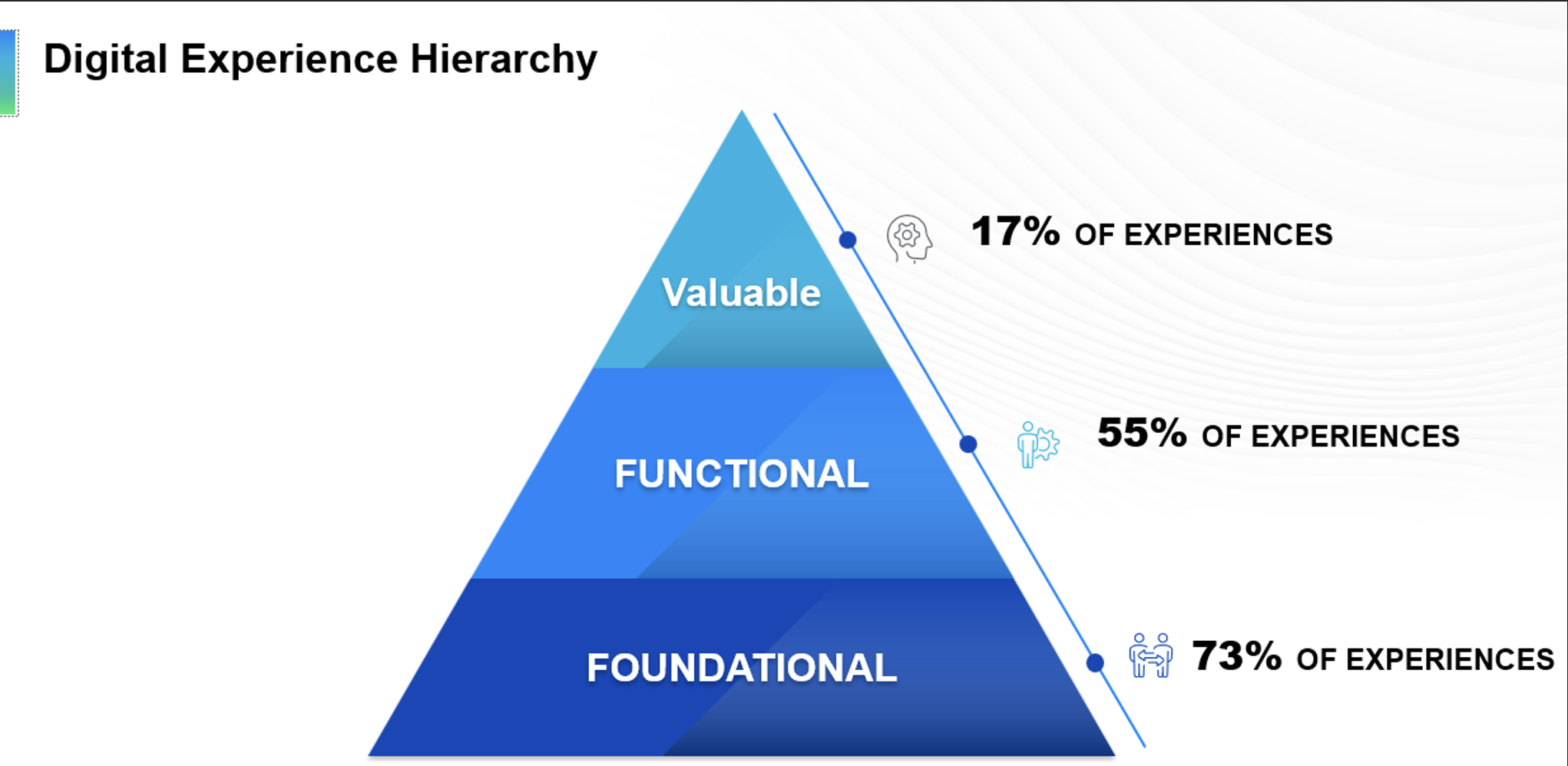
Effective digital strategies that balance all three elements –The Digital Experience Hierarchy.

The Digital Experience Hierarchy

The Digital Experience Hierarchy is a strategic framework measures the effectiveness of investors’  engagement with firms’ digital assets aligning it with investors’ satisfaction, retention, and overall business growth. This hierarchy consists of three levels: Foundational, Findable, and Valuable Elements.

Digital Experience Hierarchy

Analysis of 2,500 site evaluations by Financial Advisors who used the asset manager site in the last month, JD Power has discovered that nearly half of experiences do not achieve the “foundational” aspects.

  1. Foundational: provides content  and tools that increase product knowledge​ and has useful investment insights and education ​
  2. Findable: Easy to navigate and ability to find important content​
  3. Valuable: Aesthetically modern while reflecting the brand, is well organized, fast and responsive.

Trust: The Digital Frontier

A poor digital strategy can quickly erode trust, impacting perceptions both now and in the future. Trust isn’t built overnight. Consistent, transparent communication through digital channels can significantly enhance trust which is a critical factor in the decisions Advisors make when it comes to where to invest and who they partner with in the future.

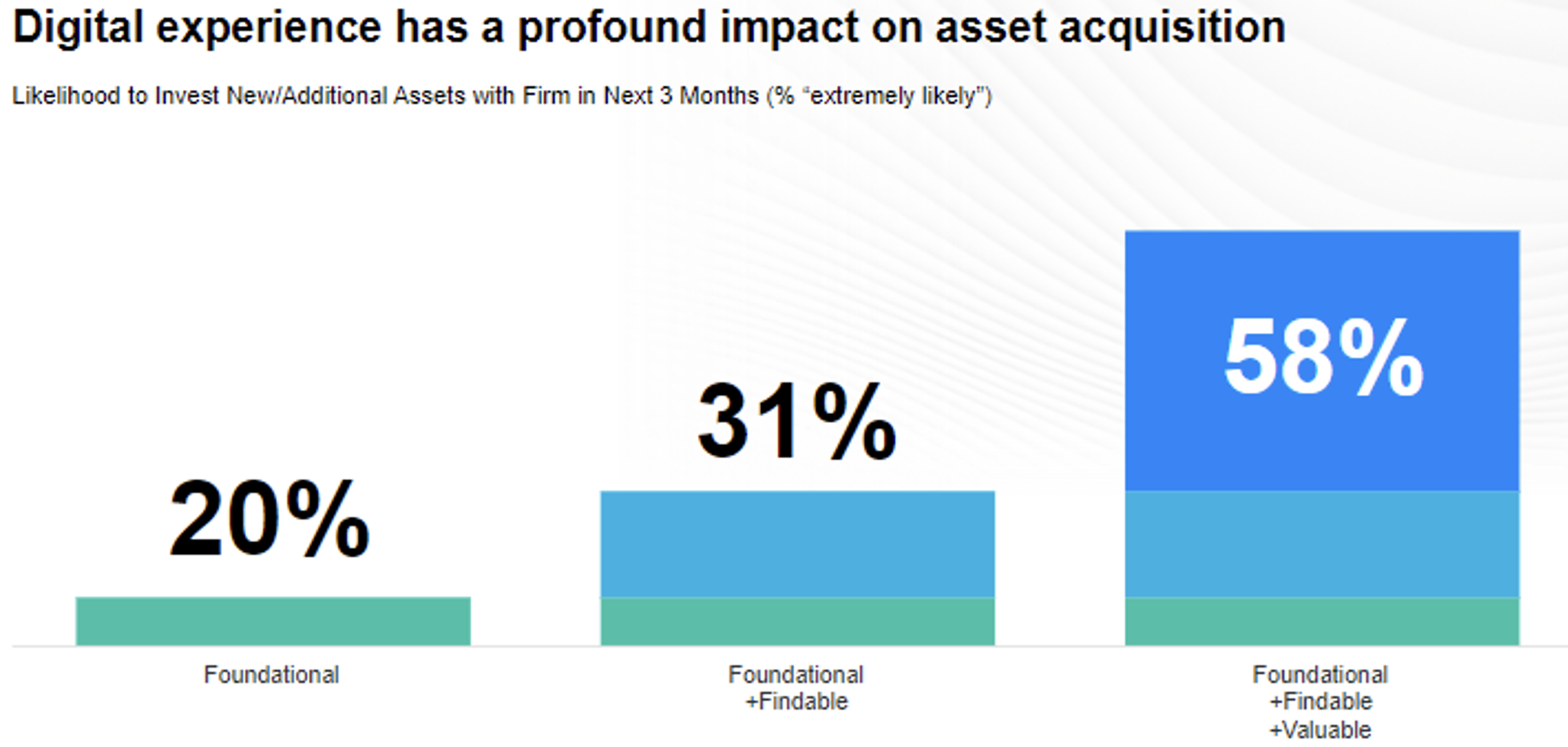
Digital experience has a profound impact on asset acquisition

A great digital experience is about understanding the ‘why’ of the end user and ensuring your digital experiences efficiently and effectively enable the end-user to achieve their goals for the site.  No matter how good your content, if it’s difficult to find and engage with then its value is minimized or totally lost. 

About the Author: Craig Martin, the Executive Managing Director of the Wealth and Lending Practice at JD Power, leads data analysis and thought leadership for Auto Finance, Consumer Lending, and Wealth Management industries, driving positive change and superior business outcomes. His insights, featured in numerous publications, address customer experience, satisfaction, and industry challenges.

In the JD Power Financial Services Intelligence update for April 2024, we discuss the 2024 U.S. Full-Service Satisfaction Study and the 2024 U.S. Self-Directed Satisfaction Study. Kapil Vora notes: “Full-service investors express greater satisfaction compared to DIY investors.” The discussion explores intersecting trends from both studies, examining how investor types and segments, such as financial health and generation, influence satisfaction levels. 

Key highlights from the update include: 

  • Service Levels Impact Satisfaction: Investors working with advisors report higher satisfaction; DIY platforms lack personalized guidance. 
  • Trends Over Time: Full-service investor satisfaction rises due to market performance and staffing investments; self-directed investor satisfaction remains stable. 
  • Segmentation Matters: Older investors more satisfied year over year; younger investors show declining satisfaction, requiring targeted outreach. 
  • Trading Habits and Financial Health: Active traders are more satisfied; buy-and-hold investors may need additional guidance. 
  • Brand Spotlight: T.D. Ameritrade and Charles Schwab excel among DIY investors; U.S. Bank stands out in the full-service segment. 
  • Differentiation Strategies: Clear communication, effective support, and transparent fees are vital for a unique value proposition. 


Where can you find more insights like this?  

  • The JD Power Full-Service Investor Satisfaction Study measures overall investor satisfaction among those who invest through a dedicated advisor or team of advisors, unveiling insights into affluence, age, and gender preferences. It offers valuable insights for enhancing client satisfaction, loyalty, and retention rates, refining investment strategies, and promoting client advocacy, aiding in identifying areas for improvement within wealth management firms. Read the Press Release  
  • The JD Power Self-Directed Investor Satisfaction Study evaluates the satisfaction levels of investors utilizing self-directed investment platforms, providing critical insights into their needs, expectations, and preferences. These valuable insights pinpoint the dynamics that influence satisfaction, such as portfolio size and trading activity, enabling them to tailor their offerings better to meet the needs of different types of investors.  Read the Press Release  


More About These Experts 

Kapil Vora is the Senior Director of Wealth Intelligence at JD Power. In this role, he is focused on equipping clients with data, analytics, and strategy to make them competitive with today’s investors and financial advisors. He leads research for various syndicated studies, including Investor Satisfaction Study, Financial Advisor Satisfaction Study, Retirement Plan Digital Study, Advisor Online Experience Study, and Wealth Management Digital Satisfaction Study.  

Miles Tullo is the managing director of the JD Power Financial Services team. He oversees the company’s consumer payments program, focusing on point-of-sale choice and non-credit card payment methods. Drawing from over 20 years of experience in both payments and mortgage lending, Miles brings valuable expertise to clients.  

Generative AI holds promise to revolutionize the wealth management industry, yet the extent of opportunities may be constrained by client and regulatory comfort levels.

Recently, Craig Martin, Executive Managing Director of Wealth and Lending Intelligence at JD Power, lead an insightful conversation with a panel of experts on AI opportunities for the wealth industry at the State of WealthTech conference, hosted by CFA Society New York. The panel included:

Together, they explored the intersection of AI and personalized financial services. With perspectives from direct client communications, market research and AI­ engineering, the group set out to answer a critical question: how can AI help advisors deliver personalization without adding complexity?

Reflecting on this discussion three key takeaways on how advisors can leverage AI.


1. Reimagining the Role of the Advisor

Technology and digital solutions have become increasingly critical to enabling advisor efficiency and empowering more proactive client engagement. The JD Power 2023 Financial Advisor Satisfaction Study uncovered that 28% of advisors feel that they do not have enough time to spend with clients and indicated that too much of their time is being spent on administrative and compliance tasks.

Deployed in the right way, generative AI could be guided to take those administrative and compliance tasks off advisors’ plates, freeing their time to focus on creating deeper client relationships.


2. Enhancing Personalization  

Engaging clients with targeted messages that resonate with their unique situation is crucial for advisors to build trust, and AI can be leveraged to streamline  the process of creating and optimizing those communications to give space to create more personal connections.  

  • Drafting Communications: AI can assist in composing personalized messages tailored to each client’s needs and preferences.
  • Timing and Topic Identification: AI algorithms can determine the best times to communicate with clients and suggest relevant topics based on their interests and behavior.
  • Advanced Analysis: Through rapid analysis of complex financial data, AI can facilitate scenario exploration and personalized financial planning.
  • Task Automation: AI can automate routine administrative tasks, allowing advisors to focus more on building meaningful relationships with clients.
  • Efficiency Boost: By leveraging AI, advisors can save time on manual processes, enhancing productivity and enabling them to dedicate more attention to personalized client interactions.


“The biggest impact a financial advisor has is often not in the giving of technical financial advice but in how that advice is received and acted upon by the client, said Craig Martin, Executive Managing Director, Global Head of Wealth & Lending Intelligence at JD Power. “This depends on the ability of both the technology and the advisor to truly personalize the relationship in a meaningful way.”


3. Demonstrating Value While Ensuring Trustworthiness

Generative AI and its potential impacts can’t be ignored. Advisors and firms of all sizes need to be clear about what their unique value proposition is to clients and what elements of the relationship can be ‘outsourced’ to technology.  In the JD Power Full-Service Investor study we see that when advisors clearly explain their firms digital capabilities and how clients can use them, 86% strongly agree that their Advisor’s recommendations are in their best interest and that drops to 51% if they aren’t totally clear on digital resources. Clearly communicating to clients where and how AI is and is not leveraged provides the transparency needed to maintain trust.


In essence, AI isn’t a magic bullet; it’s a powerful tool that, when wielded effectively, can transform the way financial advisors engage with their clients. While it’s easy to get lost in a sea of jargon and technicalities, Craig Martin clarifies that the biggest impact a financial advisor has is often not in the giving of technical financial advice but in how that advice is received and acted upon by the client. AI can enhance but not replace the relationship between the advisor and clients.

Ready to explore how JD Power’s wealth management experts can help you navigate the intersection of AI and personalized financial services? Contact us today to leverage our insights and industry-leading solutions for your advisory practice.


About the Author: Craig Martin, the Executive Managing Director of the Wealth and Lending Practice at JD Power, leads data analysis and thought leadership for Auto Finance, Consumer Lending, and Wealth Management industries, driving positive change and superior business outcomes. His insights, featured in numerous publications, address customer experience, satisfaction, and industry challenges.

Setting the Call Up for Success

More than a quarter of DIY investors reported speaking with a CSR over the phone in the past year, and over half of them navigated through an automated phone system before reaching a live representative. The first hurdle in the journey of a phone call is the automated system. Shockingly, half of the investors surveyed reported having to repeat the same information more than once, leading to a significant 65-point drop in satisfaction on average. Access to a live CSR proved to be another pivotal factor, with satisfaction plummeting by 143 points among investors who found no option to switch directly to a live representative.

How Do Customers Want to Communicate


The Impact of the 5 Key Behaviors

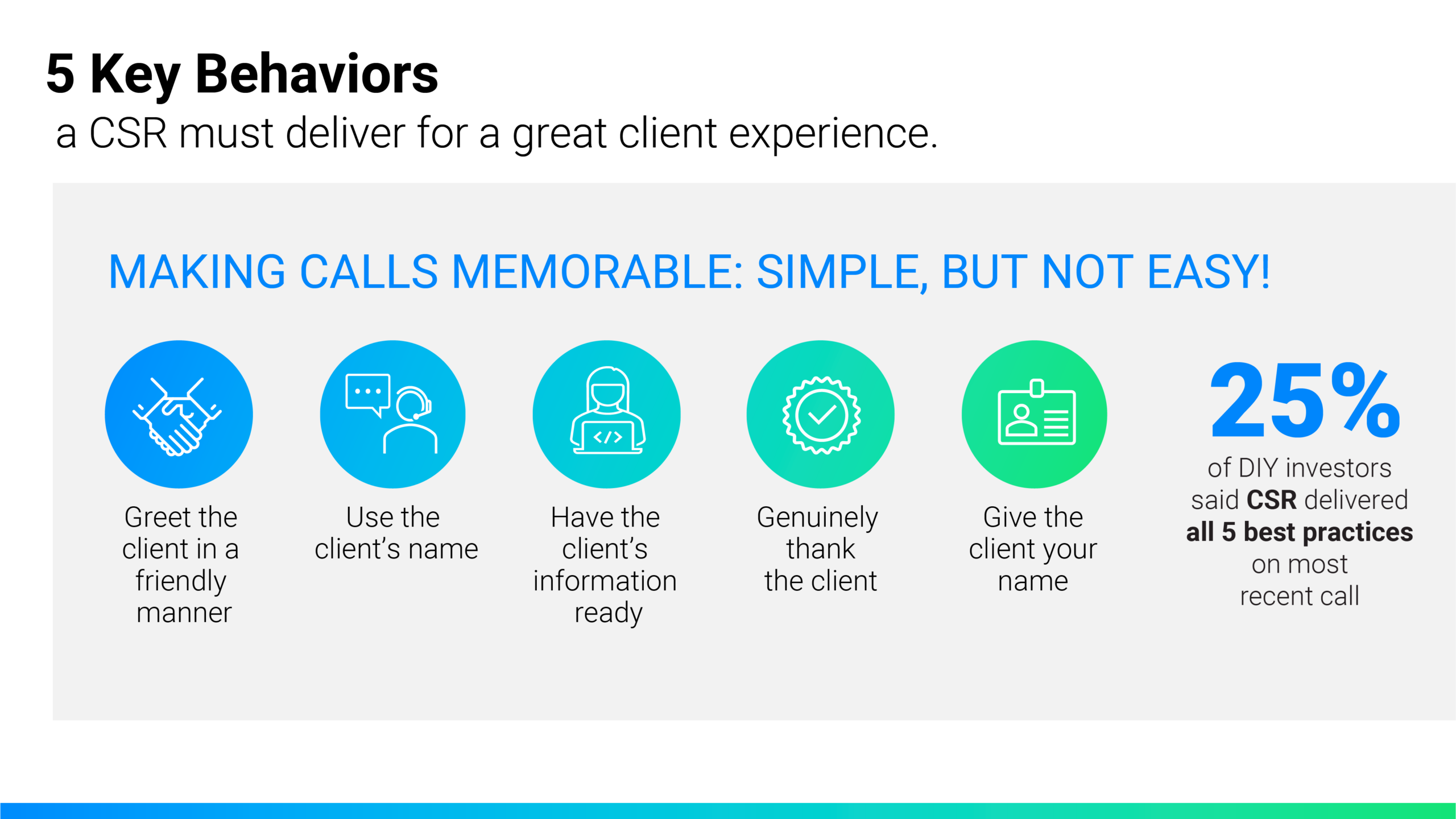
After surveying over 5,000 DIY Investors,  JD Power has found five key behaviors that CSRs must deliver to ensure a great client experience.

  • Greet the Client in a Friendly Manner
  • Use the Client’s Name
  • Have the Client’s Information Ready
  • Genuinely Thank the Client
  • Give the Client Your Name
5 Key Behaviors


When a CSR performs all five key behaviors, satisfaction scores soar to 794 out of 1,000. However, when just one key behavior is missed, client satisfaction suffers a significant 93-point drop.


Making Calls Memorable Key Drivers

Optimizing Your Live Phone Calls

Investment firms are urged to revisit their training, management, and measurement approaches for phone interactions. Ensuring that CSRs consistently deliver these key behaviors is essential for making the most out of phone calls and driving excellent client experiences. In an era where customer satisfaction is paramount, every interaction counts, and optimizing live phone calls is a strategic imperative for investment firms looking to thrive in a competitive landscape.

Want more details on this topic?