Key Insights

  • Effects of rate increases hit critical mass: The percentage of customers who shopped for auto insurance hit record-high levels at 57% in 2025, up from 49% in 2024. However, unlike past years – when switching lagged shopping – customers are finding better prices in the market, which will put further pressure on insurers in 2026.
  • High-value customer retention a top priority: Driven by premium hikes, insurers are starting to finally see customer attrition among their most valuable customers – those who are more likely to bundle products and have high rates of loyalty. With price volatility likely to remain a factor in 2026, insurers must find ways to focus their efforts on retaining these customers.
  • Digital channels and technology offer key insights: Use of digital channels and technology are vital to customer satisfaction. Overall, 47% of all insurance policy buyers now purchase through digital channels, and customers are forming new habits and opinions in their use of tech, which provides an opportunity for insurers to tailor their offerings.


Executive Summary

Sky-high policy rates have finally changed the game. After five years of unprecedented volatility, insurers are beginning to see the consequences of gradual, but consistent premium hikes. Faced with bigger bills, customers have come to expect more from their insurers. Now more than ever, insurers that fail to provide compelling offers to customers will send them rushing into the waiting arms of a company that will. 

This Insurance Intelligence Report dives into key data points gathered from JD Power Insurance Intelligence studies and proprietary market data to offer a data-driven perspective on the biggest issues confronting insurers as we head into 2026.


Premiums Drive Satisfaction, Even Among High-Value Customers

Insurers likely knew that rate hikes were building toward a tipping point. For years, the number of customers who were shopping for new policies continued to climb, but those who were actually willing to make the switch lagged. The reasons for this varied. All insurers were raising rates, so customers couldn’t find a lower premium when they were shopping. In fact, some insurers were not actively seeking new customers. But now that insurers are getting more aggressive, customers are on the move.

Even as customer satisfaction has held steady, 29% of insurance customers switched their insurer in 2025. Of particular note, customers who had high rates of loyalty in the past – those who insurers deem “high-value” customers due to their loyalty and willingness to bundle multiple products –now say they are the least likely to renew with their insurer. In fact, just 51% of high-value customers say they will definitely renew with their insurer. Lack of understanding in pricing is key to this change in behavior. In fact, when customers understand why the price of their premiums is increasing, they are typically far more satisfied with their premium. 

It’s important that insurers fill this information vacuum. In the absence of insurers explaining hikes, some customers are turning to artificial intelligence. In fact, AI is playing a heavy role in the shopping process by helping customers understand the nuances of the industry, learn the insurance lexicon and even shop quotes. This could spark the evolution of new customer habits and drive a wedge between customers and insurers. In 2026, companies need to find the best way to proactively deliver personalized customer information about their premiums.


Digital Channels Take Center Stage

One way to achieve this level of personalized communication is through digital channels. Customers want a comprehensive digital experience. According to the JD Power 2025 U.S. Auto Insurance Study,SM the KPI that most drives overall customer satisfaction is providing a seamless cross-channel experience.). In fact, among customers who start their interaction through an insurer’s app, 46% are more likely to say they had a seamless cross-channel experience than those who inquire via phone or through an agent.

What’s more, 47% of all insurance policy buyers now purchase through digital channels, significantly more than through agents (35%) and more than double that of call centers (17%). The better digital experience customers have with their insurer, the more likely they are to keep using digital channels. When customers have an excellent digital experience (overall satisfaction score of 801 or higher on a 1,000-point scale), 92% say they definitely will use digital channels in the future. When customers have a poor digital experience (overall satisfaction score of 500 or less), only 40% say they are likely to use digital channels in the future.

With more customers willing to not just start a claim or speak with an agent, but also purchase policies through an app, it will be vital for insurers to create a cohesive experience between their digital channels and the rest of their business in 2026.  


The Evolution of UBI

Usage Based Insurance (UBI), which uses telematics software to monitor an insured customers driving style and assign rates based on safety and mileage metrics, is increasingly important to shoppers, and insurers are responding in kind. This past year, 17% of insurers offered UBI programs to shoppers, up from 15% in 2024, but still down from 22% in 2023. 

While the trend toward UBI appears to be heating up again, the drop-off from two years ago reflects challenges insurers are still dealing with as they try to get the UBI formula right. Using a mobile app to collect driving info is the most common form of data collection in UBI programs, but it also correlates with the lowest levels of customer satisfaction among those who use these apps. Insurance app (628) trails vehicle system or an onboard computer (703), a device installed in the customer’s vehicle (656), or self-reported data (640).

UBI is often used to entice customers to save money on their premiums, and with so many customers shopping their policies, this is an easy way to offer a reduced price. But customers will only find this attractive if they trust the data that is collected. Done properly, insurers can use UBI to bring down premiums, attract and retain clientele and build loyalty in the process.


Controlling the Controllables 

To a degree, pricing will always create some level of attrition. But in times like these, insurers need to find ways to insulate themselves from the ebbs and flows of premium changes. To do that, companies will need to offer more personalized interactions across all channels of their customer-facing business. 

With so many customers up for grabs, particularly those high-value customers who are more likely to bundle products and are almost impossible to recapture, it will be the insurers that can unlock the most streamlined interactions and proactively communicate that will succeed in 2026.


Find out More

This Insurance Intelligence Report is based on data and insights gathered across all JD Power Insurance Intelligence studies conducted during 2025. It was authored by Craig Martin, executive director; Stephen Crewdson, managing director; and Tony Soloman, director, insurance intelligence at JD Power.

Please contact us at the numbers below to connect with the team or to learn more about the underlying research.


Media Contacts

Brian Jaklitsch; East Coast; 631-584-2200; [email protected] 

Joe LaMuraglia, JD Power; East Coast; 714-621-6224; [email protected] 

With each passing day, artificial intelligence (AI) is becoming more ingrained in all we do. From virtual assistants to image generators to chat bots, consumers in the United States are increasingly using AI, while growing more comfortable with it being a part of their daily life experiences. That includes their insurance experiences.

According to data collected by JD Power, insurance customers are keeping an open mind when it comes to AI’s role in their overall experience. However, while customers do have an open mind about it’s use that doesn’t mean there aren’t concerns about how insurance companies will use AI and more importantly who will truly benefit.    

AI Use Grows, Despite Belief Companies Benefit More 

The rate of AI utilization is growing but to whose benefit? 

When asked who will see the most gain from insurance companies integrating AI into their solutions, 68% of customers say they believe the insurance company gets most of or all the benefits, while 26% say the benefits are shared equally between the customer and the insurance company.  While consumers recognize the potential value of AI, it’s clear that they have serious doubts that investments in the technology are going to be made for altruistic reasons.

That’s not to say that consumers don’t recognize that they could benefit from insurers adopting more AI.  Customers are most comfortable with AI when it is used to automate routine aspects of their experience, such as sending automated claim status updates (24%), managing their billing (23%) and answering basic customer service questions (21%). In contrast, when it comes to important decisions there is a lot of concern of leaving it up to the computers.  Nearly half (47%) are somewhat or very uncomfortable with AI being used to process their claims, indicating a clear boundary between convenience and trust.

One-third (33%) of customers believe AI use in pricing insurance policies should be limited until companies can ensure it doesn’t introduce bias or violate ethical standards. Another 30% said AI should be limited to partial use that includes strong safeguards for fairness, explainability, and regulatory compliance. Just 15% of customers believe insurance companies should fully use AI to price their policies.

Selling the Benefit

As AI becomes a more integral part of customers’ daily lives, there appears to be growing acceptance of this technology making its way into their interactions with their insurance company. The difference, though, between customers’ willingness to use a virtual assistant and their hesitancy to accept AI in pricing their policy is that customers don’t immediately see a personal benefit in the latter that they do in the former. In fact, there is likely an inherent distrust in AI making an accurate read on underwriting decisions.

This should inform insurance companies’ strategies for further integration. Before doubling down on tech, companies need to peel back the curtain and explain the customer benefits to using AI in their decisioning. Insurers that can get that customer buy-in will have an easier time using AI to reshape their processes.

Find out More

This Insurance Intelligence Report is based on 2,099 responses from a market pulse survey conducted in mid-August . It was authored by Craig Martin, executive director, global insurance intelligence at JD Power. Please contact us at the numbers below to connect with the team or to learn more about the underlying research.

Media Contacts

Brian Jaklitsch; East Coast; 631-584-2200; [email protected]
Joe LaMuraglia, JD Power; East Coast; 714-621-6224; [email protected]
Insurance Intelligence Report
December 2024


If 2024 was the year of the sky-high insurance premium, 2025 is shaping up to be the year when everyone is shopping for a lower rate. Auto insurance premiums led the way, reaching a record high average annual premium in the United States of $2,543, up 26% from 2023. Not to be outdone, homeowners and renters insurance rates exceeded both the rate of inflation and the average increases experienced by auto insurance customers during the year.

Perhaps not surprisingly, those increases were quickly followed by a surge in insurance shopping among consumers. By May 2024, nearly half (49%) of U.S. auto insurance customers said they were shopping for a new plan, and by the third quarter, auto insurance shopping rates had reached a record high. However, with virtually every carrier increasing rates, all those shoppers had very few alternatives and many stayed put. Now, that’s all about to change. 

This JD Power Insurance Intelligence Report dives into key data points trending in JD Power Insurance Intelligence studies, the quarterly LIST Report and across various industry data points to provide key insights into what may be on the horizon for the year ahead.

Bracing for a Wave of Shopping and Switching

The insurance rate inflation everyone experienced over the past two years was driven by a perfect storm of increased frequency and severity of damage to property, increased costs in the raw materials needed to conduct those repairs, and longer repair cycle times, all of which increased costs for insurers. For example, through June of this year, auto insurers were losing an average of five cents on every dollar of premium they collected. Thanks in part to all the premium increases introduced to combat this trend, however, property and casualty (P&C) insurance profitability started to improve throughout the second half of the year. The industry is expected to return to profitability by the end of 2024.

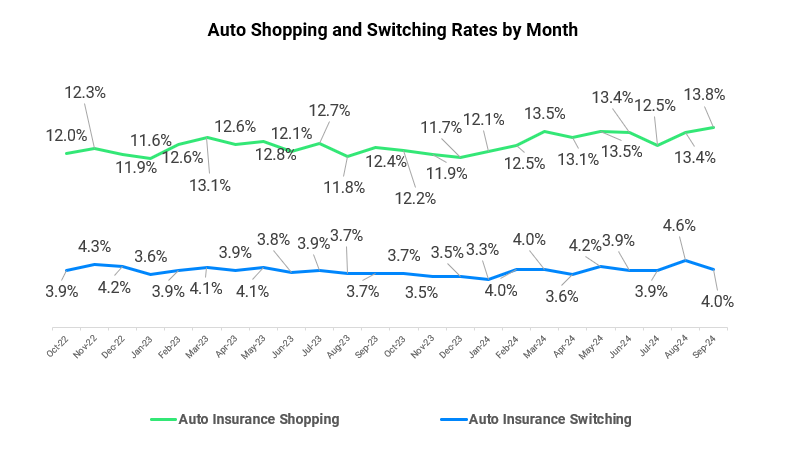
That will likely make 2025 a major tipping point for policy shopping and switching. After the past three years spent shoring up their operations and scaling back growth initiatives, insurers are going to be on the hunt for new customers in 2025 and all indications are that customers will be more than willing to comparison shop their policies and jump ship for a better rate. According to our quarterly LIST Report for Q3 of 2024, policy shopping activity hit a record high of 13.8% in September. Since then, shopping rates have stayed elevated, hitting 13.8% again in October and dipping slightly to 13.6% in November. Switch rates also increased, peaking at 4.6% in August. As more competition starts to heat up between carriers, switch rates may increase further in 2025.

Auto Shopping and Switching Rates by Month

Usage-Base Insurance Goes Mainstream

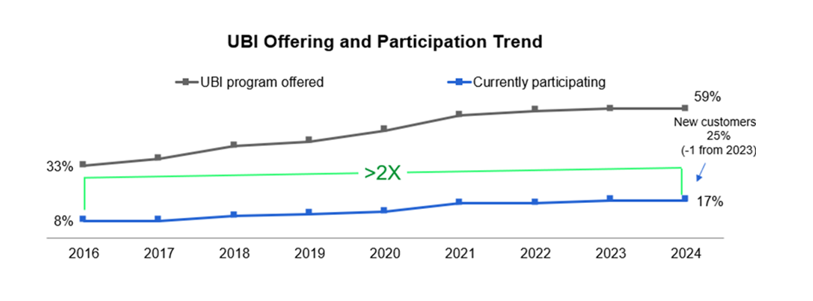
Another major tipping point we expect to see in the year ahead is more widespread adoption of usage-based insurance (UBI) policies, which use telematics technology to track customer driving patterns and offer discounts based on safe driving and fewer miles driven. According to JD Power data, even though many drivers consider UBI policies when shopping for auto insurance, just 17% ultimately buy them. While that’s double the rate of UBI uptake we saw eight years ago, when these programs were still in the early stages of being adopted by customers, it still reflects a surprising plateau considering the hunt customers have been on for premium savings in the face of rising rates. 

UBI Offering and Participation Trend

However, our data has also found that insurers had pulled back on offering UBI programs to their customers in 2024 as they focused on rate taking and profitability. In fact, just 15% of insurance shoppers were offered access to UBI programs when shopping for their policies this year, down from 22% in 2023. We also found that customer satisfaction scores are considerably higher among those who opt-in to UBI programs. On average, overall satisfaction among new customers participating in a UBI program is 64 points higher (on a 1,000-point scale) than new customers who choose not to participate in UBI programs.

The bump in customer satisfaction that’s coming from UBI, combined with a surge in rate-driven shopping and switching activity and continued interest among insurers in courting new customers have set the stage for a significant jump in UBI adoption.

Digital Keeps Getting Better

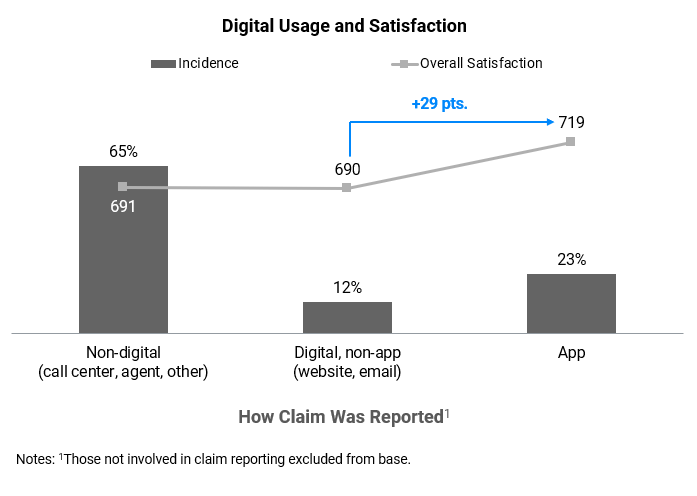
One of the silver linings of this past year of high rates, strained customer satisfaction and low profitability was the increased adoption of digital channels and a growing appreciation for the efficiencies they’ve brought to the industry. Overall customer satisfaction with the auto and home insurance digital claims experience rose 17 points this year, driven largely by improvements in the range of services offered on mobile apps and websites and the visual appeal of those digital properties. Investments in mobile apps, particularly in the claim reporting process, are paying off as claims reported through this channel have higher satisfaction than any other method, even surpassing agents and call centers.

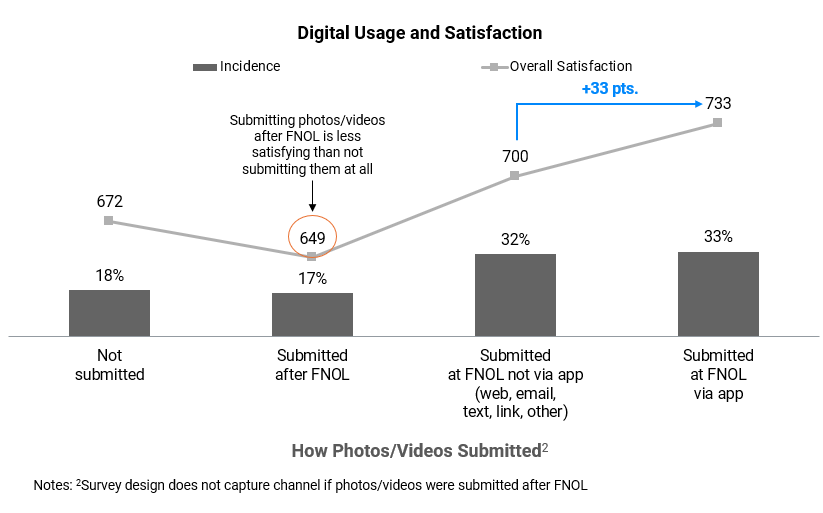
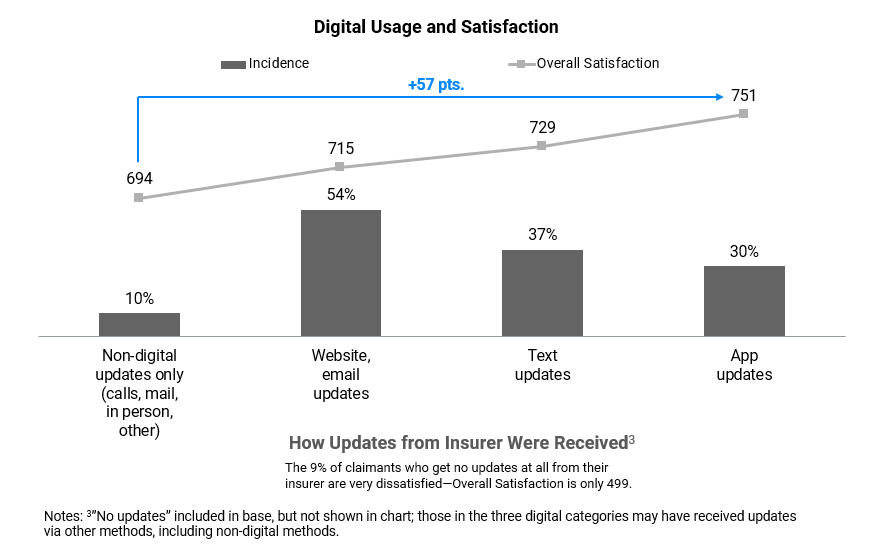
The improvements in the digital process are also having a positive impact on reducing cycle times. In fact, we saw the highest rates of insurers using customer-submitted photos in the estimation process, this year, which cuts down on time needed to arrange in-person inspections. For auto repair claims filed in 2024, the average repair cycle time has improved by five full days, driven in part by higher usage rates of photos and continued improvement in shop backlog. Additionally, the 2024 U.S. Auto Claims Satisfaction Study found that customers who stay in digital channels throughout the claim—reporting their claim, submitting photos and videos, and receiving updates—had significantly higher overall satisfaction scores. However, only 13% of customers utilize the app for all 3 of these tasks, representing a key opportunity for the industry to increase utilization. 


How Claim Was Reported


How Photos/Videos Submitted


How Updates from Insurer Were Received


A Pivotal Year Ahead

While the trends shaping up to play out in 2025 could spell some relief to consumers who’ve been surviving through a period of significant rate increases for the better part of three years, they will make for a volatile year for carriers. With costs not likely getting any lower and customers consistently demanding more—and voting with their wallets to get it—we’re likely to see a price battle emerge throughout the year. 

Throughout, those insurers who keep improving their offerings, make it easier for their customers to work with them, and consistently demonstrate their value to customers will be those who are in the best position to weather this volatility. Winning in the current environment is about combining the highest possible degree of operational efficiency with the most engaged, personalized and supportive customer-facing front end. Insurers who can get that balance right will be those who thrive regardless of what comes down the pike in 2025.

Find out More

This Insurance Intelligence Report is based on data and insights from the JD Power 2024 U.S. Auto Insurance Study, the JD Power 2024 U.S. Insurance Shopping Study, the JD Power 2024 U.S. Home Insurance Study, the JD Power 2024 U.S. Insurance Digital Experience Study, the JD Power 2024 U.S. Auto Claims Satisfaction Study, the JD Power 2024 U.S. Claims Digital Experience Study, and the JD Power LIST Report for Q3 2024. It was authored by Stephen Crewdson, senior director; Mark Garrett, director; and Amy Feeman, consumer insights analyst, insurance intelligence at JD Power. Please contact us at the numbers below to connect with the team or to learn more about the underlying research.

Media Contacts
Brian Jaklitsch; East Coast; 631-584-2200; [email protected]
Geno Effler, JD Power; West Coast; 714-621-6224; [email protected]
Insurance Intelligence Report
December 2023


For the insurance industry, 2023 was the year of disruption. Surging rates made stakeholders re-think everything, from underwriting to carrier selection to the channels through which customers can access their policies. And with 2024 bearing down on carriers and policyholders alike, there’s bound to be much more in the way of sharp turns and quick pivots.

According to data collected by JD Power, 2024 will present plenty of new challenges and shifting trends in the insurance industry. From an evolution in the way customers shop for their policies to the way insurers service those policies, we have gleaned some key insights into what may be on the horizon for the year ahead.

Unbundling for Savings

“Bundle and save” has been a point of emphasis for carriers for years. But with premiums increasing across the board, customers are starting to uncover that decoupling their carriers may boost their savings. 

According to JD Power research, customers are increasingly interested in usage-based insurance (UBI). That interest is disrupting the decision to bundle auto and homeowners insurance, with many customers finding their best deal is to have a UBI-based auto policy and a homeowners policy with a different, lower-priced carrier. In 2023, 66% of customers with less than one year with their home insurers bundled their home and auto insurance. That’s down from 76% a year ago.

Customers with more than a year with their home insurer showed more willingness to bundle, with 77% bundling home and auto, up slightly from 76%. But with no signs of premiums slowing down, we expect UBI to play an even larger role in insurance shopping in 2024, as customers become more agnostic about their carrier willing to unbundle and price shop their coverage.

Offsetting Cost with Value

In the face of heightened emphasis on rate adequacy, insurance carriers are left with no other option but to increase premiums. But that means it’s essential that carriers show an overall value proposition for auto and home insurance policies.

For customers who either want to stick with their current carrier or who don’t find a better option, the focus shifts to reducing the costs of their policies. If the carrier hasn’t already conducted proactive outreach offering a policy review, customers will be reaching out to their agents or insurer seeking ways to mitigate their higher premiums. This presents an opportunity for carriers to highlight the existing and potential value of the policy and the advantages of being their customer. 

Strategic partnerships between insurers and other companies are one way we have seen carriers bring additional value to their offerings and we expect to see more of this moving forward. For example, starting in 2022, one carrier began partnering with a mortgage company to provide its customers savings on a home loan or refinance. Another carrier partnered with a home security company to provide their homeowners free smart home security systems, sensors, and installation as well as a reduced rate on monitoring.

Insurers are also just unlocking ways to harness the power of artificial intelligence and machine learning as well, hoping that can alter the cost-benefit equation for customers. Insurers have begun factoring in this powerful new technology into their product pricing, internal operations, sales, and servicing. Carriers who figure out how to do this quickly and effectively are positioned to reduce costs through better risk assessment, claims handling and fraud detection, while increasing sales through expanded distribution channels, acceleration and automation of the underwriting process and more personalized pricing and product offerings. Ultimately, this will improve the customer experience and give insurers more tools to provide faster responses to customer requests and issues—including initiating claims—and ease the burden on agents and contact centers. 

Digital Adoption Surges

Longer claim timeframes and rising claims costs are also putting pressure on carriers to find efficiencies in their claim operations. Loss ratios remain high after two years of double-digit increases and are forcing insurers to focus on speed, efficiency, and accuracy—buzzwords we are hearing in conversations with claims teams. The challenge here is to not lose sight of the customer experience, which is already strained by very long repair times, and digital solutions present a key opportunity. For example, in total losses, industry leaders are using tech to determine totals notably quicker and seeing positive results in both cycle time reductions and improved customer experiences. 

We’ve also seen increased usage of digital channels for claim reporting and communication and expect growth to continue. More than one-third (36%) of respondents say that they texted their insurer, while 30% have used website/apps. That makes texting the second most-popular digital method behind email (50%) and is among the most satisfying channels.

However, not everyone wants to engage in digital channels throughout every aspect of their claim so another challenge for insurers is to engage with customers in their preferred interaction channel, which is key to overall satisfaction. In fact, we find that less than one-quarter of customers want to manage their claim entirely using digital channels, but those that do have high levels of satisfaction, suggesting the tools work well for those that prefer them. But nearly 40% of customers have equal preference for both people and digital interactions, so even in this digital age, carriers will have to continue to have claim staff be available, responsive, and keep customers informed. That could prove challenging with high caseloads and longer-tailed claims continuing in the future.

An Opportunity Awaits

With their wallets taking a hit due to rate increases, customers are going to be more discerning and less brand loyal to their insurers. That means they are going to be looking for the tools and information to help them better understand their policies, the reasons for the rate increases, and what they can do to bring those costs down.

For proactive companies, that can present a golden opportunity. Insurers can both increase their customer base and boost retention by empowering their customers, whether that’s explaining their rates, alerting customers to discounts they may be eligible for, and allowing them to self-service their policies. By meeting customers where they are in 2024, insurers can find a way to earn a new level of loyalty, even amid harsh conditions. 

Find out More

This Insurance Intelligence Report is based on responses from the JD Power 2023 U.S. Insurance Shopping Study, JD Power 2023 U.S. Home Insurance Study, JD Power 2023 U.S. Auto Insurance Study, and JD Power 2023 U.S. Auto Claims Satisfaction Study. It was authored by Stephen Crewdson, senior director; Mark Garrett, director; and Breanne Armstrong, director of insurance intelligence at JD Power. Please contact us at the numbers below to connect with the team or to learn more about the underlying research.

Media Contacts
Brian Jaklitsch; East Coast; 631-584-2200; [email protected]
Geno Effler, JD Power; West Coast; 714-621-6224; [email protected]
 

Insurance Intelligence Report
September 2023


Auto insurance is meant to protect drivers from many of the financial risks associated with driving. But as premiums have soared seemingly overnight, American insurance customers have had to make the difficult choice between their monthly budget and peace of mind on the road. 

As inflation has affected all sectors of the economy, the costs of repairing and replacing damaged vehicles, medical costs and all other costs associated with an auto insurance claim have increased substantially. Consequently, auto insurance premiums have increased at an unprecedented rate during the past two years (7.9% in 2022, and another 5.9% in the first six months of 2023). As a result, an increasing number of insurance customers in the United States are finding they are no longer able or willing to pay for auto insurance.

According to data collected by JD Power, the number of American households with at least one vehicle who say they do not have auto insurance has risen in the first half of 2023, up to 5.7% from 5.3% in the second half of 2022. What’s more, the percentage of customers who say they are shopping for auto insurance is 12.5% through the second quarter of 2023, an all-time high. 

The Uninsured Legions

While an increasing number of drivers are uninsured, some geographical regions have a far higher concentration of risk. JD Power research indicates that the rate at which people are electing to drop insurance has varied by state for some time, and the recent premium hikes have exacerbated the problem. 

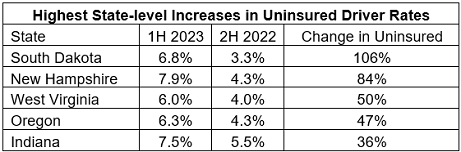
Most recently, in the first half of this year, 12 states have seen a 30% or more increase in the share of uninsured drivers compared with the second half of 2022. Two of those states have seen increases of more than 80%, as shown in the table below.

Highest State-level Increases in Uninsured Driver Rates


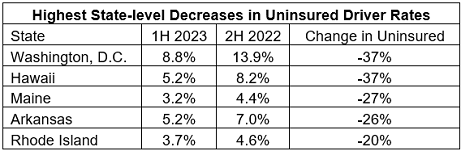
Washington D.C. and Hawaii saw the share of uninsured drivers decrease by more than 30%. 

Highest State-level Decreases in Uninsured Driver Rates


Lock Up the Loyalty

Inflation and rising loss ratios have made potential customer defection an unavoidable problem for the insurance industry. Auto insurers have found current premiums inadequate to pay for these increased claims costs, with the industry having spent 12% more on claims and other costs than all the dollars that they collected in premiums in 2022. It’s the second consecutive year that carriers have been operating at such a deficit. 

The conundrum, though, is that customers—particularly those who have not had any incidents in the past two years—simply see rate hikes. And if their driving record is clean, the hikes feel arbitrary and unjust. Carriers need to find a way to communicate with their customers on any value they can add, explain their policies to them, and potentially find unneeded features that they could trim to lower their costs. Customer loyalty is usually earned in times of turbulence. Insurers that can rise to the occasion may see added benefits in the form of increased customer loyalty and advocacy when conditions improve. 

What Should Consumers Do?

It’s certainly understandable that some customers would rather roll the dice than torpedo their monthly budget. But driving without insurance isn’t a long-term solution and often invites trouble. That begs the question: What alternatives do customers have?

The first step is to take a proactive approach with insurers. Customers can and should negotiate with their insurance provider by asking about changes they can make to their policies that could lower their premiums (e.g., changing deductibles or coverage limits, applying all eligible discounts). Many insurers also offer payment plans and other special payment date options for customers experiencing financial stress. It is often incumbent on the customer to pursue those special offers, however.

Price shopping should also become an annual rite of passage for price-conscious consumers. Whether through independent agents, who can often shop for the most competitive offers on behalf of their clients, or by researching online and contacting providers directly, insurance customers are often able to find a better deal simply by shopping their policies. 

Likewise, drivers who remain insured should consider reviewing their uninsured/underinsured motorists coverage with an insurance professional. With more uninsured motorists on the road, ensuring proper coverage can offset some of the risks of being involved in a collision with someone who is not currently or adequately insured.

Find out More

This Insurance Intelligence Report was authored by Stephen Crewdson, CPCU, senior director global insurance intelligence at JD Power. Please contact us at the numbers below to connect with Mr. Crewdson or to learn more about the underlying research.

Media Contacts
Brian Jaklitsch; East Coast; 631-584-2200; [email protected] 
Geno Effler, JD Power; West Coast; 714-621-6224; [email protected]