Home & Retail Intelligence Report
November 2024
    
This holiday season, it seems Santa has delivered a financial paradox. As consumers prepare to be inundated with Black Friday, Cyber Monday and Green Tuesday sales and promotions, economic indicators are sending analysts conflicting signals. Inflation is down from last holiday season, but consumer prices remain stubbornly high. It begs the question:  what are consumers ready to spend on themselves and their loved ones this holiday?

According to recent JD Power data, bank customers in the United States are ready to open the purse strings to make the holidays merry and bright. Overall, 59% of customers say they are prepared to spend the same or more this holiday season than they did a year ago.

Still, that jolly news isn’t without its caveats. Most notably, customers are leaning on credit, such as cards, loans or Buy Now Pay Later plans, as much as they did last year. That reflects customers’ precarious overall financial health,1 which is largely unchanged since 2023. Only33% of customers are considered financially healthy compared to 30% a year ago.

Holiday Spending Trends Up

Nearly 1 in 5 (19%) customers say they plan to spend more this holiday season than they did a year ago. That is up from 17% in 2023 and 13% in 2022. That number is highest among customers that are financially healthy and customers under the age of 40.
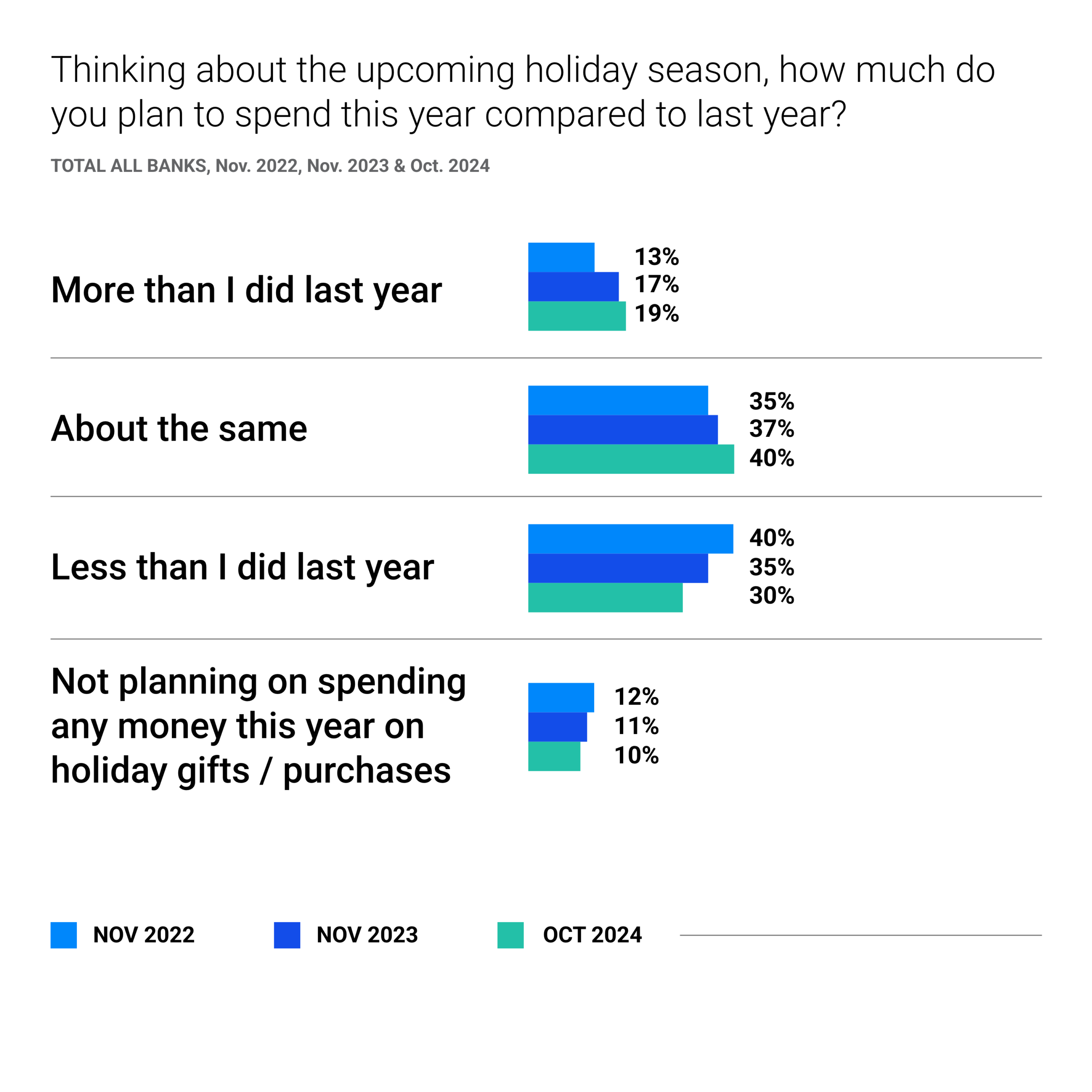
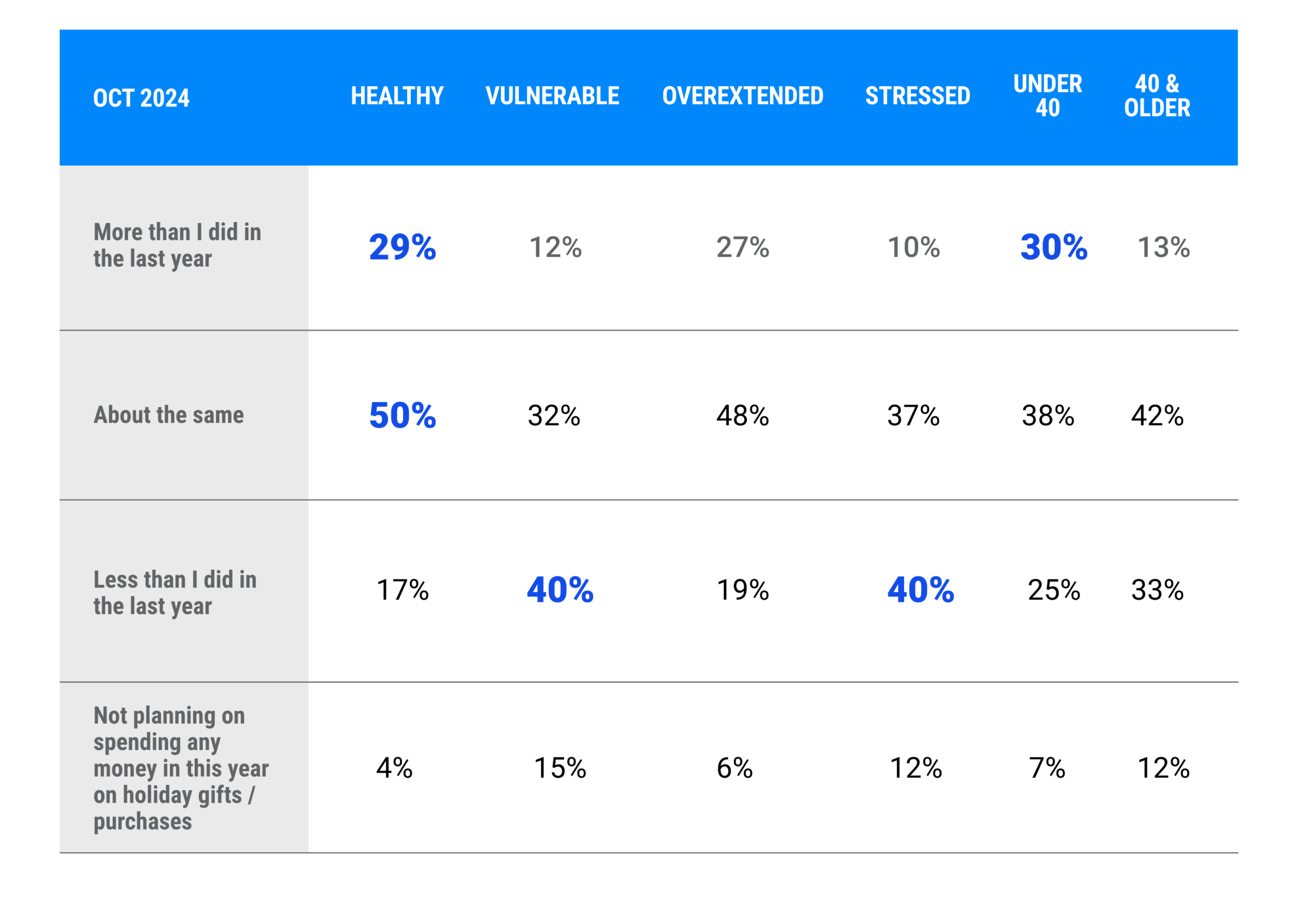
Thinking about the holiday season how much do you plan to spendHoliday Season Table

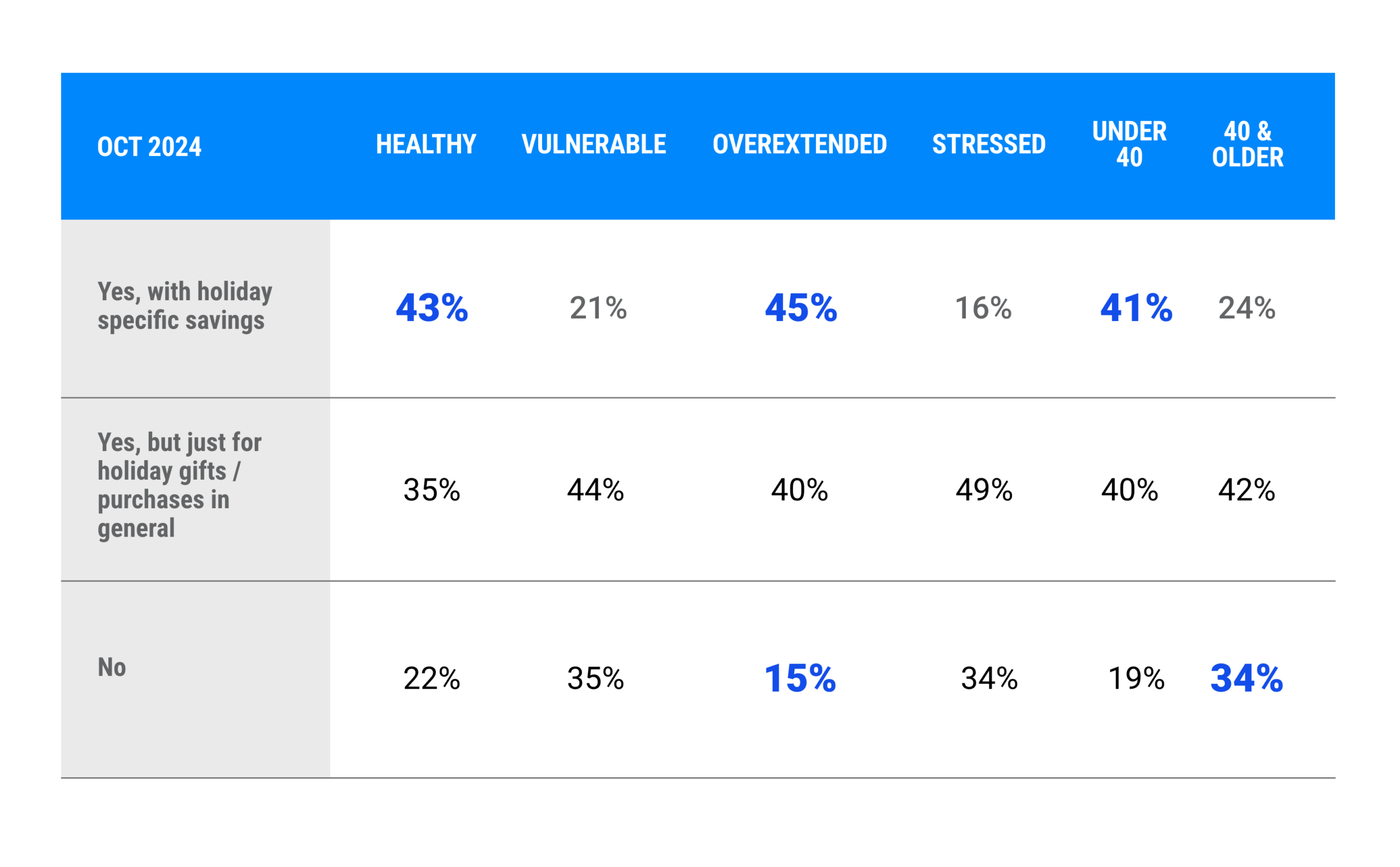
Customers’ willingness to spend may reflect enhanced financial preparedness. Overall, 31% of customers say that they budget for holiday spending with specific holiday savings, up from 27% a year ago. Another 41% say that they budget for general purchases. Only 28% say they do not budget, down from 31% a year ago. The rate of those who say they do not budget at all is highest among vulnerable customers, stressed customers and those 40 years old and older.
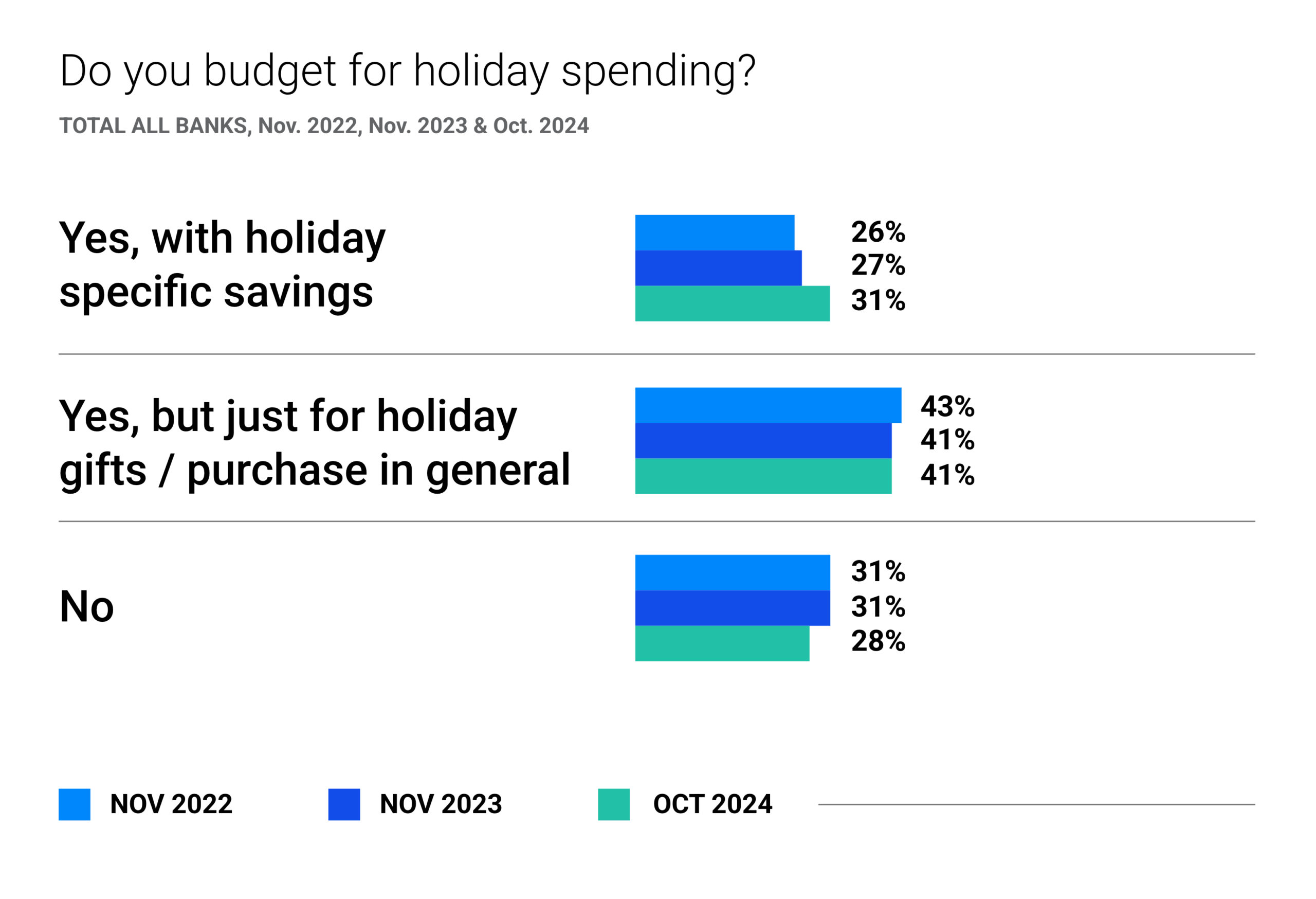
do you budget for holiday spending?


do you budget for holiday spending?
Customer Still Lean on Credit

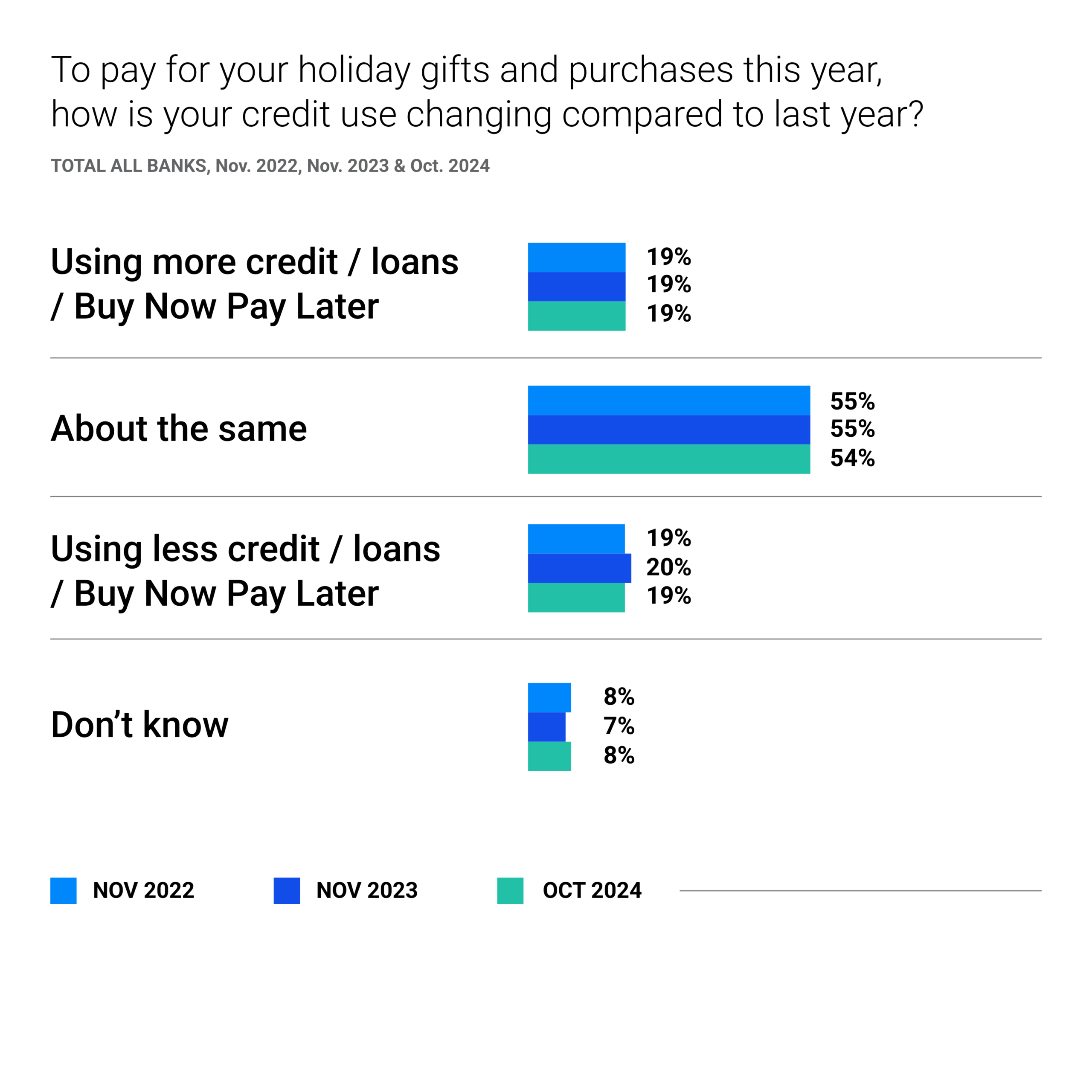
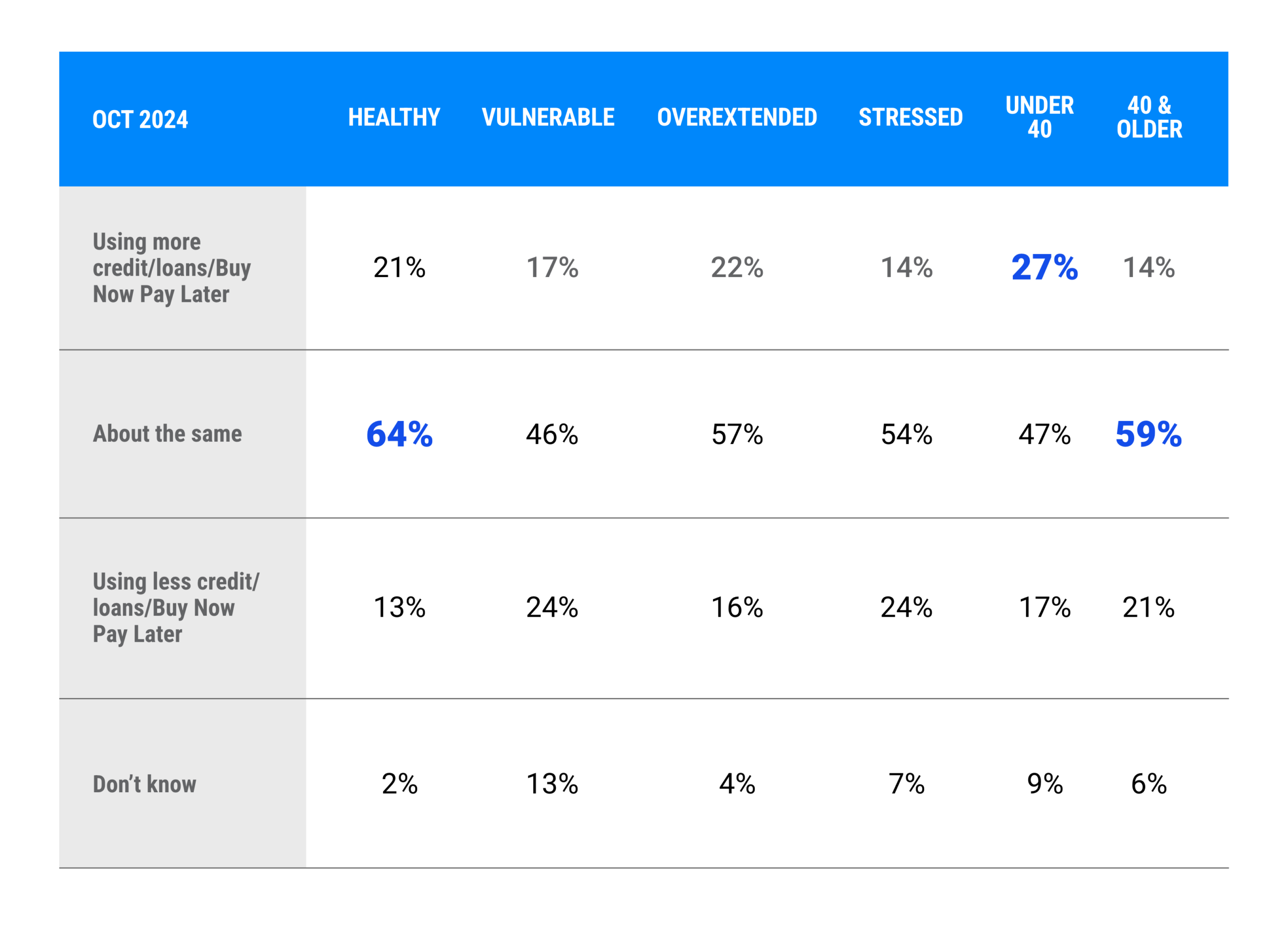
While customers may rely on savings to help pay for holiday gifts, credit will play a major role in decking the halls. When asked how their use of credit has changed compared with a year ago, 19% say they are using more credit cards, loans or Buy Now Pay Later options. That rate is unchanged from each of the previous two shopping seasons, when inflation was far worse. In fact, the rate has remained relatively unchanged for all metrics (about the same credit usage, using less credit and unsure).
To pay for holiday gifts and purchases this year, how is credit use changing?credit use table

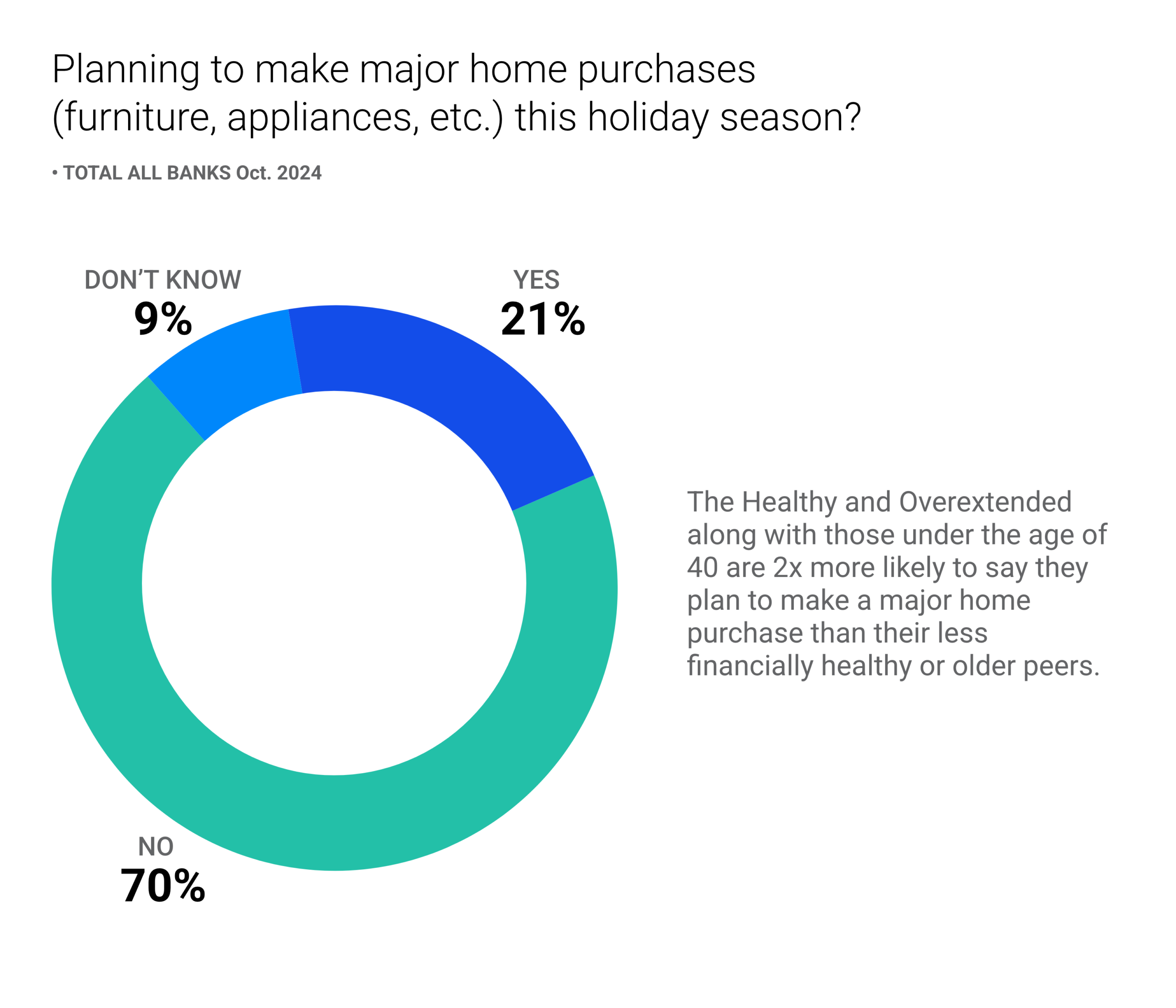
When asked if they plan to make a major purchase for their home (e.g., an appliance, furniture, etc.), customers are expressing a more conservative approach. Only 21% say they plan to make a major purchase during the holiday season, with the highest rate among those that have healthy finances and are under the age of 40.
Planning to make major home purchaseswhy are you planning on purchase

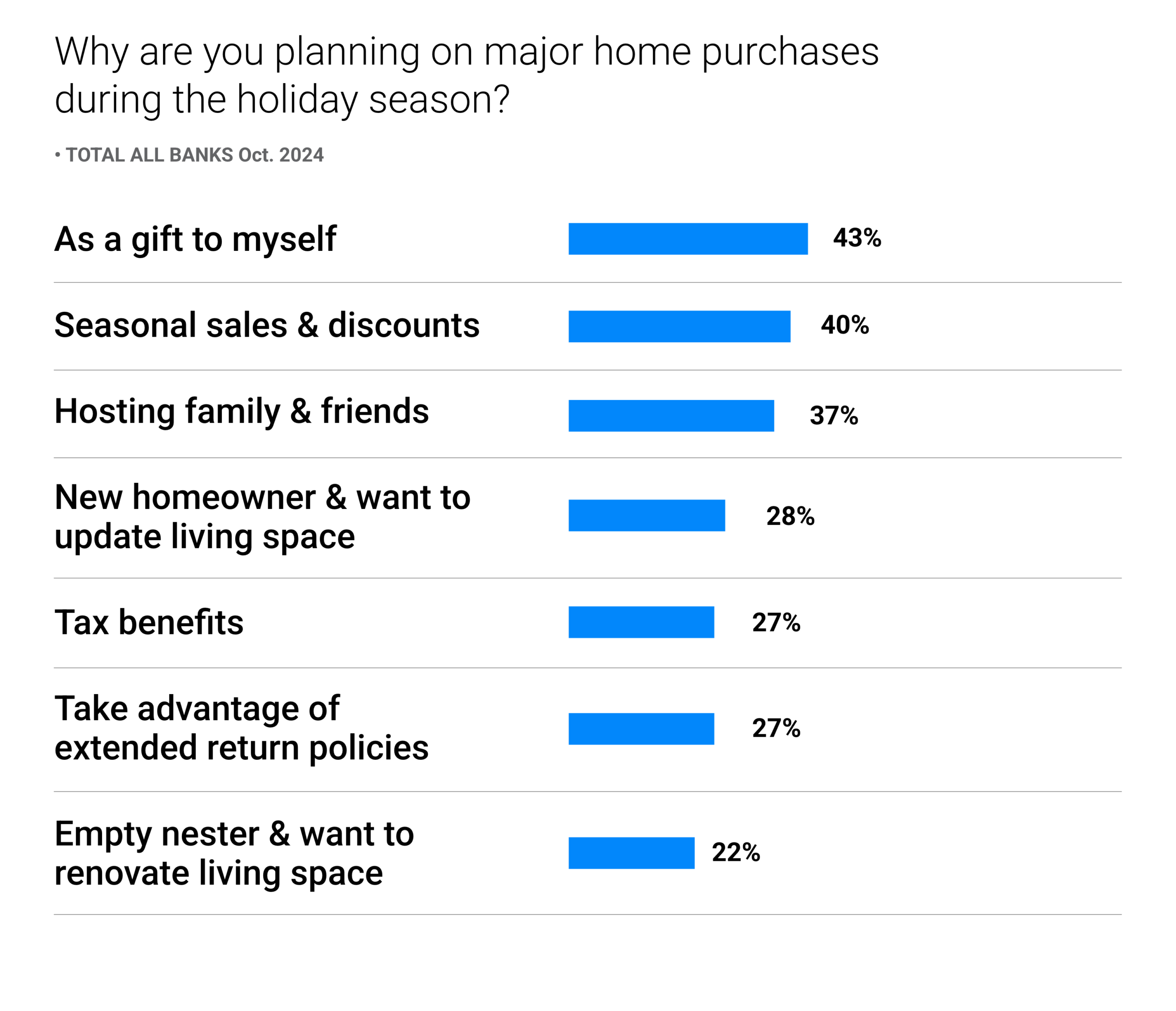
Among customers that do plan to make these purchases, 40% say they are influenced by seasonal sales and discounts. That’s not surprising, as 76% of all customers say price is the biggest influence in their purchasing decision, with sales and promotions being the next largest driver (50%).

Interestingly, customers intend to shop across a variety of channels without one option dominating. In fact, just as many customers say they prefer in-store shopping to online shopping (47% for in-store vs. 48% for online). That is largely driven by customers’ interest in ease of returns and exchanges, extended store hours, in-store and drive-up pickup options.
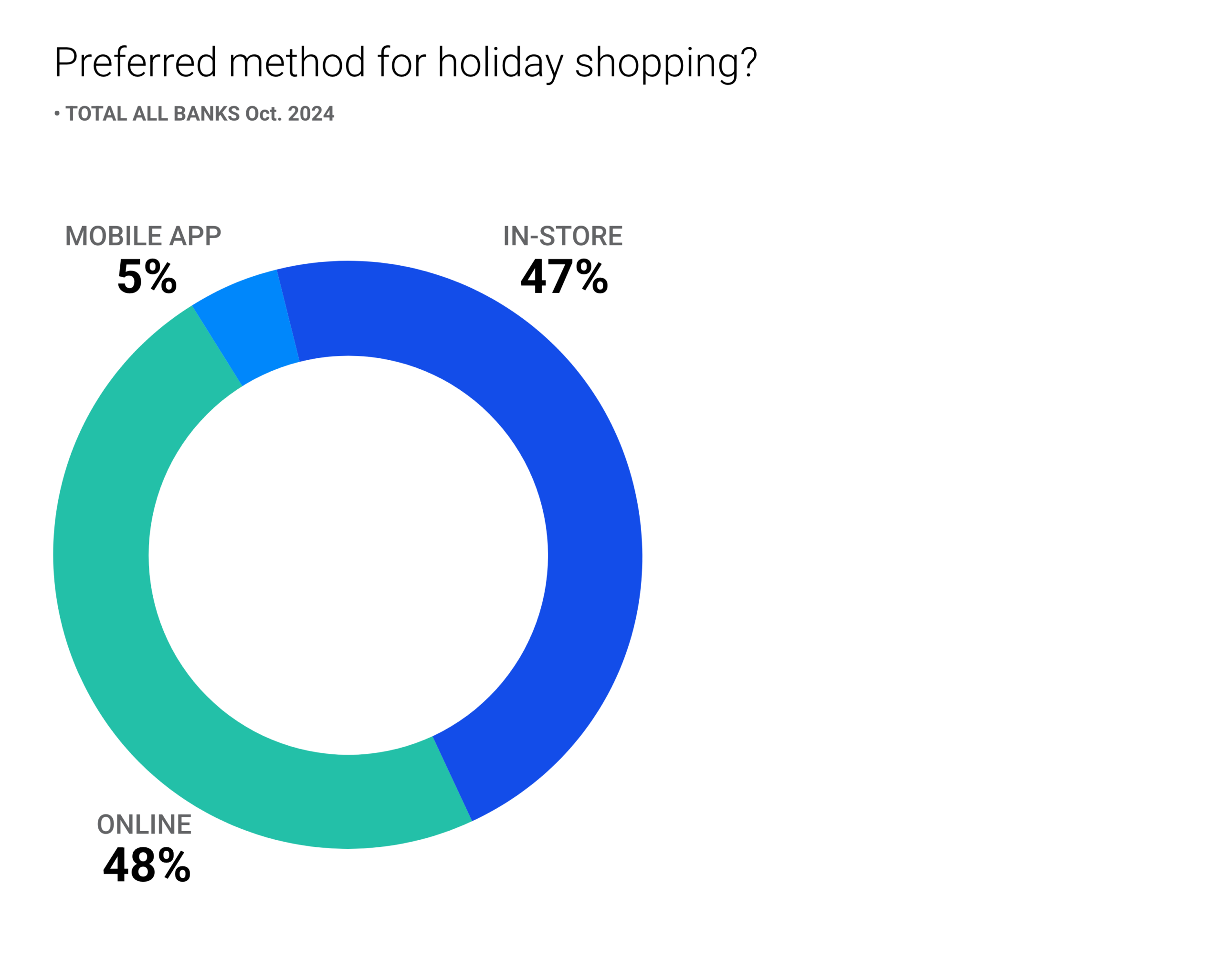
preferred method for holiday shopping
 
factors influencing shopping decisionsdesired features
Holiday Helpers

As analysts examine the data, a concerning trend emerges: many customers will be spending as if their finances have fully recovered, even if their overall financial health is unsteady.  This potentially risky behavior could lead consumers to surpass their budgetary limits and rely on already strained lines of credit, placing them in a vulnerable financial position.

For retailers, this spending trend could present a seasonal sales boost, but they should brace for the potential post-holiday spending slowdown once customers start getting the bills.

Find out More

This Home & Retail Intelligence Report is based on responses from 4,000 retail bank customers nationwide and was fielded in October 2024. It was authored by Andrea Lau, home and retail practice lead at JD Power. Please contact us at the numbers below to connect with Ms. Lau or to learn more about the underlying research.

Media Contacts
Brian Jaklitsch; East Coast; 631-584-2200; [email protected]
Geno Effler, JD Power; West Coast; 714-621-6224; [email protected]


1JD Power measures the financial health of any consumer as a metric combining their spending/savings ratio, creditworthiness, and safety net items like insurance coverage. Consumers are placed on a continuum from healthy to vulnerable.


Home and Retail Intelligence Report
March 2023

Do-It-Yourself Nation: How Inflation is Influencing Home Improvement and Retail Spending

Inflation may turn all of us into followers of Bob Villa, the famous home improvement do-it-yourselfer.

The persistent high cost of goods has everyone thinking about how they can tighten their belts. It turns out that for some, according to the latest JD Power data, that might mean adjusting their tool belts, as they get set to paint their walls or install their cabinets to save some cash.

Tool Time

When asked, at the end of 2022, how consumers in America planned to spend money, 56% said they plan to tackle home improvement projects. While the most common projects were painting (31%) or lawn/landscaping/gardening (18%), some plan to start more ambitious bathroom (14%) and kitchen remodeling projects (12%).

Nearly half (43%) of those who plan to take on a home improvement project say they plan to do the project themselves, while 33% say they plan to have friends/family help them. The remaining 24% say they will hire someone to do the work. That reflects a four-percentage point shift from those that say they completed the last home improvement project themselves (39%) vs. those who hired someone to do their last project (28%).

Curtailed Spending

While many American consumers are forging ahead with their projects in the face of inflation, rising prices have tamped down spending for some. When asked how they feel about being able to make a major purchase ($100 or more), including a home improvement project or receiving the home improvement services they want, 44% of consumers said they feel positively and have no concerns, 41% were neutral and 15% feel negatively and have concerns about that kind of expenditure.

Those with concerns cite inflation/rising cost of products and services as their main worry (29%). Concerns also included rising interest rates (20%), not being able to finish the project due to the high cost of a product they need (20%) and supply chain issues (15%).

Don’t Write Off Retail Just Yet

The death of brick-and-mortar retail stores may be greatly exaggerated. When asked how they will make their purchases, 42% of consumers said they will use a combination of in-store and online for their purchases, while 34% said they will make online purchases only and 24% said they will make in-store purchases only.

Where brick-and-mortar stores really shines, though, is with bigger expenditures. When asked how customers plan to make their larger purchases ($100 or more), a majority (51%) said in-store only. Of those who said they would shop online-only for larger purchases, 21% incorporated some component that requires a retail space, like online ordering with in-store pick-up (15%) and curbside pick-up (6%).

Informed Strategies

While retailers are understandably nervous about what inflation and a possible recession could mean for their businesses in 2023, it’s clear that American ingenuity is still alive and well, as customers are eagerly pursuing ways to make their big projects and purchases possible. That should inform retailers on how they can engage with their customers and avoid some of the volatility that may come with any future financial instability.

Marketing do-it-yourself (DIY) home improvement as attainable and doable, continuing to put on customer demonstration classes for weekend warriors and making sure big box retail stores are still adequately staffed (especially in the customer service/online pick-up locations) are just some of the ways retailers can make sure they’re adequately meeting customer demand. Retailers that can understand those goals and cater to customers should build themselves enough of a buffer between their balance sheet and a shaky economic climate.

Find out More

This Home and Retail Intelligence Report is based on responses from 2,005 consumers nationwide and was fielded in October 2022. It was authored by Christina Cooley, director of home and retail intelligence at JD Power. Please contact us at the numbers below to connect with Ms. Cooley or to learn more about the underlying research.


Media Contacts

Brian Jaklitsch; East Coast; 631-584-2200; [email protected]

Geno Effler, JD Power; West Coast; 714-621-6224; [email protected]

During the past two years, the home improvement sector experienced an uptick in sales as customers tackled do-it-yourself (DIY) projects to improve the functionality or aesthetics of their homes—and kill time. This elevated level of activity has reshaped the landscape of the paint market.

JD Power research indicates that customers are recalibrating their expectations and buying habits when it comes to paint, as factors like environmental friendliness, durability and toxicity become more top of mind in this challenging environment. This shifting dynamic creates an opportunity for brands and retailers to distinguish themselves in a competitive market.

To discuss the importance of strategic messaging in improving consumer awareness–and satisfaction–of value for price paid, safety and durability of the paint they purchase, we caught up with Christina Cooley, Director, Home & Retail Practice at JD Power.

Here is what she had to say:

Q: While issues surrounding environmental and sustainability concerns have not traditionally been a major driver of purchase decisions, is it possible that it is emerging as an important differentiator as the global economic picture evolves over the next few years?

Christina Cooley: I believe it is. A number of trends are converging to change the dialog that the paint sector (from both a manufacturer and retail perspective) is having with customers.

After an initial period of home confinement in the early days of the pandemic, most customers still find themselves home more often, many working from home indefinitely. For some, the enforced residential confinement served as encouragement to tackle home-improvement projects. Others went further and took on ambitious renovation initiatives by redesigning their living spaces to accommodate their new work/life environments.

One of the easiest DIY projects to tackle – in terms of skills, time and financial investment – is painting, which quickly increased in popularity through the pandemic period. But the same dynamics playing out in other sectors of the economy are manifesting themselves in this market. The increase in demand has not been matched by the ability to deliver supply.

Consequently, painters—both DIY and professional—are at times struggling to find what was once a widely available staple. The high-demand low-supply environment has transformed paint from a common commodity into a treasure hunt to find the exact product desired. As a result, customers are looking at paint through a more critical lens as prices rise and options may be more limited.

For paint manufacturers and retailers, this confluence of trends is prompting leaders to evaluate how they present their value proposition to customers. It is in this context that JD Power is finding messages around environmental friendliness, durability and toxicity to be an emerging opportunity to differentiate the customer experience in the paint sector.

While paint may not be the first product category people think of in the context of sustainability, the industry may be well served by exploring ways to further integrate an environmental narrative into their go-to-market activity. The good news is that many of the attributes that customers have always looked for from leading paint brands are also factors that can contribute to sustainability.

The durability factor–one of the top drivers of brand performance–is a case in point. As the economic picture becomes more uncertain, durability is more essential than ever for many paint shoppers. Long-lasting paint saves time and money. But from an environmental perspective, high durability also means that customers do not have to paint as often.

Durability is also often tied to ease of maintenance. Customers are expressing growing interest in paint that is easier to clean because of attributes that make it more resistant to internal or external wear and tear. This is an area in which the industry does quite well. An overwhelming 95% of respondents surveyed by JD Power said that they did not experience problems or defects with their paint, another key performance indicator.

Toxicity, which represents an area of concern for customers, is a more challenging and sensitive component to track. One of the few ways customers gauge toxicity is by smelling–or breathing–paint fumes. These tend to increase every time a coat of paint is applied. In other words, when it comes to paint, toxicity is a function of quantity.

Here is where players in the industry may have an opportunity to leverage innovation to promote a less toxic message. According to JD Power, most customers need to apply more than one coat of paint to achieve desired results. Only 35% of customers can accomplish their project objective with a single application. In addition, only a quarter of customers said that fume levels were better than expected. This data suggests an emerging opportunity for ongoing innovation to produce paint products that can go further for the customer in terms of both coverage and fumes.

Q: How can the home retail sector leverage messages about sustainability to influence customer satisfaction?

Cooley: In general, the perception of how brands operate as members of the communities they serve influences how customer loyalty is established and maintained. This is especially true when it comes to how paint retailers communicate with their customer base. Local knowledge of environmental factors, for instance, matters when making decisions about both internal and external painting projects.

But it is also true for how brands bring new product innovations to market. Many manufacturers, for instance, have developed interior paints with low- or no-volatile organic compounds (VOC). This is a very attractive proposition for customers attuned to environmental issues and why it is becoming more common in the industry.

The challenge for the paint sector is that customers rarely hear about these product enhancements and advancements from retailers. This represents an overlooked opportunity for brands to differentiate themselves from competitors. Our research suggests that customer awareness of these features can translate into brand loyalty and improve interest in stores that carry paints with these specific environmentally friendly attributes. A coordinated brand/retail focus on these sustainability messages can also better support the paint sustainability message before, during and after the point of purchase.

Take the paint disposal dilemma that many customers face as a prime example. The majority of customers—almost 90%—exclusively store any unused paint somewhere in their homes. Sometimes homeowners keep leftover paint for touchups down the road. However, customers often store paint in their homes’ basements, garages, and sheds simply because they do not know how to dispose of it properly.

Most customers recognize this as a potential environmental hazard and yet are unaware that many manufacturers and retailers have developed return and recycling programs. While paint retailers often include this information on their websites, it is not often a topic of discussion during the purchasing process. It is a classic problem statement that can be easily addressed through better joint messaging from retailers and brands. Customers should have no issues returning or recycling paint.

Q: What investments should the industry make across the ecosystem to ensure coordinated messaging across brands and retailers?

Cooley: There are significant opportunities for manufacturers and retailers to incorporate environmental messaging into customer-facing communication initiatives. Many brands have already listed specific environmental goals and objectives. Several also report on the investments they are making in related product developments. Others don’t discuss their sustainability accomplishments.

The overall effect on the public at large, however, has not been particularly strong. Only 20% of customers surveyed by JD Power are aware of product guarantees that obviously speak to durability. The reality is that almost all major paint brands have some type of guarantee and/or warranty. As the industry enters a new normal, environmental friendliness may become a more considerable driver for paint purchases in the future.

Context, however, is key. In the end, if the paint does not deliver on customer expectations, the sustainability conversation will not matter. It will, therefore, be important for manufacturers to create–and market–paint products that get the job done while also delivering the environmental benefits that consumers increasingly seek.
 

Find out More
To learn more about the underlying research behind this industry briefing or to schedule an interview with Christina Cooley, please contact the number below.

Media Contacts
Geno Effler, JD Power; West Coast; 714-621-6224; [email protected]  
 

Christina Cooley
Director of Home & Retail Practice
JD Power

Biography

Leading home improvement retailers and manufacturers are redefining how they design, develop and deploy digital strategies to integrate employee (ESAT) and customer satisfaction (CSAT) levels to accomplish critical future-state objectives. 

Digital maturity—the ability to harness web, mobile and emerging technologies like artificial intelligence and machine learning—is rapidly emerging as a differentiating factor for home goods organizations maintaining high customer loyalty and satisfaction levels as the pandemic enters its third year.  It is a timely area of competency for retailers and manufacturers to develop as consumers allot unprecedented time and financial resources to home improvement projects through extended—and perhaps permanent—work-from-home initiatives.

JD Power research has identified that organizations with persistently strong scores in customer satisfaction have focused on understanding the sudden shifts in customers’ digital expectations to establish indispensable relationships. But this requires the ability of employees to develop new skillsets in interpreting and acting on data captured across multiple channels of customer engagement. As a result, organizations are under pressure to build and maintain a motivated and constantly learning workforce, making the link between ESAT and CSAT more critical than ever in this important segment of the economy. 

JD Power data shows that home improvement purchases have ticked up 16% across all key categories over the last three years. Staying in the home and stimulus funds from the government have helped this surge in sales. For many households, this convergence of factors has accelerated decisions to invest in home improvement activities.

The extra time and money that many households have experienced led consumers to take on projects that they might not have been in a position to pursue otherwise. It has moved the needle positively for segments like painting and appliances.

Organizations are using technology tools to facilitate transactions and maintain a digital services relationship. This investment appears to be delivering great dividends over time, as digital agility matures and brings with it the ability to offer new value-added services to support consumers through the buying process and beyond.

Same Boat, Different Storm

Digital maturity has also emerged as a success factor in responding to supply chain issues and staffing shortages that have plagued the retail sector in general. Mastering technologies that provide employees and customers with access to critical information and automated processes will be essential in staying ahead of the digital curve as the hangover effect of the pandemic lingers. 

Leading companies in the home-goods and home-improvement sectors were already well-positioned to remain agile as the landscape changed dramatically. They experienced lower service- and product-delivery disruptions than others in the market. Organizations with mature digital go-to-market initiatives already had their teams—and strategies—in place to support customers online to provide a seamless hybrid experience integrating in-store, pickup and home delivery services.

By contrast, retailers and manufacturers that found themselves behind that digital curve scrambled to cobble together virtual solutions as customers leaned into digital engagement channels. 

With little to no access to brick-and-mortar stores, these organizations had to invest and navigate an unfamiliar digital space quickly. By only starting their digital journeys during the pandemic, they were forced to compete for scarce talent and expertise during a historic pullback in the available workforce.

Future-Proofing for the Unexpected

Digital innovation will continue to play a significant role in defining the future of this market. Decision-makers will have to pair their approach to innovation with a practical customer-centric perspective on functionality. 

Developing a new product or service without a strong connection to—and understanding of—new customer expectations has the potential to backfire at a time when any misstep could be detrimental to the overall brand. Providing customers with straightforward ways to engage—especially at the retail level—leads to the critical flexibility that is top of mind with all customers in this environment.

Digital strategies offer more options and opportunities to address these changing variables quickly and effectively. Ongoing success will require home improvement manufacturers and retailers to track constantly changing customer requirements proactively. 

JD Power will continue to keep its finger on the pulse on the home improvement industry. In our 2022 home improvement platform of studies, we will provide the industry with a window into customer expectations. By taking a closer look at digital developments and providing digital advisory services to our clients, we will equip our clients with the insights that will proactively inform them of necessary updates to apps or websites without spending precious resources reacting too late to changing variables and unfolding trends.

Find out More

To learn more about the underlying research behind this industry briefing or schedule an interview with Christina Cooley, director of home and retail intelligence at JD Power, please contact us at the numbers below.

Media Contacts
Brian Jaklitsch; East Coast; 631-584-2200; [email protected] 
Geno Effler, JD Power; West Coast; 714-621-6224; [email protected]