Stay on top of the latest JD Power Financial Services study releases with our official calendar. As the trusted source for voice of the customer data, this schedule keeps you informed on when key satisfaction results and press announcements go live.


2026-2027 Release Schedule

Track what’s ahead for banking, payments, wealth management and lending. 


Access JD Power Customer Satisfaction Data

Get full access to JD Power’s customer satisfaction data and see how the insights can drive your strategy forward. Connect with our team to get started. 

CONTACT US →


Financial Services Email Opt In Button


Lending Intelligence Report
October 2024

With AI-Powered Chatbots Coming to Customer Service, Are Mortgage Customers Ready? 

Artificial intelligence (AI) is here to stay. Three-fourths of business leaders say they are planning to escalate their AI investments, as they see its potential to redefine customer service and many other business functions. That includes the lending industry, in which AI-powered customer service has already started to establish a foothold and is poised to grow. Are customers ready for the future of AI-driven customer service?

This Lending Intelligence Report dives further into one aspect of the JD Power 2024 U.S. Mortgage Servicer Satisfaction Study. It highlights the prevailing sentiment and emerging trends in AI-powered customer service, and how that may change with the continued uptick in servicer adoption. 

AI Can Be a Problem-Solver

Arguably one of the biggest barriers to adoption of AI-powered customer service solutions is customers’ perception of online chat. Early iterations of chatbots left many customers feeling like they were simply wasting their time. But that may be changing.

Overall, 21% of mortgage servicing customers have experienced a problem in the past 12 months. Just 9% of those customers used online chat as their first point of contact. That pales in comparison with the 48% that called customer service, but customers from Generation Y1  and Z are three times more likely to use online chat than older generations so this channel will become increasingly important.

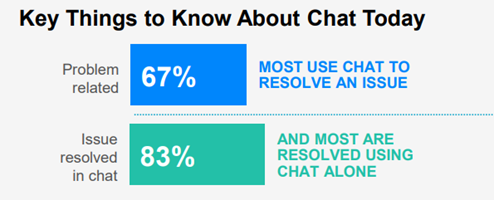
The good news is that the majority of customers who use chat found it to be useful. Two-thirds (67%) of customers using chat said it was to try to solve a problem. Of that group, 83% of those said that their problem was resolved on that chat. Unsurprisingly, those who were able to solve their problem via chat had an overall customer satisfaction rating of 702 (on a 1,000-point scale) vs. 482 for those who could not solve their problem.  

Lending Intelligence Report October 2024 Key Things to Know About Chat Today

An Opportunity for AI

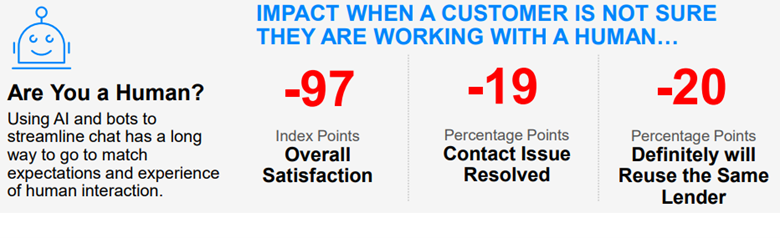
Nearly three-fourths (73%) of customers who used chat say they interreacted with a live representative, while just 10% thought it was a chat bot, and 17% were not sure. Those who said they interacted with a human had a better experience than those who thought it was a machine on the other side. Further, 63% of chat users working with a human felt the chat rep used a script, while 37% did not. 

Lending Intelligence Report October 2024 Are you human

That’s important for a few reasons. Customer satisfaction for those who felt no script was used was 699, considerably higher than the average satisfaction score (636) among customers who thought a script was used. Nearly three-fourths (73%) of those customers who felt no script was used said that the process was extremely easy vs. 27% among those who felt a script was used. As AI evolves and becomes more widely adopted in the servicing industry, firms are going to need to keep a close eye on potential negative impacts to consumer perceptions. A key point for servicers to consider is that customers are usually fine with a technological improvement, provided it adds value.   

That poses a challenge to lenders: An investment in AI needs to represent a clear understanding of what the customer wants in terms of service and problem resolution, and how they interact with their customer service channels. Without that, customers may simply refuse to engage, leaving lenders on the hook for the time and resources spent on underutilized technology. Those who can thread this needle will see higher customer satisfaction scores, improved processes, and streamlined costs. 

Find out More

This Lending Intelligence Report is based on responses from the JD Power 2024 Mortgage Servicer Satisfaction Study, which included 11,565 responses and was fielded from May 2023 through February 2024. It is authored by Bruce Gehrke, Senior Director, Lending Intelligence. Please contact us at the numbers below to connect with Bruce or to learn more about the underlying research.

Media Contacts
Brian Jaklitsch; East Coast; 631-584-2200; [email protected]
Geno Effler, JD Power; West Coast; 714-621-6224; [email protected]

[1] JD Power defines generational groups as Pre-Boomers (born before 1946); Boomers (1946-1964); Gen X (1965-1976); Gen Y (1977-1994); and Gen Z (1995-2006). Millennials (1982-1994) are a subset of Gen Y.

As trust and transparency become paramount, servicers are surprisingly thriving amidst challenges, showcasing resilience in customer relationships. In this month’s update, JD Power, Bruce Gehrke, Senior Director of Lending Intelligence and Miles Tullo, Managing Director, discuss the latest insights from the Mortgage Origination Satisfaction Study and Mortgage Servicer Satisfaction Study. Here’s a breakdown of the key highlights:

Why Mortgage Originators Face a Satisfaction Slump
Borrower satisfaction with mortgage originators has dropped significantly in 2024, reversing last year’s positive trend. Only 42% of lenders are achieving higher satisfaction scores this year, down from 70% in 2023.

Key factors influencing borrower loyalty and advocacy include:

  • Trust: Borrowers need to feel confident they got a good deal.
  • Ease of the process: Simple, fast, and transparent processes resonate with borrowers.
  • Competitive interest rates: While market factors dictate rates, customers expect lenders to remain competitive.

“At the end of the day, those interest rates matter, and a customer needs to believe and trust that their lender gave them a good deal,” says Bruce Gehrke.

Interestingly, digital tools—despite heavy investment—are not delivering the highest customer satisfaction. Traditional, human-centered service models continue to outperform digital-first approaches.

Mortgage Servicers Thrive Despite Rising Challenges
Mortgage servicers are seeing a notable increase in satisfaction, even among financially vulnerable customers. Trust plays a vital role, especially when servicers aim to retain customers for refinancing opportunities.

The top factors driving servicing satisfaction include:

  • Minimal interactions: Customers prefer smooth experiences with few issues requiring service intervention.
  • Transparency: Clear communication about fees and escrow accounts is crucial in building trust.
  • Escrow management: Rising insurance premiums and property taxes put pressure on servicers to manage escrow accounts effectively.

How Declining Rates Will Reshape the Market
As elevated interest rates reduce transaction volumes, the mortgage market is undergoing rapid changes. However, as rates begin to decline:

  • The refinance market may experience a resurgence, with direct-to-consumer models gaining the most traction.
  • Trade-up” borrowers—those who have been reluctant to sell due to low-interest mortgages—may re-enter the market.
     

Where can you find more insights like this?  
Stay up to date on the latest mortgage customer satisfaction insights with JD Power. Discover key trends and performance metrics in the Mortgage Origination Satisfaction Study and the Mortgage Servicer Satisfaction Study, covering the experiences of thousands of borrowers and homeowners. 

RecEIVE our Upcoming Press Releases


More About These Experts 
Bruce Gehrke is the Director of Lending Intelligence at JD Power, overseeing including the Mortgage Origination Satisfaction Study and Consumer Lending Satisfaction research. He develops client improvement strategies based on data analytics and has built consulting relationships with leading asset managers and mortgage lenders.

Miles Tullo is the managing director of the JD Power Financial Services team. He oversees the company’s consumer payments program, focusing on point-of-sale choice and non-credit card payment methods. Drawing from over 20 years of experience in both payments and mortgage lending, Miles brings valuable expertise to clients.  

As the world becomes more digitized, businesses need to adapt quickly to meet customer needs in new and innovative ways. The mortgage industry is no exception. With customers demanding quick and efficient service, companies are left with a choice: chat or call center? Each option has its pros and cons, but finding the right mix can lead to maximum efficiency and delighted customers. In this post, we’ll explore the differences between these two options and give you tips on how to find the perfect balance for your mortgage business,

Chat Usage Declines Throughout the Mortgage Transaction Journey

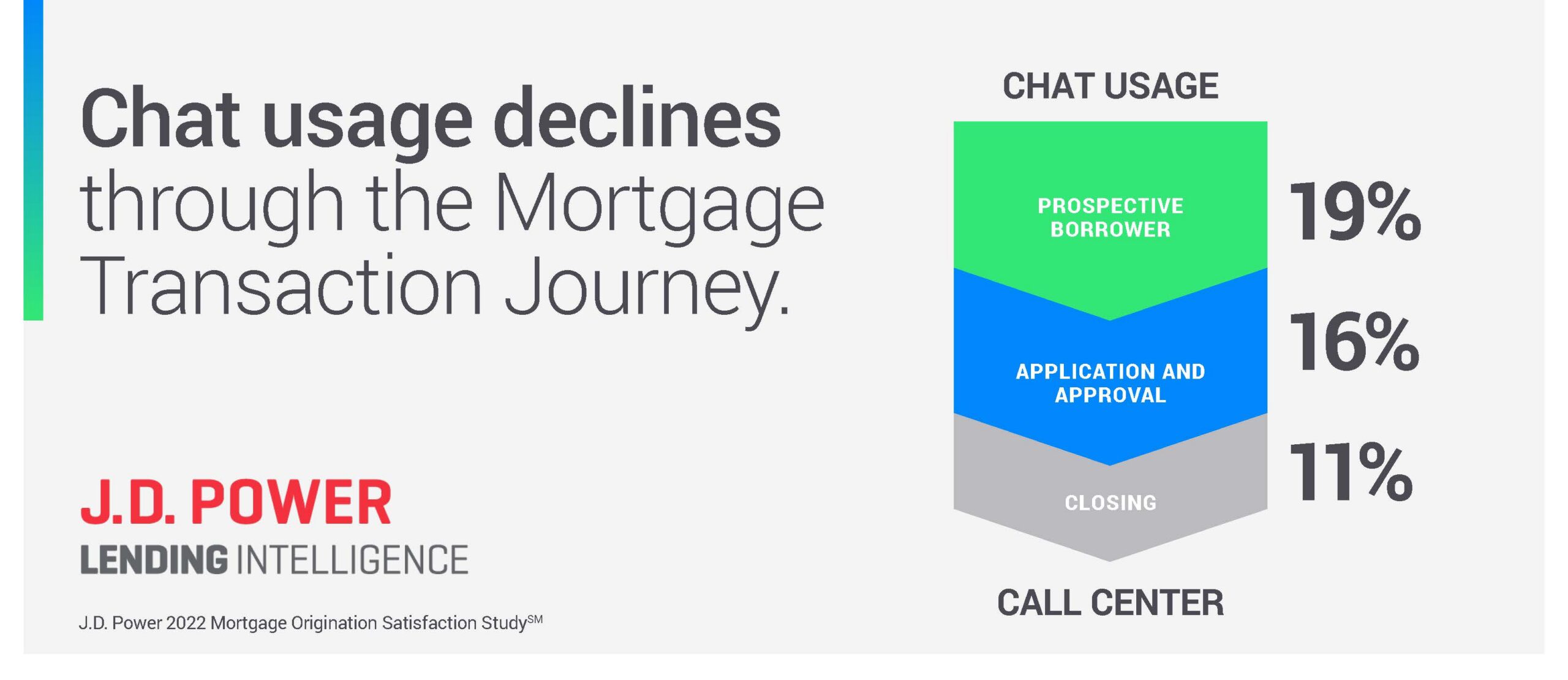
When it comes to mortgages, chat is definitely not the new black. According to the 2022 JD Power Mortgage Origination Satisfaction Study, only 19% of prospective borrowers utilized chat during last year’s refi boom. And those numbers fall even further as shoppers become customers and move through the lending journey, with 16% using chat to navigate the application and approval process and only 11% during the closing process.

graph one

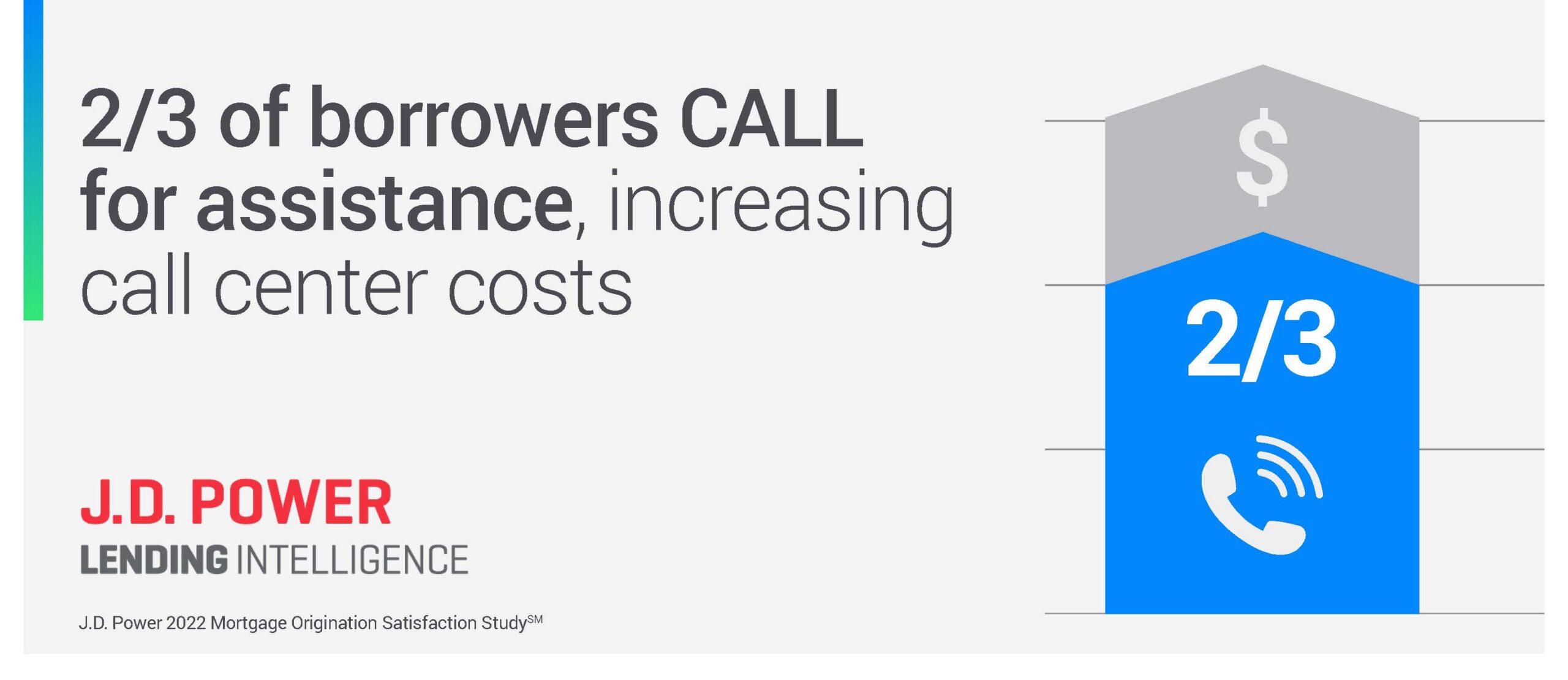
Call Centers remain the overwhelming channel of choice as over two-thirds of borrowers still reach out to communicate with someone for help navigating all three parts of the lending journey. 


graph2

Strategies for Maximizing Customer Satisfaction Through the Right Mix of Chat and Call Centers

There are a few key things to keep in mind when trying to maximize customer satisfaction through the right mix of chat and call center support.

  1. First, it’s important to understand that each customer is different and will have their own preferences for how they want to communicate with your company. Some customers may prefer chat support because it’s more convenient or faster, while others may prefer speaking to someone on the phone. It’s important to offer both options so that you can accommodate all customers.
    • Where We Can Help: JD Power Lending Research provides organizations with a detailed analysis of customers’ communications preferences by channel for each step in the borrower journey. JD Power experts examine these details against in-depth analysis regarding demographics, the influence of advertising and referrals, and other dominant factors. Learn more about our research
  2. Another key thing to remember is that not every issue can be resolved through chat support. Some issues may require a more personal touch or attention from a live agent. In these cases, it’s important to have a seamless transition from chat to call center so that the customer doesn’t feel like they’re starting all over again.
    • Where We Can Help: If you’re challenged with identifying where you are in your journey and what priorities you should focus on next, we’re here to help. When you subscribe to the JD Power Customer Service Excellence Program, you’re enlisting our team of experts, exclusive cross-industry benchmarks, and library of best practices to help you succeed. Learn More about our Customer Service Program
  3. Finally, it’s important to monitor customer satisfaction levels with both chat and call center support so that you can make adjustments as needed. By constantly monitoring and tweaking your process, you can ensure that you’re providing the best possible experience for your customers.
    • Where We Can Help: Organizations often need help identifying exactly where their customers want them to improve and monitoring progress. See what’s working during every client interaction with JD Power Pulse CX. Learn More and Request a Demo

Getting the Mix Right.

Ultimately, finding the right mix of chat and call center techniques for your mortgage business will depend on your customer base and their preferences. Analyzing data from both sources can help you determine which is most effective in delighting your customers and making them feel heard. In addition to maximizing efficiency, paying attention to customer feedback through surveys or reviews is also very important in ensuring that you are consistently providing excellent service.

E-Vision Intelligence Report
February 2023

Consumer Price Sensitivity Asserts Influence on EV Market

Key Findings

  • Price Cuts Catapult Tesla to Top of Consumer Consideration List: After losing ground, Tesla has again emerged as the most-considered EV brand among shoppers, with 44% either “very likely” or “somewhat likely” to consider the brand for their next EV purchase.
  • Leasing Volumes Surge 46% on Tax Credit: EV leases accounted for 15% of total sales in December 2022. In January, that ratio is expected to jump to 22% as manufacturers take advantage of Inflation Reduction Act tax credit to incentivize leasing.
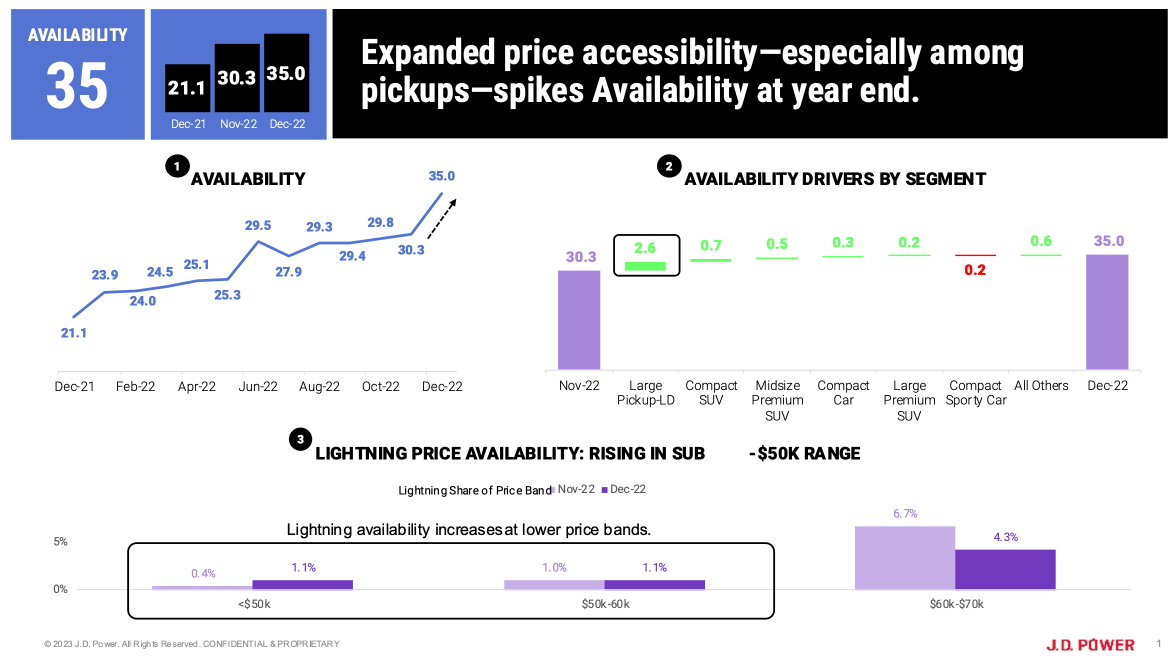
  • Availability Grows for Lower-Priced Trims of Popular Models: Overall EV availability has increased 5 index points, driven largely by growing availability of lower-priced, lower trim-level versions of popular models, such as the Ford F-150 Lightning.

Executive Summary

If ever there were a sign that EVs are rapidly transforming from high-priced playthings into mainstream consumer goods that are highly sensitive to economic trends, it was the complete about-face of consumer interest in Tesla following the brand’s January 2023 price cuts. After dropping prices across its lineup by as much as 20% virtually overnight, consumer interest in Tesla spiked, reversing a recent trend of waning consumer interest.

According to the JD Power EV Index, a new analytics tool developed by JD Power to track the progress to parity of EVs with internal combustion engine (ICE) vehicles in the United States, the recent swing in Tesla brand consideration is part of a much larger trend toward consumer price sensitivity becoming an even more significant factor in the EV adoption curve. This E-Vision Intelligence Report dives into key data points trending in each monthly EV Index update, along with other data points gathered from JD Power studies and pulse surveys, to spotlight emerging trends and important shifts in EV consumer sentiment.

Price-Sensitive Tesla Shoppers

Tesla can be credited with breaking down many of the barriers that once existed to widespread EV adoption, but affordability has not historically been one of them. The most affordable version of its Model 3 sedan retailed for about $47,000 in December 2022, while the brand’s average transaction price hovered near $73,000 throughout most of 2022. During that same period, the JD Power EV Index identified a trend toward waning consumer interest in Tesla. In fact, from November to December 2022, the percentage of shoppers either “very likely” or “somewhat likely” to consider a Tesla for their next EV purchase fell to 39% from 44%, falling behind more mainstream offerings from Chevrolet.

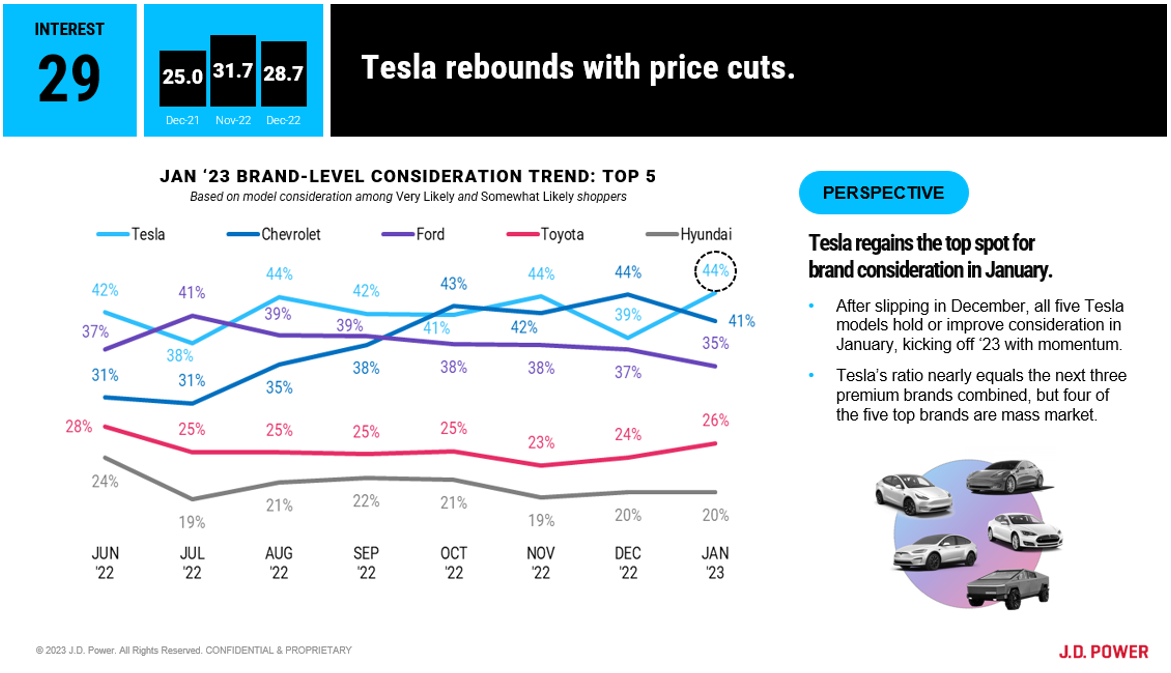
Then, in mid-January of 2023, Tesla announced sweeping price cuts that brought the price of a base Model 3 down to $44,000 and cut the price of some models and trims by as much 20%. Immediately, consumer interest suddenly roared back, putting Tesla back on top of the brand consideration ranks, with 44% of EV shoppers indicating interest in the brand.
img1


Suddenly, the brand that has been most closely associated with the premium market sentiment that has accompanied the growth of EVs, is starting to exhibit demand dynamics more in line with mainstream consumer goods. It should come as little surprise, then, that the other four brands at the top of the EV consideration list are all mainstream brands: Chevrolet (41%), Ford (35%), Toyota (26%) and Hyundai (20%).

Leasing Comes Back Big with Boost from Inflation Reduction Act

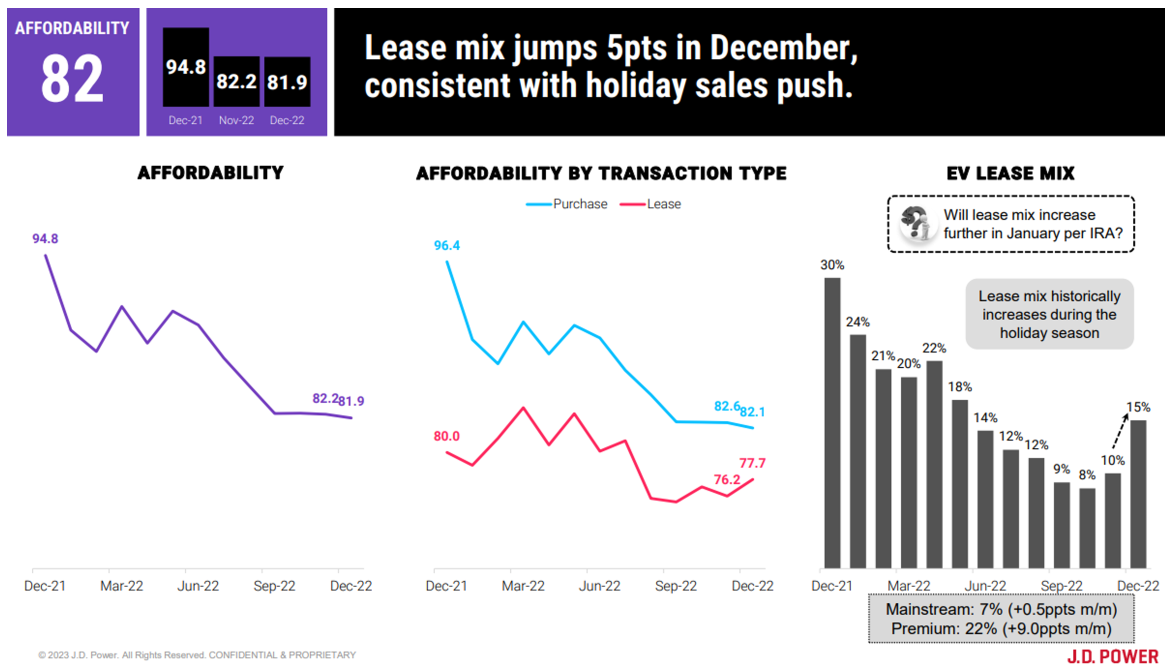
Another major shift in consumer behavior is afoot in EV leasing activity. After consistently trending downward since April 2022, EV lease mix increased to 15% in December, up five percentage points from the previous month. But that was just a harbinger of things to come. Based on an early look at January data, we find that EV lease mix has spiked to 22% of total EV volume.
ing2


That boost in month-over-month lease volume is, of course, driven by the Inflation Reduction Act and its provision designed to incentivize commercial fleets to go electric with a $7,500 federal tax credit for commercial EVs. The way the law is written, however, vehicles leased to consumers qualify as commerical. That means automakers can now opt to pass the $7,500 credit—or some portion of it—to customers who choose to lease rather than buy a new EV. Clearly, the policy has had an immediate and signifant effect on lease mix.

Lower-Trim EVs Gain Traction in December

There is a commonly used strategy in the auto industry called “launching rich.” It occurs when brands know they have a new vehicle launch that will garner lots of attention and consumer demand and use that momentum to drive sales of their highest priced trim packages at launch. It’s the logic behind special launch edition and first edition models that come loaded with every option, and it has been used widely in the EV space.

As a case in point, consider the Ford F-150 Lightning pickup, which, when it launched in the Spring of 2022, had an average transaction price of $85,600 according to the JD Power EV Index. By August, however, that average transaction price had decreased to $77,400 pulled down by increased sales volume in lower trim models priced in the sub-$50K range.  In December, Ford announced a $4,000 price increase for 2023 models, bringing the average transaction price back up to $82,500.  
img4


Methodology

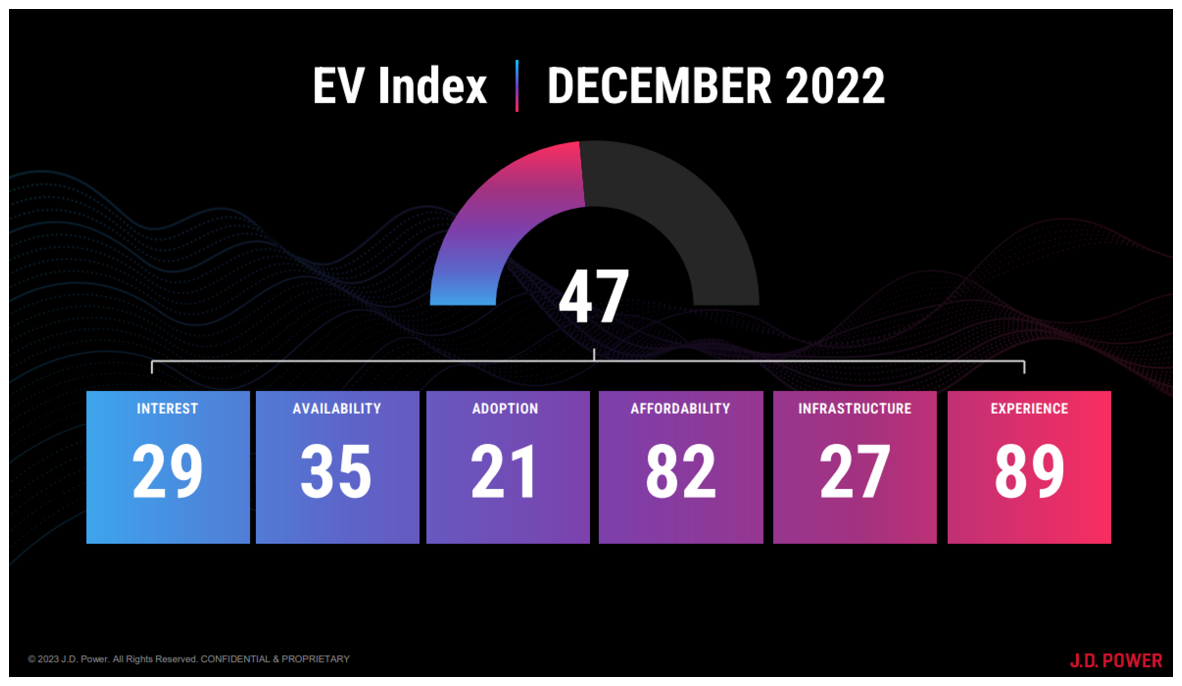
This JD Power E-Vision Intelligence Report is based on data and insights from the JD Power EV Index and the JD Power EV Consideration pulse survey. The JD Power EV Index is an analytics tool to benchmark the growing EV market in the United States. It tracks millions of data points aggregated into six categories—interest, availability, adoption, affordability, infrastructure and experience—to evaluate the progress to parity of EVs with ICE vehicles in the U.S. Each month, JD Power’s electric vehicle practice will analyze these data points, and others to spotlight emerging trends and important shifts in consumer sentiment that are helping to define the fast-moving EV marketplace.
img4


Find out More

This report was authored by Elizabeth Krear, vice president, electric vehicle practice; Brent Gruber, executive director, electric vehicle practice; Stewart Stropp, executive director, electric vehicle practice; and Kristen Richter, senior analyst, electric vehicle practice at JD Power. The JD Power E-Vision initiative is a company-wide program focused on maximizing JD Power industry-leading EV data, analytics, insights and solutions. Please contact us at the numbers below to connect with the authors or to learn more about the underlying research.


Media Contacts

Shane Smith; East Coast; 424-903-3665; [email protected]

Geno Effler, JD Power; West Coast; 714-621-6224; [email protected]

JD Power’s report said personal loans serve as a gateway to other financial products

By Kelsey Ramirez

JD POWER IN THE NEWS 

Personal loan lending slowed significantly in the midst of the COVID-19 pandemic but has since regained its strength, according to a report from JD Power

Competitive rates, easy access and a variety of options has led to an increase in demand for personal loans, especially among the financially vulnerable population, according to the JD Power 2022 U.S. Consumer Lending Satisfaction Study.

“Increasingly, personal loans are filling the void left by the end of pandemic-era relief efforts, which introduces some important new dynamics for the banks, credit card companies and fintechs at the center of this marketplace,” Craig Martin, JD Power’s managing director and global head of wealth and lending intelligence, said. “While customers are largely satisfied with these products and the market is continuing to grow, it is important for lenders to ensure the experiences they deliver are matching the promises they are making to support improved financial health.”

Read the full article on Foxbusiness.com>> 

New Insights – More Insights from the Financial Services

Consumer satisfaction with Non-Captive lenders’ websites significantly increases at the same rate that satisfaction with Captive websites decreases (+/-12 points,) effectively closing the 26-point gap from 2021.

Research also shows that the Mobile App Experience satisfaction among Captive lenders significantly declines (-21 points), falling -8 points below Mobile App Experience among Non-Captive lenders.

The JD Power Canada Dealer Financing Satisfaction Study is the most in-depth, independent survey of automotive dealer personnel and their evaluations of captive and non-captive financing providers. The 2022 edition of the study will release to subscribers on May 5, 2022, and JD Power will issue a press release with rankings and key findings on May 12, 2022. 

JD Power’s Automotive Finance team is excited to share some sneak peek insights from the study in anticipation of the May release. Our last sneak peek discussed how automotive finance lenders stay top of mind with dealers in this time of fewer on-site visits. In this final, pre-publish preview we’ll discuss the data-backed need for lender sales representatives to exceed automotive dealer expectations and the impact on future business.

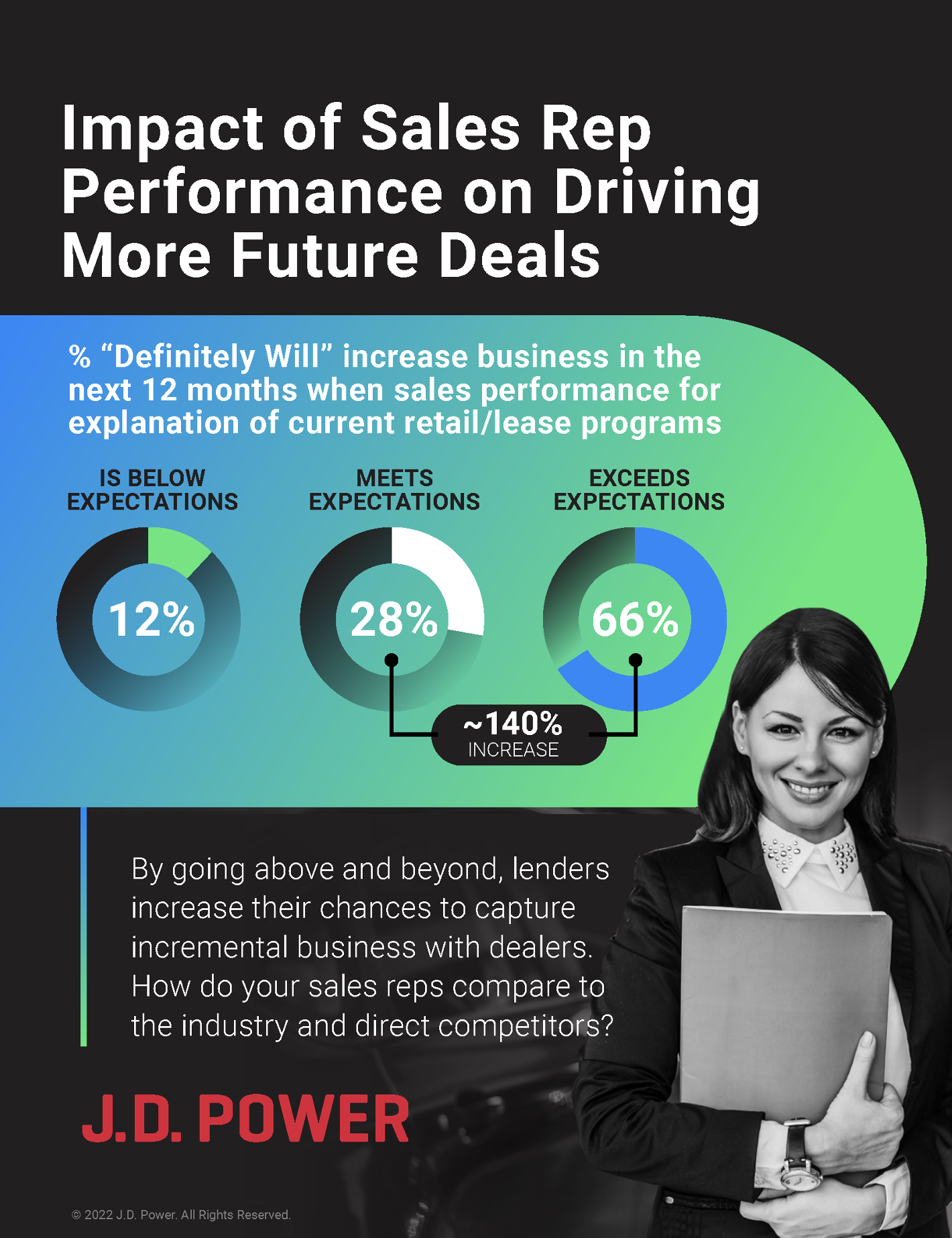
When automotive finance sales representatives meet dealer expectations on dealer-identified most important functions, only 1 in 4 dealers say they “definitely will” send more business to that lender in the next 12 months. However, when sales reps exceed dealer expectations, this number grows by nearly 140% in most instances.

The 2022 Canada Dealer Financing Satisfaction Study asks dealers to rate how well their sales representatives perform on seven dealer-identified critical functions such as an explanation of current retail/lease programs. The findings show that much opportunity remains within the industry and provide evidence that highly- successful sales reps can drive incremental business.

The visual below provides just one example of the impact that sales representative performance has on driving more deals in the future.

infographic showing the impact of sales rep performance on driving more future deals


Contact your JD Power account representative or email [email protected] to discuss how these findings impact your business.

The data analytics company found that consumers are increasingly turning to personal loans.

Written by Evan Zimmer


JD POWER IN THE NEWS

JD Power announced last week the results of its 2022 US Consumer Lending Survey. The survey found that 38% of vulnerable consumers — defined as consumers who have a difficult time making necessary payments, such as bills — have turned to personal loans to manage their debt.

Additionally, 47% of consumers said an ad influenced them to get a personal loan, and 61% said they would use their lender again. According to JD Power, the top three reasons consumers have utilized a personal loan are: debt consolidation, lower interest rates, and lower monthly payments.

Read the full article>> 

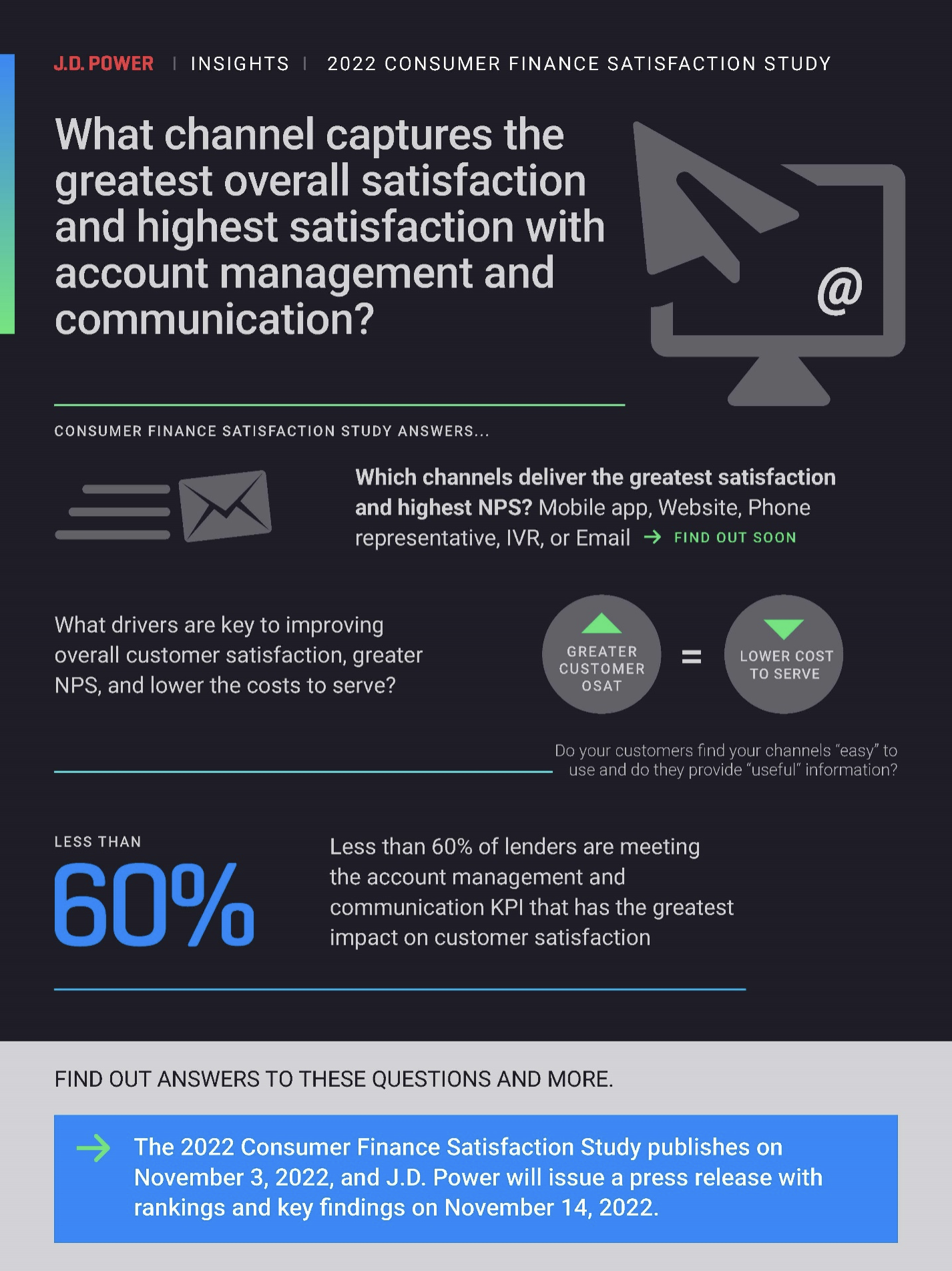
Consumer Finance Satisfaction Study is Coming Soon

Findings from the 2022 U.S. Consumer Financing Satisfaction Study will publish within PowerSource on November 3, 2022. JD Power is unveiling a glimpse of the data ahead of issuing a national press release with rankings and key findings on November 14, 2022.

The Way Consumers Research Auto Financing Has Changed

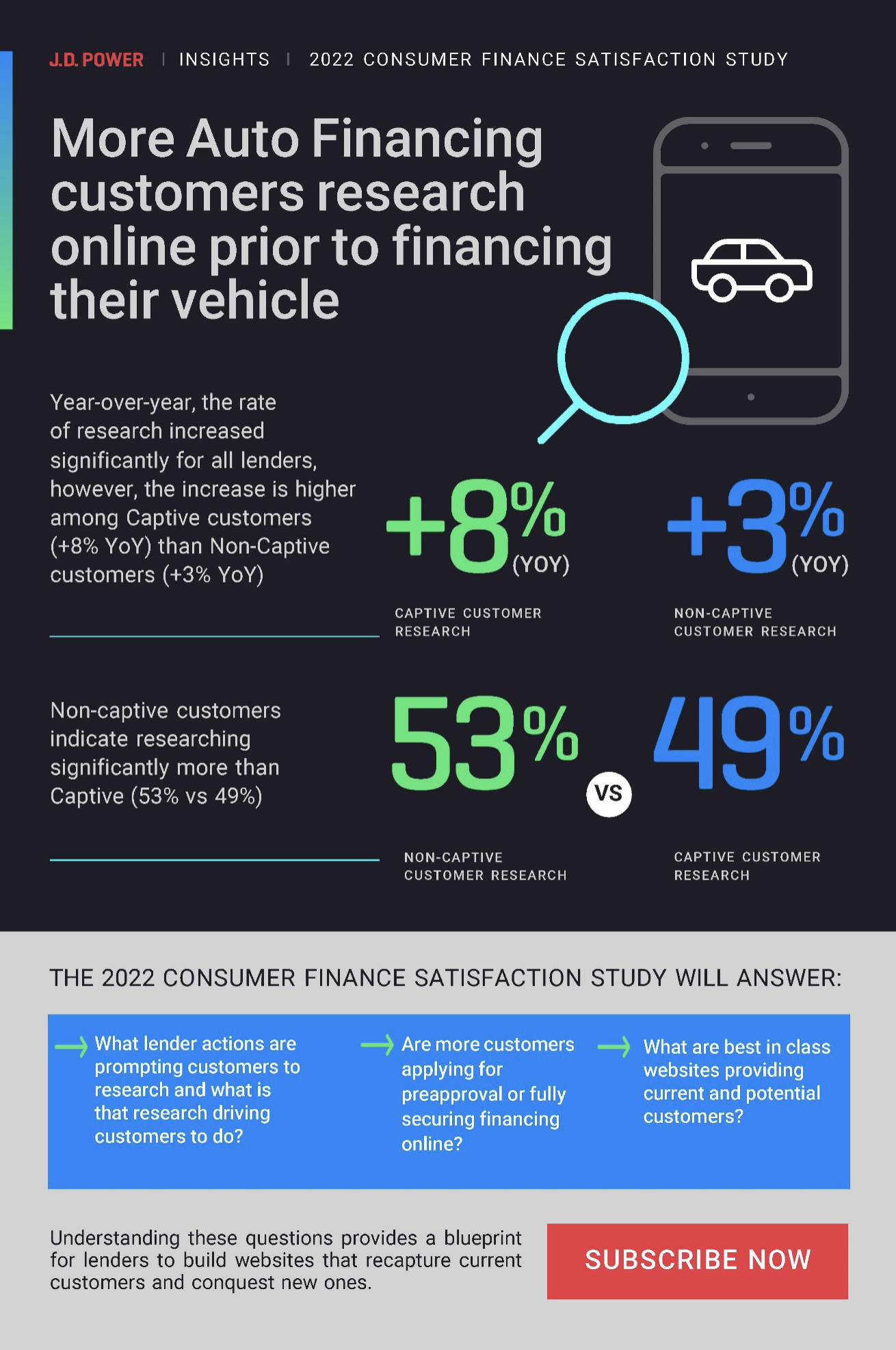
More Auto Financing customers research online prior to financing their vehicle.

  • Year-over-year, the rate of research increased significantly for all lenders, however, the increase is higher among Captive customers (+8% YoY) than Non-Captive customers (+3% YoY)
  • Non-captive customers indicate researching significantly more than Captive (53% vs 49%)  

Build a Website that Attracts and Retains

What lender actions are prompting customers to research and what is that research driving customers to do? Are more customers applying for preapproval or fully securing financing online? What are best in class websites providing current and potential customers?

Understanding these questions provides a blueprint for lenders to build websites that recapture current customers and conquest new ones.

Want access to this study?

Subscribing clients will receive early access to the data on November 3, 2022, and JD Power will issue a press release with rankings and key findings on November 14, 2022. Purchasing a subscription is quick and simple, contact us to get started.


graph

Consumer Finance Satisfaction Study is Coming Soon

The JD Power Automotive Consumer Financing Satisfaction Study is the most comprehensive independent study of borrowers who financed a new or used vehicle through a loan or lease. Findings from the Study will publish within PowerSource on November 3, 2022, ahead of issuing a national press release with rankings and key findings on November 14, 2022.


graph1


Answers You Need to Stay Competitive

This study was created to better understand customer intentions, priorities, influences, and preferences throughout the entire automotive financing process.

Want access to this study?

Subscribing clients will receive early access to the data on November 3, 2022, and JD Power will issue a press release with rankings and key findings on November 14, 2022. Purchasing a subscription is quick and simple, contact us to get started.

Banking and Payments Intelligence Report
October 2022

Are Americans Adjusting to Inflation?

Inflation isn’t going away anytime soon. But according to the latest JD Power data, some signals suggest that Americans are getting a better handle on how to manage their finances in the face of challenging economic conditions.

According to the data, the share of American banking customers now classified as financially healthy[1] increased four percentage points, this month, the largest increase in nearly a year. What’s more, number of customers that said the cost of goods increased faster than their income fell for the first time since we began tracking the metric in March 2022.

While the improvement is modest—and a significant majority of American consumers are still experiencing financial difficulties—supporting data suggest that many Americans are starting to change their spending habits to adapt to rising prices.

Financial Health Improves Slightly

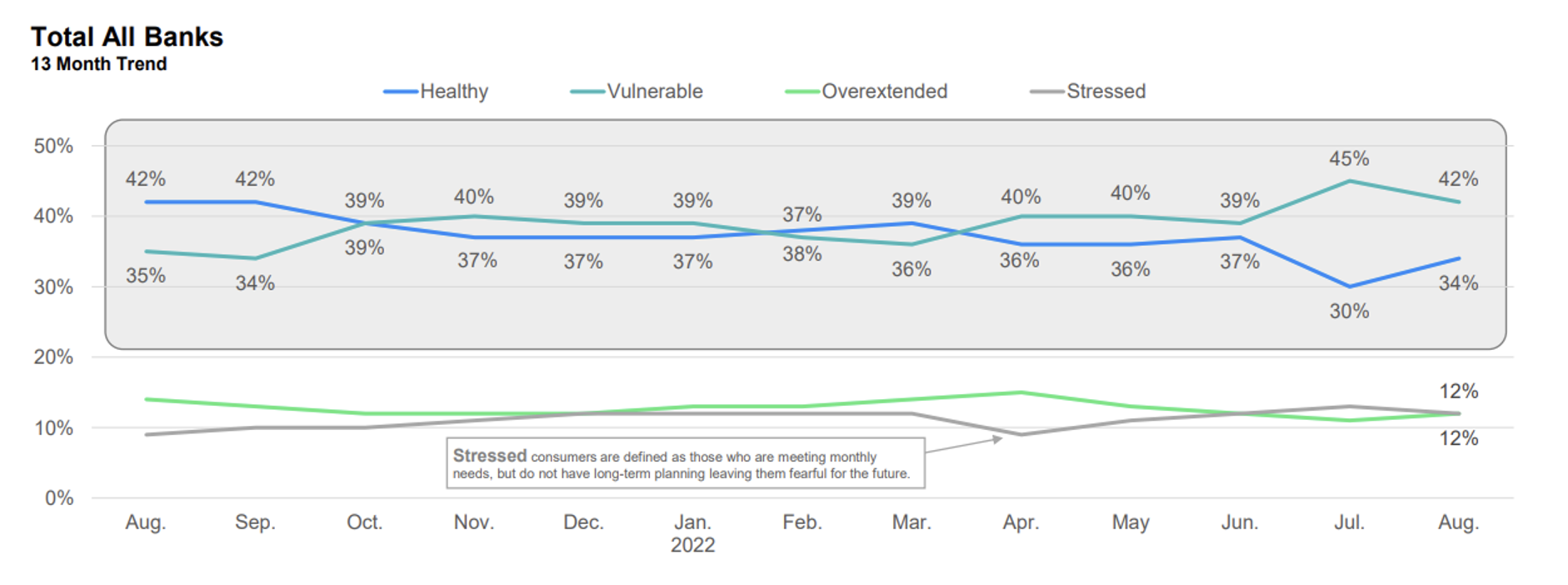
Although it is still too early to call it a rebound, some key indicators of financial health are starting to show month-to-month improvement. Notably, 34% of U.S. bank customers are now classified as financially healthy, up four percentage points from July.

Chart depicting financial health across banks


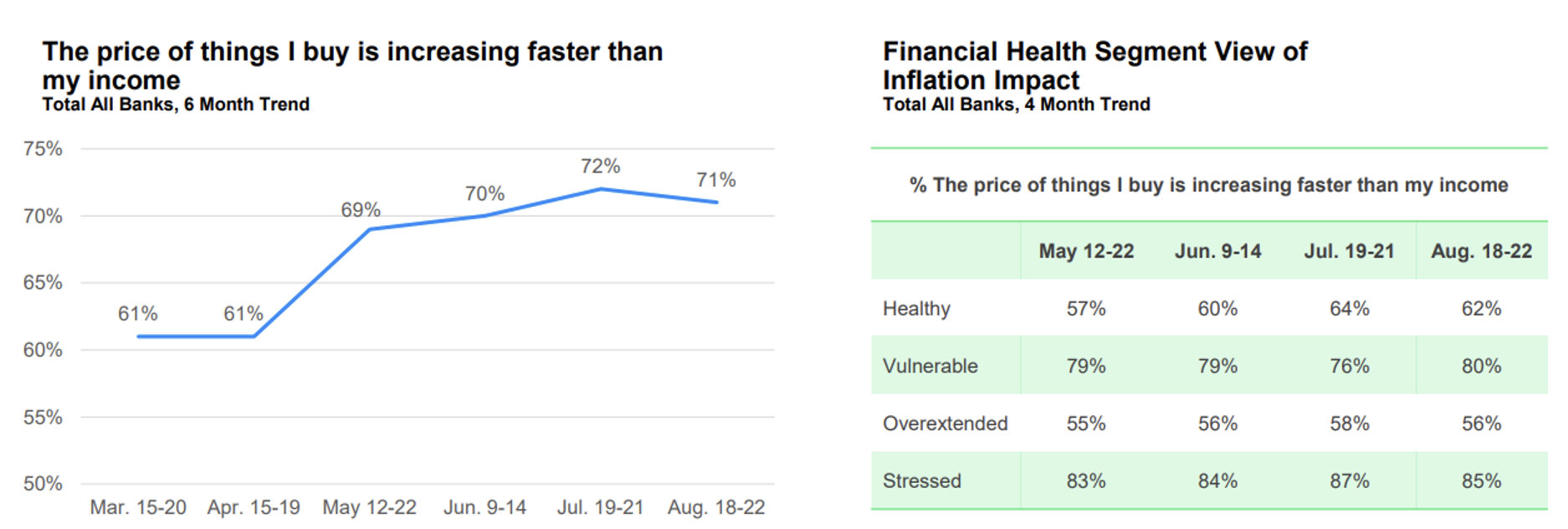
Meanwhile, the percentage of banking customers who said the price of goods is increasing faster than their income, decreased one percentage point to 71% in August.  

The price of things is increasing more than my salary


Spending, Budgeting, and Saving Strategies Evolve

Americans also seem to be adjusting their spending to mitigate the stress caused by inflation. Currently, 86% of consumers say they are taking action to manage inflation in their lives today with steps such as increased budgeting, buying fewer items to stay on budget and increasing savings to safe for future services. For example, in October 2021, 12% of bank customers told JD Power that they do not have a budget. In August, that number fell to just 8%.

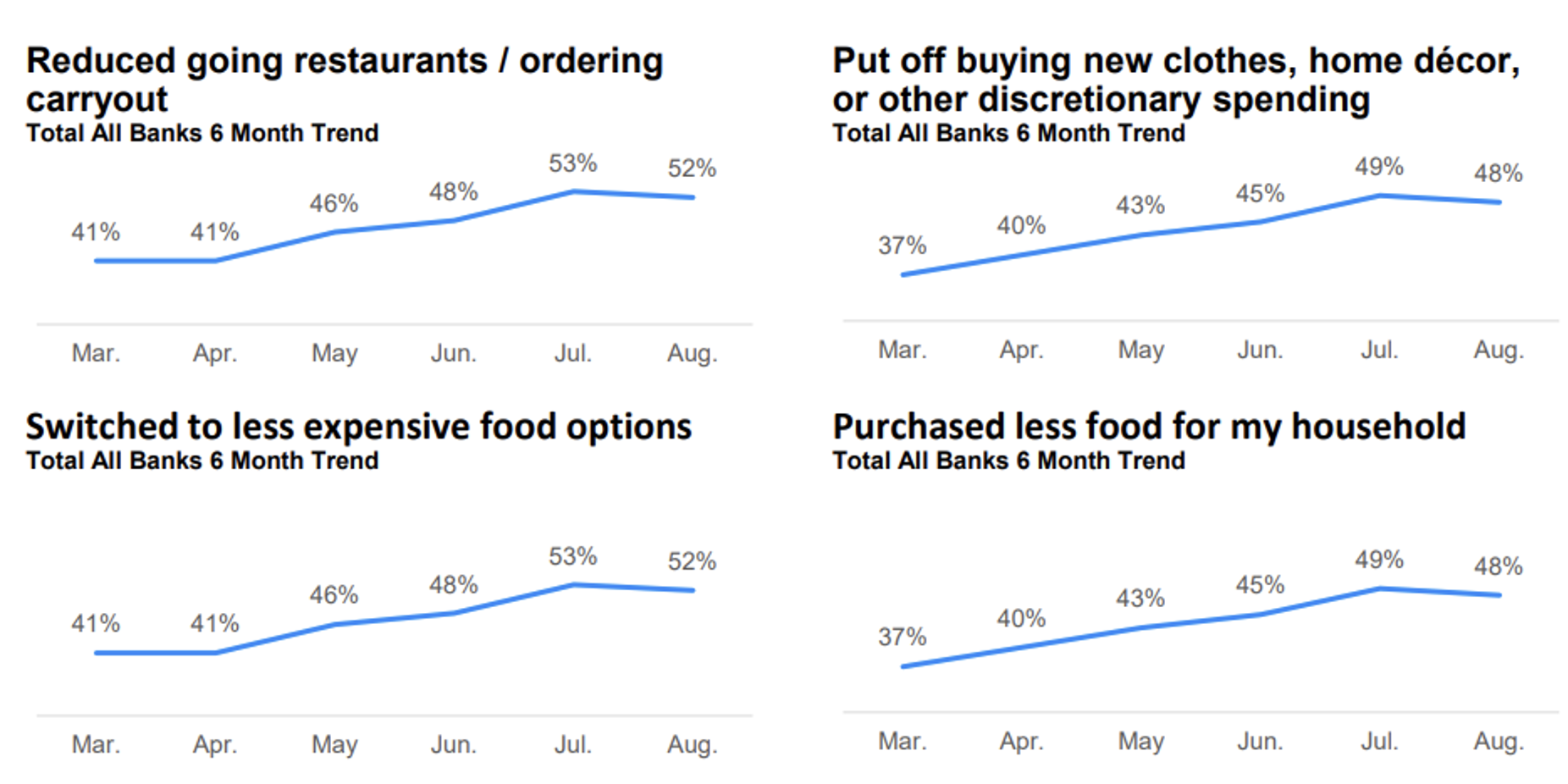
The biggest changes in consumer spending behaviors are focused on dining options and discretionary spending on items such as clothing.

Prices are rising


While Americans are reining in spending, it seems that they are backing off some of the emergency measures they took over the summer.  The number of Americans that reduced their savings to pay for immediate expenses decreased month over month, as did the percentage of those that experienced increased need for credit to pay for immediate needs.

bar graphs


Banks to the Rescue?

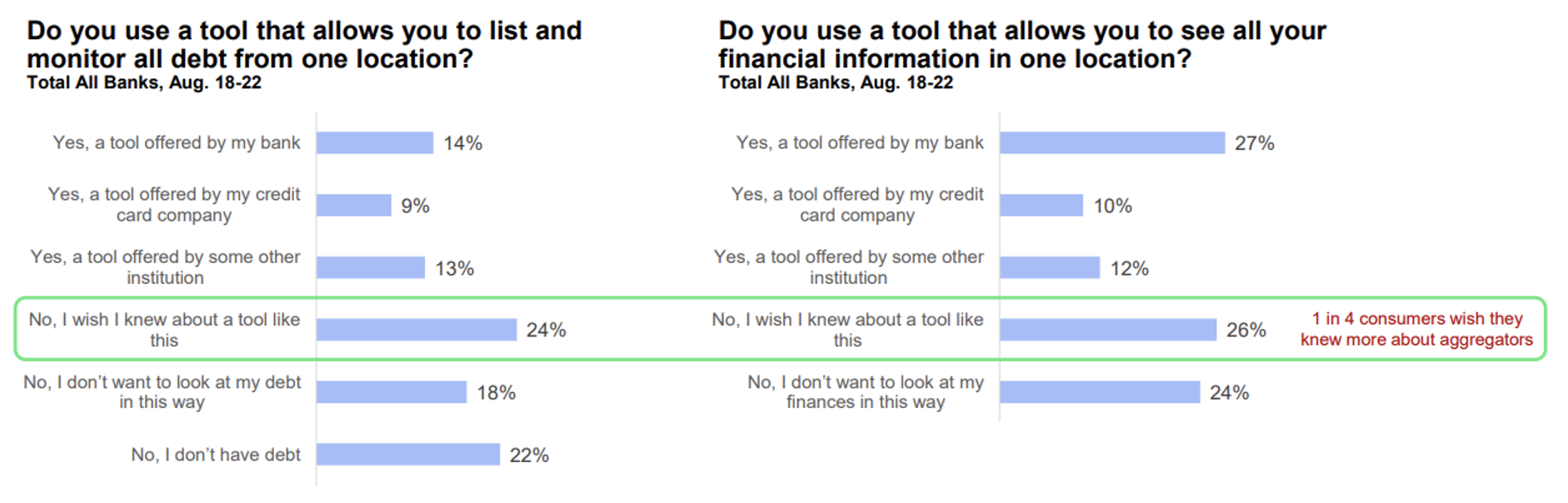
While banking customers try to navigate this financial landscape, banks are still slow to offer solutions that are making a meaningful difference. One-fourth (25%) of customers wish they received information from their bank about strategies and tool to manage inflation, save in a recession or pay down debt in a recession.

Graph showing who uses tools to monitor debt

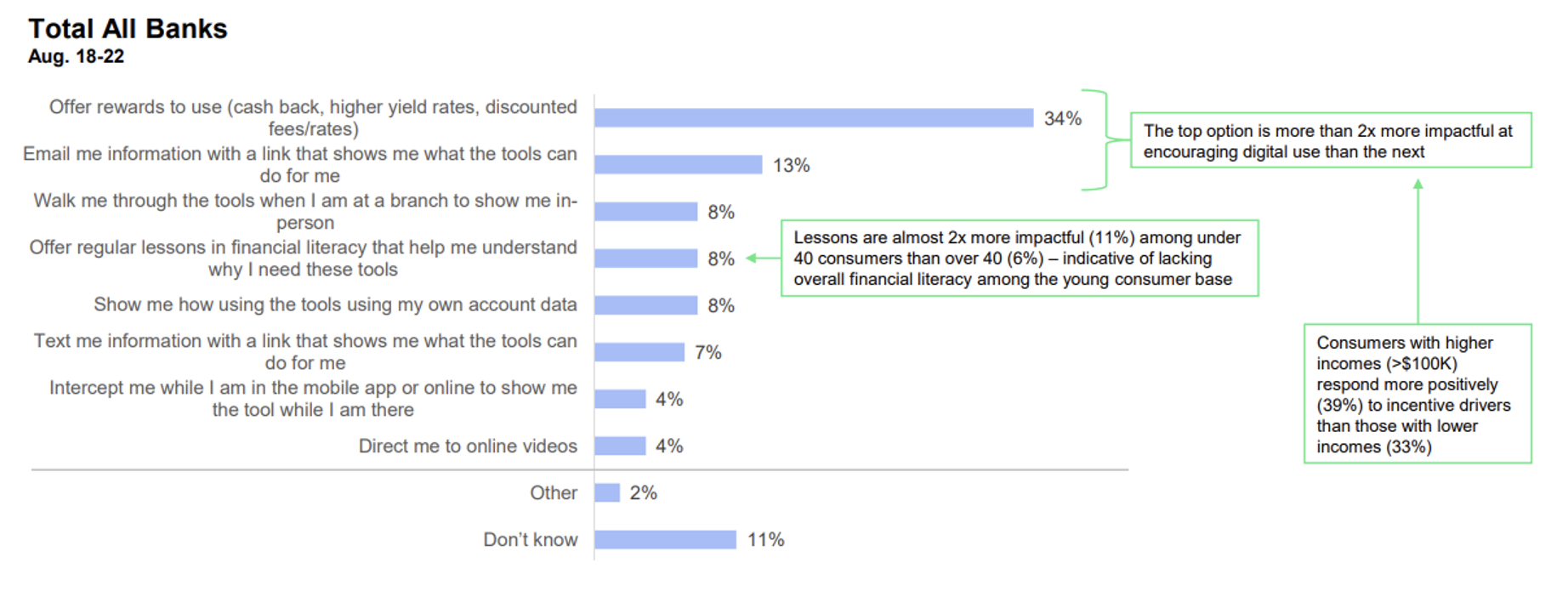
When asked what banks could do to make products compelling enough to use, Americans were quick to mention rewards, such as cash back, higher-yield rates and discounted fees (34%). Also, 13% said they would like to be emailed a link explaining benefits of such a tool, and 8% want to be walked through their options at a local branch.

Graph showing banking solutions to financial issues caused by inflation


Guiding to the Light

While the overall outlook on American financial health is still far from optimistic, the behavioral changes we are seeing in the data suggest many Americans are starting to adapt to the current inflationary environment.

For as long as that challenging economic environment persists, banks have an opportunity to make meaningful inroads in their relationships with their customers. Now more than ever, customers are looking to their financial institutions for guidance, and are receptive to programs banks have long been after customers to adopt. Handled properly, the current economic downturn could present an opportunity for banks to earn goodwill and advocacy by helping customers address their pain points.

Find out More

This Banking and Payments Intelligence Report is based on responses from 4,000 retail bank customers nationwide and was fielded in August 2022. It was authored by Jennifer White, senior director of banking and payments intelligence at JD Power. Please contact us at the numbers below to connect with Ms. White or to learn more about the underlying research.


Media Contacts

Brian Jaklitsch; East Coast; 631-584-2200; [email protected]

Geno Effler, JD Power; West Coast; 714-621-6224; [email protected]
 

[1]  JD Power measures the financial health of any consumer as a metric combining their spending/savings ratio, creditworthiness, and safety net items like insurance coverage. Consumers are placed on a continuum from healthy to vulnerable.