Companies of all sizes experienced higher Average Handle Time (AHT) during the pandemic, and that trend should spike again.
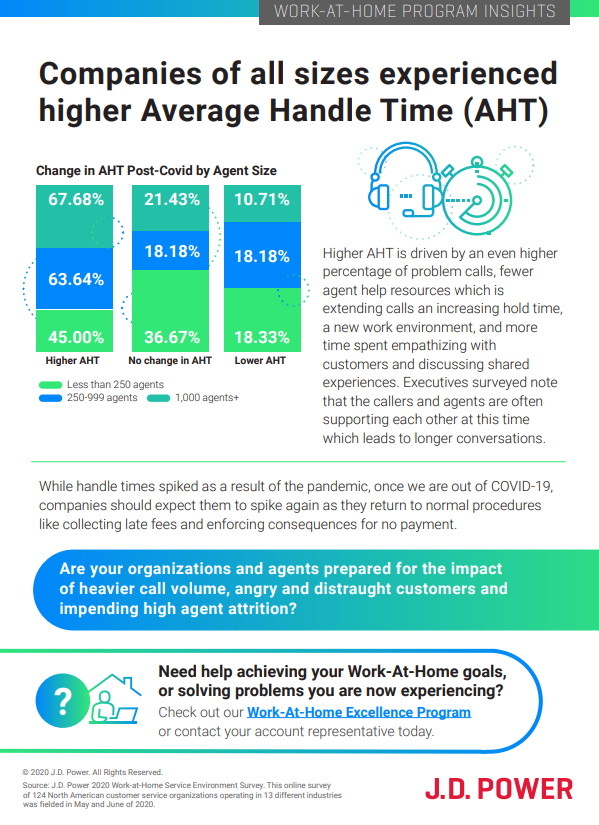
Companies of all sizes experienced higher Average Handle Time (AHT) during the pandemic, and that trend should spike again.
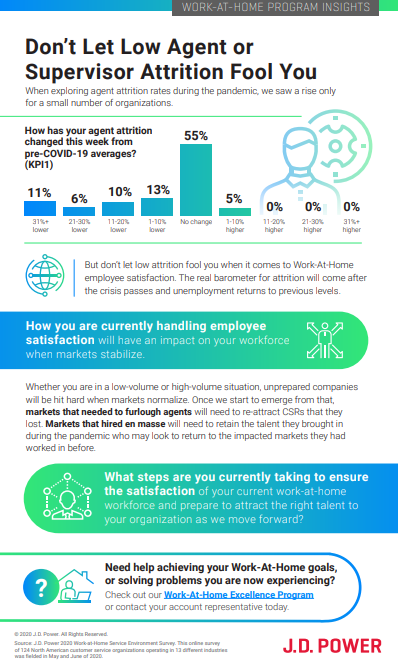
When exploring agent attrition rates during the pandemic, we saw a rise only for a small number of organizations. But don’t let that fool you.
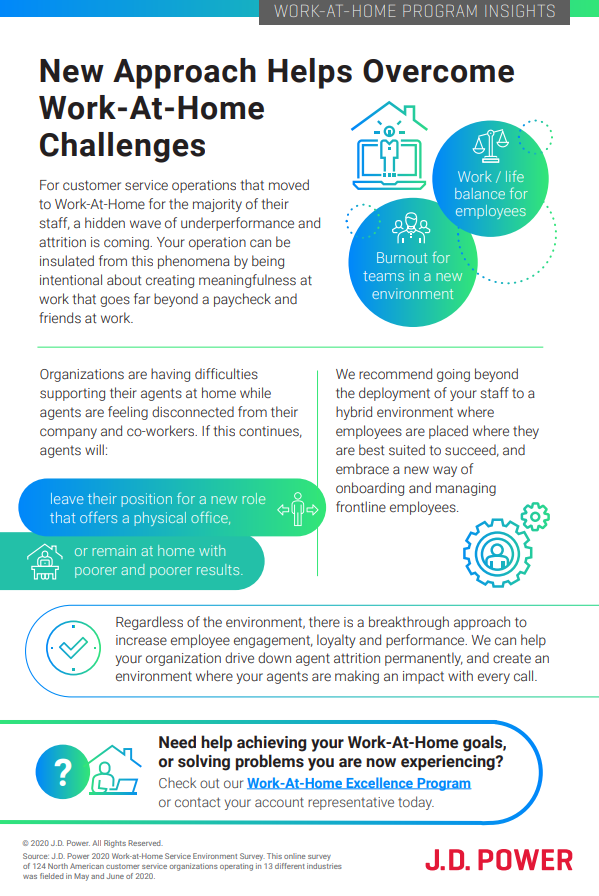
For customer service operations that moved to Work-At-Home for the majority of their staff, a hidden wave of underperformance and attrition is coming. What can you do to prepare?
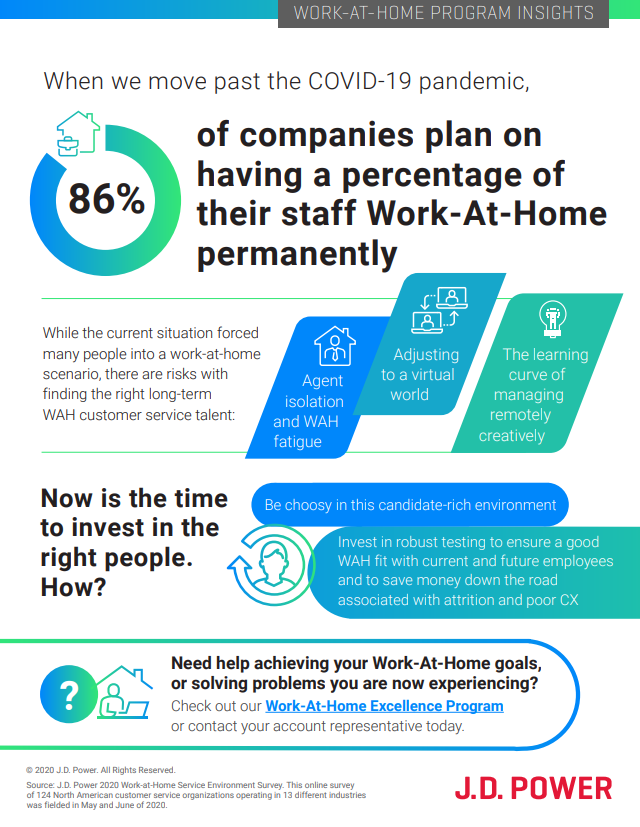
When we move past the COVID-19 pandemic, 86% of companies surveyed plan on having a percentage of their staff Work-At-Home permanently. What are the risks?
In this episode, JD Power’s Michael Vermillion, Mark Miller, and Scott Killingsworth discuss issues and trends related to the shift to Work-at-Home for customer service operations.
Topics discussed during this podcast include:
In this episode, JD Power’s Michael Vermillion, Mark Miller, and Scott Killingsworth discuss issues and trends related to the shift to Work-at-Home for customer service operations.
Topics discussed during this episode include:
In this episode, JD Power’s Michael Vermillion, Mark Miller, and Scott Killingsworth are joined by special guest Alison Fox, Travel + Leisure digital contributor, to discuss issues and trends related to the shift to Work-at-Home for customer service operations.
Topics discussed during this episode include:
In this episode, JD Power’s Jeff Conklin, Vice President of Utilities and TMT at JD Power joins Michael Vermillion, Mark Miller, and Scott Killingsworth to discuss issues and trends related to the shift to Work-at-Home for customer service operations.
Topics discussed during this podcast include:
In this episode, Carl Eckert, Co-founder & CEO of Amelia, joins JD Power’s Michael Vermillion and Mark Miller to discuss issues and trends related to the shift to Work-at-Home for customer service operations.
Topics discussed during this podcast include:
In this episode, Ted Nardin and Brian Kearney from 5th Talent join JD Power’s Michael Vermillion and Mark Miller to discuss issues and trends related to the shift to Work-at-Home for customer service operations.
Topics discussed during this podcast include:
In this episode, Brandon Knight, VP of the Contact Center Practice at Telarus, joins JD Power’s Michael Vermillion, Mark Miller, and Scott Killingsworth to discuss issues and trends related to the shift to Work-at-Home for customer service operations.
Topics discussed during this podcast include:
In this episode, Josh Gross, founder of Pizzatime, joins JD Power’s Michael Vermillion, Mark Miller, Scott Killingsworth, and Tom Bontempo to discuss issues and trends related to work-at-home customer service operations.
Topics discussed during this podcast include:
Is the call center dead? That’s one of many interesting questions COVID-19 has raised about the future of work. It’s been two decades since I first heard an enthusiastic telecom CEO talk about how call center workers would soon work from home. But now, because of COVID, it has finally happened. And according to a JD Power study out today (CEO Daily got an early peek) 86% of 124 customer service organizations surveyed say they plan to implement permanent work-from-home models even after the pandemic passes.
As physical office locations slowly begin to re-open, organizations are faced with managing agents in both physical and work-at-home (WAH) environments. In this on-demand webinar, JD Power and Amplity Health’s Rob Selvaggi discuss the lessons he has learned from managing a true “hybrid” environment with both WAH and traditional brick-and-mortar elements.
Successful Work-At-Home (WAH) operations have the required technologies, the right policies and the right management teams in place. All good management teams keep their eyes on two things: their customers and their employees. So how can you evaluate whether your team is properly managing their employees?
WAH operations look great on paper, but are challenging in reality, particularly as they relate to employee experience and, by extension, the customer experience. The fact is that while some agents will love the concept, many agents will not adjust to it over time. As a result, for employees that do not work well within, or enjoy the WAH model, attrition will occur, causing service level degradation, CX degradation, and unnecessary costs. How can contact center operations respond to this challenge and maximize success now and into the future?
In this video, Mark Miller speaks with Guardian about how JD Power’s Contact Center Certification can uniquely differentiate your brand.
JD Power certified client Freeman answers: What do certified clients have to say about the program?
Another best practice that we are seeing from top performers is around agent opt out. The first step to seeing results with agent opt out is to establish perception of it’s availability. In top performing companies, 79% of their customers perceived that they had the opportunity to opt out and get directly to a rep during their interaction with the IVR. Compare that with only 42% of lower performing companies. That is a big difference.