Lending Intelligence Report
October 2024

With AI-Powered Chatbots Coming to Customer Service, Are Mortgage Customers Ready? 

Artificial intelligence (AI) is here to stay. Three-fourths of business leaders say they are planning to escalate their AI investments, as they see its potential to redefine customer service and many other business functions. That includes the lending industry, in which AI-powered customer service has already started to establish a foothold and is poised to grow. Are customers ready for the future of AI-driven customer service?

This Lending Intelligence Report dives further into one aspect of the JD Power 2024 U.S. Mortgage Servicer Satisfaction Study. It highlights the prevailing sentiment and emerging trends in AI-powered customer service, and how that may change with the continued uptick in servicer adoption. 

AI Can Be a Problem-Solver

Arguably one of the biggest barriers to adoption of AI-powered customer service solutions is customers’ perception of online chat. Early iterations of chatbots left many customers feeling like they were simply wasting their time. But that may be changing.

Overall, 21% of mortgage servicing customers have experienced a problem in the past 12 months. Just 9% of those customers used online chat as their first point of contact. That pales in comparison with the 48% that called customer service, but customers from Generation Y1  and Z are three times more likely to use online chat than older generations so this channel will become increasingly important.

The good news is that the majority of customers who use chat found it to be useful. Two-thirds (67%) of customers using chat said it was to try to solve a problem. Of that group, 83% of those said that their problem was resolved on that chat. Unsurprisingly, those who were able to solve their problem via chat had an overall customer satisfaction rating of 702 (on a 1,000-point scale) vs. 482 for those who could not solve their problem.  
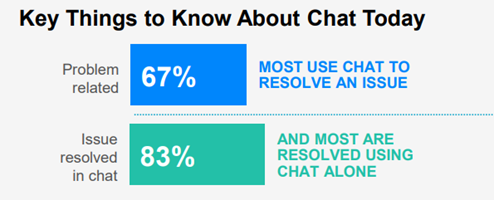
Lending Intelligence Report October 2024 Key Things to Know About Chat Today

An Opportunity for AI

Nearly three-fourths (73%) of customers who used chat say they interreacted with a live representative, while just 10% thought it was a chat bot, and 17% were not sure. Those who said they interacted with a human had a better experience than those who thought it was a machine on the other side. Further, 63% of chat users working with a human felt the chat rep used a script, while 37% did not. 
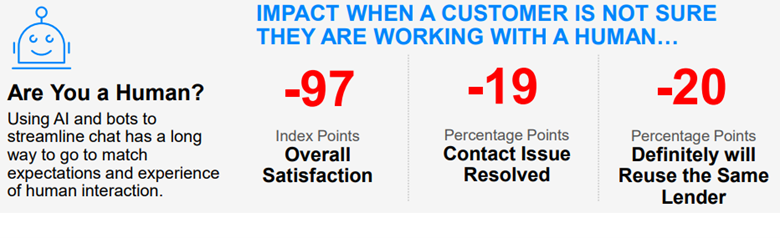
Lending Intelligence Report October 2024 Are you human

That’s important for a few reasons. Customer satisfaction for those who felt no script was used was 699, considerably higher than the average satisfaction score (636) among customers who thought a script was used. Nearly three-fourths (73%) of those customers who felt no script was used said that the process was extremely easy vs. 27% among those who felt a script was used. As AI evolves and becomes more widely adopted in the servicing industry, firms are going to need to keep a close eye on potential negative impacts to consumer perceptions. A key point for servicers to consider is that customers are usually fine with a technological improvement, provided it adds value.   

That poses a challenge to lenders: An investment in AI needs to represent a clear understanding of what the customer wants in terms of service and problem resolution, and how they interact with their customer service channels. Without that, customers may simply refuse to engage, leaving lenders on the hook for the time and resources spent on underutilized technology. Those who can thread this needle will see higher customer satisfaction scores, improved processes, and streamlined costs. 

Find out More

This Lending Intelligence Report is based on responses from the JD Power 2024 Mortgage Servicer Satisfaction Study, which included 11,565 responses and was fielded from May 2023 through February 2024. It is authored by Bruce Gehrke, Senior Director, Lending Intelligence. Please contact us at the numbers below to connect with Bruce or to learn more about the underlying research.

Media Contacts
Brian Jaklitsch; East Coast; 631-584-2200; [email protected]
Geno Effler, JD Power; West Coast; 714-621-6224; [email protected]

[1] JD Power defines generational groups as Pre-Boomers (born before 1946); Boomers (1946-1964); Gen X (1965-1976); Gen Y (1977-1994); and Gen Z (1995-2006). Millennials (1982-1994) are a subset of Gen Y.

As trust and transparency become paramount, servicers are surprisingly thriving amidst challenges, showcasing resilience in customer relationships. In this month’s update, JD Power, Bruce Gehrke, Senior Director of Lending Intelligence and Miles Tullo, Managing Director, discuss the latest insights from the Mortgage Origination Satisfaction Study and Mortgage Servicer Satisfaction Study. Here’s a breakdown of the key highlights:

Why Mortgage Originators Face a Satisfaction Slump
Borrower satisfaction with mortgage originators has dropped significantly in 2024, reversing last year’s positive trend. Only 42% of lenders are achieving higher satisfaction scores this year, down from 70% in 2023.

Key factors influencing borrower loyalty and advocacy include:

  • Trust: Borrowers need to feel confident they got a good deal.
  • Ease of the process: Simple, fast, and transparent processes resonate with borrowers.
  • Competitive interest rates: While market factors dictate rates, customers expect lenders to remain competitive.

“At the end of the day, those interest rates matter, and a customer needs to believe and trust that their lender gave them a good deal,” says Bruce Gehrke.

Interestingly, digital tools—despite heavy investment—are not delivering the highest customer satisfaction. Traditional, human-centered service models continue to outperform digital-first approaches.

Mortgage Servicers Thrive Despite Rising Challenges
Mortgage servicers are seeing a notable increase in satisfaction, even among financially vulnerable customers. Trust plays a vital role, especially when servicers aim to retain customers for refinancing opportunities.

The top factors driving servicing satisfaction include:

  • Minimal interactions: Customers prefer smooth experiences with few issues requiring service intervention.
  • Transparency: Clear communication about fees and escrow accounts is crucial in building trust.
  • Escrow management: Rising insurance premiums and property taxes put pressure on servicers to manage escrow accounts effectively.

How Declining Rates Will Reshape the Market
As elevated interest rates reduce transaction volumes, the mortgage market is undergoing rapid changes. However, as rates begin to decline:

  • The refinance market may experience a resurgence, with direct-to-consumer models gaining the most traction.
  • Trade-up” borrowers—those who have been reluctant to sell due to low-interest mortgages—may re-enter the market.
     

Where can you find more insights like this?  
Stay up to date on the latest mortgage customer satisfaction insights with JD Power. Discover key trends and performance metrics in the Mortgage Origination Satisfaction Study and the Mortgage Servicer Satisfaction Study, covering the experiences of thousands of borrowers and homeowners. 

RecEIVE our Upcoming Press Releases


More About These Experts 
Bruce Gehrke is the Director of Lending Intelligence at JD Power, overseeing including the Mortgage Origination Satisfaction Study and Consumer Lending Satisfaction research. He develops client improvement strategies based on data analytics and has built consulting relationships with leading asset managers and mortgage lenders.

Miles Tullo is the managing director of the JD Power Financial Services team. He oversees the company’s consumer payments program, focusing on point-of-sale choice and non-credit card payment methods. Drawing from over 20 years of experience in both payments and mortgage lending, Miles brings valuable expertise to clients.  

E-Vision Intelligence Report
February 2023

Consumer Price Sensitivity Asserts Influence on EV Market

Key Findings

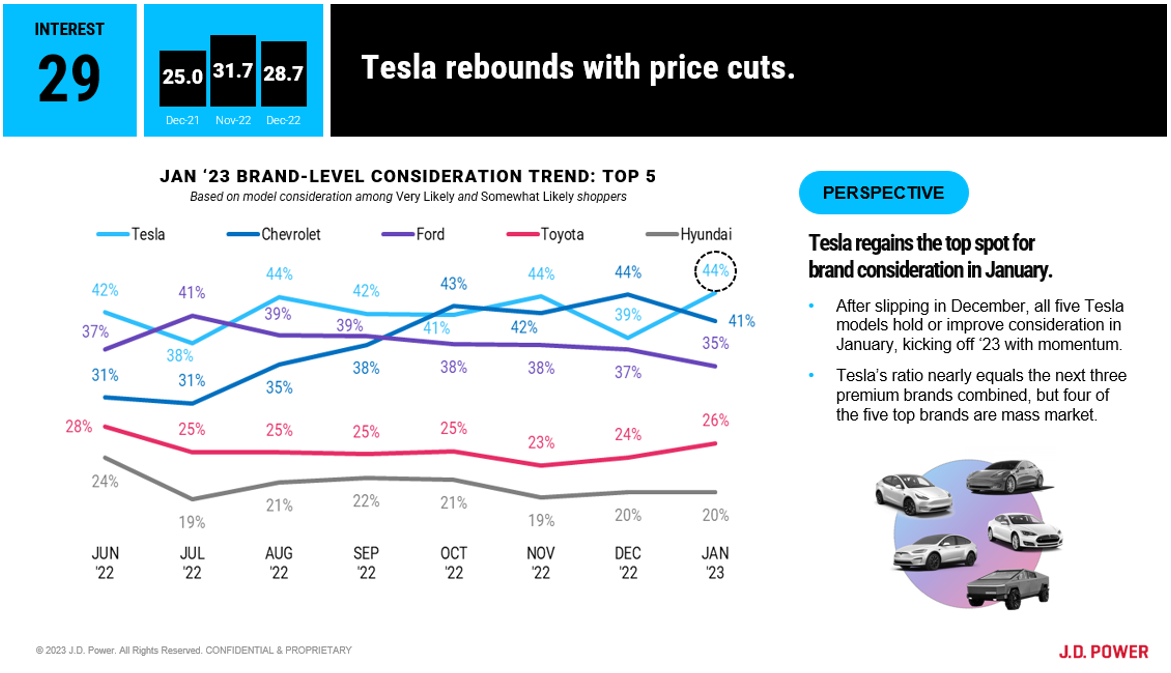
  • Price Cuts Catapult Tesla to Top of Consumer Consideration List: After losing ground, Tesla has again emerged as the most-considered EV brand among shoppers, with 44% either “very likely” or “somewhat likely” to consider the brand for their next EV purchase.
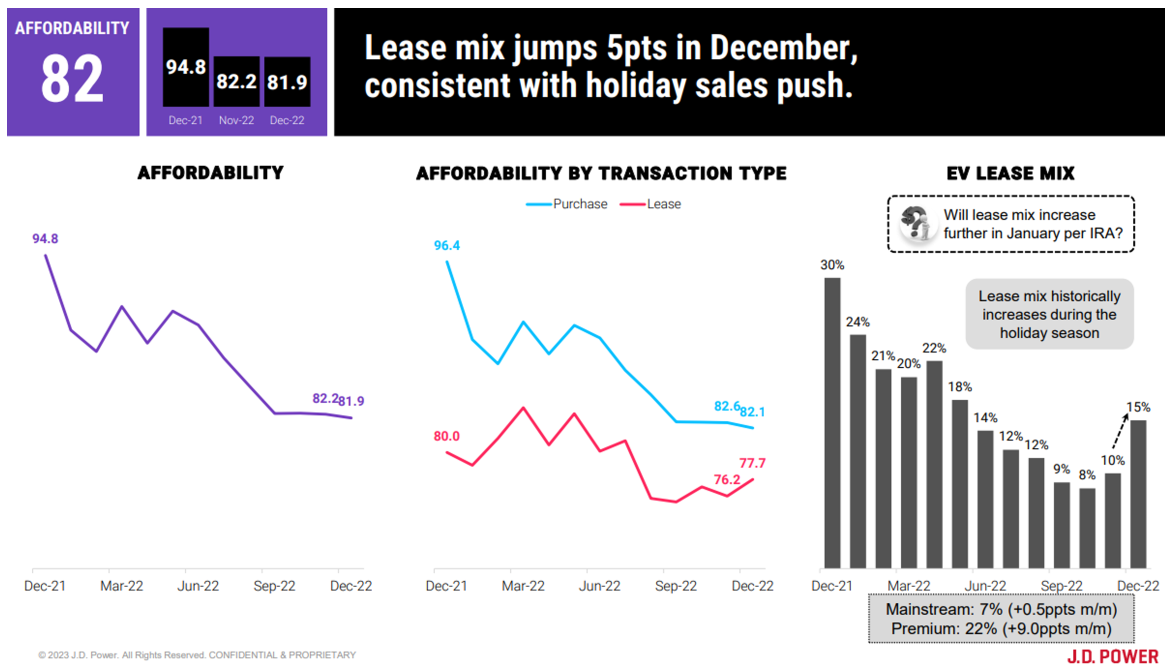
  • Leasing Volumes Surge 46% on Tax Credit: EV leases accounted for 15% of total sales in December 2022. In January, that ratio is expected to jump to 22% as manufacturers take advantage of Inflation Reduction Act tax credit to incentivize leasing.
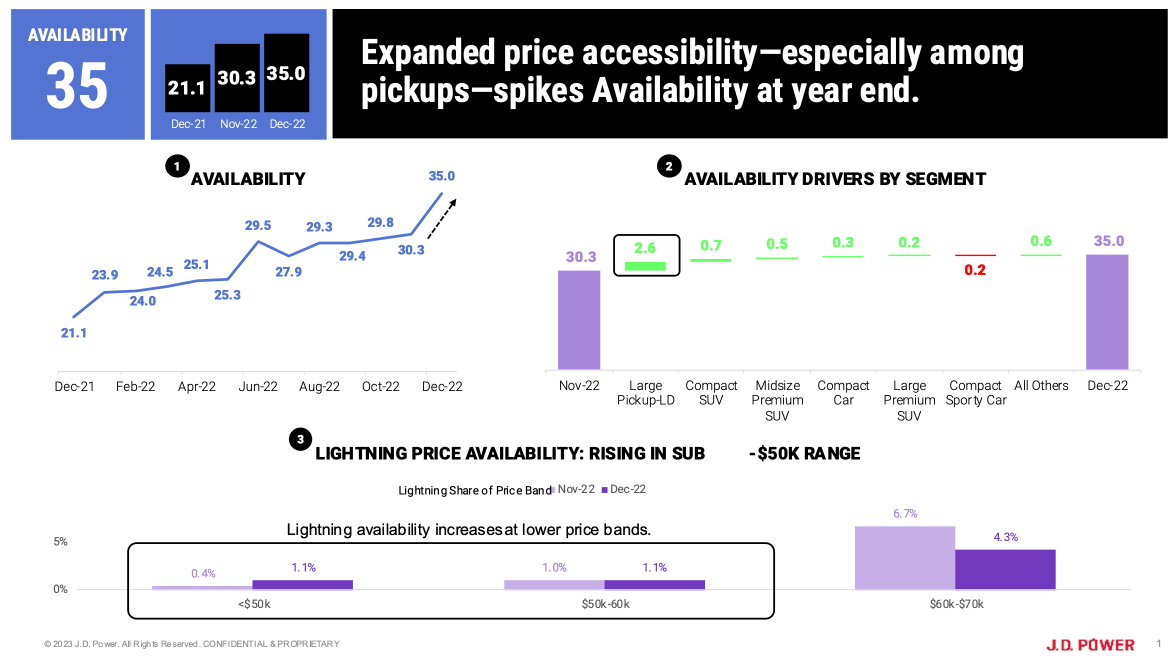
  • Availability Grows for Lower-Priced Trims of Popular Models: Overall EV availability has increased 5 index points, driven largely by growing availability of lower-priced, lower trim-level versions of popular models, such as the Ford F-150 Lightning.

Executive Summary

If ever there were a sign that EVs are rapidly transforming from high-priced playthings into mainstream consumer goods that are highly sensitive to economic trends, it was the complete about-face of consumer interest in Tesla following the brand’s January 2023 price cuts. After dropping prices across its lineup by as much as 20% virtually overnight, consumer interest in Tesla spiked, reversing a recent trend of waning consumer interest.

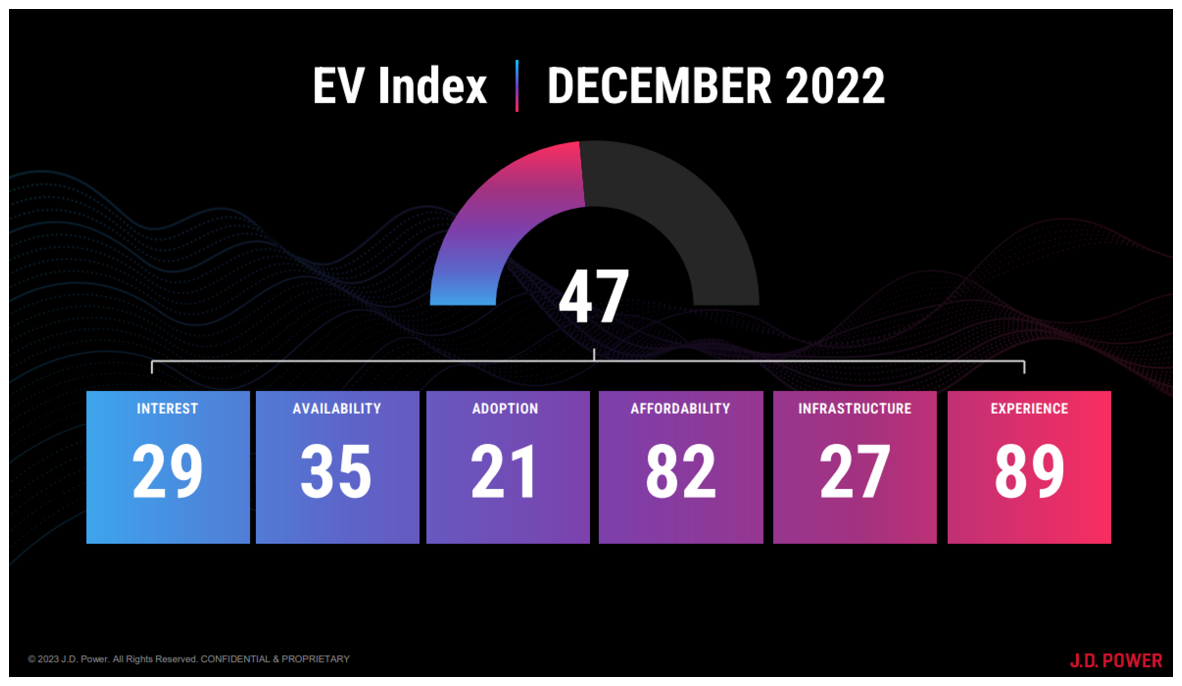
According to the JD Power EV Index, a new analytics tool developed by JD Power to track the progress to parity of EVs with internal combustion engine (ICE) vehicles in the United States, the recent swing in Tesla brand consideration is part of a much larger trend toward consumer price sensitivity becoming an even more significant factor in the EV adoption curve. This E-Vision Intelligence Report dives into key data points trending in each monthly EV Index update, along with other data points gathered from JD Power studies and pulse surveys, to spotlight emerging trends and important shifts in EV consumer sentiment.

Price-Sensitive Tesla Shoppers

Tesla can be credited with breaking down many of the barriers that once existed to widespread EV adoption, but affordability has not historically been one of them. The most affordable version of its Model 3 sedan retailed for about $47,000 in December 2022, while the brand’s average transaction price hovered near $73,000 throughout most of 2022. During that same period, the JD Power EV Index identified a trend toward waning consumer interest in Tesla. In fact, from November to December 2022, the percentage of shoppers either “very likely” or “somewhat likely” to consider a Tesla for their next EV purchase fell to 39% from 44%, falling behind more mainstream offerings from Chevrolet.

Then, in mid-January of 2023, Tesla announced sweeping price cuts that brought the price of a base Model 3 down to $44,000 and cut the price of some models and trims by as much 20%. Immediately, consumer interest suddenly roared back, putting Tesla back on top of the brand consideration ranks, with 44% of EV shoppers indicating interest in the brand.

img1


Suddenly, the brand that has been most closely associated with the premium market sentiment that has accompanied the growth of EVs, is starting to exhibit demand dynamics more in line with mainstream consumer goods. It should come as little surprise, then, that the other four brands at the top of the EV consideration list are all mainstream brands: Chevrolet (41%), Ford (35%), Toyota (26%) and Hyundai (20%).

Leasing Comes Back Big with Boost from Inflation Reduction Act

Another major shift in consumer behavior is afoot in EV leasing activity. After consistently trending downward since April 2022, EV lease mix increased to 15% in December, up five percentage points from the previous month. But that was just a harbinger of things to come. Based on an early look at January data, we find that EV lease mix has spiked to 22% of total EV volume.

ing2


That boost in month-over-month lease volume is, of course, driven by the Inflation Reduction Act and its provision designed to incentivize commercial fleets to go electric with a $7,500 federal tax credit for commercial EVs. The way the law is written, however, vehicles leased to consumers qualify as commerical. That means automakers can now opt to pass the $7,500 credit—or some portion of it—to customers who choose to lease rather than buy a new EV. Clearly, the policy has had an immediate and signifant effect on lease mix.

Lower-Trim EVs Gain Traction in December

There is a commonly used strategy in the auto industry called “launching rich.” It occurs when brands know they have a new vehicle launch that will garner lots of attention and consumer demand and use that momentum to drive sales of their highest priced trim packages at launch. It’s the logic behind special launch edition and first edition models that come loaded with every option, and it has been used widely in the EV space.

As a case in point, consider the Ford F-150 Lightning pickup, which, when it launched in the Spring of 2022, had an average transaction price of $85,600 according to the JD Power EV Index. By August, however, that average transaction price had decreased to $77,400 pulled down by increased sales volume in lower trim models priced in the sub-$50K range.  In December, Ford announced a $4,000 price increase for 2023 models, bringing the average transaction price back up to $82,500.  

img4


Methodology

This JD Power E-Vision Intelligence Report is based on data and insights from the JD Power EV Index and the JD Power EV Consideration pulse survey. The JD Power EV Index is an analytics tool to benchmark the growing EV market in the United States. It tracks millions of data points aggregated into six categories—interest, availability, adoption, affordability, infrastructure and experience—to evaluate the progress to parity of EVs with ICE vehicles in the U.S. Each month, JD Power’s electric vehicle practice will analyze these data points, and others to spotlight emerging trends and important shifts in consumer sentiment that are helping to define the fast-moving EV marketplace.

img4


Find out More

This report was authored by Elizabeth Krear, vice president, electric vehicle practice; Brent Gruber, executive director, electric vehicle practice; Stewart Stropp, executive director, electric vehicle practice; and Kristen Richter, senior analyst, electric vehicle practice at JD Power. The JD Power E-Vision initiative is a company-wide program focused on maximizing JD Power industry-leading EV data, analytics, insights and solutions. Please contact us at the numbers below to connect with the authors or to learn more about the underlying research.


Media Contacts

Shane Smith; East Coast; 424-903-3665; [email protected]

Geno Effler, JD Power; West Coast; 714-621-6224; [email protected]

The JD Power Canada Dealer Financing Satisfaction Study is the most in-depth, independent survey of automotive dealer personnel and their evaluations of captive and non-captive financing providers. The 2022 edition of the study will release to subscribers on May 5, 2022, and JD Power will issue a press release with rankings and key findings on May 12, 2022. 

JD Power’s Automotive Finance team is excited to share some sneak peek insights from the study in anticipation of the May release. Our last sneak peek discussed how automotive finance lenders stay top of mind with dealers in this time of fewer on-site visits. In this final, pre-publish preview we’ll discuss the data-backed need for lender sales representatives to exceed automotive dealer expectations and the impact on future business.

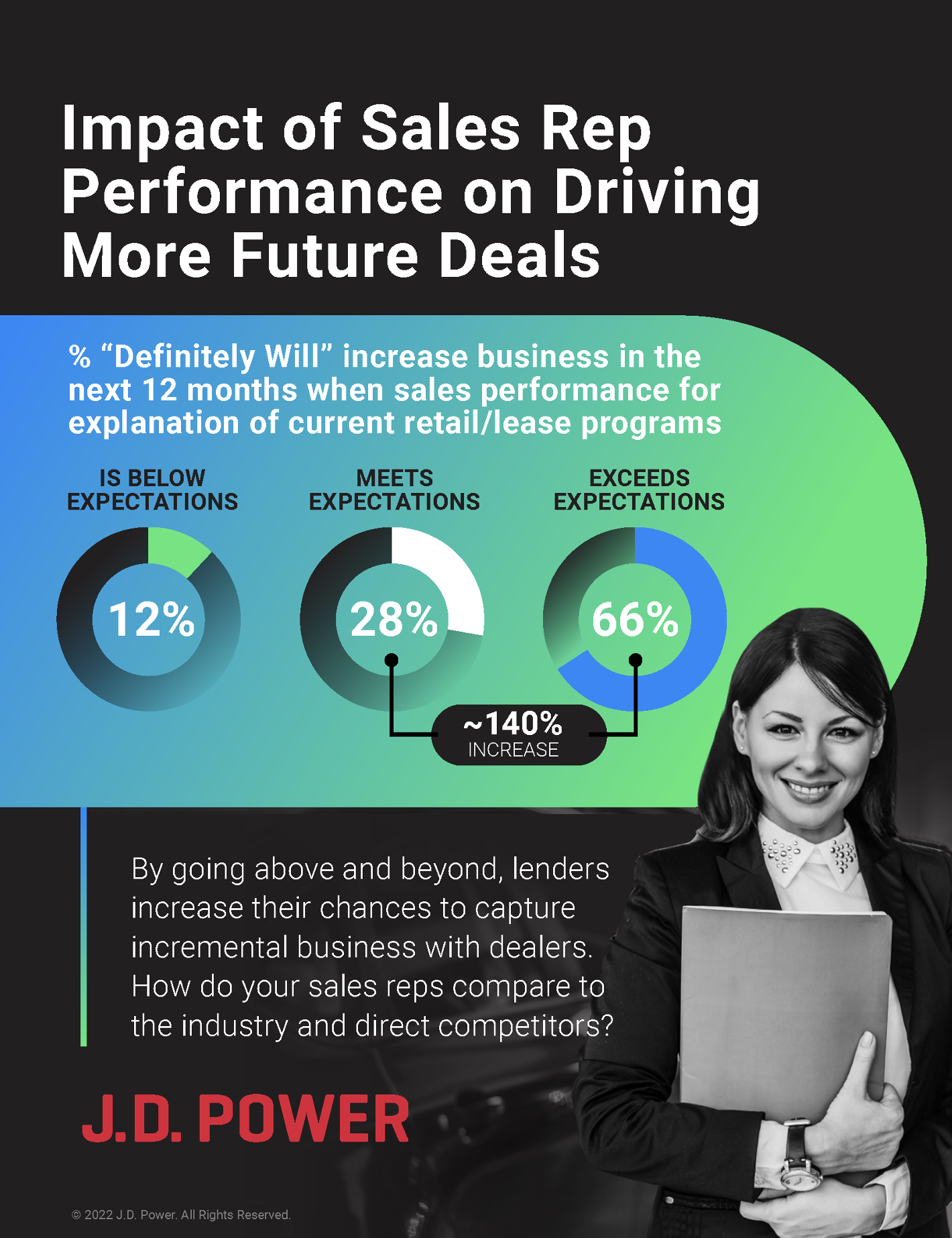
When automotive finance sales representatives meet dealer expectations on dealer-identified most important functions, only 1 in 4 dealers say they “definitely will” send more business to that lender in the next 12 months. However, when sales reps exceed dealer expectations, this number grows by nearly 140% in most instances.

The 2022 Canada Dealer Financing Satisfaction Study asks dealers to rate how well their sales representatives perform on seven dealer-identified critical functions such as an explanation of current retail/lease programs. The findings show that much opportunity remains within the industry and provide evidence that highly- successful sales reps can drive incremental business.

The visual below provides just one example of the impact that sales representative performance has on driving more deals in the future.

infographic showing the impact of sales rep performance on driving more future deals


Contact your JD Power account representative or email [email protected] to discuss how these findings impact your business.

PIN Navigator® is a customized, Web-based tool built specifically for the automotive finance industry by the Power Information Network® (PIN) from JD Power. This tool is designed to support the needs of the sales, marketing, pricing, risk and insurance departments of automotive finance lenders. PIN Navigator provides lenders with 24/7 access to the most timely data available in the market and includes more than 70 contract, dealer, and lender variables updated weekly. This is a “must have” in today’s competitive automotive financial marketplace.

PIN Navigator functionality includes:

  • Flexibility to capture, filter, and segment data by variables such as contract date, CB score, term, location, vehicle, and lender
  • Customizable scheduled reports automatically sent out via email at a regularly scheduled user-preferred time
  • Ability to save and share reports, variable aggregates, and customized data views

If you are not yet subscribing to PIN Navigator, please contact us to schedule a free demonstration using your competitors’ data as well as your own. Using this data may considerably change the way you approach managing your portfolio and monitoring the competition—there is no other source of such detailed transaction-level real-time data available today.

Financial institutions must be prepared for what’s to come in 2014.  During 2013, we saw changes throughout the industry that gave us insight into what customers will expect in the coming year. Download this webcast during which we will discuss the following topics: responding to changing channel preference and usage; identifying the drivers of primary relationships and share of wallet; providing quality advice during moments of truth; and preparing for 2014.