As the UK adopts incentives for battery-electric vehicle (BEV) purchases, the market suffered another decline in new-car deliveries last month. Autovista24 special content editor Phil Curry examines the situation.

The UK’s new-car market fell back into decline in July, as the country’s rollercoaster registrations ride continued.

In July, 140,154 new models were registered, according to data from the SMMT. This was a 5% decline compared to the same month last year. The fall comes despite the announcement of new incentives aimed at boosting the sales of BEV models.

rn

Demand from private buyers fell by 3.2% to 51,646 units in the month. Meanwhile, fleet registrations also declined, with 85,594 units representing a 6.5% drop. Deliveries in the lower volume business sector climbed 10.4% to 2,914 units. 

Across the first seven months of the year, UK registrations were up 2.4%. This was thanks to a strong performance in March, with further increases in May and June. In total, 1,182,373 units have been delivered so far in 2025.

Will incentives provide benefits?

The UK government announced a new incentive scheme for the purchase of new BEVs, which became available during July.

The plans require manufacturers to nominate their passenger cars and light-commercial vehicles to be eligible. A split-tier incentive scheme means models will either qualify for a discount of £3,750 (€4,299) or £1,500.

The grant level is based on strict sustainability criteria. Carmakers must have committed to a science-based target on emissions. Specifically, a goal to cut greenhouse gas emissions in line with the Paris Agreement on climate change.

According to the Independent, manufacturers will need to demonstrate their vehicles meet minimum technical requirements. They must also submit details about the manufacturing process and have a net-zero target in place.

The carbon emissions of electricity grids in the manufacturing location will also be important. This will count towards an environmental score assigned to the vehicle assembly and battery production location. A weighting of 70% is applied to the assessment of CO2 emissions from battery manufacturing, and 30% to vehicle assembly.

Models will also need to cost below £37,000 to be eligible for the scheme. This is below the government’s expensive car supplement (ECS) threshold of £40,000, which still applies to BEVs.

Incentives momentum is essential

With £650 million applied, the incentive scheme will run until the end of April 2029. The aim is to boost BEV sales at a time when overall registrations remain below 2025’s 28% zero-emission vehicle (ZEV) mandate threshold.

As the UK moves towards the end of petrol and diesel new-car sales in 2030, these targets will get larger. While BEV uptake has improved, it has not hit the levels expected.

‘Rapid deployment and availability of this grant over the next few years will help provide the momentum that is essential to take the EV market from just one in four today, to four in five by the end of the decade,’ commented SMMT chief executive, Mike Hawes.

‘This announcement is a welcome response to consistent calls from the industry for more support, which will be in addition to the substantive subsidies already provided by manufacturers,’ he added.

Manufacturer response to incentives

With reduced prices coming into effect from 5 August, the first models to secure the £1,500 discount are:

  • Citroën ë-C3 and Citroën ë-C3 Aircross
  • Citroën ë-C4 and Citroën ë-C4 X
  • Citroën ë-C5 Aircross
  • Citroën ë-Berlingo

With no higher discounts awarded, this highlights the potential difficulty in achieving the required sustainability status for the maximum amount. Some carmakers have already begun including discounts against models at their own expense.

Announcing its support for the scheme, MG introduced a £1,500 discount on certain all-electric models, separate from governmental funding. Smart UK announced its own £1,500 incentive scheme, on top of existing offers. Volkswagen (VW) Group has introduced a £1,500 ‘government guarantee’, providing a discount to buyers while it waits for model eligibility.

Meanwhile, Chinese carmaker BYD has announced its own scheme after what it calls ‘uncertainty surrounding eligibility’ around the government scheme.

‘While BYD has formally applied to be included in the government-backed scheme, the brand may not be immediately eligible,’ the carmaker said. Therefore, it has increased its battery warranty to eight years and has launched five years of free servicing on selected models.

These moves are likely to increase the burden of manufacturer discounting. This already reached around £6.5 billion since the introduction of the ZEV Mandate in January 2024, according to the SMMT.

The government also provided details on plans for £63 million of funding to support at-home charging for households with driveways.

This aims to make it easier for councils to put channels in pavements. Drivers will then be able to run cables from their home to their vehicle parked on the road outside. The funding will also help transition NHS fleets and create thousands of charge points at business depots.

BEV growth slows

The incentives did little to affect BEV uptake in July. While model eligibility is confirmed, private buyers may be holding back, waiting to see which discounts are available.

In the month, BEV registrations increased by 9.1% year on year. This was the second-lowest improvement of the year, and the second time growth has been below 25%. It is also a far cry from the first quarter of 2025, when the total registration rise was 42.2%.

In total, 29,825 new all-electric models took to UK roads last month, 2,490 units more than a year ago. This gave the technology a 21.3% market share. While this was up by 2.8 percentage points (pp), it was still below the ZEV mandate target of 28%.

In the first seven months of the year, BEV registrations increased by 31%, with 254,666 units delivered to customers. This is a rise of 60,235 passenger cars compared to the same period in 2024.

The 21.5% market share was 4.7pp higher than that achieved between January and July 2024. However, this is some way off the ZEV mandate target.

‘Confirming which models qualify for the new BEV grant, alongside compelling manufacturer discounts on a huge choice of exciting new vehicles, should send a strong signal to buyers that now is the time to switch,’ added Hawes.

‘That would mean increased demand for the rest of this year and into next, which is good news for the industry, car buyers and our environmental ambitions,’ he added.

Phenomenal PHEV performance

The standout powertrain in the UK during July was the plug-in hybrid (PHEV). It saw registrations increase by 33%, with 17,489 units delivered. This gave the technology a 12.5% market share, up from the 8.9% recorded in the same month last year.

In the first seven months of 2025, PHEVs have seen registrations improve by 31.5%. This means their growth rate is now higher than BEVs. In total, 124,528 units have been delivered, giving PHEVs a 10.5% hold of the market. This is a jump of 2.3pp year on year.

Combining BEVs and PHEVs, the electric vehicle (EV) market saw a rise of 16.9% in July. This equated to 6,830 more models taking to the road. Their share of 33.8% was up 6.4pp compared to the same month in 2024.

In the year to date, EV deliveries were up 31.2%, reaching 379,194 units. A 32.1% market share was up from the 25% recorded in the first seven months of 2024.

Hybrids struggling

Full hybrid (HEV) figures dropped for the second consecutive month and the third time in 2025. Deliveries were down 10% in July with 18,551 units, equating to a 13.2% market share. This was 0.8pp down year on year.

Between January and July, HEVs have seen registrations improve by 6.5%, with 165,328 deliveries. This provided the technology with a 14% share of the market, rising by just 0.5pp compared to 12 months prior.

The monthly market share between HEVs and PHEVs has been narrowing across 2025. The gap between the two powertrains in July was just 0.7pp, while in the year-to-date, PHEV trailed HEVs by 3.5pp. Momentum appears to be firmly behind PHEV powertrains in the UK market at present.

Combining EVs and HEVs, the electrified vehicle market saw a 7.8% improvement in July, with 4,758 more models delivered. This equated to a 47% share of the total, up 5.6pp.

Between January and July, registrations improved 22.5%, with 100,137 more units hitting the road. Its 46.1% share was up from 38.5% seen in the same period during 2024.

ICE continues to drop

While EVs flourish, internal-combustion engine (ICE) figures, which include mild-hybrid powertrains, continued to fall in the UK.

Petrol registrations declined by 14.7% in July, with 66,271 units delivered. However, this figure was still the highest total of any powertrain, even with 11,431 fewer models taking to the country’s roads than July 2024. The performance gave petrol a 47.3% share of total figures, down by 5.4pp.

Petrol is on a downward spiral, suffering declines in each month of the year so far. Figures between January and July were down by 10.1%, with 571,111 deliveries.

However, this is a difference of 63,856 units year on year. This means petrol held 48.3% of the UK market. Its share is still dominant, but down by 6.7pp compared to the same period last year.

Meanwhile, following its slight improvement in June, diesel returned to a decline in July. Figures were down 7.9%, with 8,018 registrations. This was a difference of just 690 units year on year. In terms of market share, diesel now lags well behind other powertrains. Its 5.7% hold in the month was 0.2pp down compared to July 2024.

In the first seven months of 2025, diesel has seen 66,740 registrations, a 10.9% decrease compared to 12 months prior. Its 5.6% market share was 0.9pp down on the same period last year.

These poor performances meant that the overall ICE market fell by 14% in July. It still led the electrified sector, with a 53% share. This was down, however, from the 58.6% market hold it recorded in July last year.

Across the first seven months of the year, ICE registrations were down 10.1%. Its 53.9% market share was still leading but was down by 7.6pp.


Tesla continued to lead the way as Australia’s battery-electric vehicle (BEV) market returned to growth for the first time this year. Meanwhile, BYD dictated plug-in hybrid (PHEV) registrations. Autovista24 web editor James Roberts unpicks the data.

BEV deliveries reached 9,784 units in Australia in May. This amounted to an 8.6% year-on-year increase, according to the latest data from EV Volumes. This was not only the strongest month for BEV registrations so far this year, but the first month of growth.

The total BEV market totalled 33,123 units between January and May, down from 41,044 across the same period in 2024. This equates to a 19.3% fall.

The PHEV market enjoyed a fifth consecutive month of growth in May with a 70.5% uptick to 2,744 units. In the year-to-date, PHEV sales were notable with 15,023 joining Australia’s roads. Contrasted with the same period in 2024, this was a 115.8% upswing from 6,959 vehicles registered.

Combined BEV and PHEV sales in Australia reached 12,528 in May, the second-highest total of 2025 and the second-highest on record. In the year to date, 48,146 electric vehicles (EVs) took to the country’s roads.

rn

Tesla BEV dominance in Australia

The Tesla Model Y continued its significant lead in the Australian BEV standings in May, with a 36.6% market share. The BEV recorded a 122.5% year-on-year gain in deliveries.

A bumper month, the best for the Model Y since March 2024, ensured the US car reached 3,580 registrations. This made up over half its annual total between January and May.

rn

The Model Y’s May success followed a notable slump. In April, the BEV recorded just 280 sales, its lowest since first recording sales in Australia in August 2022.

Despite this, in May, the Model Y ended up ahead of its nearest challenger, the Kia EV5, which recorded 703 sales. In third place, the Galaxy E5 continued a strong introduction to the Australian BEV market. In its third month on sale, the Galaxy E5 reached 511 units to cap a year-to-date total of 1,023.

BYD’s BEV train

Chinese brand BYD is shaking up the automotive market globally, which is beginning to show in the Australian market. Leading a quartet of models, the BYD Sealion 7 reached 488 registrations, bringing its total to 1,961 units since launch in February.

Following the Sealion 7, the BYD Seal claimed fifth in May’s BEV standings with 355 deliveries. However, this is down from the 1,002 sales recorded one year ago.

The BYD Dolphin emerged just 10 units adrift in sixth, with 345 registrations. This model’s fortunes have continued to improve over the year. A 97.1% year-on-year registration increase meant a 3.5% share of May’s market. The BYD Atto 3 bookmarked the Chinese brand’s presence in May’s top 10, accounting for 322 registrations, ranking seventh.

In eighth, the MG4, one of the market’s most consistent BEV-sales performers, saw its lowest total of 2025 so far. The model reached 319 sales in May, down 43.5% year on year.

The Tesla Model 3 continued its tailspin. Despite recording four-digit sales in March, the model managed just 317 in May, finishing ninth. This equated to an 83.8% drop from 1,958 units 12 months previously. The Kia EV3 completed the top 10 with 310 sales in its third month on Australia’s roads.

Tesla’s BEV lead cut

While Tesla made up the majority of BEV sales in May, cracks began to appear. In the year to date, deliveries of the Tesla Model Y were down 27.4% year on year to 6,974 units.

rn

The Tesla Model 3 followed in second, painting an even more dramatic picture of decline. Between January and May 2024, it accounted for 8,823 registrations in Australia. Fast forward 12 months, and that figure is just 2,583. This equated to a 70.7% drop in sales.

Tesla has been undergoing well-documented struggles. First, there is Tesla’s CEO, Elon Musk, whose political activities have had a tangible impact on sales. Meanwhile, the rise of affordable Chinese EVs have disrupted the market, and with it, Tesla’s dominance. Despite this, after five months, combined Tesla BEV sales reached a formidable 9,557 units in Australia.

In third, the Kia EV5 closed in on the Tesla Model 3. The Korean model was just 371 units behind the US BEV, claiming third place. This performance was boosted by record sales in May. With May marking the EV5’s seventh month of sale in Australia, the model accounted for 2,212 sales in the first five months of the year.

The challenge from Chinese OEMs is clear in the Australian BEV market. Behind Kia followed the MG4 in fourth, with 2,017 sales. However, this did mark an 18.5% year-on-year drop in sales.

BYD cemented the Chinese presence in the top 10. The Sealion 7 underlined a strong performance with 1,961 registrations in the year to date. Ranking fifth, it headed for its more established stablemate, the BYD Atto 3, in sixth. This model hit 1,278 registrations in the five-month period.

BYD’s growing presence in Australia can be partly attributed to its aggressive pricing strategy. The BYD Seal, launched in Australia in 2023, notably undercutting the Tesla Model 3.

The Galaxy E5 split a trio of BYD models, ending up seventh after five months of the year, with 1,023 sales. The BYD Seal came in eighth with 982 registrations. The MG EZS ended up ninth with 959 units, and the Kia EV3 rounded out the top 10. It reached 832 deliveries between January and May 2025.

BYD’s shark attack

A pair of BYD models headed the PHEV standings in May, underscoring the brand’s increased hold on the Australian market.

rn

After just four months on sale in Australia, the BYD Shark swam to a new sales record with 1,302 registrations in May. This equated to a 47.4% market share.

Following the BYD Shark was the BYD Seal. However, with a monthly total of 413, the country’s second most popular PHEV trailed the leader by 889 units. Despite this, the BYD Seal 6 proved a success story in Australia with a 15.1% market share in May.

Since its sales records began in June 2024, the model has accounted for 8,969 units. This figure was buoyed by a boost between August and December 2024, where the new model scored 5,160 sales.

Way behind in third place came a consistent performer, the Mazda CX-60, with 144 units and a 5.2% share of the PHEV market. Just four units behind in fourth emerged the Mitsubishi Outlander with 140 registrations, which was down 74.5% year on year. After the Japanese model, the MG eHS claimed fifth.

Sixth to 10th places could only manage double-digit sales in May. Mazda’s second appearance in the top 10 came courtesy of the CX-80 in sixth, with 55 units. It was followed by another Mitsubishi in seventh in the shape of the Eclipse Cross.

The Lexus NX ended May in eighth place with 35 sales, a 250% improvement on the 10 achieved in May 2024. The Volvo XC60 claimed ninth with 35 registrations, a 56.3% drop year on year. The Porsche Cayenne completed the top 10, shifting 33 units.

Bumper year for BYD on the cards

After the first five months of 2025, BYD was the clear leader in the PHEV standings. Market newcomer, the BYD Shark herd almost half the PHEV share, with 7,431 registrations between January and May.

rn

Fellow BYD model, and a monthly star, the BYD Seal 6 followed with an impressive 2,771 sales and 18.4% of the market. Combined, the BYD Shark and Seal were responsible for 10,202 PHEV units sold in the first five months of 2025. Therefore, the pair held a combined 67.9% share of the Australian PHEV market.

Previous PHEV leader, the Mitsubishi Outlander, was eclipsed between January and May. With 759, the established model trailed the BYD Seal 6 by 2,012 units,

The MG eHS registered 697 sales in the period, shadowed by the Mazda CX-60, claiming 644 units. Some way behind, with 286 registrations, came the Mitsubishi Eclipse Cross, sandwiched by another Mazda, the CX-80, holding 244 sales.

Ranking eighth between January and May was the Volvo XC60. The Swedish PHEV accounted for 150 registrations, tied with the Porsche Cayenne. Meanwhile, the Lexus NX completed the top 10 with 148 registrations in the first five months of the year.

The Italian new-car market witnessed a significant year-on-year decline in June, with only one powertrain trending upwards. Could the legacy of incentives be to blame? Autovista24 web editor James Roberts unpicks the reasons behind the figures.

At best, the Italian new-car market has seemingly avoided any serious registrations downturn so far in 2025. Any declines have been small, while March and April saw deliveries improve. It appears this trajectory shifted in June, in what industry trade association ANFIA has labelled a ‘worrying result.’

June saw a total of 132,320 new cars registered in the country, marking a year-on-year decline of 17.4%. This equates to 27,856 units, the largest fall in the year so far. This is a long way from the 6.3% year-on-year growth earned in March.

Looking at the first half of 2025, the inertia is reflected. In the year to date, 854,929 new-cars have been registered, 3.6% down when compared with the first half of 2024. Until June, the year-to-date market had been fairly stable in April and May. There were, however, a lower number of working days in the first six months of 2025, compared with the same period in 2024.

rn

Reasons for the apparent comparative anomaly are multi-layered. Buoyant Italian new-car registrations in June 2024 were influenced by the roll out of incentives under the Ecobonus scheme. This resulted in a 15.1% year on year boost 12 months ago. Significantly, the introduction of subsidies propelled battery-electric vehicle (BEV) registrations forwards.

Fast-forward to 2025, and while this factor has influenced the negativity, wider issues are at play. One key disrupter is a continued slide in new internal-combustion engine (ICE) registrations. Aligned with this is a wider confusion centred on current electric vehicle (EV) incentives.

ANFIA stated that the Italian new-car market is caught between stagnant demand and low production. The industry body also emphasised the need for government support and clear new incentives. It is hoped that the Ministry of Ecological Transition (MoEES) will clarify subsidies for zero-emission vehicles (ZEVs).

Italian BEV decline

Last month’s slump in BEV registrations is exacerbated when compared with June 2024. This year, the powertrain’s numbers decreased by a sizeable 40.4%, and 5,495 units. This is in contrast with the incentive-boosted period 12 months previously.

The pattern of low overall market share for Italian BEVs continued in June. Hitting 2025’s halfway point, plug-in registrations make up just 7.2% market share, one of the lowest in Europe. 

rn

Despite this, after the first six months of the year, the BEV market share has still increased. The powertrain holds a 5.2% share, up 1.3 percentage points (pp) compared with 2024. BEVs also carry a 28% increase in registrations over the same period.

More can be done to help BEV registrations in the country. Industry body UNRAE highlight a need for increased availability and policy towards EV charging infrastructure. They highlight that public charging points funded by the PNRR (National Recovery and Resilience Plan) have been reduced from €21,355 to €12,000, leaving €597.3 million in public funds unused. Additionally, a recent tender for charging stations in urban centres, which aimed for over 4,700 stations, only funded 1,400.

‘The system is clearly not working as it should,’ stated Roberto Pietrantonio, president of UNRAE. He issued a cautionary statement, highlighting that the absence of a comprehensive and operational charging infrastructure risks impeding the electrification process. This could cause Italy to lag even further behind other European nations.

Furthermore, Pietrantonio advocated for significant measures to address elevated charging costs, expedite infrastructure development, and ensure more efficient management of remaining resources by the Ministry of Environment and Energy Security (MASE).

PHEVs prevail

June has seen a continued prevalence of the popularity of plug-in hybrids (PHEVs). In total, 9,528 units reached customers.

This underscored a volume increase of 74.2% year on year, as well as a 4.8pp lift in market share to 7.2%. It also marks the highest number of PHEVs registered monthly in Italy so far in 2025.

Looking at the wider plug-in market, encompassing BEVs and PHEVs, a similar trend emerges. Whilst May recorded a 66.1% year-on-year increase in plug-in sales, June endured a 7.1% slide. This is the first time this year the EV market has dropped. However, this is in comparison with the incentive-driven period in 2024.

In the year to date, things remain on a downhill path. Combined, BEVs and PHEV registrations are up 40.7% on 2024, with a 25,885-unit upswing. Whilst this may appear positive, Italy began 2025 with a plug-in share of 65.6%, marking a 24.9pp drop across the first six months of 2025.

Italian hybrid love affair continues

Once again, hybrids, made up of full and mild hybrid powertrains, proved the overriding technology in Italy last month. However, an overall decline of 7.2% was recorded, with 57,102 units taking to the Italian roads in June. Despite this, hybrids held a 43.2% market share in the month, up 4.8pp year on year.

Spanning the first half of the year, hybrids accounted for the largest slice of Italy’s new-car market. They claimed a 44.2% market share, with 377,661 units sold. This is an increase of 6.5pp year on year, while volumes rose 10% across the first six months of 2025.

Combining EV and hybrid totals, the electrified market declined 7.2% last month, with the poor performance of BEVs and hybrids hindering PHEVs strength. The technology accounted for 56.4% of total registrations.

Meanwhile, in the first half of 2025, electrified totals are up 14.8%, with 60,263 more models delivered to customers. This equates to a 54.6% share of overall volume in the six-month period, underscoring its dominance in Italy’s new-car market.

Petrol and diesel down but not out

Petrol power underwent its biggest monthly year-on-year decline in June, plummeting 26.5%. With just 31,421 units registered, the overall market share continues to slide downwards. This equated to a 23.7% share for the month, down 3pp on one year previous.

Following a pan-European trend, diesel joins its ICE bedfellow in a continued fall. The fuel-type has witnessed consistent double-digit spirals in 2025, and June is no exception. A 34.4% year-on-year slide reduced the monthly share to 10.3%.

Combined, petrol and diesel sales dropped 29.1% year-on-year in June. This equals a 34.1% market share, the lowest monthly total recorded in 2025.

This is particularly stark as half of 2025 has now passed. In January, ICE registrations accounted for a 36.4% of overall registrations.

Moving on to June 2025, the overall market share remains at 36.3%. This is just 0.1pp below January’s figures. Therefore, while registrations are down, they appear to have hit a limit. It seems the Italian consumer preference for petrol and diesel will need to be radically shaken if the domestic picture is likely to change and electrify any time soon. 

The UK saw registrations grow for the third time this year, with electric vehicles (EVs) driving the improvement as the petrol decline continued. Autovista24 special content editor Phil Curry examines the latest data.

The UK’s new-car market is heating up. For the second consecutive month, registrations in the UK improved, as the country looks to get its market back on track.

Passenger-car deliveries rose by 6.7% in June, according to the latest data from the SMMT. With 191,316 units making their way to customers. This was the third improvement of the year, and was driven entirely by EVs.

rn

The country’s market has been in a state of flux during 2025. Carmakers are under pressure to deliver on their zero-emission vehicle (ZEV) mandate targets, despite some buyer reluctance towards the technology. Combined with a decline in internal-combustion engine (ICE) registrations, these challenges have impacted the sector.

However, thanks to a strong March, when the country introduced new registration plates, year-to-date figures have remained positive. At the end of the first half of 2025, deliveries were up 3.5%, with 1.04 million units.

EVs proved the main driver of registrations growth in June. Aside from diesel, all other powertrains experienced declines. It was the second time this year that the technology, made up of plug-in hybrids (PHEVs) and battery-electric vehicles (BEVs) has been responsible for the market’s improvement.

BEVs charge onwards in June

BEVs were the leading powertrain in terms of registrations growth in June. Volumes increased 39.1% to 47,354 deliveries. This equated to a gain of 13,320 units year on year. The technology took a 24.8% market share in the month, meaning nearly one in four cars registered was a BEV. This was up from its 19% share recorded a year previously.

rn

With no government-backed incentives for BEV purchases in the UK, carmakers are instead offering discounts. According to the SMMT, around £6.5 billion (€7.55 billion) has been spent on discounts since the ZEV mandate was introduced at the start of 2024.

For 2025, the target market share has increased to 28%. Yet in the first six months, BEV registrations accounted for just 21.6% of total deliveries, some way off the requirement. This is despite BEV deliveries increasing by 34.6% compared to the same period last year, with 224,841 units.

‘This level of discounting is unsustainable. The government has acted on the ZEV mandate, tweaking it to remove some of the burden on the industry. But consumer confidence in these new technologies is still not there,’ Mike Hawes, SMMT chief executive, told the press at the recent International Automotive Summit.

‘We would seek still more incentives, for the private consumer, from the government. But what we are getting is disincentives.’

In recent months, BEVs have been required to pay vehicle excise duty (VED) each year. They are also now eligible for the expensive car supplement (ECS). This increases the tax payable if a vehicle is sold for more than £40,000. So, it is likely that the increase in registrations comes at the cost of further discounting.

Strength in PHEVs

PHEVs have also enjoyed an upswing in registrations this year. While volume levels are some way below BEVs, growth has been consistent. June represented the sixth consecutive month of double-digit improvement, as 28.8% more units were delivered. This equated to a total of 21,382 PHEVs which made their way to customers.

The result gave the technology an 11.2% market share. This was up by 1.9 percentage points (pp) compared to June 2024.

With growth throughout the year, it is no surprise that at the end of the first half of 2025, PHEV registrations have improved strongly. With 107,039 units, deliveries increased 31.3%. The powertrain’s market share rose by 2.2pp, to 10.3%.

As PHEVs do not count towards the ZEV mandate, this growth appears to be organic. With more models available, and a potentially shrinking selection for more traditional petrol and diesel vehicles, the market is suddenly more attractive for buyers.

The two strong results for BEVs and PHEVs meant that, combined, EV registrations rose by 35.7% in June to 68,736 units. This equated to an additional 18,098 deliveries year on year. Between January and June, EV volumes improved by 33.5% to 331,880 registrations, with 83,262 more units taking to UK roads.

A fall for hybrids

While EVs gained, full hybrids (HEVs) struggled in June. Unlike other markets, the SMMT does not merge mild-hybrid (MHEV) powertrains together with HEVs, giving a clearer picture of the powertrain’s progress.

For the second time in 2025, HEVs suffered a registrations decline last month. Deliveries fell by 8.5%, with 23,835 units. This left the powertrain with a 12.5% market share, a drop of 2pp year on year.

HEVs have consistently been the UK’s third-best performing powertrain type, behind BEVs and petrol models. However, with the continued strong results for PHEVs, the gap between these two hybrid technologies has been closing in recent months.

June represented the smallest difference between PHEV and HEV market shares so far this year, at just 1.3pp. In comparison, HEVs January share was 4.2pp ahead of PHEV market hold during the same month.

In the year to date, HEVs are up by 9%, with 146,777 registrations. This has given the powertrain a 14.1% market share, up by 0.7pp compared to the first half of 2024.

Adding HEVs into the UK’s EV mix, electrified vehicles were again the dominant powertrain technology last month. With a 20.7% rise in registrations, they accounted for 48.4% of the overall registrations total, a rise of 5.6pp.

In the first six months of 2025, the technology has seen growth of 24.9%. The powertrain grouping also recorded a 7.8pp market share increase to 45.9%.

Rare growth for diesel

Diesel registrations, including MHEVs, increased for the first time since December 2023. However, their monthly improvement was negligible, with a 10,716-unit total translating to a 0.2% rise. This meant just 20 more models were delivered to customers in the month.

Despite the marginal increase, the fuel type’s market share dropped by 0.4pp, to 5.6%.

In the first six months of the year, diesel registrations have declined by 11.3%, as 58,722 units took to UK roads. This means its share of the overall registration total in this period is also 5.6%, down by 1pp compared to the same period in 2024.

Petrol registrations, combined with MHEV powertrains, continued their run of declines, with a 4.2% drop in the month. The fuel type remained the UK’s most dominant powertrain. Paradoxically, June represented its lowest market share of the year, at just 46%. This was down by 5.3pp compared to the same point last year.

Between January and June, petrol registrations have fallen by 9.4%, with 504,840 units delivered. Yet, they still make up the majority of the UK’s new-car market, with a 48.4% share. However, this was down from the 55.4% market hold recorded in the first half of last year.

Combined, ICE deliveries were down by 3.7% in June. This gave the powertrain grouping a 51.6% market share, a drop of 5.6pp year on year.

Across the first six months of 2025, ICE registrations declined by 9.6%, with a 54.1% share down from 61.9% in the same period of 2024. However, this was still 22.3pp ahead of the EV market and led the electrified market by 8.2pp.

What is shaping the future of used-vehicle retail? Could residual values (RVs) bounce back by the end of 2025? Which model announcements were made this week? Tom Geggus, Autovista24 editor, explores these topics in The Automotive Update podcast.

This week, what impact will trade tension, increased battery-electric vehicle (BEV) volumes, and artificial intelligence (AI) have on used-car retail? Did RVs stabilise in June, and what role did new-car list prices and supply have? Plus, what major new model announcements made the headlines this week?

Subscribe to the Autovista24 podcast and listen to previous episodes on SpotifyApple and Amazon Music.

Residual values impact retail

Remarketing experts and industry insiders gathered in Frankfurt at the end of June for the Used Vehicle Retail Summit. As covered by Autovista24 journalist Tom Hooker, one of the biggest talking points at the event was RVs.

EV Volumes director of content, Christian Schneider, outlined how values have fallen over the last two years. This followed a surge during the COVID-19 pandemic.

Currently, supply and demand are gradually balancing. However, due to considerable economic pressure and struggling economies, the pressure on RVs is unlikely to let up in the immediate future.

He went on to explore the additional RV impact of tariffs on the European used-car market. Schneider also talked about used BEVs, which are recording an increasing number of sales. However, the all-electric models are also seeing RVs fall at a steeper rate than the overall market.

Can AI benefit retail?

AI emerged as a key topic at the summit. McKinsey & Company partner Peter Cholewinski believes ‘a highly disruptive change is coming.’ This follows the release of an increasing number of large language models (LLMs).

Agentic AI proved a key talking point. These models are designed to autonomously make decisions and act. However, very few companies can capture the value of this new technology due to its difficulty.

McKinsey & Company project manager Dr Lisa Schrewentigges showed how an AI tool is helping an unnamed German dealer group. The product can tailor and personalise messages for customers and online leads.

The tool was developed within six weeks and helped the dealer group record a 20% increase in conversion rates. Each sales representative also saw an additional 15 to 25 vehicle sales annually on average.

Will RV declines continue?

Despite a year-on-year %RV declines across seven European used-car markets, June’s Monthly Market Update revealed value stabilisation in some countries.

Three key markets witnessed an uptick in RVs compared to May. However, four nations saw %RVs continue their decline.

One factor which may have influenced this was a notable rise in new-car list prices. In June, six out of the seven markets saw list prices rise compared to 12 months ago.

New model announcements

The Polestar 7, a premium compact SUV, will be launched in 2028. Meanwhile, Geely launched its BEV SUV, the EX5, in Greece at an event in Athens.

Ferrari revealed the new Amalfi, which replaces the Ferrari Roma. On 10 July, Mazda will unveil the third generation of the CX-5.

Elsewhere, the next iteration of the Skoda Octavia will be launched at this year’s IAA show in Munich, according to Car Magazine. Finally, Lancia will reprise the Delta HF Integrale next year, according to Autocar.

This year has seen a surge in artificial intelligence (AI) advances. But what impact has this technology made on the used-car retail industry, and what is yet to come? Autovista24 journalist Tom Hooker takes a deep dive into the subject.

Through the likes of ChatGPT, Google Gemini and Microsoft Copilot, AI has transformed the way we work. Forbes reported that the technology will reach a market revenue of $1.33 billion (€1.18 billion) by 2030. Meanwhile, 64% of businesses believe that artificial intelligence will help increase their overall productivity.

Within the automotive sector, AI is already embedded in manufacturing and quality control, such as BMW’s ‘Factory Genius’ assistant. It is also being used to improve connected car experiences. Volvo Cars is using AI to enhance advanced driver-assistance systems (ADAS).

How would the technology work in the world of used-car retail? It could give customers a more personal and efficient experience. But how does this translate into realistic sales and revenue growth for dealerships?

AI and disruption

Answering this question means stepping back to look at the AI industry and the anticipated changes just around the corner.

‘Now we see what we believe to be also a highly disruptive change coming up with artificial intelligence,’ stated McKinsey & Company partner Peter Cholewinski at the Used Vehicle Retail Summit.

From left to right: Peter Cholewinski, McKinsey & Company partner. Dr Lisa Schrewentigges, McKinsey & Company project manager

‘The topic is not new. AI has been around for many years. However, with the introduction of ChatGPT, this has arrived in our daily lives and in the lives of companies. The speed of progress is just amazing,’ he added.

ChatGPT is an example of a generative large language learning model (LLM). This means it can create content such as text and images in response to a person’s prompt or request.

To do this, it relies on using machine frameworks known as deep learning models. These algorithms simulate the human brain’s learning and decision-making processes.

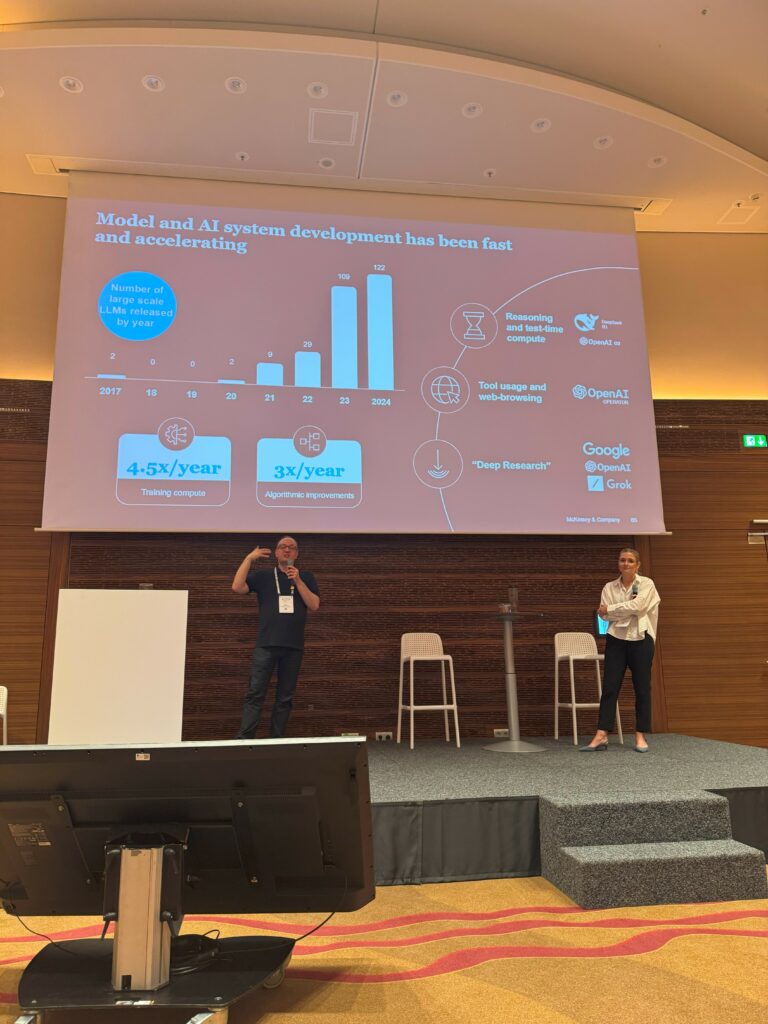
Cholewinski showed the growing number of LLM releases. In 2024, 122 new models entered the market. This was up from the 109 LLMs launched in 2023 and a significant increase from 29 releases in 2022.

From left to right: Peter Cholewinski, McKinsey & Company partner. Dr Lisa Schrewentigges, McKinsey & Company project manager

‘In 2025, you have many models out there, and those models are becoming smarter. We are now not talking about large language models, but about reasoning models. Additional tools are also coming out, like deep research. The machine can go on its own onto the internet and figure a lot of information out by itself,’ Cholewinski explained.

Agentic AI can capture value

While generative AI LLMs depend on users’ prompts and requests, agentic AI LLM models are designed to autonomously make decisions and act, with the ability to pursue complex goals with limited supervision, IBM wrote. This combines the flexibility of LLMs with the accuracy of traditional programming.

‘This year, everybody is talking about agentic AI. When you take those models with reasoning capabilities, they can plan and think about what they need to do to achieve a goal. You can also have several of them working together, exchanging basic information, reviewing each other, and trying to solve a problem on their own.

‘So, it is not only about one chatbot that you talk to, but end-to-end processes and how several agents can achieve something useful and valuable.

‘Agentic machines can tap into different workflow steps and coordinate across those workers. This means we have more automation possibilities across workflows. This is where most of the value will be captured, especially as they become smaller,’ commented Cholewinski.

The first fully autonomous agentic LLM model, Manus, was released in March 2025, as written by Forbes.

AI transformation troubles

‘Everybody is trying it out, but only a very small number can say we invested something, and we actually captured something. This is because it is very difficult,’ said Cholewinski.

‘You need to have the technology, but you also need to have the right talent to understand how to use that technology and an operating model that will drive the change management to scale and adopt this technology,’ he added.

From left to right: Peter Cholewinski, McKinsey & Company partner. Dr Lisa Schrewentigges, McKinsey & Company project manager

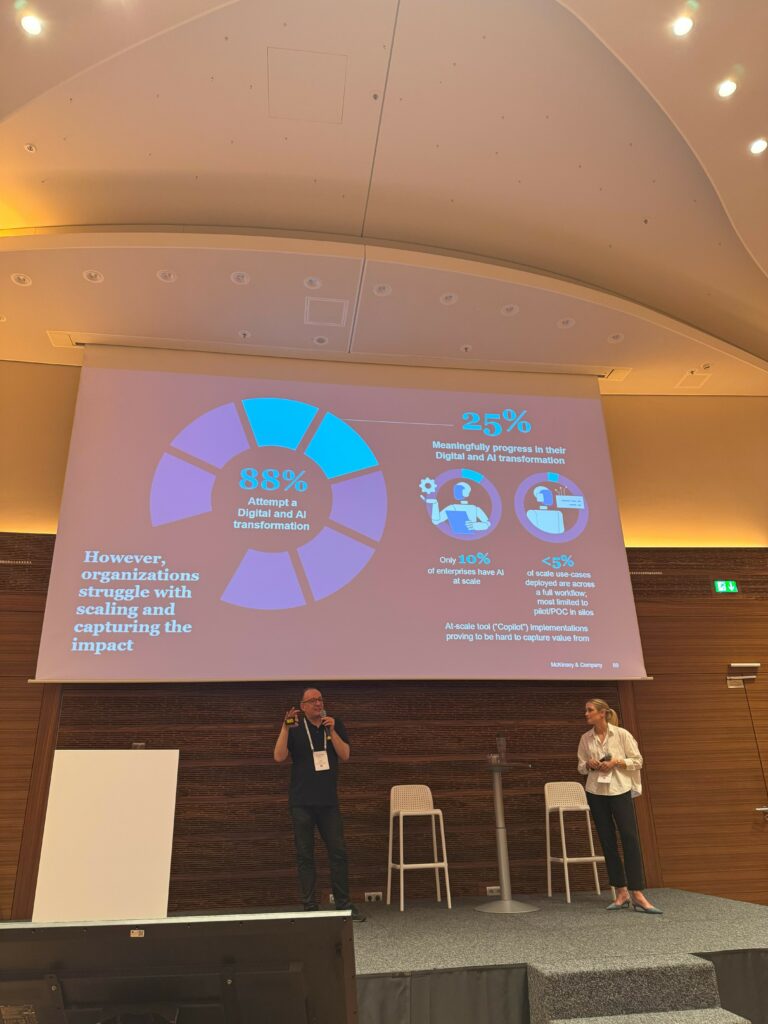
Cholewinski showed that 88% of companies attempt a digital and AI transformation. However, just 25% meaningfully progress in their digital and AI transformation. Furthermore, just 10% of enterprises have AI at scale, and under 5% of scale use-cases deployed are active across full workflows.

‘In the cases where we are seeing value being captured, they are thinking about several use cases together and in an agentic fashion,’ he highlighted.

AI assists dealership leads

So, what real-world use cases are already being implemented in the automotive retail sector, and what impact is this having?

One example is a generative AI-based tool that can tailor and personalise messages for customers and online leads. The unnamed product was built for one of the largest German dealer groups. This means covering 200 different dealerships and a database of over 500,000 existing customers from vehicle sales.

From left to right: Peter Cholewinski, McKinsey & Company partner. Dr Lisa Schrewentigges, McKinsey & Company project manager

‘What they struggled with is looking into the lead management and how to have a very structured approach in contacting existing customers in a very fast way, which is also very tailored,’ explained McKinsey & Company project manager Dr Lisa Schrewentigges.

In her presentation, she showed that the dealer group previously spent around five to 10 minutes on every customer outreach. They also struggled with how to respond to incoming website leads and how to personalise this interaction.

Fast development times

‘What we have done together with them is, within six weeks, develop a generative AI tool, which allowed them to identify the most promising leads. Secondly, tailor the messages towards those leads and be fast in answering those leads,’ she outlined.

‘With generative AI and agentic AI, you can implement those kinds of solutions very fast because you do not need to train the AI anymore. These models are so powerful that you can actually use them off the shelf,’ noted Cholewinski.

‘This is also where the potential lies. You can think about your end-to-end processes, where there is a lot of manual work that you could improve. Then, think about the several use cases that make sense to improve productivity or sales with this technology,’ he added.

The sales agent journey

Schrewentigges walked through the typical sales agent journey. This starts with selecting a customer and thinking about which promotion to send. Then, interacting with the customer, and in the end, moving this customer towards a decision.

‘Where we helped here was bringing together the customer information that they already have on the system, matching it with third-party data and different website data,’ she said.

From left to right: Peter Cholewinski, McKinsey & Company partner. Dr Lisa Schrewentigges, McKinsey & Company project manager

‘Then you have a full, enriched customer profile, identifying the most promising leads and personalising communications with a specific customer, which helps the sales agent convert them to a sale,’ Schrewentigges said.

A dashboard then enables the sales agent to see a full customer overview. It can prioritise the customer based on a lead score and suggest specific email campaigns. The dashboard also displays different customer groups, such as existing customers, website leads, and follow-ups.

She then showed the typical outcome of this personalised messaging. Various data points can be used by the generative AI to create an individualised email to the customer.

‘They were able to not only send out emails, but also very personalised phone calls based on the information that we put together. This, in the end, led to much faster reply times from website leads, because we had a very standardised approach in answering typical emails, but also it led to much more personalised communication,’ Schrewentigges said.

An instant impact?

‘We had a lot of impact regarding the speed of answers, personalised communication, but also in the end, this will ultimately sell cars much faster,’ she stated.

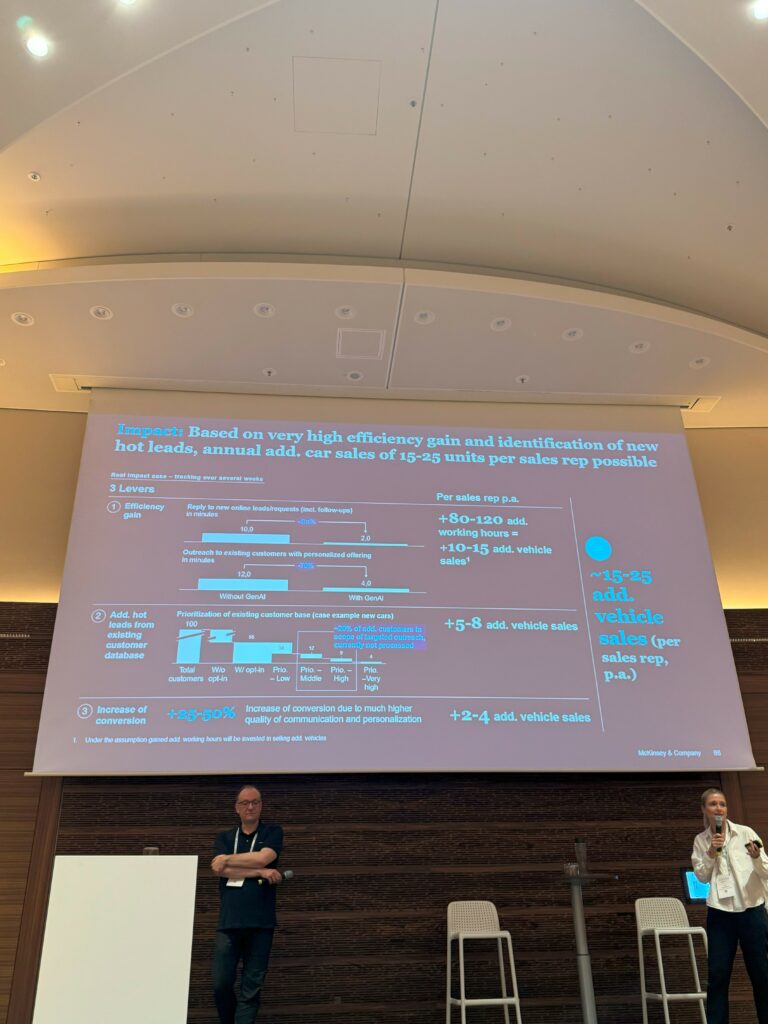
The dealer group recorded an increase of more than 20% in conversion rates. Each sales representative recorded an additional 15 to 25 vehicle sales annually on average.

This was made possible through a 70% to 80% efficiency gain, which meant more time to sell cars. Furthermore, 10 to 15 times more customers were approached with relevant sales campaigns. However, there were still significant challenges and concerns for the tool to overcome.

From left to right: Peter Cholewinski, McKinsey & Company partner. Dr Lisa Schrewentigges, McKinsey & Company project manager

‘You always need to drive a balance between not using too much information because once you go into too many details that the AI might know, it becomes very creepy,’ commented Cholewinski.

Additionally, as AI becomes more powerful, could this put jobs in dealerships at risk in the future?

‘Even though generative AI solutions will help with emails, there will always be a personalised component in contacting the dealership, having a phone call, and visiting the car,’ said Schrewentigges.

 ‘I think it will, in a certain part, probably affect how vehicles will be sold, but we always need this component. People come to the dealership and want to see and feel a vehicle,’ she explained.

Virtual assistants for retailers

Elsewhere, Novaco AI provides virtual assistants that can be used on automotive retailer websites. By connecting to their data, the assistants are designed to improve dealership efficiency, automate conversations, and optimise customer interactions.

‘It is connected to inventory, virtual planning, digital work orders, but also your lead management system,’ outlined Novaco AI CEO Maarten Bekkers.

The assistant started with Google AI in 2019. After LLMs were released, the tool began utilising them. It is now beginning to use agentic AI models and is bringing its assistant to WhatsApp.

The company also provides a virtual assistant for dealership employees to increase their efficiency and find information quickly. The AI companion is also connected to pricing information.

‘So, if somebody calls and asks, “what would it cost to replace my clutch for the car with that number plate?”, you just fill in the question to the companion and it will generate the answer within a few seconds. ‘It is a real virtual employee that works for you,’ said Bekkers.

From left to right: Johan Verbois, Co-founder MA5 Used Vehicle Consulting group. Jan-Willem Seeder, CEO JP.cars. Maarten Bekkers, CEO Novaco AI. Nicolas Daive, chief of staff Lizy. Paweł Samczyk, COO Exacto Holding Automotive

The assistants can also help dealerships with common queries, freeing up time for employees.

‘Complaint number one at dealerships is that the phone keeps on ringing with the same questions every day. The majority of people who book a service call the dealer. It is the most expensive resource of the dealer is actually booking the service, it is crazy,’ he commented.

‘So, you should turn it around. If people really want to call, they can still call. But in the near future, a virtual assistant will be on the phone, having the same conversation as a human and making a booking,’ Bekkers added.

AI’s organisational prowess

‘AI has been instrumental for our success,’ said Lizy’s chief of staff, Nicolas Daive, as he began his presentation. The company is an online B2B car leasing platform offering used vehicles to companies.

‘Used cars are more operationally complex and messy than new cars. Despite that, because you have lower asset value, lower leasing prices and longer holding periods, you can be extremely efficient. With AI, we were able to transform this messy product into a very simple operation,’ highlighted Daive.

 ‘To make sure we have the best possible offering, we source vehicles all over Europe, across more than 100 suppliers. This means that we have more than 100 data formats, data types, processes, and ways of working.

‘In the past, working with this number of suppliers would have meant you needed four or five full-time employees due to the complexity it brings. With AI, we were able to do this with half a full-time employee,’ he commented.

Daive explained the process of buying cars from a supplier, with a PDF containing data. An employee then forwards the PDF to their AI agent with a few instructions. This includes scheduling a pickup time for the vehicles and pre-pricing them.

‘All that is done from the click of a button. In the past, we probably would have had a full-time employee that is doing a lot of copy and pasting, getting the right data into the right fields, and talking to a lot of departments,’ he noted.

‘Automation is nothing new. Commission is something we have been doing for almost four decades. What is new is that AI allows us to automate chaos. It can take unstructured data, structure it, then send it to the right places,’ concluded Daive.

Driven by a desire for efficiency and safety, more cars on sale today feature advanced driver-assistance systems (ADAS). But what does this term mean? Autovista24 special content editor Phil Curry explores the technology.

When it comes to today’s automotive market, safety and efficiency are paramount. Vehicle manufacturers are incorporating a range of systems designed to make driving easier, more comfortable, and safer. These systems come under the umbrella term, ADAS.

Some of these systems are designed to improve the driving experience. Others have been included due to regulations, such as the EU’s General Safety Regulation. There is also an increasing demand from drivers who want technology to help them on their everyday journeys.

ADAS is rapidly becoming widespread in the automotive market. According to ADAS developer Valeo, this technology will feature in 90% of all vehicles sold worldwide by 2030.

There are many systems that help to keep drivers and other road users safe. These can be split roughly into three areas: safety, parking, and driving.

ADAS keeps you safe

Systems that work within the safety category help to improve a driver’s ability to react to hazards on the road. They also work to keep other road users and pedestrians safe.

This is achieved through advanced detection sensors and early warnings. These combine to alert drivers, either through lights or audible warnings, indicating that action needs to be taken.

For example, intelligent speed assistance detects a road’s speed limit. Should a vehicle go too fast, an alert will sound, indicating the driver should reduce the speed. Driver drowsiness detection utilises a sensor behind the steering wheel to scan a driver’s eyeline. An alert sounds should this deviate away from the road. If this continues, the vehicle can suggest pulling over for a rest.

Safety systems can also take control in extreme circumstances. Anti-lock braking will reduce pressure on wheels, avoiding skidding. Meanwhile, collision avoidance systems will automatically apply the brakes, potentially preventing a collision.

Parking developments

Parking ADAS provides convenience and safety. Originally, this technology relied on parking sensors fitted into a vehicle bumper. However, modern cars feature an array of cameras around the vehicle, which provide a live feed to the infotainment screen.

Vehicle systems can also stitch these images together to provide a 360-degree birds-eye view of the car. This can help the driver avoid obstacles, as well as pedestrians, cyclists, or anything else in the vehicle’s path.

More autonomous technology also allows vehicles to park themselves, using park assist features. When activated, a car will scan for a space big enough, and then manoeuvre the vehicle into it. Some carmakers offer remote options. This allows parking to be completed while the driver is outside the car, accessing the service via an app.

Driving comfort

ADAS can help a driver feel more comfortable in the car, enabling a more efficient use of the vehicle. Driving ADAS can automate and adapt vehicle usage, with or without driver input.

One of the most well-known systems is adaptive cruise control. This helps control the speed of the vehicle, relative to the car in front. When a certain distance limit is reached, brakes are applied, and the gap is maintained. Other systems, such as lane-change assist, can help the vehicle switch lanes when the indicator is applied.

Sensing ahead

ADAS uses a series of cameras and sensors placed around a vehicle. The most common detection sensors include ultrasonic, radar cameras, and light detection and ranging (LiDAR). These feed information to the systems for processing, allowing the technology to assess the next best action.

Many sensors are located in the front of the vehicle. A camera is often placed behind a rear-view mirror and behind a smooth panel in the grill. Additional cameras can be placed around the vehicle to aid parking, while more units can be placed in bumpers to provide more information.

This makes a car more complex, especially when it comes to repair and maintenance. Should a panel or windscreen need replacing, or a vehicle’s wheel alignment adjusting, a full ADAS calibration is often needed. This is essential to ensure systems function correctly with the right data being gathered.

As petrol and diesel registrations declined, did battery-electric vehicles (BEVs) and plug-in hybrids (PHEVs) spur Italian new-car market growth? Autovista24 web editor James Roberts looks at the figures from May.

May saw 139,484 new vehicles registered in Italy, according to the latest data from ANFIA. This marked a 0.1% decline compared with 2024 and a unit difference of just 189. Despite a month of growth in March, May continued a wider pattern of stagnation.

Across the first five months of the year the country saw 722,704 new cars delivered. This was a drop of 0.5% year-on-year, amounting to 3,751 fewer units.

rn

The Italian new-car market has proven fragile so far in 2025. Registrations remain below pre-pandemic levels, indicating an ongoing struggle with underlying vulnerabilities and external pressures. The market remained below 2024 heading into the second quarter.

In a market underpinned by significant structural shifts in powertrain preferences, diesel and petrol registrations continued their consistent contraction. This has acted as the primary drag on the overall market throughout the first quarter.

Conversely, the Italian market has witnessed strong BEV and PHEV growth. However, a relatively small market share is having little impact on overall registrations. Hybrids continued to emerge as the dominant powertrain as the year approaches the halfway point, driving combined electrified figures.

EV market not enough

Electric vehicles (EVs) claimed an 11.4% market share in Italy during May, up from 6.8% 12 months ago. However, registrations of new plug-ins amounted to 15,845, marking a 66.1% year-on-year increase.

This brought total EV registrations between January and May to 71,920 units, up 60.9% year on year. Despite the continued growth of EV registrations, the market share remained at just 10% in the year to date. This remains consistently below fellow major European new-car markets.

‘The European comparison sees Italy lagging far behind in the diffusion of electric vehicles, but positive signs are not lacking, and the growing availability of increasingly affordable models represents a possible turning point for the market,’ comments Motus-E president Fabio Pressi, emphasising the importance of activating the new bonuses for electric cars announced by the government very quickly.

The fortunes of EV sales in Italy expose the fragility of the Italian automotive landscape. Sales performance is sensitive to various factors, including incentive instability and low comparative base volumes from the previous year.

EV policy clarity urged

The influence of policy and incentives on EV uptake is a recurring theme across Europe, and Italy Is no outlier. In late December 2023, the Italian government announced the reintroduction of EV purchase incentives under the Ecobonus scheme. Regional incentives also complement national measures by offering additional financial support.

The Italian Ministry of Environment and Energy Security (MASE) recently announced new incentives for zero-emission vehicles. Key to this is the reallocation of approximately €600 million from the PNRR funds originally designated to EV charging infrastructure.

This initiative promotes the replacement of internal-combustion engine (ICE) vehicles with electric ones, targeting both private individuals and businesses. It will be seen whether this can help boost EV market share as the year progresses.

‘The announcement of new incentives for zero-emission vehicles provided by the MASE represents a positive and unexpected development for the market, which could give new momentum to the demand for BEVs, although subject to the conditions of scrapping old vehicles and belonging to two specific ISEE income brackets,’ stated Roberto Vavassori, president of ANFIA.

Digging deeper into the overall performance for May, BEV numbers totalled 7,118. With this 40.8% year-on-year increase, the powertrain’s market share rose by 1.5 percentage points (pp) compared with May 2024. This meant BEVs accounted for 5.1% of new-car registrations last month.

PHEVs enjoyed a delivery surge of 94.4% year-on-year, with 8,736 units registered. However, seemingly significant increases were tempered by a relatively limited 6.3% market share.

rn

Hybrid market moment

The hybrid markets, including both full and mild, solidified their position as undisputed market leaders.

This powertrain has consistently captured nearly half of all new registrations in Italy since the third quarter of 2021. This indicates a sustained and deeply rooted consumer preference, serving as the primary gateway for electrification.

In May, 60,619 hybrids were registered in Italy. This underlined an 8.7% year-on-year increase, with a sizeable 43.5% share of the market. In the year to date, hybrids claimed a 44.3% market share, with 320,513 vehicles hitting Italian roads.

The popularity of hybrids ensured that electrified vehicles claimed a market share of 54.8%. This was up 8pp on May 2024. Over the first five months of 2025, electrified registrations accounted for 54.3% of deliveries. With 392,433 units registered, this equated to a 20.2% increase compared with the first five months of 2024.

Fossil fuel fall continues

Meanwhile, petrol and diesel vehicles have experienced a sustained and significant decline, acting as a major impediment to overall growth. New-car registration figures for May starkly confirmed this. The month saw another ICE decline of 22.3% year-on-year with 50,578 units.

Splitting the two ICE variants, petrol endured a 19.5% year-on-year decline, plus a continued decline in market share to 25.9%. Diesel registrations have seen an even more severe and prolonged fall. It has consistently been the worst-performing powertrain, suffering serious registration drops.

In May, diesel deliveries slumped by 28.6% with 14,383 units registered and a share of 10.3%. This picture is similar in the year-to-date. The fuel type endured a 31.7% fall compared with 2024, and a market share fall of 4.6pp to 10.2%.

Despite the ongoing tailspin, between January and May 2025, ICE occupied a 36.8% market share. This remained 26.8 pp above plug-in registrations. This affirms some of the complexities facing the Italian new-car landscape. While the EV growth is gradually offsetting the decline in ICE sales, general volumes are not sufficient to drive overall growth.

How have rare earth restrictions impacted automotive manufacturing? What happened to European used car residual values (RVs) in May? What is the German government’s latest strategy for supporting carmakers? Autovista24 editor Tom Geggus breaks down the latest industry trends in The Automotive Update podcast.

In this week’s episode, a look at the wider implications of recent rare earth material restrictions. Also, a deep dive into the fortunes of the European used-car market and the impact on RVs. Plus, an exploration of Germany’s new-car market performance, and what new tax breaks could mean for companies’ electrification.

China’s rare earth element restrictions

China’s new export restrictions on seven rare earth elements are significantly impacting the global automotive sector. Controlling over 90% of the world’s processing capacity for these essential materials, Beijing now requires export licenses, Reuters reports. This stems from the ongoing trade dispute with the US. These events have sparked urgent diplomatic activity, according to Reuters.

Supplier production lines have suffered down due to these restrictions, Reuters states. Further impact is expected as inventories become further depleted. Components critical to both internal-combustion engine (ICE) and electric vehicles (EVs) are affected.

Ford temporarily halted production of the US-based Explorer SUV in Chicago, and Suzuki paused output due to component shortages. Meanwhile, BMW confirmed some supplier impact, and Mercedes-Benz is reportedly advising its suppliers to stockpile rare earths as a precaution.

Bosch and ZF both said bottlenecks were affecting its suppliers. Meanwhile, Autoliv has set up a task force to deal with the restrictions, but does not expect a halt to production in the coming weeks.

Used-car demand drops in Europe

Used-car demand fell sharply across major European markets in May, reversing gains seen in April and putting pressure on RVs.

Germany, Spain, France, Switzerland, Italy, and Austria all recorded month-on-month drops in dealership sales of two-to-four-year-old vehicles. Most markets also experienced significant year-on-year declines. The UK was the only major country to avoid a monthly fall in its sales volume index (SVI).

Year-on-year used-car demand in Spain saw the biggest drop according to the SVI, while Germany experienced a significant decline. These figures highlight growing pressure in the used-car market, with a weakening trend likely to continue, weighing on RVs.

German new-car market upswing

Germany’s new-car market showed a modest recovery in May, with registrations up 1.2% year-on-year. This marks the first upswing since October 2024. Amid positive private and commercial sales, battery-electric vehicles (BEVs) drove growth. This helped push the combined EV market to a 27.5% share in the year to date.

ICE vehicles continued to lose market share in May, with both petrol and diesel models experiencing further declines. In contrast, hybrid powertrains, made up of full and mild hybrids, performed strongly, recording their best month of the year so far.

To support further electrification, the German government has introduced new tax incentives, which have been welcomed by the country’s industry bodies. Despite this, there have been calls for broader reforms, including lower charging-related taxes, and the expansion of charging infrastructure.

The UK new-car market rebounded in May amid economic uncertainty and policy changes, making the long-term outlook far from clear. Autovista24 web editor James Roberts assesses the latest data.

In May, the UK new-car market recorded its second month of growth so far this year. The latest data from the SMMT revealed a 1.6% rise in registrations compared with the same month last year. This marks the strongest May since 2021, however, sales remained 18.3% below pre-COVID-19 levels. 

In total 150,070 vehicles were registered. Businesses and fleets powered the market’s growth, with deliveries up 14.4% and 3.7%, respectively. These sectors accounted for 62.6% of all new-car sales. In contrast, private buyer demand continued to weaken, falling for the second month in a row, down 2.3%.

rn

This promising May follows a disappointing April and a buoyant March, which was boosted by the ‘plate change’ effect. However, recent growth has been tempered by wider economic uncertainty and legislative changes.

Challenges for UK industry

In April, the UK government confirmed new hybrids can be sold until 2035. It also gave carmakers more flexibility around meeting the ZEV mandate targets. This gives manufacturers more leeway to avoid penalties amid economic pressure and global trade challenges.

However, the month also saw the introduction of vehicle excise duty (VED) on battery-electric vehicles (BEVs). Alongside this, the Expensive Car Supplement (ECS) was applied to electric models costing over £40,000 (€47,482). 

In late May, Autocar reported that the UK government was considering changes to the ECS. Proposed amendments look to raise the payment threshold, as many EVs have a price tag of over £40,000. This would help carmakers meet green targets by encouraging buyer adoption. 

Concerns continue

Despite this, concerns remain. Under pressure to hit strict targets, manufacturers have resorted to heavy discounting to shift electrified models.

‘A return to growth for new car registrations in May is welcome but manufacturer discounting on new products continues to underpin the market, notably for electric vehicles,’ commented SMMT chief executive Mike Hawes.

‘This cannot be sustained indefinitely as it undermines the ability of companies to invest in new product development, investments which are integral to the decarbonisation of all road transport,’ he added.

The government will deliver its spending review on 11 June, outlining how much funding will be allocated to public services. The review will also confirm how much will be invested into infrastructure projects and wider transport policy. It is expected that EV-related issues will be key.

‘The impact of pressures such as employers’ national insurance, the extension of vehicle excise duty and the Expensive Car Supplement to electric vehicles will be closely monitored moving forward as well as the uncertainty regarding the blocking or unblocking of US tariffs,’ stated Sue Robinson, chief executive of the NFDA.

‘Looking ahead, we are likely to see pressure on the new-vehicle market, due to weak economic growth. We expect electric vehicle sales to continue to increase, however, they still remain someway off the ZEV mandate targets for 2025. Over many years, franchised dealers have proven their resilience and this current period of economic turbulence is no different,’ she added.

BEV increases continue

BEV registrations grew 25.8% in May, with 32,738 new vehicles taking to the UK’s roads. This pushed the powertrain’s market share up by 4.2 percentage points (pp) to 21.8% in the month.

rn

Between January and May, the BEV market was up 33.4% year on year, hitting 177,487 registrations. However, a 20.9% market share highlights that the market is still below the ZEV mandate target of 28%.

The SMMT has continued to stress that halving VAT on new electric vehicles (EVs) could put 267,000 more EVs on the road over the next three years. This would apparently cut CO2 emissions by six million tonnes each year. The industry body is also calling for EVs to be removed from the ECS, as well as aligning VAT on public and home charging.

The availability of charging infrastructure continues to hinder EV uptake. Recently, the UK government announced plans to ease legislation surrounding the building of new charging points. Under proposed changes, drivers will no longer need to submit planning applications to install public or private chargers.

Hybrids prove popular in UK

Full hybrid (HEV) registrations continued to grow in May following the first decline of 2025 in April. Last month registrations of the powertrain grew by 6.8% to 20,351 units. This meant a 13.6% share, up from 12.9% a year ago.

However, it was plug-in hybrids (PHEVs) that really shone the brightest in May. Following a strong result in April, PHEV registrations increased by 50.8%, amounting to 17,898 units. This marked a market share of 11.9%, up 3.9p.

In the year to date, HEV registrations were up 13.2%, with 122,942 units. Meanwhile, PHEV uptake increased by 31.9%, reaching 85,657 deliveries. This meant full hybrids made up 14.4% of the market and plug-in hybrids 10.1%.

The popularity of BEVs and PHEVs boosted the overall electric vehicle (EV) market in May, as it grew by 33.6%. This equated to a 47.3% market share, up from 38.6% from May 2024. In the year to date, EVs captured 30.9% of new-car volumes, up from 23.9%. This was thanks to a 32.9% improvement in registrations, with 263,144 models handed over to customers.

Combining HEV registrations, the UK’s electrified market grew by 24.6% to 70,987 units. These models made up 47.3% of all new-car deliveries. In the year to date, registrations of these models soared by 25.9%, accounting for 45.4% of the market.

This underlines how electrified vehicles have become the primary driver of growth in the market. However, the powertrain grouping has yet to achieve an overall market majority. This highlights the gap that carmakers and policymakers need to work together to bridge.

ICE resilient despite decline

Petrol remained the dominant powertrain technology, albeit with deliveries falling by 12.5%. In total, 71,291 petrol-powered vehicles joined the UK’s roads in May.

The fuel type held a 47.5% market share, down 7.7pp compared to a 55.2% market share in May 2024. Looking at the first five months of 2025, petrol maintained a 49% market share, however, this was down 7.2pp year on year.

Diesel continued its declining trend in May. With a 5.2% market share in May, the fuel type dropped from 6.2% 12 months ago, recording just 7,792 unit registrations. Between January and May 2025, diesel saw the biggest drop of all powertrains in the UK. A total of 48,006 deliveries amounted to a 13.5% drop for the fuel type. Diesel-powered models made up 5.6% of overall volumes in this period, down from 6.7%.

In May, petrol and diesel models accounted for 52.7% of the market with 79,038 units registered. This was equated to a year-on-year drop of 12.8%. The ICE market share was just 5.4pp ahead of the electrified powertrains. This gap has shrunk from the previous month’s deficit of 8.2pp.

As the year approaches the halfway point, combined diesel and petrol registrations made up 54.6% of the market. Across the first five months of 2024, the share was 63%. How long will it be before ICE-powered registrations slip below a 50% share and electrified powertrains take over?

New-car registrations in France took a dive last month, with nearly every powertrain seeing declines, except for hybrids. Autovista24 editor Tom Geggus breaks down the numbers behind the downturn.

With 123,918 units delivered in May, the French new-car market fell by 12.3% year on year. This is according to Autovista24’s latest calculations based on data published by automotive industry body the PFA.

Despite having the same number of working days as May 2024, registrations dropped by 17,378 units, extending the market’s ongoing downward trend. According to AAA Data, the primary reason for this sharp drop was the private channel.

However, fleet registration also fell by 18% as carmakers turned to tactical sales channels to support volumes. This includes methods such as dealer self-registrations, short-term fleet rentals and demonstration vehicles.

Deliveries have fallen every month of the year so far. Registrations were down by 6.2% in January, 0.7% in February, 14.5% in March, and 5.6% in April.

rn

These consecutive months of decline led to an 8.2% drop in year-to-date registrations. Between January and May, 672,700 new cars were delivered. This means 60,477 fewer units hit the road compared to the same period last year.

Multiple market influences

‘Almost all indicators are in the red for the month of May,’ detailed Marie-Laure Nivot, head of automotive market analysis at AAA DATA.

‘We do not expect a recovery in the registration trend in the coming months. Changes in public policy have made buyers cautious, and opportunists are waiting for the electric leasing announced for September.’

AAA Data highlighted that private buyers are turning away from electric cars, with registrations in this channel dropping by 58%. Meanwhile, fleet purchases of battery-electric vehicles (BEVs) increased by 19%. However, this still proved insufficient.

In an upcoming study, AAA Data will reveal how manufacturers’ offerings are still dominated by petrol. The fuel type accounted for 221 models and 635 different versions last year, far exceeding the number of electric vehicle (EV) options.

This reflects the transitional balance between industrial dynamics and broader decarbonisation goals. It also reveals how product offerings shape the market’s performance.

AAA Data outlined that with slower registrations, manufacturers are favouring strategies to preserve profitability and competitiveness. This is boosting higher value-added segments, such as SUVs, while slowing the disappearance of internal-combustion engines (ICE).

Additionally, changing environmental regulations are increasing uncertainty for carmakers and consumers, in turn hindering electrification. Across the EU, carmakers can now average out fleet emissions between 2025 and 2027 to meet targets.

In May, the French National Assembly also voted to abolish low-emission zones which block older vehicles from urban centres. However, this change still needs to be confirmed by the final adoption of the simplification law.

Hybrids cannot save market

Amid all these complications, the French new-car market saw a definitive winner in May. Hybrids, including full and mild versions, was the only powertrain category to see registrations increase in the month. The technology has recorded a perfect growth streak so far this year.

Recording 54,553 registrations, hybrid deliveries grew by 14.7% year on year. The powertrain grouping captured 44% of the market, up from its 33.7% share in May 2024.

In the year to date, the powertrain accounted for 44.9% of all registrations, jumping from 22.9%. Deliveries grew by 38.3% to 301,880 units.

rn

This success reflects the transitioning marketplace. Buyers are looking to move on from pure ICE models but are still uncertain about going fully electric. Offering quick refilling times and improved fuel economy, hybrids offer the best of both worlds. But with so many powertrains in decline, hybrids were unable to be able to save the market alone.

EV market troubles

BEV registrations fell by 18.8% year on year last month to 19,414 units. This means all-electric cars have seen deliveries decline in January, February, March and May this year. The powertrain’s share of the French new-car market dropped 1.2 percentage points (pp) to 15.7%.

However, in the first five months of the year, BEVs represented 17.8% of all new-car sales in France. This equated to an improvement of 0.2pp. As registrations dropped by 7.4% to 119,475 units in this period, this reflects a wider market decline.

Plug-in hybrids (PHEVs) saw deliveries fall by 19.8% to 8,180 units in May. The powertrain has yet to escape double-digit declines this year. This meant PHEVs made up 6.6% of the market, down 0.6pp. Across the year to date, the technology saw a delivery drop of 37.4%, taking a 5.6% share, down 2.5pp.

Combined, both powertrains saw registrations fall by 19.1% to 27,594 units. EVs made up 22.3% of all deliveries, down 1.9pp year on year.

Across the first five months of 2025, the EV share fell from 25.7% in the first five months of 2024 to 23.3% so far this year. Registrations dropped by 16.9% in this period, with 156,840 EVs hitting the French roads.

Combining the EV and hybrid results reflects an increasingly electrified market. Last month the category made up nearly two-thirds of all registrations. The 66.3% electrified share was up by 8.5pp from May 2024. Registrations increased by 0.6% to 82,147 units.

In the year to date, deliveries were up by 12.7%, with 458,720 electrified vehicles taking to the country’s roads. This equated to a 68.2% share, up from 55.5% at the same time last year.

ICE continues to melt

Last month the greatest decline was felt by ICE models. Diesel-powered cars saw the largest fall of any powertrain, down 39.3% to 6,925 units. Its market share reached 5.6% from 8.1% in May 2024.

In the year to date, the fuel type felt an even greater drop, down by 43.4% to 31,752 registrations. This is due to consistent declines of over 30% in every month so far in 2025. It claimed 4.7% of the market, down 3pp.

Petrol deliveries decreased by 30.2% to 30,217 units, with the technology making up 24.4% of the French new-car market. This was down from its 30.6% share recorded in May 2024.

In the year to date, the fuel type dropped by 34.3% to 157,100 deliveries. It has yet to manage a decline of less than 27% this year. This meant it held a 23.4% market share, down 9.2pp.

Combined, the two powertrains accounted for 30% of the French new-car market in France in May. Down 8.7pp. Deliveries slumped by 32.1% year on year to 37,142 units.

In the year to date, the decline was more pronounced, with registrations falling by 36.1% to 188,852 units. This meant ICE accounted for 28.1% of deliveries, down from 40.3% at the same point last year.

Which models and brands celebrated success in China’s booming electric vehicle (EV) market? What is the latest tariff update? Which carmakers have made model announcements? Autovista24 editor Tom Geggus breaks down the industry news in The Automotive Update podcast.

In this week’s episode, analysis of the expanding Chinese EV market. Also, a look at hurdles to tariffs on imports into the US. Plus, Alpine unveils its sport fastback, Skoda redraws the past, and Xiaomi announces its challenger to Tesla.

Subscribe to the Autovista24 podcast and listen to previous episodes on SpotifyApple and Amazon Music.

China’s EV market boom

China’s EV market surged in the first quarter of 2025. According to data from EV Volumes, nearly 2.63 million EVs, including battery-electric vehicles (BEVs) and plug-in hybrids (PHEVs) were registered from January to March. This marks a 43.2% year-on-year increase.

The Geely Geome Xingyuan topped the BEV sales charts, followed closely by the Wuling Mini. Tesla came in third with the Model Y some way back from the top two. In the PHEV stakes, BYD dominated with eight models placed inside the top 10.

In terms of brands, BYD commanded the EV market, with sales up 36.4% year on year. Geely jumped up to second, thanks to a strong BEV performance. Plus, Galaxy performed strongly in the PHEV market with the Starship 7. In total, Geely’s registrations increased 274.3% in the first quarter.

BYD discounts and Chinese used cars

BYD launched significant discounts on 22 of its models in China, as reported by the Financial Times. According to electrive, the carmaker cut prices by roughly 21% on vehicles like the Seagull EV and Qin Plus DM-I PHEV.

Meanwhile, China’s Ministry of Commerce summoned carmakers and industry groups to discuss increasing sales of ‘zero-mileage’ used cars, Reuters reported. These cars had been registered and given license plates, but were being sold as used, having never been driven.

Tariff turbulence

The US Court of International Trade ruled that US President Donald Trump had exceeded his authority by imposing certain tariffs. Notably, the ruling did not apply to the 25% tariff on vehicles, as well as those on steel and aluminium.

However, the decision was short-lived. Just one day later, a panel of judges from the US Court of Appeals for the Federal Circuit reinstated the tariffs while legal proceedings continue.

Amid this tariff uncertainty, Reuters reported ongoing talks between the US government and Volkswagen Group (VW). VW Group CEO Oliver Blume told a German newspaper that the carmaker is holding ‘fair’ and ‘constructive’ talks with the US government.

EV announcements

This week Alpine unveiled its new all-electric five-seater sport fastback the A390. It will be available from the fourth quarter, with pricing confirmed for two trim levels, the GT and GTS.

Skoda has presented an updated electrified take on its Favorit model. Meanwhile, Peugeot revealed the GTi variant of the e-208, as reported by Autocar.

Xiaomi announced its YU7 SUV will become available for purchase in July, Reuters reported. The BEV looks set to compete with the Tesla Model Y. 

Meanwhile, Carscoops has reported the Lynk & Co 08 has been launched in Europe. Xpeng unveiled its MONA M03 Max sedan in China, according to electrek.

Emission targets confirmed

On Tuesday this week, the European Council confirmed it has given final approval to CO2emission target amendments. These give vehicle makers more flexibility, allowing them to meet an average threshold across 2025, 2026 and 2027.

The council body confirmed in a release that: ‘The regulation will enter into force on the 20th day following its publication in the Official Journal.’