
• The total share of financially unhealthy consumers in the U.S. rose to 71% in May
  • 81% of consumers report changes to their day-to-day spending, including skipping meals and delaying healthcare appointments
  • 39% say they have more stress about their job security than they did six months ago

The financial health[1]  of consumers in the United States continues to deteriorate. And as inflation continues to climb to its highest level in three years, consumers are beginning to take drastic cost-cutting measures to deal with the high price of goods.

Overall, 81% of consumers say they’ve made changes to their day-to-day spending to address mounting costs. Those changes include limiting discretionary spending, such as dining out at restaurants, but consumers are also foregoing necessities, such as skipping meals or delaying or foregoing healthcare. The stress doesn’t end there. Consumers also have significant fears about job security. Beyond these economic pressures, many have also recently been victims of fraud, forcing consumers to navigate through a very difficult landscape.


Financial Health Dips

In May, the total share of financially unhealthy consumers, defined as those who are financially vulnerable, overextended or stressed, rose to 71%. That marks the highest number of financially unhealthy consumers since January and just 1 percentage point away from a 12-month low in overall financial health.

Affordability Concerns Intensify

Nearly half of consumers (48%) say monthly expenses feel less affordable than they did six months ago. That reflects a 4-percentage point drop from April, however that may be deceptive. Those that felt affordability was roughly the same rose 4 percentage points, hinting that consumers may simply just be getting acclimated to higher prices.

Most consumers continue to modify their spending habits, with 81% reporting changes to their day-to-day expenses in May. Most concerning is that some cuts are not coming from discretionary spending. In fact, 30% of consumers say they cut back on groceries or skipped meals in the last 30 days, while 19% have delayed paying a bill, and 16% skipped or delayed a medical visit.

Grocery and gas prices continue to place the greatest strain on consumers, by a wide margin. Overall, 42% say that the high cost of groceries is causing the most stress, with gas ranking a close second at 38%. Interestingly, 18% say that credit card or other debt payments are too high, which indicates a portion of consumers are taking on high-interest debt to address day-to-day expenses.

 Concerns about job security

It’s not just prices that have consumers concerned; they are also contending with worries about job security and rising instances of fraud. Overall, 18% of consumers report consistently high stress around job security, a level that is highest among vulnerable consumers and those under the age of 40. An additional 39% say they experience occasional or moderate stress about their job security. What’s more, 39% report higher stress around job security compared to six months ago.

 The Continued Threat of Fraud

If that wasn’t enough, financial scams remain widespread, with impersonation scams most common and younger consumers consistently more likely to report experiencing several types of fraud. The most common fraudulent interaction is someone claiming to be from a government agency or business (37%), followed by the offering of a specific type of investment of financial product (27%).

 When consumers experience fraud, some say they do not report it due to the feeling of shame for falling prey to a scam. Of those consumers that have had fraudulent interactions, 23% say they were so embarrassed that they did not report the incident to their bank or the police.

Quieting the Noise

In times of financial difficulty, the best advice is often for consumers to focus their attention on a singular goal at a time. Cut spending or pay down the highest interest card or downsize their housing. Unfortunately, right now, consumers are feeling pressure from all sides.

That’s where financial institutions can help. Consumers are looking for directions. When to take a loan, what budgeting tools work, how to craft a savings strategy, all in the face of obstacles that can seem overwhelming. They are also looking for guidance on how to identify and avoid fraud, as well as confidence that their money and accounts are protected.

By stepping in and being active partners in helping their customers focus their efforts on where they will make the most difference, while also providing education and protection against fraud, banks have an opportunity to help their customers simplify a complex landscape.


Find out More

This Banking and Payments Intelligence Report is based on responses from 4,000 consumers nationwide and was fielded in May 2026. It was authored by Jennifer White, managing director of financial services intelligence at JD Power. Please contact us at the numbers below to connect with Ms. White or to learn more about the underlying research.


Media Contacts
Brian Jaklitsch; East Coast; 631-584-2200; [email protected]

Joe LaMuraglia, JD Power; East Coast; 714-621-6224; [email protected]

[1] JD Power measures the financial health of any consumer as a metric combining their spending/savings ratio, creditworthiness, and safety net items like insurance coverage. Consumers are placed on a continuum from healthy to vulnerable.

  • More than half (52%) of Canadians are considered financially vulnerable or stressed
  • Canadians seek a mix of short-term guided solutions with long-range planning
  • Two in five Canadian (41%) AI users utilize it for financial advice and 73% act on it

TORONTO: 25 June 2026 — With slightly more than half (52%) of Canadians considered financially vulnerable or stressed,1 financial customers are expecting their banks and credit card issuers to provide financial advice and support that can help alleviate short-term financial pressure and guide longer-term financial decisions, according to the JD Power 2026 Canada Financial Health Support and Advice Satisfaction Study,SM released today. The study also finds that Canadians are turning to AI tools for personal financial advice, creating a more competitive environment for financial institutions as a trusted source of guidance.

According to the study, nearly two-thirds (64%) of Canadians used AI tools during the past year, with two in five (41%) leveraging AI to seek information about their personal finances. Among those who used AI for financial advice, 73% acted on it, a level like the rate at which customers act on advice from their bank. The topics customers are most interested in from their banks include a mix of long-term advice related to investment (32%) and retirement (27%), coupled with short-term financial advice on topics such as fee reduction (29%) and tips to improve one’s financial situation (24%).  The highest performing banks and credit card issuers consistently offer a variety of services, tools, and advice experiences while focusing on ensuring their customers recognize this support is available frequently. Security topics such as fraud prevention and identity protection are desirable but ranked lower among customers. 

“Getting customers’ attention has become increasingly challenging, and the market for financial advice and support is more competitive than ever,” said Jennifer White, managing director of financial services intelligence at JD Power. “Banks and card issuers are rising to the challenge, and satisfaction with advice is improving, but customers facing financial pressure know the type of guidance they want, and many are turning to AI and acting on the information it provides. The highest-performing organizations consistently offer a range of services, tools and advisory experiences, while ensuring customers are aware of the support available. With Canadians polarized between those who are financially healthy and those who are financially vulnerable, banks and card issuers have an opportunity to differentiate themselves by making advice and supportive services more visible, personal and tailored to each customer’s needs.”

Following are some key findings of the 2026 study:

  • Personal touch still matters: While customers are turning to AI and digital tools for financial advice, traditional channels remain highly relevant. Marketing communications remain the preferred way for bank customers to receive advice and guidance (51%), followed closely by direct representative channels including branch, specialty and contact centre representatives (47%), which continue to outpace digital channels (31%). Branch representatives (25%) and specialty representatives (22%) are preferred rather than telephone representatives (11%), highlighting the continued importance of accessible personal guidance.
  • Barriers to engagement: Three in five customers (61%) face engagement barriers for financial support from their bank or credit card issuer. The top three barriers bank customers cite are lack of awareness that support is available, low confidence in their own financial literacy and already having a trusted source of financial information. Credit card customers also ranked lack of awareness as the top barrier, along with having a trusted source for financial information followed by the support offered is too generic or not personalized. The results indicate a need for financial institutions to make the availability of financial supportive services more prominent, make it easier to use, and always personalized.   
  • High awareness, low adoption rates: Across the board, Canadian banks demonstrate year-over-year improvement in the frequency and variety of advice they offer and awareness of supportive services is as high as 4 in 5 customers which positively impacts customer satisfaction. Although today’s struggling bank customer tell JD Power they want support and awareness of services is high, only 15% are using tools to help them manage their spending and only 12% of customers are utilizing money management or financial health education services. Credit cardholders use tools for credit score monitoring the most, however, the rate of usage is still only 1 in 5.

Index Ranking

RBC ranks highest in customer satisfaction with retail banking advice for a sixth consecutive year, with a score of 589 (on a 1,000-point scale). CIBC (587) ranks second and Scotiabank (585) ranks third. 

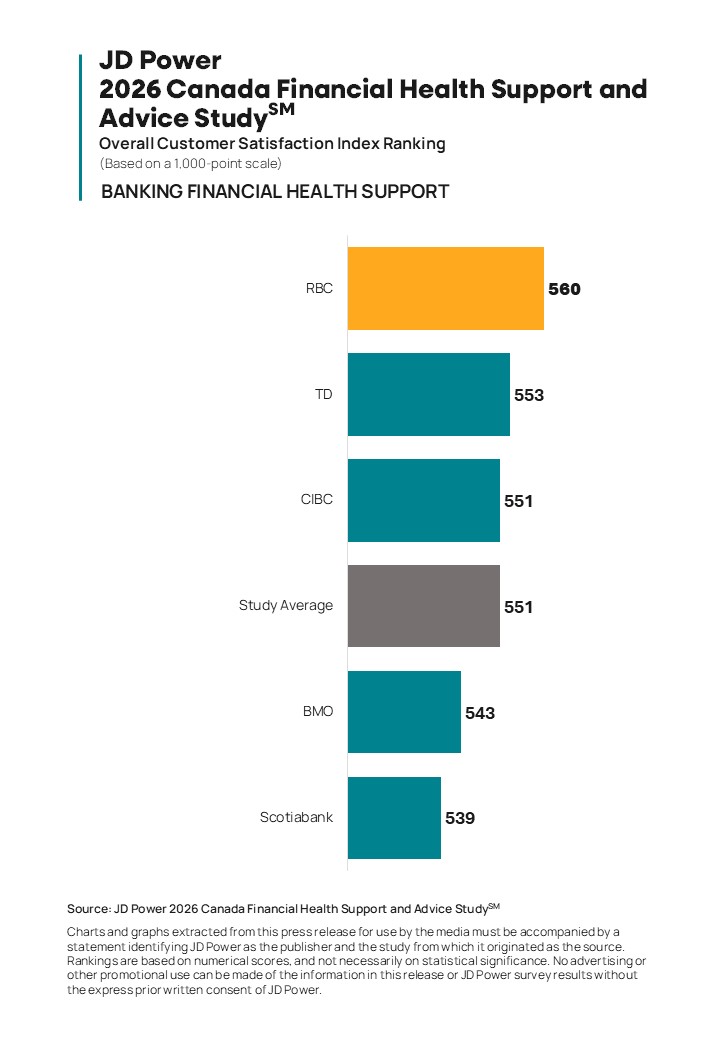
RBC also ranks highest in customer satisfaction with banking health support with a score of 560. TD (553) ranks second and CIBC (551) ranks third. 

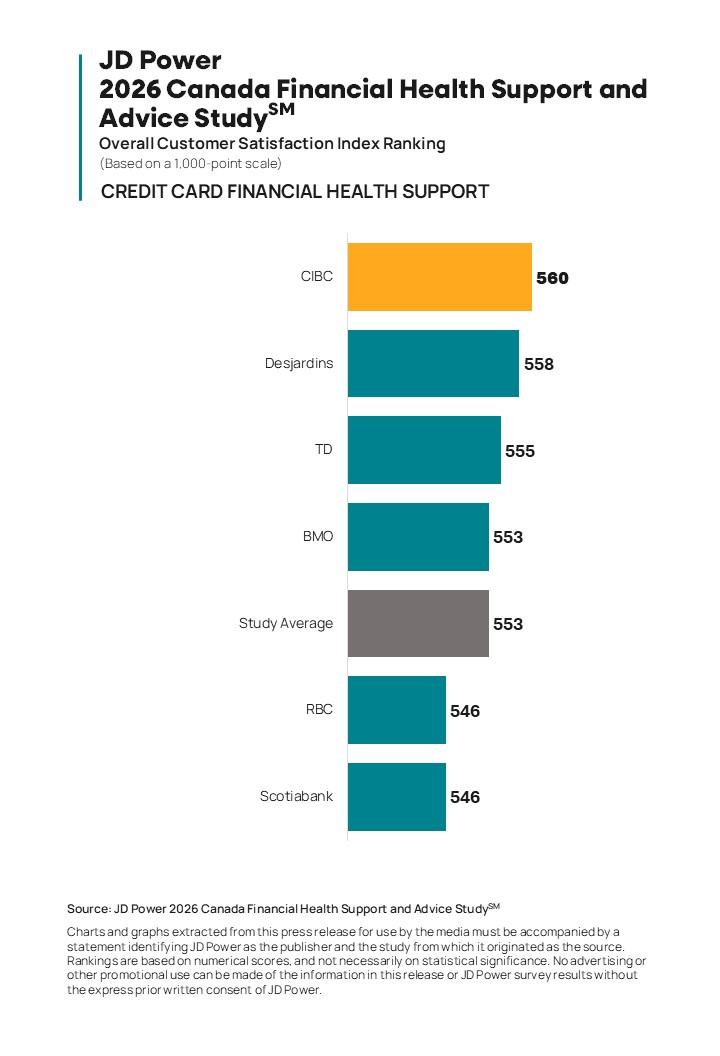
CIBC ranks highest in customer satisfaction with credit card health support with a score of 560. Desjardins (558) ranks second and TD (555) ranks third.

The Canada Financial Health Support and Advice Study measures customer satisfaction with banking and credit card health support and retail banking advice. The 2026 study banking and credit card support segments are based on responses from 5,833 and 5,593 customers, respectively, who have a primary banking or credit card relationship with a qualifying bank or issuer. Among the banking customers, 2,845 received advice or guidance in the past 12 months and are included in the retail banking advice segment. 

Banking health support satisfaction is evaluated in the following core dimensions (in order of importance): communicates financial health information; offers a variety of products and services; helps make better financial decisions; and helps meet savings goals. Credit card health support satisfaction is evaluated in the following core dimensions (in order of importance): helps meet credit/borrowing needs; helps improve credit score; helps make better financial decisions; and helps manage spending. Customer satisfaction with retail banking advice is based on performance in five core dimensions (in order of importance):  clarity; concern for needs; relevancy; quality; and frequency. The study was fielded from January 2026 through March 2026. 

To learn more about these studies, visit https://www.jdpower.com/business/financial-health-and-advice-satisfaction-study.

About JD Power

JD Power delivers mission-critical data, analytics and intelligence that help businesses improve customer experience and operational performance with confidence and clarity. Using proprietary, comprehensive data–including millions of consumer interactions and authoritative automotive datasets–combined with advanced analytics, artificial intelligence and deep industry expertise, JD Power enables leaders to respond to market shifts, make smarter decisions and drive measurable performance improvements.

As an objective source of deep insight into real-world customer interactions with brands and products, JD Power provides the independent intelligence organizations need to anticipate change, strengthen customer engagement and advance growth. Learn more at JDPower.com.

Media Relations Contacts

Joe LaMuraglia, JD Power; 714-621-6224; [email protected]
Gal Wilder, NATIONAL; 416-602-4092; [email protected]

About JD Power and Advertising/Promotional Rules: www.jdpower.com/business/about-us/press-release-info

1JD Power measures the financial health of any consumer as a metric combining their spending/savings ratio, credit worthiness and safety net items such as insurance coverage. Consumers are placed on a continuum from healthy to vulnerable.

Financially Stressed Canadians Expect Banks to Provide Guidance but Turn to AI for Advice, JD Power Finds
  • The total share of financially unhealthy consumers in the U.S. fell to 68%, a 4-percentage-point improvement from January
  • One-third of consumers say their financial situation will worsen in the next three months
  • The vast majority of consumers have changed spending habits, with many purchasing less expensive grocery items and even purchasing less food for their households


As holiday bills continue to be paid off and tax refunds get set to hit consumers’ bank accounts, the number of consumers in the U.S. classified as financially unhealthy[1] is 68%, as measured by JD Power. That marks an improvement from 72% last month, but it hardly spells widespread relief.

Overall, 50% of consumers are buying fewer items to stay within a budget, and 25% say they are using savings to survive today. While consumers try to stay resilient in trying times – 38% have found new ways to earn extra income, for example – the struggles they are experiencing are becoming hard to ignore.


Financial Health Improves Slightly

In February, the total share of financially unhealthy consumers, defined as vulnerable, overextended or stressed, fell to 68%. That reflects a 4-percentage-point improvement from January. 


Still, despite that improvement, fewer than half of consumers feel financially stable or secure. In fact, 32% say that they worry their financial situation will worsen over the next three months. Overall, 65% of consumers say the price of goods is increasing faster than their income in February, a slight decline from the rate of the past six months.


The Slow Burn of Higher Prices


Bubbling under the surface of these overall financial health readings is a very real need for a capital infusion. Overall, 50% of consumers say they have changed the amount of goods that they purchase to fit a tighter budget, and 25% say they are using money from their existing savings to pay for their current expenses.


Overall, 86% of consumers say they have changed their spending habits, and not just their discretionary spending. A staggering 42% say they have purchased less expensive food items, while 34% say they have turned down their thermostat in their home, and 33% say they have switched to less expensive food options. 


Consumers are trying to find ways to combat these changes to their budgets. When asked what actions they’ve taken in the last three months to make more money available to manage increasing costs, 38% of consumers say they have found new ways to earn extra income, while 27% have changed how much they contribute to savings, and 17% have lowered debt payments. 


Consumers under the age of 40 are particularly aggressive in altering their habits, potentially sacrificing their future to improve their present financial situation. These consumers are twice as likely to reduce investing (21% vs. 12%), reduce retirement contributions (17% vs. 9%) and refinance existing debt (15% vs. 7%) than those over the age of 40 (7%).


Tax Return to the Rescue?

Tax season is here, and while some consumers are concerned they may owe more this year, others are banking on refunds. Almost half (49%) of consumers say they have the same level of anxiety about tax season than they did last year, while 23% have more anxiety than normal, and 8% have less. Overall, 20% say they have no anxiety about tax season. All of these levels are largely in line with 2025. 


When asked about their expected tax outcome, most consumers are cautiously optimistic. Just 16% said they expect to pay more than last year, down from 22%, and 21% say they expect to pay the same as last year, down from 24%. Meanwhile, 16% say they expect a bigger return from last year, up from 11%, while 27% say they expect the same refund as last year. 


Resilience in the Face of Hardship

Even if consumers do get a favorable tax outcome, the underlying metrics around financial health should give everyone pause. Yes, consumers are exhibiting resilience in the face of financial difficulties, finding ways to creatively patch together a tighter budget, but some of the spending cuts being made by a wide swath of consumers aren’t necessarily sustainable. 

About one‑third of consumers — and nearly half of those under 40 — have sought help affording everyday living. When it comes to financial advice, consumers are as likely to consult internet or social media sources as they are to talk to a bank (both 25%) and are twice as likely to ask family or a friend (54%). This is where banks could make inroads into building better relationships and offering the kinds of financial advice and spend management tools to help consumers navigate the current economy.


Find out More

This Banking and Payments Intelligence Report is based on responses from 4,000 consumers nationwide and was fielded in February 2026. It was authored by Jennifer White, senior director of financial services intelligence at JD Power. Please contact us at the numbers below to connect with Ms. White or to learn more about the underlying research.


Media Contacts
Brian Jaklitsch; East Coast; 631-584-2200; [email protected]

Joe LaMuraglia, J.D. Power; East Coast; 714-621-6224; [email protected]

[1] JD Power measures the financial health of any consumer as a metric combining their spending/savings ratio, creditworthiness, and safety net items like insurance coverage. Consumers are placed on a continuum from healthy to vulnerable.
A marketer’s guide to leveraging regional customer satisfaction insights to strengthen trust, loyalty, and brand differentiation.

Banking Customer Insights driven by JD Power Research

In today’s crowded financial services landscape, customer experience has become one of the most powerful—and credible—marketing differentiators. With more than half of retail banking customers open to switching banks within the next year, marketers face a clear mandate: earn trust, prove performance, and communicate value in ways that resonate locally and emotionally.

For CMOs and agencies serving retail banks, this environment elevates the importance of unbiased, third‑party customer insights. Data‑driven performance signals not only inform smarter marketing strategies—they also provide the proof points that build confidence, credibility, and brand preference.

Unbiased customer insights help banks understand what matters most, allowing banks to craft more effective marketing strategies. Messaging should resonate with regional audiences while reinforcing the bank’s reputation as a trusted institution. By addressing the priorities of different customer segments, banks can fight attrition and strengthen their competitive position. 

Regional Variations in Customer Satisfaction 

A one-size-fits-all national approach can fall short in addressing local market differences—especially those around trust and reputation. JD Power research reveals that customers in the New England, Northwest, Upper Midwest and California regions have lower-than-average scores on critical-to-success metrics. These include overall satisfaction; level of trust; likelihood to say they definitely will reuse the bank; and reputation. This regional performance gap is driven in part by a divide among age groups. For example, Gen Z customers in California have a lack of confidence in regional and midsize banks and a preference for national banks. The opposite is true in the New England and Upper Midwest regions, where Gen Z customers display a lack of confidence in national and regional banks and a preference for midsize banks.

Banks on both sides of the size equation must proactively highlight their reputation for satisfying customers to win new business and retain existing accounts. 

Marketing Strategies Based on Data-Driven Regional Insights  

Effective regional marketing requires a nuanced and informed approach with strategically tailored messages that speak to regional customer preferences. 

Regional marketing campaigns help banks to meaningfully engage customers, reinforce a reputation for exceptional customer satisfaction, and build lasting relationships that inspire retention.  

Marketers can make the most of regional consumer data with messaging that meaningfully addresses the concerns of regional banking customers. 

Emphasizing Reputation and Security

A bank’s reputation remains a top reason why customers select a bank, while “security/fraud” is the main reason why customers replace a previous checking account with a new one. Marketers should highlight credible proof of performance, customer satisfaction, and the bank’s demonstrated strength in security and fraud prevention to reinforce and promote their bank’s positive reputation in regional markets. By pairing marketing efforts with both reputation management and clear communication of security and fraud‑prevention capabilities – grounded in real‑world customer experience data – banks can more effectively communicate their trustworthiness, their commitment to protecting customers, their ability to deliver a satisfying experience, and their overall brand value

Developing Regionally Tailored Campaigns 

Banking customers in different regions have distinct priorities and expectations when choosing and working with a financial institution. To connect with customers effectively, banks must create tailored campaigns that address regional concerns, demonstrate their commitment to local markets and highlight how they meet customer needs. 

Final Thoughts 

The banking landscape is changing rapidly. Staying competitive relies on leveraging every advantage. Credible third-party customer insights are more important to marketing efforts across the banking industry than ever before, especially for banks serving clients in a variety of regions and those competing with national players.

Customer insights from reliable sources are useful to banks looking to stand out in a competitive market and understand how they perform when compared with national and regional competitors. Data-driven rankings and recognitions also help consumers avoid exhaustive searches and piecemeal comparisons, saving time, and frustration, and giving a more accurate picture of available choices. 

The results of the JD Power 2026 U.S. Retail Banking Satisfaction Study are coming soon. Stay tuned for the results. 

In the meantime, explore insights from the JD Power 2025 U.S. Retail Banking Satisfaction Study. Read the 2025 press release >

[1] JD Power defines generational groups as Pre-Boomers (born before 1946); Boomers (1946-1964); Gen X (1965-1976); Gen Y (1977-1994); and Gen Z (1995-2006). Millennials (1982-1994) are a subset of Gen Y.

The following is based on data gathered through the JD Power Churn Data and Analytics 2025 fourth-quarter report. Review insights on this quarter’s results in the latest industry briefing: FinTech Brands Continue to Attract and Convert New Banking and Investment Accounts


Checking Savings

Who is Acquiring the Most New Accounts?

Chime captures the highest share of checking account openings and is most effective at turning considerations into new accounts. This mirrors results from Q3 2025.


Do Those Open Rates Hold True by Affluency? 

Chime maintains its leadership among the Mass Market, but Bank of America and Chase capture the highest percentage of new accounts among the Affluent and Mass Affluent.


SAVINGS ACCOUNT

Who is Acquiring the Most New Accounts? 

Chase outpaces Chime in new savings account openings, but Chime converts the most considerations into new accounts.


Do Those Open Rates Hold True by Affluency? 

Chime leads in savings account openings within the Mass Market, but Chase, Bank of America, Wells Fargo, and Capital One win the most Mass Affluent and Affluent new savings accounts.


INVESTMENT ACCOUNT

Who is Acquiring the Most New Accounts? 

Chime captures the highest share of checking account openings and is most effective at turning considerations into new accounts. This mirrors results from Q3 2025.

.


Do Those Open Rates Hold True by Affluency?

Chime leads in savings account openings within the Mass Market, but Chase, Bank of America, Wells Fargo, and Capital One win the most Mass Affluent and Affluent new savings accounts.


About JD Power Churn Data Analytics

JD Power U.S. Financial Services Churn Data & Analytics is a syndicated benchmarking study profiling the actions and experiences of customers opening new financial products/accounts in the U.S. The study includes the following consumer account types: checking, credit card, savings/money market, individual investment, HELOC/HELoan, personal loan, auto loan, and retirement. The key metrics in this study track the opening and closing (“churn”) of customer financial accounts among institutions. 

Contact our team to get the full results. 

Make sure you are on the list to get the latest report as soon as it is published. 

  • Chime sees highest new customer acquisition for checking accounts and conversion rates for checking and savings accounts
  • Fidelity leads on new investment account openings, SoFi leads on investment account conversion rate
  • Bank of America and Chase capture highest percentage of mass affluent and affluent banking customers


The “soft switching” phenomenon, whereby banking and investment services customers are opening secondary accounts and quietly making them their primary relationships, continues for a second consecutive quarter in the JD Power Financial Services Churn Data and Analytics report.

The report, which tracks customer attrition among the nation’s leading financial services providers, finds that FinTech brands, such as Chime and SoFi have become the biggest beneficiaries of this trend, attracting and converting new account openings faster than more established financial services brands. The trend is particularly noteworthy in the mass market banking segment, while traditional brands continue to lead on new account openings in the mass affluent and affluent banking segments[1].


Chime Leads on New Bank Account Openings and Conversions

Just under half of new checking (49%) and savings (46%) account openings in the fourth quarter of 2025 were for secondary accounts, opened by customers who already have an existing banking relationship, while 26% of checking and 18% of savings account openings were replacement accounts. Brand new banking relationships among customers who did not previously have a banking or checking account represented 25% of all checking and 36% of all savings account openings. This pattern of secondary account opening, which is consistent with Q3 2025, suggests that more banking customers are expanding and diversifying away from their primary deposit relationships.


Chime claimed the largest share of new checking account openings in Q4 with 12.8%. It was followed by Chase (8.4%) and Wells Fargo (7.1%). Among new savings account openings, Chase saw the largest overall market share at 9%. It was followed by Chime (8.4%) and Bank of America (6.3%).

One area where Chime has continued to show strength for a second consecutive quarter is its conversion rate—the percentage of time the checking account was opened with the bank after customers evaluated other brands. Overall, Chime has the highest conversion rate for customers who considered opening checking (78%) and savings accounts (85%). For both checking and savings accounts, Chime consistently outperformed both FinTechs and more established brands on new account conversion.


Bank of America and Chase Win More Affluent Banking Customers

When it comes to targeting higher income, and higher net worth, customers, the Big Four national banks are outperforming FinTech brands. Among checking account openings, Chime led on customer acquisition in the mass market segment, claiming 11.5% of new customers, while Chase led in the mass-affluent segment, with 10.9% of new customers, and Bank of America led in the affluent segment, with 14.1% of new customers in Q4. A similar trend played out in savings accounts, where Chime led mass market customer acquisition with 11.5% market share, and Chase led in both the mass affluent (9.7%) and affluent (11.5%) segments. 


Investment Account Openings, SoFi Converts More Customers

In the investment account category, Fidelity claimed the largest share of new account openings in Q4 with 16.8%. It was followed by Charles Schwab (9.1%) and Robinhood (8%). When it came to new account conversions, however, FinTech brand SoFi claimed the lead, capturing 83.1% of accounts that were opened after other brands were evaluated. SoFi was followed by Fidelity (80.2%) and Acorns (78.2%)


When segmenting customer acquisition by total investible assets, Fidelity maintained the top position among mass market (16.3%), mass affluent (17.7%) and affluent (16.4%) customers. It is followed by Robinhood (10.5%) in the mass market segment and Charles Schwab in the mass affluent (10.8%) and affluent (13.1%) segments.


A Mature Market Ripe for Disruption

The findings in this report are noteworthy because they spotlight a critical transition point in the decision-making process of financial services customers as they evaluate a steadily growing list of brands and options for how to manage their money. We are clearly seeing a trend toward more consumer interest and experimentation with relatively new FinTech brands, particularly in the mass market segment. The fact that many of these brands are succeeding at converting customers suggests that effective digital engagement will play a major role in the future development of the financial services industry. Incumbent brands need to monitor this trend closely and make sure they are continuing to connect with the right customers at the right time with the right approach.


Find out More

This Financial Services Intelligence Report is based on 263,151 responses collected as part of the JD Power Financial Services Churn Data and Analytics report between October and December 2025. It was authored by Jennifer White, senior director, financial services intelligence at JD Power. Please contact us at the numbers below to connect with the team or to learn more about the underlying research.


Media Contacts
 

Brian Jaklitsch; East Coast; 631-584-2200; [email protected]

Joe LaMuraglia, JD Power; East Coast; 714-621-6224; [email protected]
 

[1] JD Power defines wealth categories for banking as Mass Market (income <$150,000 and investable assets <$100,000); Mass Affluent (income of $150,000+ and investable assets <$250,000 or income <$150,000 and investable assets of $150,000+); and Affluent (income of $150,000+ and investable assets of $250,000+). Wealth categories for investment accounts are defined as Mass Market (<$250,000 in household investments); Mass Affluent ($250-<$1milion in household investments); and Affluent ($1 million+ in household investments).


View the 2025 Q4 Financial Services Churn Data and Analytics Report

The stubbornly high cost of consumer goods continues to be a drain on consumers in the United States. The number of consumers in the U.S. classified as financially unhealthy[1] has climbed to its highest level in 12 months, as measured by JD Power.

As their struggles continue, consumers are prioritizing their payments and coming up with strategies for what bills would go to the back of the line should that become a necessity. While consumers plan for the worst, there are provider programs and banking tools that may be able to help, but a knowledge gap exists, particularly among those that stand to benefit from assistance the most. 


Financial Health Shows Strain

Financial health has been on a steady decline since October. In January, the proportion of consumers who are financially vulnerable rose to 46%. That increase brings the total share of financially unhealthy consumers, defined as vulnerable, overextended or stressed, to 72%: its highest mark in 12 months. Holiday spending may have had an impact, and if so, we would expect to see a correction within the next month.


The persistently high price of consumer goods has become an accepted reality. Overall, 68% of consumers say the price of goods is increasing faster than their income in January, largely in line with the rate of the past six months. This could be an indication that prices have had a snowball effect, and consumers are finally reaching a tipping point. Vulnerable (74%) and stressed (79%) consumers have notably higher levels of concern regarding inflation. 


When Hardship Hits

With financial health slipping, some consumers are making difficult choices on what bills need to be paid in a timely manner. More than half (56%) say that if they could not pay their bills on time, they would skip or delay entertainment subscriptions or other memberships. That includes 62% of healthy consumers and 61% of those over the age of 40. Interestingly, 29% say that they would skip their internet or mobile phone bill, followed by a credit card payment (28%). 


In the event of financial hardship, consumers have options to contact their provider for a grace period, payment assistance or inclusion in a hardship program. But according to JD Power data, there is a gap in provider-contact knowledge. While 73% of consumers say they know how to contact their internet or mobile phone provider, just 42% say they know how to do the same for a personal or student loan provider. What’s more, knowledge on how to contact these providers is notably higher among healthy consumers and those over the age of 40 – the populations that are less likely to need help.


Can Banks Help Stave off Hardship

While consumers are certainly planning for a worst-case scenario, they should be working just as hard on a path forward. The price of goods doesn’t seem to be declining anytime soon, and many consumers could have to come up with strategies to stay afloat. 

One way banks may consider intervening is a huge engagement push around digital tools. More than one-third (37%) of consumers say they are willing to use digital banking tools, such as budgeting and spend management tool, more, including 61% of overextended consumers and 54% of consumers under the age of 40.  If banks can find a way to expand the reach of these tools, it could mitigate some of the financial risk exposure that consumers face. 


Find out More

This Banking and Payments Intelligence Report is based on responses from 4,000 consumers nationwide and was fielded in January 2026. It was authored by Jennifer White, senior director of banking and payments intelligence at JD Power. Please contact us at the numbers below to connect with Ms. White or to learn more about the underlying research.


Media Contacts
 

Brian Jaklitsch; East Coast; 631-584-2200; [email protected]

Joe LaMuraglia, J.D. Power; East Coast; 714-621-6224; [email protected]


[1] JD Power measures the financial health of any consumer as a metric combining their spending/savings ratio, creditworthiness, and safety net items like insurance coverage. Consumers are placed on a continuum from healthy to vulnerable.

Even in the best economic conditions, the holidays can create financial stress. But as consumers in the United States continue to feel the pinch of persistent inflation and high cost of consumer goods, a perfect storm of financial insecurity may be brewing.

According to JD Power, the number of consumers in the United States classified as financially healthy[1] fell to 30%. The drop represents a 13-month low, as consumers show growing concern about not only how they’ll afford their holiday shopping, but also how to manage the cost of household necessities. 

Monthly utility bills are a focal point. More than 1-in-5 (22%) consumers do not feel they are financially equipped to handle their current utility bill, and 78% are worried about the cost of their utilities in the next 12 months. 


Financial Health Tumbles 

The percentage of U.S. consumers categorized as financially healthy dropped to 30% in November, down 4 percentage points from October. This is the lowest rate of financially healthy consumers in over a year. The share of consumers who are either vulnerable, overextended or stressed increased to 70%.


The percentage of consumers who say the price of goods is rising faster than their income rose to 69% in November. Notably, the percentage of financially healthy consumers who say the price of goods is rising faster than their income is now 58%, up 3 percentage points from November. 


Festival of (Expensive) Lights

That financial pinch isn’t just from trying to pile presents under the tree. In fact, as the data has indicated for years, consumer financial health has long been stuck in a malaise, vacillating between varying degrees of financial stress. And, as we’ve seen consumers trim back on travel, holiday shopping and more, their worries are now shifting to something more basic: utilities. 

Overall, 22% of consumers say they do not feel financially equipped to handle their current utility bills. This rate was highest among vulnerable consumers (39%) and consumers under the age of 40 (26%). 


When asked about the next year of utility bills, consumer sentiment turned increasingly negative. A majority (78%) of consumers say they are worried about the cost of their utility bills increasing in the next 12 months, with 25% of those being extremely worried. Once again, vulnerable consumers pace the field, as 84% say they are concerned, followed by 82% of stressed consumers, and 78% of consumers over the age of 40. 


A Time for Resolutions

The jury is still out whether this latest dip in financial health is the culmination of four years of struggle, or simply another monthly ebb in consumer sentiment. But with the primary indicators tracking downward amid increased anxiety around routine household expenditures, there is certainly reason for some concern.

As we continue to monitor through next month – when many of these holiday bills come due – consumer financial health will need be front-and-center in the minds of banks and financial institutions, utilities, retailers and more.


Find out More

This Banking and Payments Intelligence Report is based on responses from 4,000 consumers nationwide and was fielded in November 2025. It was authored by Jennifer White, senior director of banking and payments intelligence at JD Power. Please use the contact information below to connect with Ms. White or to learn more about the underlying research.


Media Contacts
Brian Jaklitsch; East Coast; 631-584-2200; [email protected]

Joe LaMuraglia, JD Power; East Coast; 714-621-6224; [email protected]


 [1] JD Power measures the financial health of any consumer as a metric combining their spending/savings ratio, creditworthiness, and safety net items like insurance coverage. Consumers are placed on a continuum from healthy to vulnerable.

‘Tis the season for holiday shopping-themed economic indicators. Black Friday, Green Monday, and Cyber Tuesday are quickly approaching, and consumers in the United States are gearing up for their annual rite of retail passage. With that surge in consumer spending comes many insights into overall consumer financial health.

According to JD Power, the number of consumers in the United States classified as financially healthy[1] increased in October, but many—no matter their financial status—are staying financially disciplined when it comes to their holiday shopping. In fact, 45% of all consumers say they expect to spend about the same amount as last year. To finance these purchases, most consumers expect their credit use to stay consistent with last year. 

Financial Health Improves 

The percentage of U.S. consumers categorized as financially healthy rose to 35% in October, up 3 percentage points from September. The share of consumers who are either vulnerable, overextended or stressed, fell to 65%, down 3 percentage points from September. This is a return to the levels we observed throughout the summer months.


The percentage of consumers who say the price of goods is rising faster than their income dropped slightly in October to 67%. The percentage of consumers classified as vulnerable (76%) and healthy (55%) saw slight decreases, while the number of stressed (83%) consumers ticked up 2 percentage points. 


Consumers Exercise Spending and Credit Discipline

Consumers are playing it safe this holiday season, no matter their financial status. When asked about their plans to spend this holiday season, 45% of all consumers say they expect to spend about the same amount as last year (up slightly from 40% from 2024). Consumers classified as healthy (57%) and overextended (50%) are most likely to say the same, showing that the restraint extends across the financial health continuum. 

One-third (31%) of consumers said they will spend less than last year (compared to 30% in 2024), while just 14% said they plan to spend more than last year (down from 19% in 2024). Interestingly, overextended consumers are among those most likely to say they plan to increase their spending (20%).


When asked how they plan to pay for their holiday spending, 32% said a debit card, 25% said on a credit card they pay off in full each month, and 17% said cash. This implies that consumers do have cash on hand to cover their holiday gifts.


For consumers who are using credit to pay for their holiday purchases, 61% said their use of credit is about the same as last year (up from 54% in 2024), while 16% said they are using more credit, loans or Buy Now Pay Later options (down from 19% in 2024). Notably, 23% of consumers under the age of 40 say they will use more credit this year, compared to just 12% of those over the age of 40.

Inflation Still a Factor

Most consumers (88%) say inflation will play at least a slight role in what they buy or how much they spend this season. One-third (33%) of vulnerable consumers and 30% of consumers under 40 say inflation will greatly affect their holiday purchases, while 39% of overextended consumers say it will moderately affect their spending.


When asked if they took advantage of any bank services (such as special savings accounts or savings buckets) to help plan for this year’s holiday spending, 23% say they did. That includes 39% of overextended consumers, 34% of consumers under 40, and 30% of healthy consumers. While 38% say they did not because these services would not help, another 35% say they did not, but they wish they had.


A Holiday Helper

Inflation has been persistently stuck at around 3% for the better part of two years and the overall financial health of the country has been plodding along without much variation. As consumers prepare to rack up more retail spending, there is an appetite for banks to step in and lend a helping hand. Given how consumers intend to shop, at a minimum, banks have the opportunity to help them set budgets, track spending, and achieve their holiday spending goals

With more than one-third of consumers regretting the fact that they didn’t take advantage of bank services to plan ahead for their holiday shopping, this presents a clear strategic path for banks. Forward-thinking banks need to use the holidays as an opening point for discussion and communicate to consumers about how they can help navigate this period with sound advice, budgeting tools and proper planning. 


Find out More

This Banking and Payments Intelligence Report is based on responses from 4,000 consumers nationwide and was fielded in October 2025. It was authored by Jennifer White, senior director of banking and payments intelligence at JD Power. Please use the contact information below to connect with Ms. White or to learn more about the underlying research.

Media Contacts

Brian Jaklitsch; East Coast; 631-584-2200; [email protected]

Joe LaMuraglia, JD Power; East Coast; 714-621-6224; [email protected]
 

[1] JD Power measures the financial health of any consumer as a metric combining their spending/savings ratio, creditworthiness, and safety net items like insurance coverage. Consumers are placed on a continuum from healthy to vulnerable.

Churn is more than outright defection; it can also include silent attrition, where customers remain nominally active but reduce engagement, spending, or product adoption. 

High churn rates erode revenue, weaken loyalty, and limit growth potential. In highly competitive industries, such as financial services, insurance, and wireless service providers, churn reflects subtle shifts in customer behavior in shopping for rates, opening secondary accounts or moving business elsewhere. 

Accessing accurate churn analytics and benchmarking uncovers valuable insights to strengthen loyalty and improve performance. For example, “Insurers use LIST to understand which customer segments are defecting and to which insurers, on a regional basis, to inform targeted retention campaigns focused on retaining and winning back their most valuable customers, said Stephen Crewdson, managing director of insurance business intelligence at JD Power.

The same principle applies across industries: organizations that can accurately measure and interpret churn data are better positioned to strengthen loyalty, anticipate market shifts and improve overall performance.


How to Calculate Churn: 

Measuring churn starts with a simple calculation, but interpreting the results requires context. At its core, the customer churn rate shows the percentage of customers who stop doing business with a company over a given period.

The Churn Rate Formula is:

(Lost Customers / Total Customers at Start) * 100 = Churn Rate


Key Considerations When Measuring Churn:

  • Define the time frame: Monthly, quarterly, or annual churn rates based on typical customer lifecycle and usage patterns.  
  • Clarify what counts as churn: Determine if it includes silent attrition (reduced spending or dormant accounts) or only full customer loss?
  • Account for acquisitions: Some businesses calculate net churn by factoring in new customers gained.
  • Segment the data: Measuring churn by market, product, or demographic provides deeper insights than one topline figure.

Accurately measuring churn rate is the foundation for customer attrition analysis, benchmarking performance against peers, and building strategies to decrease churn over time.


How to Track Churn Effectively

  1. Capture the Entire Market
    • True churn measurement requires visibility into all customer movement across the industry.  A market-wide view provides the competitive intelligence needed to benchmark churn against peers, identify where you’re losing ground and to who, and pinpoint opportunities to win customers back.
  2. Access Timely Data
    • Churn is dynamic. Tracking in near real time ensures you see shifts in behavior as they happen, not months later, when it’s too late to act.
  3. Combine Quantitative & Qualitative Insights
    • Numbers reveal the “what” (who left, where they went, how many).
    • Customer feedback reveals the “why” (reasons for attrition, perceptions, and loyalty drivers).
    • Together, they provide a more addressable picture of churn dynamics.
  4. Tracking Churn across segments
  • Pinpoint where churn poses the greatest risk, prioritize retention resources accordingly, and develop targeted strategies to protect their most valuable relationships.
  • For example, losing a high customer lifetime value (CLV) customer in insurance has a bigger financial impact than losing a low CLV customer.

“Many brands measure their own churn rate but lack benchmarking data, so they don’t know if their rate is competitive or not, or if changes in their rate are due to a changing tide, said Miles Tullo, Managing Director, Financial Services Intelligence. JD Power provides benchmarking data so brands can compare their rates to specific competitors and the market average.”


Why Customer Churn and Attrition Matter

Customer churn goes beyond tracking who leaves. It is a direct indicator of revenue risk, competitive pressure, and shifting customer expectations.

Using churn data and analysis effectively improves business performance by:  

  • Protecting Revenue and Lifetime Value: 

    Tracking customer attrition rate quantifies the direct impact on recurring revenue and CLV. Even small reductions in churn translate into significant financial gains over time.

  • Safeguarding Brand Equity and Market Share

    High churn rates often signal declining brand perception. By analyzing why customers leave, leaders can address service gaps before they erode market share or damage reputation.

  • Exposing Competitive Weaknesses

    Customer churn analysis highlights where product features, pricing, or service models fall short against competitors. These insights help organizations close gaps and win back share.

  • Driving Segment-Level Growth

    Measuring churn by market, demographic, or even down to the zip code reveals patterns that enable precise, data-driven go-to-market (GTM) strategies and targeted retention campaigns.

  • Building Loyalty and Retention Programs

    Accurate churn data forms the foundation for proactive retention strategies, from personalized outreach to loyalty programs, ensuring customers remain engaged and profitable.


Getting Started

Understanding and addressing churn requires more than internal data alone. JD Power draws on decades of experience, large-scale customer panels, and proven methodologies to provide a comprehensive, near real-time view of customer shopping and switching intent and behavior across the financial services and insurance industry. Become a subscriber to better track and understand how your organization compares to peers and identify patterns that may signal risk or opportunity for company growth. 

The number of consumers in the United States classified as financially unhealthy[1] increased to a four-month high in September, causing many to start seeking financial advice from an array of different sources—few of which are true financial professionals.

According to JD Power, 48% of consumers say they consult friends or family for financial advice or guidance. That’s a figure that dwarfs both the number of consumers who ask a financial advisor or planner (26%) or a bank or credit union representative (25%).

It’s not only friends and family that are getting a say in consumers finances. A surprisingly large number (21%) of consumers say they use social media for financial information, and 14% say they use artificial intelligence (AI) tools or chatbots. These numbers are even higher among consumers under the age of 40. 


Financial Health Slides 

Overall consumer financial health levels slid in September. The share of consumers who are either vulnerable, overextended or stressed, rose to 68%, up 4 percentage points from July. This marks the highest share of financially unhealthy consumers since May.


The percentage of consumers who say the price of goods is rising faster than their income held steady in September at 68%. Vulnerable (77%) and overextended (53%) consumers saw slight decreases. 


Consumers Turn to New Sources of Financial Intel

When it comes to seeking financial advice, friends or family are the most frequently cited source of financial information by a wide margin with 48% of consumers saying they typically seek financial advice from this group. That’s nearly double the proportion of those who seek advice from a financial advisor or planner (26%) or a bank or credit union representative (25%). One-in-five (21%) consumers say they seek advice from social media, and 14% say they consult artificial intelligence (AI) tools or chatbots.


When consumers under 40 were asked where they derive their financial advice from, the findings were even more striking. Over half (55%) of consumers under 40 said they ask friends or family, and just 21% say they ask a financial advisor or planner. Consumers under 40 seek advice from a bank or credit union representative at roughly the same rate (26%) as those over 40 (25%), but social media and AI is where we observe a pronounced shift. One-third (34%) of consumers under 40 go to social media for financial advice compared to 12% of consumers over 40. Meanwhile, 21% of consumers under 40 use AI for financial advice, while just 10% of those over 40 do the same.


A Paradigm Shift 

As consumers continue to grapple with their financial health, it’s clear that there is an emerging profile of customer within the younger demographic that banks need to understand and cater to. These younger consumers are open to taking financial advice from non-traditional sources, which could potentially weaken the connection between banks and their customers. At the same time, this shift presents a clear opportunity for banks to evolve and engage with these consumers in new and meaningful ways. Not only do banks need to earn trust within their existing clientele, they need to tailor a strategy to reach this new breed of consumer. By creating AI modeling tools or developing digital outreach strategies, banks can meet customers where they are seeking advice. Banks that can re-frame themselves in the eyes of consumers as a trusted source of great financial information, whether that’s from financial advisors, bank employees, or AI models, stand to gain significantly in both relevance and customer loyalty.


Find out More

This Banking and Payments Intelligence Report is based on responses from 4,000 consumers nationwide and was fielded in September 2025. It was authored by Jennifer White, senior director of banking and payments intelligence at JD Power. Please contact us at the numbers below to connect with Ms. White or to learn more about the underlying research.


Media Contacts

Brian Jaklitsch; East Coast; 631-584-2200; [email protected]

Joe LaMuraglia, JD Power; East Coast; 714-621-6224; [email protected]


(1)  JD Power measures the financial health of any consumer as a metric combining their spending/savings ratio, creditworthiness, and safety net items like insurance coverage. Consumers are placed on a continuum from healthy to vulnerable.
 

In the latest episode of the JD Power Financial Services Intelligence Update, Mike Foy, managing director of Wealth Intelligence, and Jon Sundberg, director of Digital Solutions, joined Miles Tullo, managing director of Financial Services, to discuss insights from the 2025 U.S. Retirement Plan Digital Satisfaction Study.

The conversation revealed what separates top-performing digital retirement platforms from those falling behind and what plan providers can do to improve participant engagement, trust and satisfaction.


The 103-Point Experience Gap

According to the 2025 U.S. Retirement Plan Digital Satisfaction Study, there’s a 103-point difference between the best and worst digital experiences in the industry. Top-performing firms excel across every aspect of design, performance, tools, and content, but two factors stand out:

  • Interactive Tools That Drive Engagement: Tools that help users visualize progress and take action on savings goals keep participants engaged, especially after “set it and forget it” enrollment processes.
  • Mobile Experience That Feels Seamless: “We’ve seen firms like Bank of America really invest in unifying their mobile experience,” Foy said. “Features like the virtual assistant Erica and the Life Plan tool make it easier for customers to engage across multiple financial needs.”


Security: A Must-Have for Trust and Satisfaction

Security has become a major driver of satisfaction. The study found that when participants perceive security as “very effective,” overall satisfaction jumps by 52 points.

Leading firms are now designing security into the user experience, not around it. “We know security is vital. This is your customer’s information, their digital DNA,” Sundberg said. “They want to feel confident that their data is being protected, and design plays a big role in that perception.”

Key design elements can help build trust and improve satisfaction:

  • Clean, professional login pages with recognizable options like “Remember Me.”
  • Multi-factor authentication (MFA), now widely expected and even appreciated by users.
  • Small touches such as padlock icons and clear, jargon-free messages that reassure users their data is safe.

Even younger users, who once resisted MFA, now welcome it, especially when it is combined with biometric authentication for faster and more seamless access.


The Missed Opportunity: Proactive Guidance

Despite progress in design and security, 61% of plan participants say digital tools fall short on proactive guidance.  “Proactive guidance means delivering relevant, personalized and timely information that helps participants make smarter financial decisions,” Foy said.

He explained that retirement planning doesn’t happen in isolation. Participants, especially younger ones, are also managing:

  • Student loan debt
  • Credit card balances
  • Savings for major purchases like a first home

To help bridge the industry-wide gap in proactive guidance, many retirement plan providers are turning to artificial intelligence (AI) and predictive analytics to deliver more personalized digital experiences. “AI allows firms to use participant data to identify what messages and topics have resonated with others who share similar profiles,” Foy said. “It’s a huge differentiator in creating targeted, relevant content.”

Learn more about what makes a great retirement plan digital experience. 

The JD Power 2025 U.S. Retirement Plan Digital Satisfaction Study, now available in the press release linked below, measures how effectively retirement plan providers deliver digital experiences that build engagement, trust, and satisfaction across web and mobile platforms.

Stay informed on the latest research and insights by subscribing to the JD Power Monthly Intelligence Update.

Read the Press Release

View All Financial Services Intelligence Update Episodes.