
Insights

Tagged:
Clear filters
Industry
Topic
Segment
| Dealer

News

The Automotive Update: What does China’s slowing EV market mean for global sales?

What is happening in China’s electric vehicle (EV) market? How much is Uber investing in autonomous vehicle charging hubs? Can Europe build its own EV batteries? Tom Geggus, Autovista24 editor, discusses these points in The Automotive Update podcast. In this episode, Autovista24 analyses China’s slowing EV market and reveals the best-selling models in the country. Plus, how has Tesla avoided suspension of its dealer and manufacturer licence in the US? Subscribe to the Autovista24 podcast and listen to previous episodes on Spotify, Apple and Amazon Music. China’s slowing EV market Globally, China accounts for 59.1% of battery-electric vehicle (BEV) sales and 70.3% of plug-in hybrid (PHEV) deliveries. But despite dominating the figures, the country saw its total EV numbers struggle in December. Figures rose by just 0.5%, according to the latest data from EV Volumes. Despite total plug-in sales increasing between January and December last year, this was not helped by the country’s PHEV market. It experienced a run of monthly declines from July onwards. One reason for this poor performance was the decline of BYD. The brand accounted for 33.3% of total EV sales in China during 2025 and dominated the PHEV market. Yet its sales were down 9.9% across the year. However, with new players entering the PHEV market, 2026 will see more brand diversification. This could help boost figures, while new BYD models will also help impress buyers. BEV sales rose by just 4% in December 2025 following a run of double-digit improvements. China’s carmakers will be hoping this is not the start of a new trend, especially if the PHEV market continues to struggle. Tesla avoids suspension Tesla has avoided a 30-day suspension of its dealer and manufacturer license in California. This follows the brand halting its use of the term ‘Autopilot’ in its vehicle marketing in the state. The Department of Motor Vehicles adopted a decision that the use of the term is ‘misleading and violates state law’. This is linked to Tesla’s use of Autopilot to describe its advanced driver-assistance systems. Uber invests in autonomous charging Uber Technologies will invest more than $100 million (€84.9 million) into autonomous vehicle charging hubs, according to Reuters. The company will deploy DC fast charging stations at its fleet depots and other locations throughout priority cities. This is expected to begin in the Los Angeles Bay Area as well as Dallas, before hitting other hubs. Uber will also work with charge point operators to establish ‘utilisation guarantee agreements’. This will support the rollout of hundreds of new chargers in cities across the world. EV charging offer in the Netherlands Leasing provider, Ayvens, has launched a new EV charging offering. Ayvens Power promises customers in the Netherlands access to over one million charging points across Europe, spanning different operators. Drivers will get real-time availability and pricing details before arrival. Meanwhile, a fleet portal will provide charging insights, cost visibility and reporting tools. The solution is due to roll out in France, Germany, Italy, Belgium, and the UK later in 2026. Can Europe build EV batteries? Yann Vincent, CEO of the Automotive Cells Company (ACC), has questioned who will make batteries for Europe’s domestic carmakers. ‘One crucial question remains: who will manufacture the batteries for European cars?’ Vincent asked. ‘Asian players, particularly Chinese giants, as is already the case for 99% of them? At the risk of putting the strategic independence of European car manufacturers solely in the hands of BYD, CATL, LG, etc?’. The CEO also confirmed that the ramp-up of ACC’s gigafactory in Hauts-de-France is taking longer and costing more than expected. This is weakening the company’s financial position. He also stated the goal of building the factory was ‘too close to give up on.’
Dealer

News

Discussing design at the 2024 Paris Motor Show

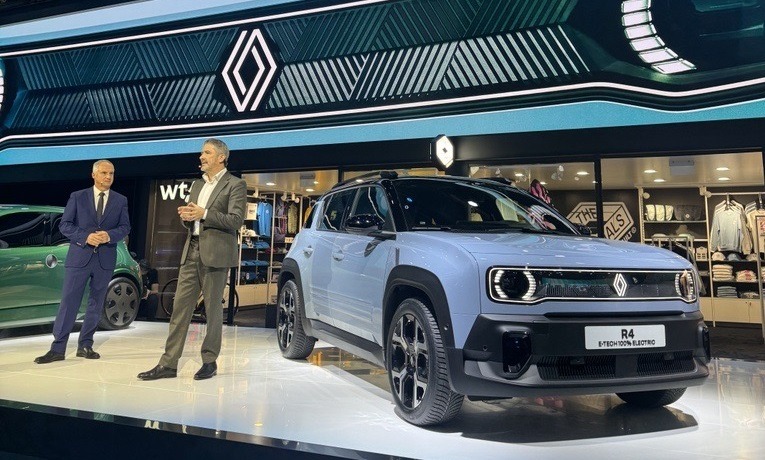
This year’s Paris Motor Show had plenty of world premieres and European debuts. But what did carmakers attending the event have to say? In the latest Autovista24 podcast, journalist Tom Hooker speaks with industry leaders about their design languages. The 90th anniversary of the Paris Motor Show attracted carmakers from across the globe. Speaking with Autovista24, industry experts gave exclusive insights into the design, technology and ambitions behind their newest vehicles. Subscribe to the Autovista24 podcast and listen to previous episodes on Spotify, Apple and Amazon Music. Show Notes Highlights from the 2024 Paris Motor Show What to look out for at the 2024 Paris Motor Show French brands fascinate One brand with a large presence at the event was Renault, as it revealed the new Renault 4. The highly anticipated B-segment battery-electric vehicle (BEV) takes strong design cues from its 1960s predecessor. The brand also unveiled the Renault Emblème, a concept car aiming to tackle carbon emissions throughout its lifecycle. The model features a dual-energy electric powertrain, combining a rechargeable battery for everyday use with a hydrogen fuel cell for longer journeys. Renault’s domestic rival, Citroën, had a large presence at the event too. The manufacturer premiered its C5 Aircross Concept. The model showcases a future C-segment SUV, which will be built on the Stellantis STLA Medium platform. Also on the brand’s stand was the newly revealed C4 and C4 X, with both vehicles due to arrive in dealerships early next year. Leaping into Europe After forming a joint venture with Stellantis and recently launching operations in Europe, Leapmotor was also at the event. The carmaker attracted a large crowd during its press conference, which included Stellantis CEO Carlos Tavares. The brand hosted the global debut of the B10, a C-segment SUV and the first model in its B-series. Other Leapmotor models on display included the C16 mid-size SUV and T03 city car. Peugeot showcased its new e-408. The C-segment BEV follows the release of a plug-in hybrid version in 2022. The new long-range e-3008 and e-5008 models were also on show, offering an electric range of 435 miles (700km) and 415 miles (668km) respectively. BYD made headlines with its new Sealion 7. This Tesla Model Y rival is the eighth electric vehicle (EV) to be launched by the manufacturer in Europe. Additionally, BYD said it is still committed to building two local production facilities in Europe as tariff talks continue. Dacia’s big surprise Dacia revealed the new Bigster. This is yet another C-segment SUV, with three mild-hybrid powertrains and one full-hybrid option on offer. Kia used the event to display its EV3, a compact electric B-segment SUV with high-tech features. It has a range of 375 miles (604km) when opting for its bigger battery. One of its competitors will be the Skoda Elroq. The EV has a 560km range and prices start at around €33,000. It marks the beginning of six BEV Skoda model launches over the coming years. Meanwhile, the Volkswagen Tayron made its public debut. The model is a seven-seat SUV that sits above the Tiguan. Cadillac also made waves, with its new Lyriq and Optiq electric SUVs. One stand that drew a lot of attention was Xpeng, with the unveiling of the P7+. The fastback sedan’s advanced driver-assistance systems feature as standard. More reveals Mini had two global debuts at the event, the John Cooper Works Electric and the John Cooper Works Aceman. The latter provides a range of 355km while the former can reach 371km on one charge. Another world premiere was the Audi Q6 Sportback e-Tron. The midsize SUV has a range of 656km and is built on the premium platform electric or PPE. Alpine also had a sporty reveal for visitors at the show. The A390_β is a precursor to the brand’s future BEV fastback sportscar. BMW showcased its Neue Klasse and Neue Klasse X in Paris. Both provide an outlook on the brand’s future model portfolio, with the former a sporty electric sedan while the Neue Klasse X is an electric SUV.

Displaying 2 of 2 insights