Insights

Tagged:
Clear filters
Industry
Topic
Segment
Radio microphone on black background. 3d illustration| Dealer

News

The Automotive Update: The changing fortunes of Chinese and European EV markets

How did the Chinese and European electric vehicle (EV) markets perform at the start of 2026? Plus, which manufacturers are speeding up plug-in vehicle charging? Tom Hooker, Autovista24 journalist, presents the latest episode of the Automotive Update. In this episode, Autovista24 looks at the varying performances of the Chinese and European EV markets. Plus, how are carmakers speeding up EV charging? Also, an insight into which manufacturers are turning to robotics and AI for use in their production lines. Subscribe to the Autovista24 podcast and listen to previous episodes on Spotify, Apple and Amazon Music. China sees EV struggles China’s EV market recorded a decline of 27.1% in January, according to the latest data from EV Volumes. Both the plug-in hybrid (PHEV) and battery-electric vehicle (BEV) sectors saw sales decline year on year. The results were reflected in the best-seller tables, where mainstream models struggled. The Xiaomi YU7 was the leading BEV in January, with a dominant display. It  was some way ahead of the second-placed Nio ES8. The Tesla Model Y finished third. Meanwhile, the PHEV table saw BYD dominance slip away. Leading the charge was the Fang Chen Bao Tai 7, a BYD sub-brand and model. It was ahead of the Aito M7, while the BYD Song Pro finished third in the month. Europe’s EV market on a high Conversely, Europe’s EV sales grew, according to EV Volumes data. Sales were up 19.2% overall in January, with both BEVs and PHEVs seeing increases. PHEVs posted a 33.5% rise, while BEV deliveries increased by 12.7%. The Skoda Elroq was Europe’s best-selling BEV in January. It was followed by the combined results of the Renault 5 and Alpine A290, with the Tesla Model Y in third. In the PHEV market, two Chinese models led the way. The BYD Seal U came first, ahead of the Jaecoo J7. Both PHEVs were well ahead of the Volvo XC60 in third place. Even faster battery charging The Denza Z9GT, a model from BYD’s premium marque, is set to arrive in Europe later this year. It could enable quicker charging times of up to 12 minutes. According to Denza, the Z9GT delivers a 10% to 70% charge in only five minutes, and a 10% to 97% refill in just nine minutes. The carmaker also quoted a 20% to 97% recharge in 12 minutes, even in temperatures around -30°C. Meanwhile, Chery has revealed its all-solid-state battery that can achieve a range of over 1,500km, Electrek reported. A robotic future? Renault is using an AI-trained humanoid robot, called Calvin, to help it build cars. It was developed by French robotic firm Wandercraft. Renault plans to roll out a further 350 humanoid robots over the next 18 months, according to Auto Express. This comes as carmakers increasingly identify automation and robotics investment as a key response to rising costs and competitive pressures. A recent survey by ABB robotics revealed that 31% of vehicle manufacturers and suppliers felt this way.
Abstract image of headphones and a microphone Dealer

News

The Automotive Update: Renault and Ford collaboration plus global EV enthusiasm cools 

What has drawn two automotive giants to collaborate on future vehicles? How are delays impacting the EU emissions target discussions? Autovista24 special content editor Phil Curry discusses the week’s biggest stories in The Automotive Update podcast. In the latest episode, further details on the seismic collaboration between Renault and Ford. Also, a look at what the automotive industry wants to see in the delayed EU discussions on 2035 CO2 targets. Plus, is electric vehicle (EV) interest cooling, and what could renewed negotiations between China and the EU mean for Chinese Built EVs. Subscribe to the Autovista24 podcast and listen to previous episodes on Spotify, Apple and Amazon Music. Renault and Ford join forces on EVs Ford is to partner with Renault on development of battery-electric vehicles (BEVs) and all-electric vans. The agreement will see the development of two Ford-branded EVs based on the Ampere platform that underpins the Renault 5 and Renault 4. These vehicles will be produced at Renault’s ElectriCity manufacturing plant in the north of France.  Designed by Ford, and developed with Renault Group, the two cars will feature distinctive driving dynamics, authentic Ford-brand DNA and intuitive experiences. The first of the two vehicles is expected in showrooms in early 2028.  The RAC has predicted that the partnership could signal a return for the Ford Fiesta. The model was discontinued in 2023, as the carmaker focused on larger vehicles. However, a revival in the small car market could see the popular vehicle return, with the underpinnings of the Renault 5.    EU emissions target delay The European Commission has delayed discussions of a new proposal to potentially revise the EU’s 2035 ban on the sale of new CO₂-emitting cars and vans. According to Reuters, talks are now expected to happen on 16 December. The postponement comes as policymakers and industry leaders call for adjustments to the current strategy. ACEA director general Sigrid de Vries recently highlighted the industry’s slow post-COVID-19 recovery and limited investment in EV charging infrastructure. She also argued that the 2030 and 2035 emissions targets are no longer realistic. De Vries offered five recommendations, including stronger consumer incentives , and greater technological neutrality. Environmental groups oppose the easing of restrictions. Lucien Mathieu, cars director at Transport & Environment, warned against permitting biofuels and plug-in hybrids (PHEVs) beyond 2035. ’[The new proposals]’may give them short-term comfort, but strategically it is a mistake that risks pushing the European industry into a dead end,’ he stated. Chinese EV tariff talks resume China's commerce ministry has stated that negotiations with the EU over a minimum price plan for Chinese-built electric vehicles have restarted, Reuters has reported. The ministry has also urged the bloc not to talk independently with manufacturers. The EU approved tariffs of up to 45.3% in October 2024. This followed a European Commission investigation into whether Chinese carmakers were benefiting from unfair subsidies that could impact competition in Europe. China insists its manufacturers are simply more competitive than their European counterparts. As a result, Beijing has urged Brussels to accept a minimum price plan in place of tariffs.  Study reveals a return to ICE A new study by EY has revealed that many global car buyers are shifting back from EVs to internal combustion (ICE) models.  The EY Mobility Consumer Index shows that 50% of global car buyers intend to purchase an internal combustion engine vehicle in the next 24 months. This is an increase of 13 percentage points (pp) from 2024. In addition, battery-electric vehicle preference has fallen to 14pp, a drop of 10pp. Meanwhile hybrids preference had declined to 16%, down five percentage points. Range anxiety appears to continue to be one of the top barriers for consumers choosing EVs. According to the report, 29% of respondents cited this as their top concern, while 28% pointed to the lack of EV charging infrastructure.  New autonomous partnerships Mercedes-Benz and Momenta are ushering in the next stage of automated driving with the launch of an SAE Level 4 robotaxi service. The carmaker, together with its advanced driver assistance systems partner for China, is announcing this driverless shuttle service based on the new Mercedes-Benz S-Class.  Following an initial test phase in Abu Dhabi, the partners intend to roll out the service more broadly to other locations and markets.  Meanwhile Stellantis and mobility platform Bolt have entered a partnership. They will jointly explore the development and deployment of Level 4 autonomous vehicles for commercial operations across Europe. Automotive AI investment decline? By 2029, only 5% of carmakers will maintain strong, AI investment growth, a decline from over 95% today. That is the forecast from business and technology insights company, Gartner.  The firm predicts that only a handful of automotive companies will maintain ambitious AI initiatives after the next five years. Organisations with strong software foundations, technology awareness in its leadership, and a consistent very long-term focus on AI will pull ahead from the rest, creating a competitive AI divide.  Gartner predicts that by 2030, at least one manufacturer will achieve fully automated vehicle assembly, marking a historic shift in the automotive sector. 
Colorful sound waves lights effect. Music round background or voice control wave.|Glowing red neon audio speaker volume on line art icons for apps and websites. Dealer

News

The Automotive Update: New EV incentives in Spain and tariff hope for VW Group

Spain launches a new national electric vehicle (EV) incentive framework. The EU reviews tariffs on Volkswagen (VW) Group’s countervailing duties. Also, a look into Zipcar’s potential UK exit. Autovista24 editor Tom Geggus goes behind the headlines in The Automotive Update podcast. In this week’s episode, Autovista24 is joined by Autovista Group’s regional head of valuation and insights, Ana Azofra. She offers her thoughts on Spain’s bold new EV incentive plans, and what they mean for the country’s new-car market. Also, a look into how the European Commission is reviewing tariffs on a made-in-China battery-electric vehicle (BEV) from VW Group. Finally, Zipcar looks to cease its UK operations. Subscribe to the Autovista24 podcast and listen to previous episodes on Spotify, Apple and Amazon Music. Spain’s revamped EV inventive plan This week saw the formal unveiling of Spain’s new approach to EV incentives. Dubbed the Auto 2030 Plan, the scheme will replace the current MOVES funding framework, which ends on 31 December. The plan will allocate €400 million to aid direct purchases of electric cars. It will be rolled out from 1 January 2026, according to Motor.es. Under the Auto 2030 Plan, regional administrations will no longer control and allocate funds. Instead, the process will be directed by the central government. Another key change includes providing incentives at the point of purchase, as reported by EFE. The Auto 2030 Plan will direct €580 million from an EU-funded scheme to support industrial development. Additionally, €300 million will be made available to expand the country’s EV charging infrastructure. EU review of tariffs The European Commission is reviewing its tariffs on VW Group BEVs made in China. This follows VW Anhui, producer of the Cupra Tavascan, and SEAT, importer of the model, proposing a price undertaking. Since the EU implemented tariffs on BEVs made in China last year, the model has seen countervailing duties of 20.7%. This is on top of the existing 10% import duty. SEAT confirmed with Autovista24 that its proposal includes an annual import quota and a minimum import price. ‘If accepted, this would result in the non-application of countervailing duties on the Cupra Tavascan. The exemption will take effect once the European Commission accepts the undertaking and adopts the corresponding regulation,’ a spokesperson said. The process can be expected to take a few months. A spokesperson for the European Commission told Autovista24 that: ‘the door remains open for other companies to submit price undertaking offers, either jointly by groups of companies or by individual companies, as long as they adequately address the issue of Chinese subsidies.’ End of the road for Zipcar in the UK Zipcar, the car-sharing platform, looks set to close its UK operations by the end of this year. The Avis Budget-owned company has updated its UK site with a message for customers. ‘Zipcar proposes to cease operations in the UK, subject to formal consultation with affected employees. During this period, we will not be accepting new member applications,’ it reads.   Vehicles can still be booked and used up until 31 December 2025. Any new bookings are temporarily suspended beyond this date, pending the employee consultation. Zipcar operations in the US are not affected by this proposal, according to the company’s FAQs.
Microphone with Transparent Glass Panel in Front of Neon Lights| Dealer

News

The Automotive Update: Significant EV tax changes in UK and 2026 new-car market forecast

How will the UK’s Autumn budget impact the country’s electric vehicle (EV) industry? What can be expected from the global new-car market in 2026? Plus, the latest key EV battery production announcements. Autovista24 journalist Tom Hooker presents The Automotive Update podcast. In this week’s episode, a look at what the UK government’s budget means for drivers of EVs. Also, an expert-led webinar focused on new-car markets. Finally, the latest EV battery production news, unpacked. Subscribe to the Autovista24 podcast and listen to previous episodes on Spotify, Apple and Amazon Music. UK EV drivers face revamped tax framework The UK government has announced plans for a pay-per-mile tax on battery-electric vehicles (BEVs) and plug-in hybrid vehicles (PHEVs). The latest budget outlined that BEVs will be charged 3p per mile, while PHEVs will pay 1.5p per mile, from 2028 onwards. Dubbed the Electric Vehicle Excise Duty (eVED), it will sit alongside the usual annual Vehicle Excise Duty (VED). EV owners will pay both the standard tax and the mileage-based charge. Drivers look to be required to input their annual mileage when renewing their vehicle tax. They can either pay the full amount in advance or spread payments across the year. At the end of the period, they will report their actual mileage. While some have welcomed changes to VED, there is dissent. Critics of the new plans warn that the additional charge could make EVs less appealing and may slow adoption rates. What to expect for new-car markets in 2026 Autovista Group’s latest webinar, Global new-car market outlook 2026, explored some key new-car market forecasts. https://www.youtube.com/watch?v=i-C26zAOiUU An expert panel discussed whether economic headwinds and supply-chain challenges could prevail into 2026. While gross domestic product is expected to fall in many markets as inflation remains mostly flat, EV adoption will continue. Additionally, the demand for electric powertrains is driving battery innovation. In particular, lithium iron phosphate (LFP) batteries can be expected to feature in a greater number of new electrified vehicles. The webinar also assessed the potential success of Chinese carmakers in the European market. Affordability and build quality emerged as key factors in dictating potential prosperity. These new brands look set to capture a greater share of the European EV market in 2026. The question is which ones will have the staying power to succeed. EV battery production developments CATL revealed it will train up to 4,000 workers to operate its €4.1 billion battery plant in Spain. According to Reuters, the site will begin production in late 2026, supplying batteries to Stellantis. It marks China’s biggest investment in Spain and is also backed by €300 million in EU funds. The project will be Spain’s biggest battery production facility when it is completed. Three more Spanish battery plants are planned, including projects by Envision AESC, Volkswagen’s (VW) PowerCo and Inobat. LG Chem and Sinopec announced a partnership to develop key materials for sodium-ion batteries, electrive reported. The two companies said the batteries produced would be used for applications in China and globally, including ‘low-speed’ EVs. Foxconn will expand its own battery production, according to electrive. The contract manufacturer plans to produce battery cells for EVs at its Taiwan facility. Finally, Panasonic Energy will supply batteries to Zoox, Amazon’s self-driving unit, Reuters reported. Deliveries will begin in early 2026 under a multi-year agreement. 
Car Symbol With Binary Code||||||| Dealer

News

Will AI transform the way used cars are bought and sold?

This year has seen a surge in artificial intelligence (AI) advances. But what impact has this technology made on the used-car retail industry, and what is yet to come? Autovista24 journalist Tom Hooker takes a deep dive into the subject. Through the likes of ChatGPT, Google Gemini and Microsoft Copilot, AI has transformed the way we work. Forbes reported that the technology will reach a market revenue of $1.33 billion (€1.18 billion) by 2030. Meanwhile, 64% of businesses believe that artificial intelligence will help increase their overall productivity. Within the automotive sector, AI is already embedded in manufacturing and quality control, such as BMW’s ‘Factory Genius’ assistant. It is also being used to improve connected car experiences. Volvo Cars is using AI to enhance advanced driver-assistance systems (ADAS). How would the technology work in the world of used-car retail? It could give customers a more personal and efficient experience. But how does this translate into realistic sales and revenue growth for dealerships? AI and disruption Answering this question means stepping back to look at the AI industry and the anticipated changes just around the corner. ‘Now we see what we believe to be also a highly disruptive change coming up with artificial intelligence,’ stated McKinsey & Company partner Peter Cholewinski at the Used Vehicle Retail Summit. From left to right: Peter Cholewinski, McKinsey & Company partner. Dr Lisa Schrewentigges, McKinsey & Company project manager ‘The topic is not new. AI has been around for many years. However, with the introduction of ChatGPT, this has arrived in our daily lives and in the lives of companies. The speed of progress is just amazing,’ he added. ChatGPT is an example of a generative large language learning model (LLM). This means it can create content such as text and images in response to a person’s prompt or request. To do this, it relies on using machine frameworks known as deep learning models. These algorithms simulate the human brain’s learning and decision-making processes. Cholewinski showed the growing number of LLM releases. In 2024, 122 new models entered the market. This was up from the 109 LLMs launched in 2023 and a significant increase from 29 releases in 2022. From left to right: Peter Cholewinski, McKinsey & Company partner. Dr Lisa Schrewentigges, McKinsey & Company project manager ‘In 2025, you have many models out there, and those models are becoming smarter. We are now not talking about large language models, but about reasoning models. Additional tools are also coming out, like deep research. The machine can go on its own onto the internet and figure a lot of information out by itself,’ Cholewinski explained. Agentic AI can capture value While generative AI LLMs depend on users’ prompts and requests, agentic AI LLM models are designed to autonomously make decisions and act, with the ability to pursue complex goals with limited supervision, IBM wrote. This combines the flexibility of LLMs with the accuracy of traditional programming. ‘This year, everybody is talking about agentic AI. When you take those models with reasoning capabilities, they can plan and think about what they need to do to achieve a goal. You can also have several of them working together, exchanging basic information, reviewing each other, and trying to solve a problem on their own. ‘So, it is not only about one chatbot that you talk to, but end-to-end processes and how several agents can achieve something useful and valuable. ‘Agentic machines can tap into different workflow steps and coordinate across those workers. This means we have more automation possibilities across workflows. This is where most of the value will be captured, especially as they become smaller,’ commented Cholewinski. The first fully autonomous agentic LLM model, Manus, was released in March 2025, as written by Forbes. AI transformation troubles ‘Everybody is trying it out, but only a very small number can say we invested something, and we actually captured something. This is because it is very difficult,’ said Cholewinski. ‘You need to have the technology, but you also need to have the right talent to understand how to use that technology and an operating model that will drive the change management to scale and adopt this technology,’ he added. From left to right: Peter Cholewinski, McKinsey & Company partner. Dr Lisa Schrewentigges, McKinsey & Company project manager Cholewinski showed that 88% of companies attempt a digital and AI transformation. However, just 25% meaningfully progress in their digital and AI transformation. Furthermore, just 10% of enterprises have AI at scale, and under 5% of scale use-cases deployed are active across full workflows. ‘In the cases where we are seeing value being captured, they are thinking about several use cases together and in an agentic fashion,’ he highlighted. AI assists dealership leads So, what real-world use cases are already being implemented in the automotive retail sector, and what impact is this having? One example is a generative AI-based tool that can tailor and personalise messages for customers and online leads. The unnamed product was built for one of the largest German dealer groups. This means covering 200 different dealerships and a database of over 500,000 existing customers from vehicle sales. From left to right: Peter Cholewinski, McKinsey & Company partner. Dr Lisa Schrewentigges, McKinsey & Company project manager ‘What they struggled with is looking into the lead management and how to have a very structured approach in contacting existing customers in a very fast way, which is also very tailored,’ explained McKinsey & Company project manager Dr Lisa Schrewentigges. In her presentation, she showed that the dealer group previously spent around five to 10 minutes on every customer outreach. They also struggled with how to respond to incoming website leads and how to personalise this interaction. Fast development times ‘What we have done together with them is, within six weeks, develop a generative AI tool, which allowed them to identify the most promising leads. Secondly, tailor the messages towards those leads and be fast in answering those leads,’ she outlined. ‘With generative AI and agentic AI, you can implement those kinds of solutions very fast because you do not need to train the AI anymore. These models are so powerful that you can actually use them off the shelf,’ noted Cholewinski. ‘This is also where the potential lies. You can think about your end-to-end processes, where there is a lot of manual work that you could improve. Then, think about the several use cases that make sense to improve productivity or sales with this technology,’ he added. The sales agent journey Schrewentigges walked through the typical sales agent journey. This starts with selecting a customer and thinking about which promotion to send. Then, interacting with the customer, and in the end, moving this customer towards a decision. ‘Where we helped here was bringing together the customer information that they already have on the system, matching it with third-party data and different website data,’ she said. From left to right: Peter Cholewinski, McKinsey & Company partner. Dr Lisa Schrewentigges, McKinsey & Company project manager ‘Then you have a full, enriched customer profile, identifying the most promising leads and personalising communications with a specific customer, which helps the sales agent convert them to a sale,’ Schrewentigges said. A dashboard then enables the sales agent to see a full customer overview. It can prioritise the customer based on a lead score and suggest specific email campaigns. The dashboard also displays different customer groups, such as existing customers, website leads, and follow-ups. She then showed the typical outcome of this personalised messaging. Various data points can be used by the generative AI to create an individualised email to the customer. ‘They were able to not only send out emails, but also very personalised phone calls based on the information that we put together. This, in the end, led to much faster reply times from website leads, because we had a very standardised approach in answering typical emails, but also it led to much more personalised communication,’ Schrewentigges said. An instant impact? ‘We had a lot of impact regarding the speed of answers, personalised communication, but also in the end, this will ultimately sell cars much faster,’ she stated. The dealer group recorded an increase of more than 20% in conversion rates. Each sales representative recorded an additional 15 to 25 vehicle sales annually on average. This was made possible through a 70% to 80% efficiency gain, which meant more time to sell cars. Furthermore, 10 to 15 times more customers were approached with relevant sales campaigns. However, there were still significant challenges and concerns for the tool to overcome. From left to right: Peter Cholewinski, McKinsey & Company partner. Dr Lisa Schrewentigges, McKinsey & Company project manager ‘You always need to drive a balance between not using too much information because once you go into too many details that the AI might know, it becomes very creepy,’ commented Cholewinski. Additionally, as AI becomes more powerful, could this put jobs in dealerships at risk in the future? ‘Even though generative AI solutions will help with emails, there will always be a personalised component in contacting the dealership, having a phone call, and visiting the car,’ said Schrewentigges.  ‘I think it will, in a certain part, probably affect how vehicles will be sold, but we always need this component. People come to the dealership and want to see and feel a vehicle,’ she explained. Virtual assistants for retailers Elsewhere, Novaco AI provides virtual assistants that can be used on automotive retailer websites. By connecting to their data, the assistants are designed to improve dealership efficiency, automate conversations, and optimise customer interactions. ‘It is connected to inventory, virtual planning, digital work orders, but also your lead management system,’ outlined Novaco AI CEO Maarten Bekkers. The assistant started with Google AI in 2019. After LLMs were released, the tool began utilising them. It is now beginning to use agentic AI models and is bringing its assistant to WhatsApp. The company also provides a virtual assistant for dealership employees to increase their efficiency and find information quickly. The AI companion is also connected to pricing information. ‘So, if somebody calls and asks, “what would it cost to replace my clutch for the car with that number plate?”, you just fill in the question to the companion and it will generate the answer within a few seconds. ‘It is a real virtual employee that works for you,’ said Bekkers. From left to right: Johan Verbois, Co-founder MA5 Used Vehicle Consulting group. Jan-Willem Seeder, CEO JP.cars. Maarten Bekkers, CEO Novaco AI. Nicolas Daive, chief of staff Lizy. Paweł Samczyk, COO Exacto Holding Automotive The assistants can also help dealerships with common queries, freeing up time for employees. ‘Complaint number one at dealerships is that the phone keeps on ringing with the same questions every day. The majority of people who book a service call the dealer. It is the most expensive resource of the dealer is actually booking the service, it is crazy,’ he commented. ‘So, you should turn it around. If people really want to call, they can still call. But in the near future, a virtual assistant will be on the phone, having the same conversation as a human and making a booking,’ Bekkers added. AI’s organisational prowess ‘AI has been instrumental for our success,’ said Lizy’s chief of staff, Nicolas Daive, as he began his presentation. The company is an online B2B car leasing platform offering used vehicles to companies. ‘Used cars are more operationally complex and messy than new cars. Despite that, because you have lower asset value, lower leasing prices and longer holding periods, you can be extremely efficient. With AI, we were able to transform this messy product into a very simple operation,’ highlighted Daive.  ‘To make sure we have the best possible offering, we source vehicles all over Europe, across more than 100 suppliers. This means that we have more than 100 data formats, data types, processes, and ways of working. ‘In the past, working with this number of suppliers would have meant you needed four or five full-time employees due to the complexity it brings. With AI, we were able to do this with half a full-time employee,’ he commented. Daive explained the process of buying cars from a supplier, with a PDF containing data. An employee then forwards the PDF to their AI agent with a few instructions. This includes scheduling a pickup time for the vehicles and pre-pricing them. ‘All that is done from the click of a button. In the past, we probably would have had a full-time employee that is doing a lot of copy and pasting, getting the right data into the right fields, and talking to a lot of departments,’ he noted. ‘Automation is nothing new. Commission is something we have been doing for almost four decades. What is new is that AI allows us to automate chaos. It can take unstructured data, structure it, then send it to the right places,’ concluded Daive.

an electric vehicle (EV) Dealer

News

How have global EV forecasts adjusted to tariffs?

Tariffs on automotive imports into the US have shaken the industry, but how will electric vehicle (EV) forecasts be affected? Neil King, head of forecasting at EV Volumes, sets out his expectations with Autovista24 editor Tom Geggus. Since taking office in January, US President Donald Trump has imposed import tariffs on countries around the world. The subjects of these duties have been broad, with rates subject to change. Most recently, Trump signed orders easing pressure on carmakers by introducing a mix of credits and relief from duties. Accordingly, these companies will be able to offset a portion of tariff costs on imported parts. Until 30 April 2026, carmakers can claim 3.75% of the manufacturer’s suggested retail price on vehicles built in the US. From 1 May 2026 to 30 April 2027, this rate will drop to 2.5% and then be phased out. https://www.youtube.com/watch?v=U3nIzj9Tc2Q Furthermore, carmakers will not be subjected to stacked tariffs, meaning no cumulative effects from multiple vehicle-related duties. Companies will instead be subject to the highest import rate. So, a carmaker would pay a component’s 25% import duty, but not the on the part’s steel and aluminium as well. How have all these tariff changes impacted global EV expectations? EV Volumes’ latest forecast highlights the impact on the global light-vehicle market, covering passenger cars and light-commercial vehicles. Shake up for global forecasts By the end of 2025, light-vehicle volumes are now expected to grow by 1.2% year on year. This is down from the 1.9% growth outlined in its March forecast. In volume terms, the reduction equates to 600,000 fewer units in 2025 and one million units in 2026. The downgrade is due to the added economic uncertainty in the wake of the new US goods tariffs and a spiralling trade war with China. There is also the expected earlier withdrawal of the Inflation Reduction Act (IRA) in the US. However, the global EV share forecast for 2025 has been increased to 23.6%, compared to 22.7% in the March update. An upgraded outlook in China compensated for the reduction in Northern America and adjustments in Europe and the non-Triad region. EV sales are forecast to grow by 19.2% year-on-year, up from 16% predicted in March. The latest forecast of 21.32 million EV sales globally in 2025 is 700,000 units higher than EV Volumes predicted previously. EVs are forecast to account for 43% of global light-vehicle sales in 2030, rising to a 65.3% share in 2035, and 84.1% in 2040. Uncertainty in Northern America Light vehicle sales in Northern America, including the US and Canada, increased by 2.9% year on year in 2024. This followed 12.4% growth in 2023. The EV share rose to 10.3% in 2024, up from 9.4% in 2023. On 26 March, the US announced a 25% import duty on vehicles. This did come with an adjustment for US parts in vehicles produced in Canada or Mexico. However, even US-built vehicles do not escape unscathed as a 25% tariff applies on the non-US parts. OEMs cannot fully pass on these new tariffs through higher prices without incurring large sales declines. However, this has not happened in Europe since import duties were increased for EVs built in China. According to J.D. Power analysis, the average price of new vehicles in the US is expected to increase by 5% by the end of 2025. This translates to an 8% reduction in the sales rate. However, a ‘pre-tariff bump’ to sales is expected in the second quarter, a trend already recorded in March and April. Prices are then predicted to rise by between 3% and 5% on average in the third quarter. Then the ‘new normal’ of 5% higher prices is expected to take effect from the fourth quarter. Alongside automotive and goods tariffs, EV Volumes has factored another upcoming hurdle into its forecast. It assumes the IRA, which provides EV tax credits, will be withdrawn in the second half of 2025. Forecasts lowered EV Volumes has lowered its 2025 light-vehicle sales forecast for Northern America to 17.67 million units. This equates to a 0.9% year-on-year decline. The long-term outlook has also been reduced due to the lower base. The EV share of light-vehicle sales in Northern America is now predicted to reach 11.1% in 2025. This is down from the 12% forecast in March. In 2030, this is expected to reach 27.4%, growing to a 45.2% share in 2035, and then 64.1% in 2040. BEVs are expected to account for 76.7% of EV sales in 2025. This share is projected to rise to 79.5% in 2026, then reaching 89.7% in 2030, 92.9% in 2035, and 94.2% in 2040. Europe under pressure Europe’s light-vehicle market grew by a modest 1.7% year-on-year in 2024. This followed the 14% registrations growth in 2023. There is uncertainty surrounding the new US goods tariffs and Europe's response. This is in addition to existing regional stresses such as the war in Ukraine. However, EV Volumes does assume a greater risk of rising inflation and energy costs. This may lead to higher interest rates and taxes across the region and downgraded gross-domestic product forecasts. EV Volumes forecasts that light-vehicle sales in Europe, covering Western and Central regions, will grow by 0.15% this year. This is lower than the 0.65% growth predicted in its March forecast. At just under 15 million units, this outlook falls far short of the 18 million light vehicles registered in Europe in 2019. Additionally, the European market is not expected to return to this level during the current forecast horizon to 2040. European EV deliveries fell by 2.2% year on year to 3.07 million units in 2024, representing a 20.5% market share. This is compared to 21.3% in 2023. This was mostly because of changes in EV subsidies. This includes shifts in France, Germany and Ireland. Incentives also fell during the year, especially for PHEVs. Even EV-friendly Norway ended its VAT exemption. Most legacy OEMs could stay safely below their CO2 limits without selling more EVs. There was even a clear year-end push on ICE vehicles in many markets. This was so the models would not count towards the lower average emissions targets from 2025. Positively, more affordable BEVs such as the Citroen e-C3 are rolling out. BYD also has regional expansion plans, as do other Chinese OEMs. Furthermore, Germany is considering a possible reintroduction of BEV incentives. However, this may not be implemented given the current socio-economic climate. BEV growth to continue Considering the latest changes to the EU CO2 emissions targets, EV Volumes forecast that European EV sales will increase by 14.3% this year. Therefore, 3.51 million units will likely be sold by the end of 2025, equating to 23.4% of all light-vehicle sales. This is higher than the 20.5% share achieved in 2024 and the 21.3% gained in 2023. BEV volumes are forecast to grow by 20% this year, accounting for 71.8% of EV sales. Meanwhile, PHEV deliveries are only expected to increase by 2.8%. The rollout of new EVs and the EU’s latest CO2 emissions targets will also influence market developments. EV Volumes foresees EVs capturing 26.4% of European light-vehicle sales in 2026. By 2027, these powertrains are forecast to account for one in three new vehicle registrations. Economic stimulation in China China’s EV growth continued last year, supported by greater price competitiveness. A scrappage scheme was introduced in April 2024, encouraging vehicle replacements through higher incentives. This programme has been extended to 2025, meaning there is continued support for EVs in China. The country is currently facing a challenging economic situation. So, the government is attempting to stimulate domestic consumption while addressing deflation and the BEV price war. State-owned OEMs are seeing considerable support as a result. The spiralling trade war with the US has also compounded the challenge. There are concerns about the country reaching its growth target of 5% this year. EV Volumes now expects the country’s light-vehicle market to reach 26.69 million units in 2025. This equates to 2.7% year-on-year growth. Chinese OEMs will continue to roll out countless new PHEVs and extended-range electric vehicles, exacerbating their appeal. EV Volumes forecasts these powertrains will capture a 44.5% share of the EV mix in 2025. However, BEVs are expected to gain ground from 2026 onwards. In the medium and long term, EV Volumes’ China forecast is not restricted by target shares or capacity limitation. EVs are forecast to account for 52.6% of light-vehicle sales in 2025, and 73.8% in 2030. Come 2035, they are expected to make up 89.3% and 96.5% in 2040. Growth rates could suggest even faster electrification, but EV Volumes remains cautious because of regulatory and economic uncertainties. This forecast for China shows retail sales, not wholesale, for historic and forward volumes. This excludes exported units and inventory build-up. Non-Triad region to see growth Light-vehicle volumes in the non-Triad markets rose for the fourth consecutive year in 2024. EV demand is increasingly supported by a wider availability of products, higher incentives, and lower import duties in some countries. EV sales reached 1.34 million units last year, representing a year-on-year growth of 32.6%. In 2024, the EV share increased to 4.4%, bolstered by EV incentives in countries such as India, Malaysia, Thailand, and Colombia. The region is feeling added economic uncertainty stemming from the new US tariffs, and government responses. EV Volumes has therefore lowered its growth forecast for light-vehicle sales in 2025 to 1.7%. This is down from the 2.3% assumed in March. A strong performance is still anticipated in the first half of 2025. However, an even greater slowdown is now expected in the second half. There is a greater risk if tariffs are applied at the elevated levels in place before the 90-day grace period took effect on 9 April. The 2025 EV share forecast for the non-Triad countries sits at 5.85%, translating to 1.8 million EV sales. Additionally, countries like South Korea and Japan continue to offer financial support for PHEVs. South Korea has even reduced subsidies for BEVs and increased support for hydrogen fuel-cell models. However, incentives and tax breaks could be in jeopardy if governments need to introduce measures to counter an economic downturn. The EV share of non-Triad light-vehicle sales is predicted to rise to 16.8% in 2030, 41.6% in 2035, and 76.7% in 2040. This trails global EV adoption by five to six years. Many developing countries impose high tariffs on vehicle imports. Unless EVs are exempted, these countries will need to develop their own EV industry to catch up with more mature markets.
podcast| Dealer

News

The Automotive Update: Tesla battles BYD, Japanese merger talks, and a critical consultation

The automotive industry did not slow down at the end of 2024, with major announcements across the globe. But what were the most important stories to break over the festive period? In a new podcast, Autovista24 editor Tom Geggus covers the major headlines. Did Tesla or BYD sell the most battery-electric vehicles (BEVs) in 2024? What to know about Nissan, Honda and Mitsubishi’s merger talks. Why is the UK holding a consultation on its phase-out of pure petrol and diesel-powered cars? What agreement did Volkswagen (VW), IG Metall and the Works Council reach? Subscribe to the Autovista24 podcast and listen to previous episodes on Spotify, Apple and Amazon Music. Tesla holds on to lead As carmakers begin to deliver their first models of 2025, last year’s overall figures are being revealed. This includes data from BEV market leaders Tesla and BYD. But which carmaker sold the most all-electric cars last year? Tesla delivered 1.78 million BEVs globally in 2024, a drop of 1% from the previous year. This volume was mainly driven by its Model 3 and Model Y vehicles. The pair recorded a combined 1.7 million deliveries. The US brand narrowly edged out BYD. The Chinese carmaker reached 1.76 million BEV deliveries worldwide in 2024. This was up 12%, or over 190,000 units, on 2023. Massive automotive merger? Meanwhile, Nissan, Honda and Mitsubishi confirmed they are in merger talks. The companies are considering integration through the establishment of a joint holding company. This could result in the creation of one of the largest OEMs, alongside the likes of Toyota and VW Group. ‘Honda and Nissan have begun considering a business integration and will study the creation of significant synergies between the two companies in a wide range of fields,’ stated Nissan’s CEO Makoto Uchida. ‘It is significant that Nissan's partner, Mitsubishi Motors, is also involved in these discussions. We anticipate that if this integration comes to fruition, we will be able to deliver even greater value to a wider customer base,’ he explained. Another update from Mitsubishi is expected at the end of January, confirming its involvement. Phase-out consultation A consultation on the phase-out of pure petrol and diesel-powered cars has been launched in the UK. The document and subsequent discussions, led by transport secretary Heidi Alexander, have confirmed plans to restore the phase-out deadline to 2030. To achieve this, the government wants input from the automotive and charging industries. This follows the previous Conservative government postponing the date from 2030 to 2035. The consultation is looking to define what vehicles will be available to buyers between 2030 and 2035, after which only new zero-emission vehicles (ZEVs) will be available. Currently, by 2030 a total of 80% of a manufacturer’s fleet must be zero-emission models, rising to 100% by 2035. The new consultation also proposes updates to the zero-emission vehicle (ZEV) mandate. Some carmakers were already struggling to meet targets in 2024. ‘[The consultation] will give the sector the opportunity to consider how the current arrangements and flexibilities are working, which hybrid cars can be sold alongside zero emission models between 2030 and 2035, and any further support measures to help make the transition a success for industry and consumers,’ the government stated. Mike Hawes, SMMT chief executive, was in favour of the consultation. ‘The automotive industry welcomes government’s review of both the end of sale date for cars powered solely by petrol or diesel, and possible changes to the flexibilities around the ZEV mandate,’ he said. ‘These are both critical issues for an industry that is facing significant challenges globally as it tries to decarbonise ahead of natural market demand. Aside from the billions invested in new technologies and products, it has cost manufacturers in excess of £4 billion (€4.8 billion) in discounting in the UK this year alone,’ Hawes added. Future agreement reached Volkswagen, the IG Metall union and the Works Council reached an agreement on the carmaker’s future direction. This followed a turbulent period of worker strikes and negotiations. The brand is realigning its production capacities at its German locations. This will allow VW to reduce labour costs by €1.5 billion per year. The manufacturer plans to cut its workforce in Germany by more than 35,000, with an agreement on the company wage settlement until 2030. Reduced labour costs, structural realignment through capacity reduction and decreased development are expected to lead to cost savings of over €4 billion a year in the medium term. Investments in future products through to 2030 will be enabled by a planned reduction in capacity of 734,000 units across the company’s German plants. VW also stated that it is aiming to become the technology leader of the world’s volume manufacturers by 2030.
Dealer

News

Discussing design at the 2024 Paris Motor Show

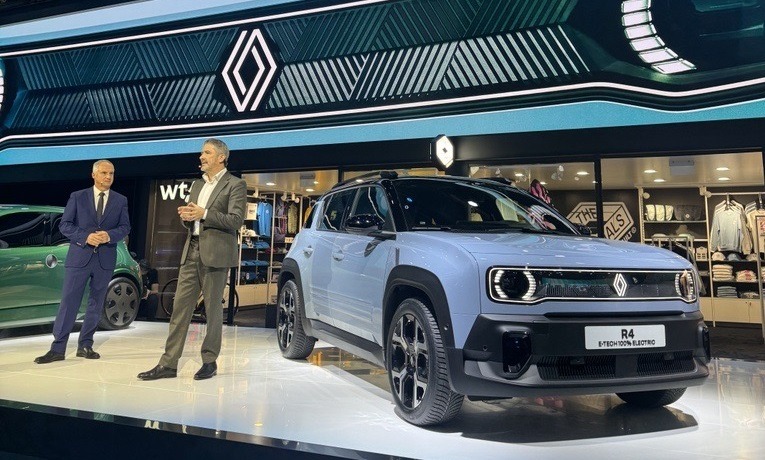
This year’s Paris Motor Show had plenty of world premieres and European debuts. But what did carmakers attending the event have to say? In the latest Autovista24 podcast, journalist Tom Hooker speaks with industry leaders about their design languages. The 90th anniversary of the Paris Motor Show attracted carmakers from across the globe. Speaking with Autovista24, industry experts gave exclusive insights into the design, technology and ambitions behind their newest vehicles. Subscribe to the Autovista24 podcast and listen to previous episodes on Spotify, Apple and Amazon Music. Show Notes Highlights from the 2024 Paris Motor Show What to look out for at the 2024 Paris Motor Show French brands fascinate One brand with a large presence at the event was Renault, as it revealed the new Renault 4. The highly anticipated B-segment battery-electric vehicle (BEV) takes strong design cues from its 1960s predecessor. The brand also unveiled the Renault Emblème, a concept car aiming to tackle carbon emissions throughout its lifecycle. The model features a dual-energy electric powertrain, combining a rechargeable battery for everyday use with a hydrogen fuel cell for longer journeys. Renault’s domestic rival, Citroën, had a large presence at the event too. The manufacturer premiered its C5 Aircross Concept. The model showcases a future C-segment SUV, which will be built on the Stellantis STLA Medium platform. Also on the brand’s stand was the newly revealed C4 and C4 X, with both vehicles due to arrive in dealerships early next year. Leaping into Europe After forming a joint venture with Stellantis and recently launching operations in Europe, Leapmotor was also at the event. The carmaker attracted a large crowd during its press conference, which included Stellantis CEO Carlos Tavares. The brand hosted the global debut of the B10, a C-segment SUV and the first model in its B-series. Other Leapmotor models on display included the C16 mid-size SUV and T03 city car. Peugeot showcased its new e-408. The C-segment BEV follows the release of a plug-in hybrid version in 2022. The new long-range e-3008 and e-5008 models were also on show, offering an electric range of 435 miles (700km) and 415 miles (668km) respectively. BYD made headlines with its new Sealion 7. This Tesla Model Y rival is the eighth electric vehicle (EV) to be launched by the manufacturer in Europe. Additionally, BYD said it is still committed to building two local production facilities in Europe as tariff talks continue. Dacia’s big surprise Dacia revealed the new Bigster. This is yet another C-segment SUV, with three mild-hybrid powertrains and one full-hybrid option on offer. Kia used the event to display its EV3, a compact electric B-segment SUV with high-tech features. It has a range of 375 miles (604km) when opting for its bigger battery. One of its competitors will be the Skoda Elroq. The EV has a 560km range and prices start at around €33,000. It marks the beginning of six BEV Skoda model launches over the coming years. Meanwhile, the Volkswagen Tayron made its public debut. The model is a seven-seat SUV that sits above the Tiguan. Cadillac also made waves, with its new Lyriq and Optiq electric SUVs. One stand that drew a lot of attention was Xpeng, with the unveiling of the P7+. The fastback sedan’s advanced driver-assistance systems feature as standard. More reveals Mini had two global debuts at the event, the John Cooper Works Electric and the John Cooper Works Aceman. The latter provides a range of 355km while the former can reach 371km on one charge. Another world premiere was the Audi Q6 Sportback e-Tron. The midsize SUV has a range of 656km and is built on the premium platform electric or PPE. Alpine also had a sporty reveal for visitors at the show. The A390_β is a precursor to the brand’s future BEV fastback sportscar. BMW showcased its Neue Klasse and Neue Klasse X in Paris. Both provide an outlook on the brand’s future model portfolio, with the former a sporty electric sedan while the Neue Klasse X is an electric SUV.

Displaying 8 of 8 insights