What did CES 2025 reveal about the progress of self-driving technology? Autovista24 editor Tom Geggus unpacks some of the biggest autonomous developments from the event.

The buzz around self-driving cars has dissipated in the last few years. Once a mainstay of discussions at various automotive events, autonomous vehicles have begun to feel less relevant.

The technology seems to have spent a while in Gartner’s trough of disillusionment. Disenchantment around autonomous systems has also been impacted by reports of collisions and company cautiousness.

However, self-driving cars still carry some momentum and might even make it up the ‘slope of enlightenment’. This is where the societal benefits of the technology start to become more widely understood.

In the second half of 2024, S&P Global Mobility reported a comparative surge of autonomous vehicle advances in China. The US also saw positive technological developments. At the start of 2025, CES offered an opportunity for an update from some of the industry’s major autonomous advocates.

Self-driving CES

Automotive technology was defined by software at CES 2025, with the latest concepts featuring astounding new capabilities. To achieve these new heights, carmakers have turned to technology titans like Nvidia.

Hyundai Motor Company confirmed it will work with the company to advance its integration of AI. The carmaker will tap into Nvidia’s computing capacities, allowing it to manage the large amounts of data needed to train its advanced AI models. This in turn will help with the building of an autonomous-vehicle software stack.

The Korean manufacturer will work with Nvidia to create simulated environments to develop autonomous systems. Simulations provide a safe way to test autonomous vehicles in any possible weather, traffic, location as well as dangerous scenarios.

‘Hyundai Motor Group is exploring innovative approaches with AI technologies in various fields such as robotics, autonomous driving and smart factories,’ said Heung-Soo Kim, executive vice president and head of the global strategy office at Hyundai Motor Group. ‘This partnership is set to accelerate our progress, positioning the Group as a frontrunner in driving AI-empowered mobility innovation.’

Nvidia is stacking up automotive customers. Its founder and CEO Jensen Huang explained at CES how his company is now working with nearly every major carmaker.  Discussing autonomous vehicle collaborations, he mentioned, BYD, Tesla, JLR, Toyota, Mercedes-Benz, Waymo, and Zoox.

‘The autonomous vehicle revolution is here,’ Huang said. ‘Building autonomous vehicles, like all robots, requires three computers: Nvidia DGX to train AI models, Omniverse to test drive and generate synthetic data, and Drive AGX, a supercomputer in the car.’

Road ahead for self-driving cars

Mobileye returned to CES, with President and CEO Amnon Shashua, mapping out the road ahead for autonomous technology. He explained that these systems have two key development axes.

One of these is precision, effectively how safe a system is. This can be measured by the mean time between failures (MTBF), so how much time passes between each incident.

‘What would be the sufficient MTBF for an eyes-off system? At least tens of thousands of hours of driving. When we talk with OEMs, there are much bigger numbers being thrown, one million hours, 10 million hours,’ Shashua said.

On the other axis is recall, covering when an autonomous system can operate. Higher recall is available when self-driving technology has wider operational parameters. Geographical scalability is important too, considering how good an out-of-the-box system is at adapting to a new location. Then there is cost, including the funds needed for building and maintenance.

Shashua said that Waymo is racing up the precision axis, while Tesla pushes further ahead with recall. This approach leaves both companies needing to advance along the opposing axis to reach SAE Level 5 Autonomy at scale.

A third way

Meanwhile, Mobileye is following a third school of thought. Its eyes-on, hands-of SuperVision assisted-driving platform has moved along the recall axes. It is scheduled to reach the end of this path next year.

In parallel, Chauffeur, Mobileye’s eyes-off autonomy for consumer-owned vehicles will focus on precision. ‘On highways, it is going to be a very useful system. 130kph driving, autonomous lane changes. It is an eyes-off system,’ Shashua said. ‘You can do something else in the car, you can work on your smartphone, you can do something else.’

Chauffeur is set to become more powerful in the coming years with more sensor capabilities, lidar, and an imaging radar.  

A continental approach

Continental brought its modular and scalable advanced driver-assistance system (ADAS) portfolio. The system is reportedly capable of managing high complexity with its birds-eye fusion technology. A full-stack partnership with Ambarella powers the system.

The supplier has also sought to help OEMs reduce components and improve vehicle aesthetics. Accordingly, it has developed radar-based parking solutions while maintaining high-speed ADAS features. This has meant using existing surround-range radars while removing ultrasonic sensors.

Continental, Aurora and Nvidia also announced a new strategic partnership to deploy driverless trucks at scale. Continental plans to mass-manufacture the Aurora Driver, an SAE Level 4 autonomous driving system for trucking, in 2027. The system features Nvidia’s Drive Thor and DriveOS technology.

‘Delivering one driverless truck will be monumental. Deploying thousands will change the way we live,’ said Chris Urmson, CEO and co-founder of Aurora. ‘Nvidia is the market leader in accelerated computing, and they will strengthen our ecosystem of partners and our ability to deliver safe and reliable driverless trucks to our customers at scale.’

Commercial and competitive advances

Elsewhere in the commercial automotive world, John Deere revealed several new autonomous machines. These are built to support customers in agriculture, construction, and commercial landscaping.

The autonomous lineup included the 9RX tractor for large-scale agriculture, the 460 P-tier articulated dump truck for quarry operations and a battery-electric mower for commercial landscaping.

At the other end of the scale, the Indy Autonomous Challenge (IAC) achieved a world first for high-speed competitive autonomy. The Las Vega Motor Speedway saw the first successful completion of a multi-car autonomous race.

‘Our goal has always been multi-agent racing, so being the first to have all our AI drivers complete a race and do so with five overtakes, no accidents, and a nose-to-nose finish is a testament to the progress of the IAC’s global ecosystem of highly talented university researchers, industry partners, and government supporters,’ said Paul Mitchell, IAC president and CEO.

Simulation step up at CES

When it comes to developing autonomous systems, Here Technologies announced the introduction of SceneXtract. Built alongside Amazon Web Services (AWS), the software aims to simplify and speed up the creation of real-world environments. Manually searching, locating, and converting real-world environments into simulation-ready scenes for ADAS and automated vehicles is time-consuming.

‘SceneXtract marks a significant milestone in ADAS and automated driving development, providing developers with a powerful tool to reduce the time, cost and complexity of simulating real-world scenarios,’ said Remco Timmer, vice president of product management at Here Technologies.

‘By utilising the Here HD live map and AWS’s AI-powered search capabilities, SceneXtract enables more efficient and accurate testing, allowing manufacturers to bring safer, more advanced autonomous driving technologies to market faster,’ Timmer added.

The race to automate

While this progress is a positive sign for self-driving vehicles, it is being spearheaded by certain countries. Maria Alonso, autonomous systems lead at the World Economic Forum, highlighted at CES how the US and China are leading development.

‘I would say the US is really at the forefront when we think about these deployments, together with China. One of the reasons why the two countries are going to continue being at the forefront is because it is a race. It is a race with the US against China in vehicle autonomy,’ she said.

Meanwhile, progress in other regions like Europe can be expected to take longer. This is because some of the largest players currently working on self-driving cars are not active in the region. Additionally, with so many different countries in Europe, each having its own regulations, it is far harder for developers to make strides like they would in the US and China.

A Deloitte study considered an easing regulatory environment that may aid the deployment of autonomous vehicles in some global markets. However, more than half of surveyed consumers in India, the UK and the US remained concerned about safety.

So, as autonomous vehicles continue to develop, the challenges ahead are clear. Companies will need to prove the application, safety and ease of use of autonomous systems. If they fail to win over potential users, self-driving cars will remain parked.  

With a long list of automotive suppliers making the trip to CES, what major announcements were made in Las Vegas? Tom Hooker, Autovista24 journalist, reviews the event.

There was a noticeable lack of carmakers at this year’s CES. However, there was no shortage of suppliers in attendance. These companies unveiled the latest advancements in software-defined vehicles (SDVs), in-cabin user experience, AI and safety solutions.

Multiple collaborations were also announced as carmakers and technology companies found more common ground in SDVs. Blackberry, Amazon Web Services (AWS), Snapdragon and Qualcomm all look set to increase their automotive presence.

AI in-cabin experience

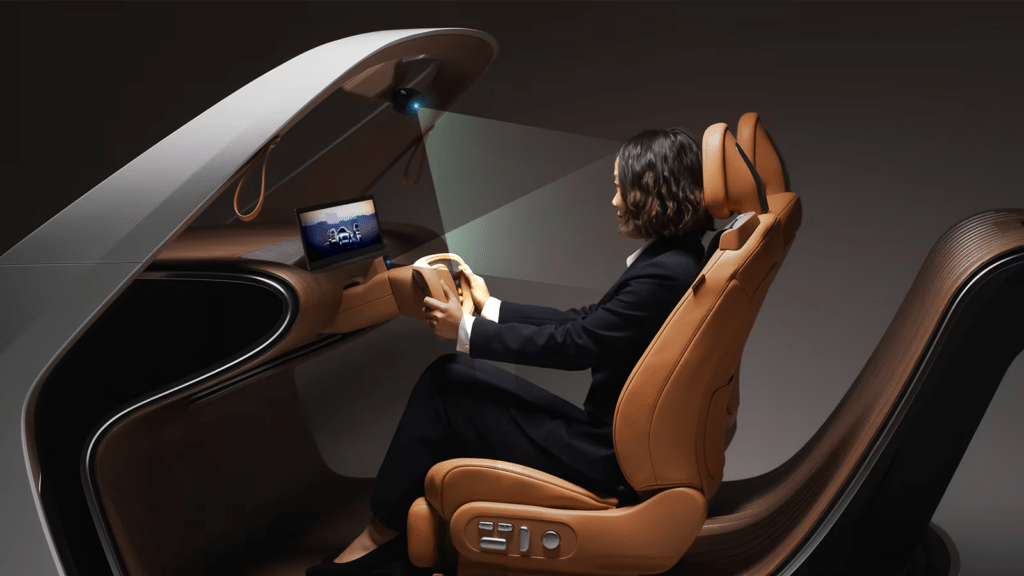
LG was one of the first companies to host a press conference at this year’s CES. The brand focused on its ‘Affectionate Intelligence’ approach. This AI is designed to better understand and empathise with customers while delivering a more personalised experience.

This theme was apparent in its AI-based in-cabin sensing solution, the AI in-vehicle experience. The concept is designed to make driving safer and more convenient. It leverages LG’s Vision AI to detect and respond to occupants’ needs while optimising cabin conditions.

Source: LG

The solution adapts to each driver’s preferences and provides tailored services. This includes personalised driving routes, real-time updates on road conditions, and information on nearby infrastructure as well as points of interest.

LG’s demonstrated these capabilities during its press conference. The system proactively suggests rerouting to avoid an accident. It also recommended holding a video conference inside the vehicle due to traffic delays.

‘With LG’s Affectionate Intelligence technology, LG’s in-cabin solution provides automakers with performance, quality and flexibility, while providing drivers and passengers with a safer and more enjoyable on-road experience,’ said Seokhyun.

Important automotive partnerships

This solution is made possible by analysing the driver and the vehicle’s interior. This is carried out using two systems, the driver monitoring system (DMS) and the driver and interior monitoring system (DIMS).

The former was developed with semiconductor AI company Ambarella, using its CV25 AI system-on-chip. DMS can detect a user’s physical health and emotional state with heart rate monitoring and facial expression recognition. It can notify the driver if they become distracted or drowsy while alerting them to their overall well-being.

‘Our collaboration with Ambarella represents a major step forward in the use of AI-driven technology to advance vehicle safety,’ stated president of LG vehicle solution company, Eun Seokhyun.

The company is also working with Qualcomm on a cross-domain controller platform for vehicles. This incorporates LG’s in-vehicle infotainment system and advanced driver-assistance system (ADAS) into a single controller.

A personalised cabin at CES

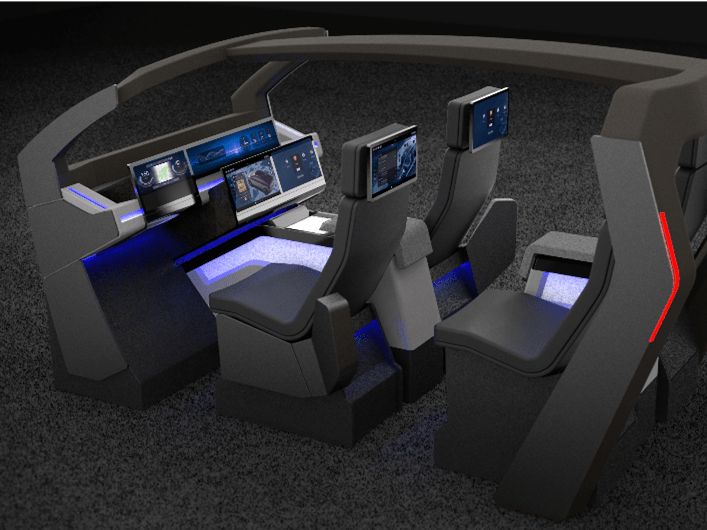
Garmin presented its highly personalised Unified Cabin 2025. The system boasts an ultra-wide front display, with a total of six screens and four seats in the interior concept.

Source: Garmin

Generative AI supports theme customisation based on user inputs and a personalised voice assistant is available for each seat. Using ultra-wideband technology, the system can detect if seats are occupied by adults or children based on breathing patterns. There are also customisable cabin lighting and unique audio streams. These features are all run from a single Garmin control module.

‘Garmin Unified Cabin has resonated strongly with global automakers because there is nothing else like it on the market today. This scalable solution can be customised to meet the needs of premium and mainline brands and includes a growing number of cabin electronics running off a single system on chip,’ explained executive vice president and managing director for Garmin Automotive OEM, Matt Munn.

The Unified Cabin 2025 is powered by Qualcomm Technologies’ Snapdragon cockpit elite platform, enabling an SDV architecture.

‘This next-generation digital cockpit solution offers automakers unparalleled entertainment and personalisation for their vehicles, setting a new standard for software-defined vehicle architecture,’ commented group general manager, automotive, industrial and cloud, Qualcomm Technologies, Nakul Duggal.

Multitude of collaborations

LG and Garmin were just two of Qualcomm’s automotive collaborations announced at CES. The company is currently working with Leapmotor, Mahindra, Hyundai Mobis, Alps Alpine and Royal Enfield. Using Snapdragon Digital Chassis, Qualcomm is developing in-cabin solutions and ADAS features in these partnerships.

Desay and Panasonic Automotive are also collaborating with the company using the Snapdragon elite-tier platform. Qualcomm and Amazon intend to work together on accelerating the integration of advanced AI technologies in vehicles.

This will allow carmakers, developers, and suppliers to deliver innovative and advanced in-car experiences while reducing development time and costs. This could include features such as Alexa.

‘As we continue to work with automakers to redefine automotive experiences that delight drivers and passengers, whether it’s through Alexa or our content services like Audible and Amazon Music, it made sense to collaborate with a company renowned for building advanced automotive chipset platforms,’ said Amazon smart vehicles vice president, Anes Hodzic.

The two companies intend to optimise large language model-powered experiences in the car, while also leveraging the AWS cloud. This aims to provide manufacturers with a virtual development environment for Snapdragon automotive chipsets.

CES and safety

VinAI brought six different technologies to CES, each designed to make the driving experience safer and easier.

The company revealed the world’s first passive drunk-driving detection system that does not require a breathalyser. Instead, DrunkSense adopts a multi-sensor approach including facial behaviour tracking, vehicle control monitoring and air alcohol sensors.

VinAI also presented InteriorSense, a driver and occupant monitoring system. The safety solution analyses behaviour patterns and can alert the driver if they become distanced. Another solution inside the cabin is MirrorSense, the world’s first automatic mirror adjustment feature.

VinAI’s Jelly View was also on display, providing drivers with a transparent vision through the vehicle. This can be used to assess road conditions and avoid unexpected accidents.

Bosch’s future projects

Bosch shared its future ambitions and projects during its CES press conference. The company expects to generate sales of over €6 billion with software and services by the beginning of the next decade. It forecasts that its mobility business sector will generate around two-thirds of this sales revenue alone.

The German supplier also discussed how AI will play a pivotal role in its future. Almost 5,000 Bosch AI specialists are currently working on intelligent solutions, with 1,500 AI patents registered in the last five years. Additionally, the company’s own AI Academy has trained more than 65,000 associates.

New AI-supported systems from Bosch, include technology which allows cars to brake smoothly without jerking. The company is also developing solutions for new centralised architectures. This software can effortlessly manage all interactions between automotive electronics and the cloud.

Another digital innovation presented in the company’s press conference was Bosch’s wrong-way driver warning. This cloud-based system tracks cars as they approach entrance or exit ramps and can tell if a vehicle is moving in the permitted direction of travel. If it is moving the wrong way, a warning is issued to the driver.

A warning can also be sent to other drivers, alerting them that an approaching vehicle is travelling in the wrong direction.

Continental’s SDV innovations

Continental showcased its SDV innovations to enable safer, more efficient and customisable driving experiences. Its road-to-cloud ecosystem speeds up the development of vehicle software.

Additional software solutions on show included cabin sensing, holistic motion control, and smart device-based vehicle access to further progress SDV capabilities. All of these features were combined in Continental’s Intelligent demo car.

This vehicle analyses its environment while anticipating and interacting with its users. It combines AI algorithms with existing vehicle sensors. Meanwhile, touch-free access to the concept is enabled using biometrics.

This means the car recognises users even before they get into the vehicle. It interprets and processes facial and movement characteristics. For example, if the car is parked outside a supermarket, the boot will be opened for the driver on their return. It can also identify individuals who are not authorised to operate the vehicle and keep doors locked while a warning is activated.

‘The car is on track to become a smart device, similar to a cell phone, which will use biometric technologies to take the user experience to a new level of security and comfort,’ said head of architecture and network solutions at Continental Jean-François Tarabbia.

Continental’s invisible biometrics sensing display features a range of capabilities. This includes 3D-distance mapping for airbag deployment, seatbelt monitoring and contactless biometric sensing for heart rate tracking.

The company also presented a roadmap for future brakes. The supplier showed how brakes will be developed into smart systems without the use of hydraulics.

A strategic rebrand at CES

Blackberry renamed and relaunched its ‘Blackberry IoT’ division to QNX. The brand focused on vehicle soundscapes, digital cockpit development, and edge-to-cloud data services at this year’s CES.

For example, its QNX Cabin is an innovative framework that allows carmakers to virtualise the development of digital cockpits in the cloud. This allows architects and developers to design, test and refine every line of code in the cloud.

The approach means teams can collaborate across different locations, speeding up development workflows, streamlining processes and improving overall time-to-market.

‘Designing, developing and maintaining a digital cockpit is challenging, especially for globally deployed engineering organisations that rely on cloud-based development but still need safety, security and reliability,’ highlighted chief operating officer and head of product, engineering and services at QNX, John Wall.

QNX also announced its collaboration with Microsoft in Las Vegas. The companies aim to make the process of building, testing, and refining software within the cloud easier for manufacturers. This could accelerate the development of SDVs in the future.

Additionally, QNX is working with Vector and TTTech to collaborate, develop and market a foundational vehicle software platform in a multi-year partnership.

CES 2025 saw updates from carmakers spanning new models, technologies and mobility concepts. Autovista24 special content editor Phil Curry discusses some of the highlights.

With the automotive market becoming increasingly technology-driven, CES has established itself as an important event for the industry. Concept cars are now a mainstay at the Las Vegas Convention Centre and surrounding area. This year’s show was no exception to the rule.

Several carmakers used the occasion to preview new models, concepts and launch plans. The event provided a global stage on which OEMs could highlight their technological advancements. This meant utilising new strategies and systems to develop not just products, but business practices.

Honda holds nothing back

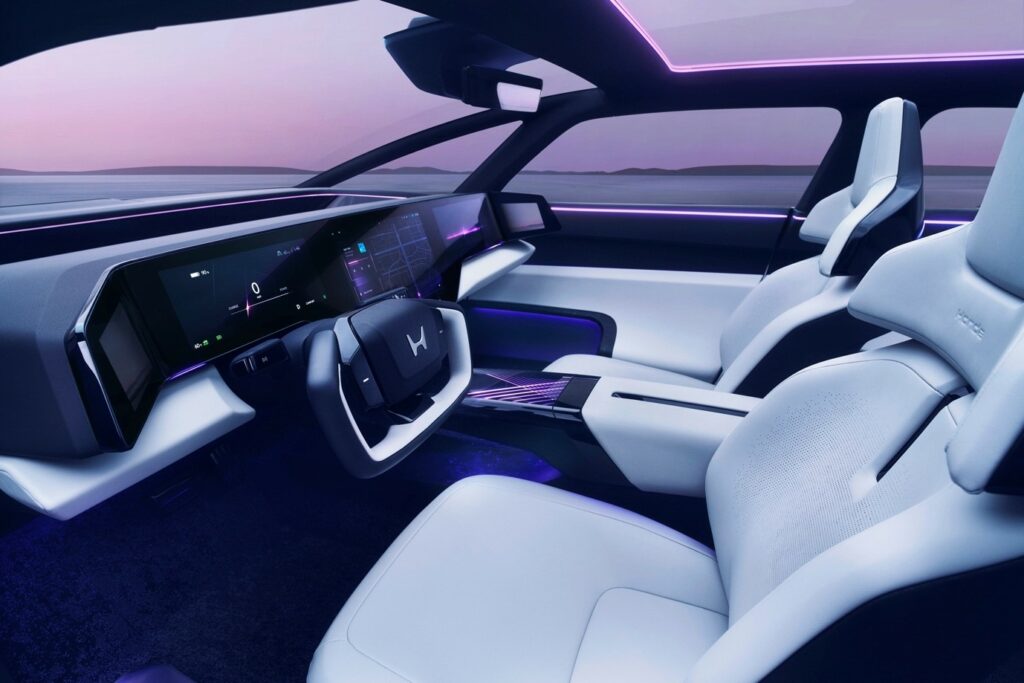
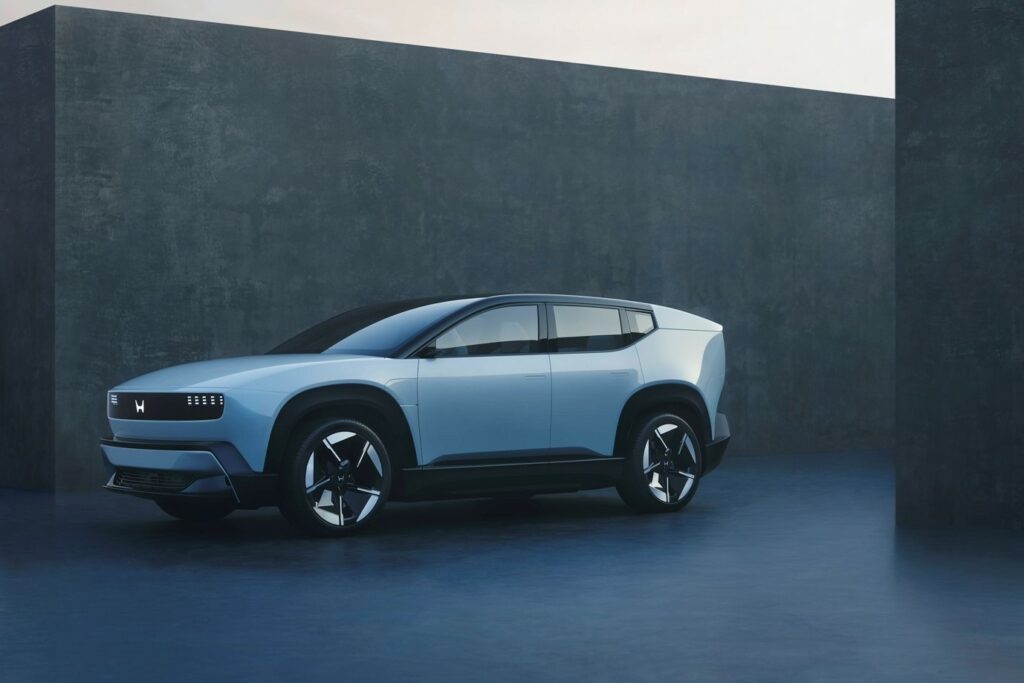
Honda used CES 2025 to introduce two prototype models in its 0 Series range. The carmaker also provided an update on its new operating system that will be used within the cars.

Source: Honda

The cars follow the ‘thin, light and wise’ concept introduced at CES 2024, and are scheduled for launch in 2026. The first models in this electric vehicle line-up will go on sale in the US, with Japan and Europe expected to follow.

The Honda 0 Saloon keeps the shape of the concept model launched at last year’s CES. The Japanese brand advanced this further by adding information on the model’s systems and capabilities.

‘With competition around software-defined vehicles, we are describing our vehicles as wise, rather than smart, to highlight the integration of technology. The Honda approach is human-centric, and we will offer optimisation for the driver,’ said Katsushi Inoue, senior managing executive officer of Honda’s electrification business development operations.

The car will learn about the driver and their preferences. Artificial intelligence (AI) will power the personalisation of the vehicle based on moods and settings. More functions will be added to the cars, even after purchase.

Additions to 0 series

Honda also unveiled a new addition to the 0 Series, the 0 SUV. Based on the Space-Hub concept unveiled last year, the mid-size SUV will deliver on the ‘thin, light and wise’ approach. This includes increasing interior space with an unrestricted field of view and better cabin flexibility to improve comfort.

Source: Honda

Capable of bi-directional charging, the vehicle can serve as a virtual power plant, while recharging based on a driver’s requirements. The vehicle will also utilise the best charging times to optimise performance.

A new operating system will be at the core of the two vehicles. Honda has named it Asimo OS after its robot mascot unveiled at CES in 2005. This system will enable integrated control of electronic control units for automated driving, advanced driver-assistance systems (ADAS) and infotainment systems.

The 0 Series will also benefit from Honda’s knowledge of autonomous driving. In 2021, Honda became the first carmaker in the world to put SAE Level 3 autonomous systems into practical use.

The brand announced at CES 2025 that it will be working with Helm.ai to expand the application of AI that can recognise and understand its surroundings. The collaboration will analyse several regions and their specific requirements.

Afeela taking orders

As well as its own vehicle announcements, Honda’s joint venture with Sony also presented an update at CES 2025.

Source: Sony Honda Mobility

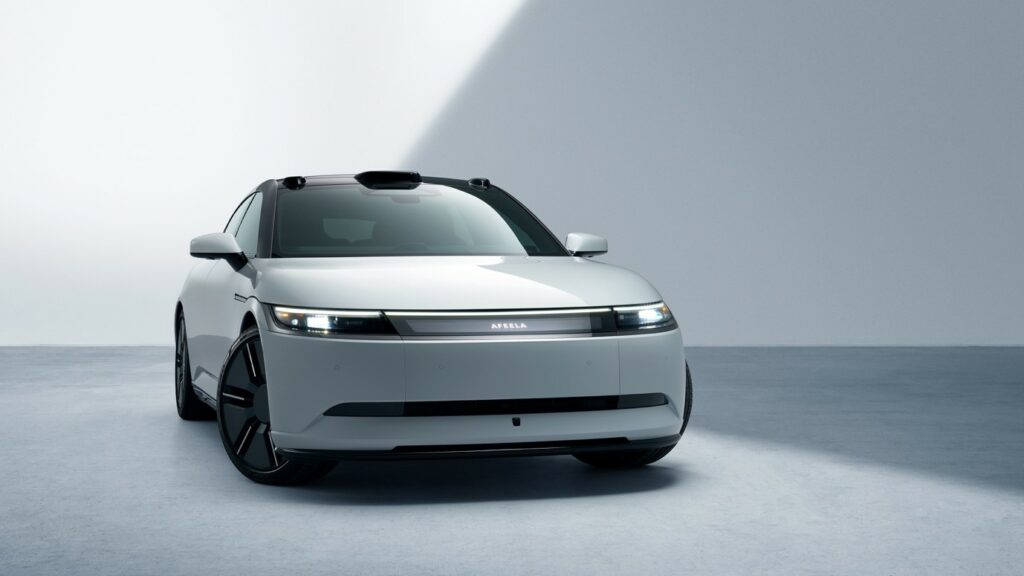
Sony Honda Mobility first announced a concept vehicle in 2020, before refining this into its Afeela 1 model in 2023. The company took to the stage in Las Vegas to announce the commencement of online registrations for the Afeela 1. Attendees also got an update on the software and options available.

The carmaker is only taking reservations in the US state of California at present. This will gradually expand to more areas over time, with the brand focusing on more ‘active’ markets. There was no confirmation as to whether the model will be launched globally.

The joint venture also announced the creation of the Afeela Studio and Delivery Hub. This will allow visitors to directly experience the brand, with locations expected in Torrance and Fremont, California.

So customers can access aftersales services, Sony Honda Mobility also announced a partnership with Crash Champions. This will enable premium repair and maintenance services.

Inside, the Afeela 1 sports a sound system developed by Sony, together with optimal displays for each passenger. This grants access to a number of apps and services, with the carmaker’s partners including Amazon, Crunchyroll, and Microsoft.

Two models will be launched. The Afeela 1 Origin is available for $89,900 (€87,992), while the Afeela 1 Signature is priced at $102,900.

BMW’s Panoramic view

BMW stated that it would be adding ‘a little magic’ to its presentation at CES 2025. The brand ‘shrunk’ comedian Tim Meadows to present BMW’s new iDrive system from the dashboard of a vehicle itself.

Source: BMW

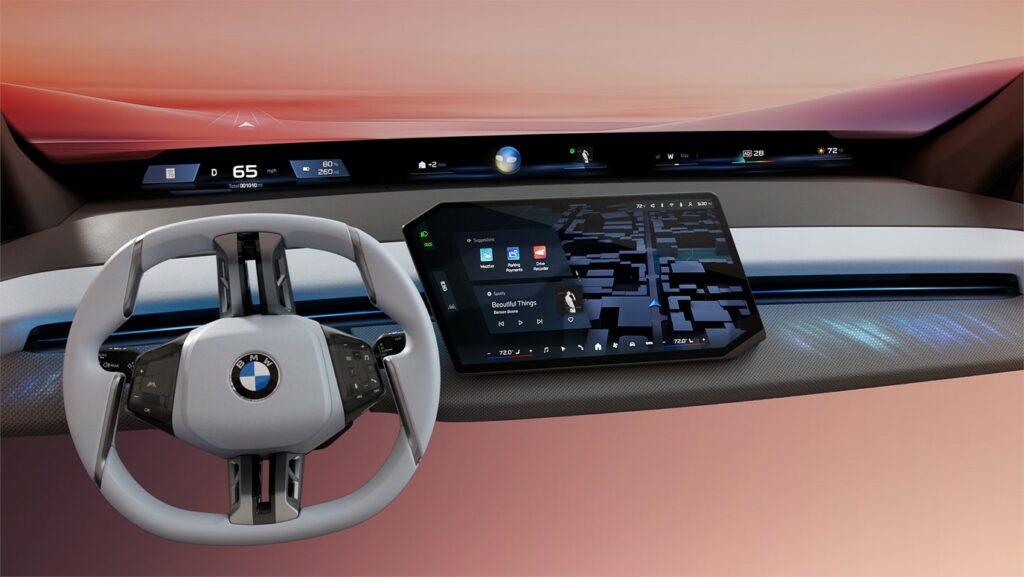
The new iDrive will feature in BMW’s Neue Klasse series from the end of 2025. The centrepiece of the new system is the BMW Panoramic Vision screen. Meanwhile, the new BMW Operating System X acts as an intelligence hub for the vehicle.

‘High tech meets highly intuitive operation, a quarter of a century of pioneering work and technological leadership in operating concepts has been channelled into the new BMW Panoramic iDrive,’ commented Frank Weber, member of the board of management of BMW AG, responsible for development.

‘The foundations are provided by the new BMW Operating System X. With this advance, we are giving our most comprehensive infotainment system even greater capability and once again setting the industry benchmark in multimodal interaction.

‘Starting with the first series-produced Neue Klasse model at the end of this year, the new BMW Panoramic iDrive will form an integral part of all future BMW models’ Weber highlighted.

Pillars of performance

The iDrive system sees four elements coming together to re-invent BMW’s ‘hands on the wheel, eyes on the road’ approach. This means it needs to be both intuitive and user-friendly, as well as being ergonomically optimised for driver comfort.

BMW Panoramic Vision is a head-up display concept developed to project content forward. It reflects visible information between each A-pillar on a black printed surface in the lower section of the windscreen. 

The most important driving information is projected directly into the driver’s line of sight above the steering wheel. The driver can personalise content in the central and right-hand areas of the BMW Panoramic Vision from the central display. Overall, the function creates a 3D effect for the driver and passengers.

The new iDrive concept also features a 3D head-up display above the Panoramic Vision, together with a central display with matrix backlight technology. Selected content can be carried over to the head-up display with a swipe on the central touchscreen. Finally, a new multifunction steering wheel uses BMW’s shy-tech approach. This means the relevant buttons are illuminated to highlight available functions.

‘The overall concept of the new BMW Panoramic iDrive with Operating System X has been enabled by a large technological leap forward,’ added Stephan Durach, senior vice president, connected company, BMW Group.

‘It offers intuitive operation, emotionally engaging experiences and specific personalisation. The new BMW iDrive with Operating System X demonstrates the potential of a software-defined vehicle,’ he said.

Woven fabric for Toyota

CES 2025 was also an opportunity to provide updates on new approaches to the automotive world. Toyota announced the completion of the initial phase of construction of its Woven City.

Source: Toyota

The update was presented by Toyota Chairman Akio Toyoda. The carmaker announced its transformation into a mobility company at CES 2018, with the Woven City concept unveiled in 2020.

Steady progress has been made since the Woven City groundbreaking ceremony on 23 February 2021. This took place at the site of Toyota’s former Higashi-Fuji plant in Shizuoka, Japan.

Construction of the Phase 1 buildings and the initial area for co-creation activities was completed in October 2024. The ‘test course for mobility’ is expected to launch in the third quarter of this year.

Early January 2025 has seen a flurry of major automotive news stories, from emissions pooling to CES. Autovista24 journalist Tom Hooker discusses the week’s biggest headlines.

Which European market sold the most battery-electric vehicles (BEVs) in 2024? The UK reconfirms its phase-out date for the sale of new petrol and diesel cars. Carmakers are pooling their emissions figures to navigate CO2 targets.

CES 2025 featured some important new automotive technology. Which model announcements made waves this week? Xpeng and Volkswagen announce a new joint charging network in China. Rolls Royce confirms the expansion of a UK production facility.

Subscribe to the Autovista24 podcast and listen to previous episodes on Spotify, Apple and Amazon Music.

The BEV battle

The 2024 registration results for Germany and the UK have been released. The UK recorded growth across the year while deliveries in Germany declined. This drop was largely due to a slump in the BEV sector, which fell by 27.4%. This meant the country lost its title as Europe’s best-selling BEV market. The UK took the mantle instead, thanks to a 56.8% BEV surge in December.

Meanwhile, the UK government confirmed it will bring the sales ban on new petrol and diesel models back to 2030. This deadline has changed on multiple occasions over the past few years. It was first announced in 2017, with a target date of 2040. In 2020 this was brought forward to 2030, before its push back to 2035, which was confirmed in 2023.

Carmakers are ‘pooling’ CO2 emissions with Tesla and Polestar to meet the EU’s 2025 targets. This means manufacturers with lower electric vehicle (EV) sales can buy emissions credits from other brands that are comfortably meeting targets. Stellantis, Ford, Toyota and Mazda are set to pool with BEV manufacturer Tesla. Meanwhile, Polestar, Volvo Cars, Mercedes-Benz and Smart will pool their emissions together.

CES 2025 and new models

At CES 2025, Sony Honda Mobility confirmed it is now accepting online reservations for its Afeela model. However, the company is currently only accepting orders from customers in California. Honda presented a world premiere of two prototype models from its 0 Series. BMW also revealed new in-cabin technology to improve the user experience. These systems will appear in new models, including the Neue Klasse, from the end of this year. 

Elsewhere, Skoda unveiled its new Enyaq on Wednesday. Renault revealed the interior of its Twingo E-Tech prototype at the Brussels Motor Show. BYD also introduced the BYD Atto 2 to its European lineup. Toyota confirmed its new Urban Cruiser will be rolled out in late summer 2025. Genesis took the covers off its redesigned GV60 crossover SUV, with more details expected in the first quarter of this year.

Xpeng and Volkswagen (VW) announced plans to jointly build one of the largest super-fast charging networks in China. With a target of over 20,000 charging piles operated by the carmakers across 420 cities, both Xpeng and VW customers will be able to access the services.

Rolls Royce revealed expansion plans for its production facility in the UK on Wednesday. More than £300 million (€358 million) will be invested into its Goodwood site. This is the largest financial commitment made to the location since it opened in 2003.

The automotive industry did not slow down at the end of 2024, with major announcements across the globe. But what were the most important stories to break over the festive period? In a new podcast, Autovista24 editor Tom Geggus covers the major headlines.

Did Tesla or BYD sell the most battery-electric vehicles (BEVs) in 2024? What to know about Nissan, Honda and Mitsubishi’s merger talks. Why is the UK holding a consultation on its phase-out of pure petrol and diesel-powered cars? What agreement did Volkswagen (VW), IG Metall and the Works Council reach?

Subscribe to the Autovista24 podcast and listen to previous episodes on Spotify, Apple and Amazon Music.

Tesla holds on to lead

As carmakers begin to deliver their first models of 2025, last year’s overall figures are being revealed. This includes data from BEV market leaders Tesla and BYD. But which carmaker sold the most all-electric cars last year?

Tesla delivered 1.78 million BEVs globally in 2024, a drop of 1% from the previous year. This volume was mainly driven by its Model 3 and Model Y vehicles. The pair recorded a combined 1.7 million deliveries.

The US brand narrowly edged out BYD. The Chinese carmaker reached 1.76 million BEV deliveries worldwide in 2024. This was up 12%, or over 190,000 units, on 2023.

Massive automotive merger?

Meanwhile, Nissan, Honda and Mitsubishi confirmed they are in merger talks. The companies are considering integration through the establishment of a joint holding company. This could result in the creation of one of the largest OEMs, alongside the likes of Toyota and VW Group.

‘Honda and Nissan have begun considering a business integration and will study the creation of significant synergies between the two companies in a wide range of fields,’ stated Nissan’s CEO Makoto Uchida.

‘It is significant that Nissan’s partner, Mitsubishi Motors, is also involved in these discussions. We anticipate that if this integration comes to fruition, we will be able to deliver even greater value to a wider customer base,’ he explained.

Another update from Mitsubishi is expected at the end of January, confirming its involvement.

Phase-out consultation

A consultation on the phase-out of pure petrol and diesel-powered cars has been launched in the UK. The document and subsequent discussions, led by transport secretary Heidi Alexander, have confirmed plans to restore the phase-out deadline to 2030.

To achieve this, the government wants input from the automotive and charging industries. This follows the previous Conservative government postponing the date from 2030 to 2035.

The consultation is looking to define what vehicles will be available to buyers between 2030 and 2035, after which only new zero-emission vehicles (ZEVs) will be available. Currently, by 2030 a total of 80% of a manufacturer’s fleet must be zero-emission models, rising to 100% by 2035.

The new consultation also proposes updates to the zero-emission vehicle (ZEV) mandate. Some carmakers were already struggling to meet targets in 2024.

‘[The consultation] will give the sector the opportunity to consider how the current arrangements and flexibilities are working, which hybrid cars can be sold alongside zero emission models between 2030 and 2035, and any further support measures to help make the transition a success for industry and consumers,’ the government stated.

Mike Hawes, SMMT chief executive, was in favour of the consultation. ‘The automotive industry welcomes government’s review of both the end of sale date for cars powered solely by petrol or diesel, and possible changes to the flexibilities around the ZEV mandate,’ he said.

‘These are both critical issues for an industry that is facing significant challenges globally as it tries to decarbonise ahead of natural market demand. Aside from the billions invested in new technologies and products, it has cost manufacturers in excess of £4 billion (€4.8 billion) in discounting in the UK this year alone,’ Hawes added.

Future agreement reached

Volkswagen, the IG Metall union and the Works Council reached an agreement on the carmaker’s future direction. This followed a turbulent period of worker strikes and negotiations.

The brand is realigning its production capacities at its German locations. This will allow VW to reduce labour costs by €1.5 billion per year. The manufacturer plans to cut its workforce in Germany by more than 35,000, with an agreement on the company wage settlement until 2030.

Reduced labour costs, structural realignment through capacity reduction and decreased development are expected to lead to cost savings of over €4 billion a year in the medium term. Investments in future products through to 2030 will be enabled by a planned reduction in capacity of 734,000 units across the company’s German plants.

VW also stated that it is aiming to become the technology leader of the world’s volume manufacturers by 2030.

This year’s Paris Motor Show had plenty of world premieres and European debuts. But what did carmakers attending the event have to say? In the latest Autovista24 podcast, journalist Tom Hooker speaks with industry leaders about their design languages.

The 90th anniversary of the Paris Motor Show attracted carmakers from across the globe. Speaking with Autovista24, industry experts gave exclusive insights into the design, technology and ambitions behind their newest vehicles.

Subscribe to the Autovista24 podcast and listen to previous episodes on Spotify, Apple and Amazon Music.

Show Notes

Highlights from the 2024 Paris Motor Show

What to look out for at the 2024 Paris Motor Show

French brands fascinate

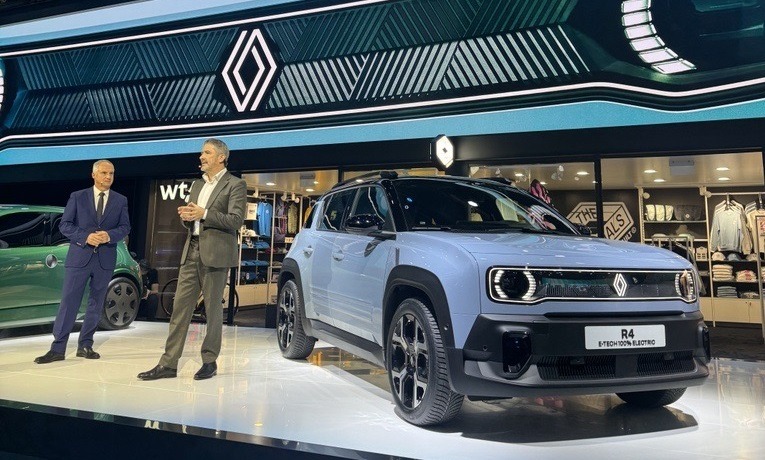
One brand with a large presence at the event was Renault, as it revealed the new Renault 4. The highly anticipated B-segment battery-electric vehicle (BEV) takes strong design cues from its 1960s predecessor.

The brand also unveiled the Renault Emblème, a concept car aiming to tackle carbon emissions throughout its lifecycle. The model features a dual-energy electric powertrain, combining a rechargeable battery for everyday use with a hydrogen fuel cell for longer journeys.

Renault’s domestic rival, Citroën, had a large presence at the event too. The manufacturer premiered its C5 Aircross Concept. The model showcases a future C-segment SUV, which will be built on the Stellantis STLA Medium platform.

Also on the brand’s stand was the newly revealed C4 and C4 X, with both vehicles due to arrive in dealerships early next year.

Leaping into Europe

After forming a joint venture with Stellantis and recently launching operations in Europe, Leapmotor was also at the event. The carmaker attracted a large crowd during its press conference, which included Stellantis CEO Carlos Tavares.

The brand hosted the global debut of the B10, a C-segment SUV and the first model in its B-series. Other Leapmotor models on display included the C16 mid-size SUV and T03 city car.

Peugeot showcased its new e-408. The C-segment BEV follows the release of a plug-in hybrid version in 2022. The new long-range e-3008 and e-5008 models were also on show, offering an electric range of 435 miles (700km) and 415 miles (668km) respectively.

BYD made headlines with its new Sealion 7. This Tesla Model Y rival is the eighth electric vehicle (EV) to be launched by the manufacturer in Europe. Additionally, BYD said it is still committed to building two local production facilities in Europe as tariff talks continue.

Dacia’s big surprise

Dacia revealed the new Bigster. This is yet another C-segment SUV, with three mild-hybrid powertrains and one full-hybrid option on offer.

Kia used the event to display its EV3, a compact electric B-segment SUV with high-tech features. It has a range of 375 miles (604km) when opting for its bigger battery.

One of its competitors will be the Skoda Elroq. The EV has a 560km range and prices start at around €33,000. It marks the beginning of six BEV Skoda model launches over the coming years.

Meanwhile, the Volkswagen Tayron made its public debut. The model is a seven-seat SUV that sits above the Tiguan. Cadillac also made waves, with its new Lyriq and Optiq electric SUVs.

One stand that drew a lot of attention was Xpeng, with the unveiling of the P7+. The fastback sedan’s advanced driver-assistance systems feature as standard.

More reveals

Mini had two global debuts at the event, the John Cooper Works Electric and the John Cooper Works Aceman. The latter provides a range of 355km while the former can reach 371km on one charge.

Another world premiere was the Audi Q6 Sportback e-Tron. The midsize SUV has a range of 656km and is built on the premium platform electric or PPE.

Alpine also had a sporty reveal for visitors at the show. The A390_β is a precursor to the brand’s future BEV fastback sportscar. BMW showcased its Neue Klasse and Neue Klasse X in Paris. Both provide an outlook on the brand’s future model portfolio, with the former a sporty electric sedan while the Neue Klasse X is an electric SUV.

germany