Battery-electric vehicles (BEVs) recorded surging sales in Germany’s new-car market during March. Yet it was not the only powertrain to enjoy positive results, as overall registrations achieved double-digit growth. Autovista24 journalist Tom Hooker reviews the figures.

After a sluggish start to 2026, the German new-car market bounced back in March. Registrations increased by 16% year on year to 294,161 units, according to the KBA. This marked the biggest delivery growth since April 2024 and the highest volume total since June 2024.

Last month’s increase was powered by soaring BEV sales, while lower-than-usual internal-combustion engine (ICE) declines also influenced overall results. Across the first quarter, registrations improved by 5.2% to 699,404 units. This can be seen as a positive performance, following a decline in January and a marginal increase in February.

‘March 2026 demonstrated notable growth within Germany’s new-car market. Private registrations increased by 22.2% in March. Meanwhile, commercial registrations, which maintained a dominant market share of 65%, saw growth of 13%,’ commented Ina Gronemeyer, cluster head of valuations for Germany, Austria and Switzerland.

‘The SUV segment remains the leading category, recording a 29% increase and capturing a 37.1% market share,’ she added.

Volkswagen’s contrasting fortunes in Germany

Germany’s best-selling new-car brands saw varying results across the first quarter. Some inter-group battles remained, while Chinese brands continued to take a foothold in the market.

Volkswagen (VW) suffered a 5.3% drop in registrations between January and March. Yet, it continued as Germany’s most popular new-car brand, with a 18.7% share. In contrast, Skoda, a VW Group brand, enjoyed a 24.6% year on year increase in the first quarter. It placed second in the best-sellers table, with an 8.9% share of overall deliveries.

There were differing performances for other domestic carmakers. Mercedes-Benz endured a 2.4% delivery decline in third place, just 548 units ahead of BMW, which recorded an 8.1% improvement.

Audi saw an uptick of 7.1% in fifth. This contrasted with fellow VW Group brand SEAT, which saw a 14.6% drop in sixth.

Positive first quarter for Stellantis

Stellantis brands Opel and Fiat had a positive first quarter. The former posted a registrations increase of 38.9% in seventh, as Fiat deliveries soared by 65.6% in 10th. In between the two marques came Ford and Hyundai. The US carmaker suffered a 7.4% decline in eighth, while Hyundai achieved a 16.5% improvement in ninth.

Elsewhere, BYD continued its upward trajectory. It saw a 644.5% surge in registrations year on year, giving it a 1.3% market share. Leapmotor and Xpeng also saw deliveries soar by 370.7% and 179.4%, respectively. Although both recorded market shares of less than 1%.

Tesla posted a higher share of 1.8% while achieving a triple-digit improvement of 160% year on year. Overall, non-domestic brands performed strongly across the first quarter, according to the VDIK.

‘Non-domestic manufacturers have once again significantly increased their market share compared to the previous year. This shows that the vehicles coming from these brands are technically innovative, attractive and meet the wishes of the customers,’ explained Imelda Labbé, VDIK president.

‘In the case of BEVs, non-domestic carmakers were also able to make noticeable gains,’ she noted.

Soaring BEV market in Germany

BEV registrations saw significant year-on-year growth in March. Volumes surged by 66.2% to 70,663 units, translating to a 24% market share. This was up 7.2 percentage points (pp) from March 2025.

This was the biggest monthly increase and largest share since August 2023. However, that period saw a pull-forward effect, before subsidies for commercial BEV buyers ended in September 2023.

From January to March, all-electric deliveries improved by 41.3% year on year. The technology accounted for 22.8% of overall new-car volumes, up 5.8pp from 12 months prior.

The technology also ended the first quarter 0.1pp ahead of petrol in terms of market share. This meant BEVs were the second most popular powertrain in Germany’s new-car market during the first quarter of 2026.

Smaller PHEV improvement

Meanwhile, plug-in hybrid (PHEV) volumes recorded smaller improvements. Registrations rose by 13% in March to 29,996 units. After a strong 2025, this marked the powertrain’s lowest year-on-year increase since December 2024.

Yet due to even greater growth from BEVs and hybrids, its market share fell by 0.3pp to 10.2%. This was PHEV’s smallest slice of the market since June 2025.

PHEVs posted a 19.3%* year on year improvement in the first quarter, with 76,114 registrations. The technology captured 10.9% of overall volumes, up from 9.6%.

Combining BEV and PHEV figures, electric vehicle (EVs) saw a 45.7% increase in deliveries during March. The powertrain group made up 34.2% of total registrations, up 7pp year on year. EV growth reached 33.4% in the first quarter, with its market share going from 26.6% to 33.7%.

Wait for EV incentives continues in Germany

Behind the successful start for EVs in 2026, multiple factors may have helped to boost demand, including purchase incentives. The new scheme was announced at the start of the year, with retroactive applications eligible back to 1 January.

Taxable household income and family size determine the amount of funding available for BEV, PHEV and extended-range electric vehicle purchases. Users will be able to apply for support online; however, the portal will not open until May.

‘The significant increase in private registrations may be attributed to the newly introduced EV incentives,’ Gronemeyer outlined.

‘However, it is premature to determine their long-term effectiveness, given the complexity and uncertainty surrounding application conditions. Challenging economic circumstances also make forecasting their effectiveness difficult,’ she projected.

While many buyers will be willing to buy before the portal is opened, some may hold off until May. The ZDK believes this delay will limit the potential of EV growth.

‘People need planning security, and not a funding policy on demand. As long as the promise of EV incentives is not implemented, customers will react with reluctance to buy,’ explained Thomas Peckruhn, ZDK president.

‘For many interested parties in the income class addressed by the incentives, it is a central component of financing, especially for the direct payment of special leasing instalments.’

‘Without clear guidelines, the desired impulse will fizzle out, and the hoped-for ramp-up of EVs will either not get going at all or will be significantly delayed,’ he commented.

Fuelling EV demand

Rising fuel prices may also be affecting EV demand, with the total cost of ownership (TCO) increasing for ICE models. According to the ZDK, the energy costs per 100 kilometres for BEVs are currently significantly lower than those for ICE vehicles.

‘The increased fuel prices play a role in the purchase of EVs, but it remains to be seen whether this will lead to more sales. Vehicle decisions are planned for the long-term, whereas short-term price signals at the petrol station only have a limited impact. So, clear funding rules and reliable framework conditions are crucial,’ outlined Peckruhn.

‘If energy prices remain at an elevated level and at the same time the eligibility criteria and the application procedure for EV incentives are defined clearly, transparently and reliably, then there is a good chance of a noticeable revival of private demand for EVs in the coming quarters,’ he forecasted.

Hybrid growth in Germany

Hybrids, including full and mild hybrids, achieved a 17.4% uptick in deliveries during March. This marked its strongest monthly growth since December 2024, with a total of 87,850 units. It also ensured a 0.3pp increase in share to 29.9%, making it the most popular powertrain in Germany’s new-car market.

Between January and March, hybrid volumes improved by 7.4%, with 206,566 units. This ensured a dominant 29.5% share, up 0.6pp year on year.

Adding hybrids to the EV total, electrified deliveries increased by 31% in March. This gave the powertrain group a controlling 64.1% market share. Electrified volumes improved by 19.9% in the first quarter, with a slightly lower share of 63.2% compared to March alone.

Can diesel recover?

While diesel deliveries continued to decline last month, its performance was surprisingly encouraging. It saw registrations drop by just 0.6%, the fuel type’s best year-on-year result since its 3.7% growth in October 2024. However, its 37,664-unit total was only enough for a 12.8% market share, down 2.1pp year on year.

Things looked slightly bleaker for diesel in the first quarter. Deliveries fell by 6.5% between January and March to 96,311 units, while its share went from 15.5% to 13.8%.

Petrol suffered steeper declines in both March and the first three months of 2026. The fuel type saw a 4.9% slump to 66,959 units, as its hold loosened by 5pp to 22.8%. However, this did mark its best performance since its 3.7% growth in October 2024.

In the first quarter, petrol volumes dropped by 16.1% to 159,058 units. It represented 22.7% of overall registrations, down from 28.5%.

Combining petrol and diesel figures, the ICE market endured a 3.4% drop in March, as its market share fell from 42.7% to 35.6%. First quarter deliveries were down by 12.7%, while the powertrain group’s hold slipped by 7.5pp to 36.5%.

* Editor’s note: This article has been corrected since publication, with PHEV year-on-year growth in the first quarter 19.3%, not 41.3% as previously stated.


Join our list!

To get the latest insights, announcements, and industry intelligence from our JD Power experts delivered right to your inbox, we invite you to sign up for the mailing lists that are critical to your role:

How will new-car markets transform over the course of 2026? Plus, what is happening with used-car supply and demand in Europe? Autovista24 editor Tom Geggus finds out in the latest Automotive Update podcast.

In this episode, Autovista24 reviews the latest JD Power webinar, which explored Europe’s new-car outlook. Plus, a look into the latest residual value (RV) trends in the continent’s used-car market.

Subscribe to the Autovista24 podcast and listen to previous episodes on SpotifyApple and Amazon Music.

Outlook for European automotive markets

This week, JD Power hosted its latest webinar: Europe’s Auto Forecast 2026: Technology, Policy, and EV Adoption.

The session covered Europe’s new-car market outlook from 2026 to 2040 across multiple powertrains. Panellists also delved into the bloc’s diverging electric vehicle (EV) adoption and the factors behind it. Plus, the webinar reviewed upcoming technologies and emerging brands expanding across the continent.

Attendees were asked how much they thought Europe’s new-car market would grow, or shrink, by the end of this year. 40% of respondents expected a year-on-year improvement between 0% and 2% compared to 2025.

This matched the latest EV Volumes forecast, which projected a 0.2% increase in its March update. However, this was reduced from the 1.5% growth forecast in its December report.

The March update also projected overall growth for European light-vehicle sales, which includes new cars and light-commercial vehicles. In 2026, a year-on-year increase of 0.1% is forecast, down from 1.7% in the previous report.

The panel also discussed varying EV adoption rates in the bloc. They identified key structural differences that are either limiting or assisting plug-in uptake.

Furthermore, the experts showed how, in some instances, EVs are closing the price gap to internal-combustion engine models. This comes as the choice of small EVs on the new-car market continues to widen.

Positivity for used-car markets?

JD Power experts forecast year-on-year RV declines across European used-car markets in the latest Monthly Market Update.

In Austria, France, Germany, Italy, Spain, Switzerland and the UK, values are expected to decline by the end of 2026. However, these drops are expected to be slight.

A drop is also projected across all observed markets in 2027. This is the case in 2028 as well, except for Italy, with marginal growth forecasted.

RVs became inflated during the COVID-19 pandemic when supply was low, but demand was high. As these drivers balanced out, values underwent a period of normalisation.

In March 2026, the active-market volume index (AMVI) for 24-to-48-month-old used cars showed year-on-year growth in every observed market. When compared to February 2026, only the UK suffered a marginal downturn, with a slight 1.1% dip in supply.

The sales-volume index (SVI) of 24-to-48-month-old cars also increased compared with March 2025. This trend occurred in six of the seven observed markets, except for Italy, which recorded a 1.1% decline. Month-on-month results were more mixed, as single-digit drops were recorded in France, Italy and the UK.

If supply continues to outpace demand, RVs will face increased pressure, with more units available and fewer potential buyers.

Join our list!

To get the latest insights, announcements, and industry intelligence from our JD Power experts delivered right to your inbox, we invite you to sign up for the mailing lists that are critical to your role:

Are levels of supply and demand balanced across major European used-car markets? Alongside regional experts, Autovista24 editor Tom Geggus explores the data from March in the latest Monthly Market Update.

There were positive developments in both supply and demand across many major European used-car markets during March. Key performance indicators, including the sales-volume index (SVI) and the active-market volume index (AMVI) in many countries, reveal an emerging balance.

Cars 24 to 48 months old saw dealership sales increase compared to February in four of the seven observed markets. While changes in France and Italy were marginally negative, the UK saw a double-digit decline. However, the country also saw one of the biggest stock day improvements, with cars taking less time to sell.

Changes in the SVI were more uniform across markets when compared with March 2025. Only Italy saw the indicator drop, with a small 1.1% fall. Meanwhile, Germany, the UK and Spain all recorded double-digit increases.

Five of the seven observed markets saw year-on-year AMVI growth, exceeding the SVI performance as more used-car adverts appeared. This reveals a normalisation in supply, which was mirrored in the month-on-month results. Only the UK saw a downturn within this comparison.

So, many major used-car markets are seeing greater balance in the supply and demand of used cars. However, if supply outpaces demand, residual values (RVs) will feel greater pressure as stock levels exceed the number of buyers.

Austria sees stronger turnover

Austria’s SVI for two‑to‑four‑year‑old passenger cars continued to improve in March. After a strong rebound in February, the metric increased by 7.1% month on month. Compared with March 2025, the SVI was 3.2% higher, marking an improvement from the year‑on‑year decline reported in February.

The AMVI also edged slightly higher. It recorded a 1.7% month‑on‑month increase and a 3.7% year-on-year rise. This confirmed that stock was above last year’s levels.

‘Turnover strengthened noticeably in March,’ highlighted Robert Madas, regional head of valuations. ‘The average time needed to sell a car dropped to 69.7 days, a significant seven‑day month-on-month improvement. Compared to March 2025, days to sell were broadly stable.’

Diesel models took the lead in turnover speed again, with an average of 65.2 days to sell. This was followed by petrol cars taking an average of 70.6 days to sell. Then came plug-in hybrids (PHEVs) at 73.5 days, followed by battery-electric vehicles (BEVs) at 75.7 days. This was a significant improvement of 13.1 days from last month. Full hybrids (HEVs) took the longest time to sell at 79.4 days.

Pricing dynamics showed slightly increasing developments. The average trade RV of 36‑month‑old cars at 60,000km increased to €23,070, up 2.1% month on month and 7.8% year on year.

Structural depreciation pressures

RVs as a percentage of retained list price (%RV) improved to 47.3%, up 0.2 percentage points (pp) compared to February. Year on year, %RVs decreased by 0.7pp, pointing to ongoing structural depreciation pressure amid rising supply and normalising demand. List prices remained at elevated levels, climbing to an average of €48,765, an increase of 1.8% month on month and 9.3% higher year on year.

HEVs retained the highest trade value at 50.5%, followed by petrol cars at 49.4%. Then came diesel models with 48.2% and PHEVs with 45.4%. BEVs held the lowest %RV once again, at 37.7%.

‘The RV outlook remained broadly unchanged. %RVs are forecast to decline gradually over the coming years as supply normalises further,’ Madas said.

In December 2026, a 0.5% year-on-year decline is forecast. This decline is expected to accelerate to 0.7% in 2027, indicating a slow but steady downward trajectory in retained values. This is consistent with a market that is more balanced and less supply-constrained than in recent years.

France sees RV bounce

‘RVs fell slightly in France during March, compensating for the slight increases recorded in previous months,’ explained Ludovic Percier, senior RV analyst for France. ‘This brought the overall RV trend back to levels seen in November 2025.’

Petrol-powered car values decreased marginally but were stable compared with November 2025. Overall, the fuel type has seen a level RV performance, while other powertrains experienced larger decreases. Additionally, petrol is still offered by many manufacturers while diesel models are getting rarer.

Diesel recorded a slight RV fall in March but still did better than at the end of 2025. The fuel type continues to see demand in the used-car market. Fleets are also not buying as many new diesel-powered cars as they have previously.

HEVs saw a small value drop last month. The powertrain has been gaining popularity among manufacturers as they offer more models with the technology. This means more HEVs on the used-car market, with most of these new entrants being from established brands.

Toyota continues to lead the way on the used HEV market. In recent months, three Toyota models have appeared in the top five fastest-selling ranking for the powertrain. Overall, used HEVs are still in demand in France, but carmakers cannot risk adding big price premiums to these models. This would jeopardise their value retention.

PHEV supply and demand imbalance

The supply and demand for PHEVs remains imbalanced. In previous years, many vehicles were sold to fleets on the back of fiscal advantages, with a high list price on the new-car market. This strategy explains such low RVs. Vehicles offering an electric-only range of below 60km have been most affected.

PHEVs were once again among the slower-selling used cars in France. There was a decline in average days to sell in March as more of these models came back from leasing. Compared with newer PHEVs, the electric range of these older units is not as substantial. Larger electric ranges have supported the value retention of more recent plug-in hybrids.

BEV values were stable after months of declines. Three years ago, models were being launched with greater ranges. The impact of this can now be seen on the used-car market, with these cars retaining slightly more value.

BEVs from lower segments with smaller list prices and lower ranges have been impacted more by the environmental bonus and the social leasing scheme. Upper segments have not yet been affected by the fiscal advantages for fleets. Those vehicles will come to the used-car market in early 2028.

‘BEVs continued to struggle, spending 84 days on average in stock, compared with the overall market average of 66. The powertrain also retained 35.6% of its new car list price after 36 months and 60,000km in March. This was compared to the overall market’s 50.7%,’ Percier outlined.

Increased used-car demand in Germany

Used‑car demand in Germany increased again in March following a strong rebound in February. The SVI rose by 28.8% month on month. Demand remained well above last year’s level, with the SVI 32.4% higher year on year, indicating a stronger market than in early 2025.

‘Supply conditions also continued to stabilise,’ said Madas. ‘The AMVI was up slightly by 0.9% month on month and 21.2% higher year on year. This confirms a further expansion of available stock and ongoing normalisation of used‑car supply.’

The average number of days needed to sell a used car hit 65.5 days, a 2.8‑day improvement month on month. However, this was 3.9 days longer than a year ago, signalling that despite improved turnover, the market remains slower.

Looking at powertrain performance, BEVs were the fastest-selling technology, taking 58.8 days to leave forecourts. Then came PHEVs at 62.4 days. Diesel cars followed at 64.5 days, while HEVs took 66.4 days. Petrol-powered cars sold the slowest, at 68.6 days.

RVs still under pressure

RVs remained under pressure in the country, as %RVs fell to 46.5%. This was down 0.3pp month on month and 1.1pp year on year. Absolute trade RVs also decreased to €21,532, a 1.4% decline month on month, though still 1.1% higher year on year.

‘Meanwhile, list prices dipped to €46,345, down 0.6% from February, but remained 3.6% higher compared to a year ago. This continued a long‑term upward trend in new‑car pricing,’ Madas commented.

By fuel type, petrol-powered cars continued to lead with a %RV of 48%, followed closely by diesel at 47.8% and HEVs at 47.2%. PHEVs held on to 43.1% of their value, while BEVs remained the lowest at 37.1%, maintaining the powertrain gap observed throughout 2025.

Looking ahead, gradual downward pressure on %RVs is still expected as supply normalises further. By the end of 2026, %RVs are projected to decline by 1.6% compared with December 2025. Pressure is predicted to ease somewhat in 2027, with a smaller decline of 0.9% expected. This indicates ongoing RV strain, driven by recovering supply, normalising demand, and elevated list prices.

Weaker Italian market?

‘The Italian used-car market continued to show signs of weakness in March. This confirmed a negative trend which has been persistent for several months,’ explained Marco Pasquetti, cluster head of forecasting for Spain and Italy.

The SVI indicates overall demand stability. Levels were slightly lower than both February 2026 and March 2025, but the drops cannot be considered particularly significant.

As for sales pace, the average days to sell stood at 59.1 days. This marks an increase of 1.7 days compared to the previous month, yet still 6.4 days fewer than in March 2025.

Based on the latest figures, the outlook for the end of 2026 remains negative. Compared with 12 months ago %RVs were down. Levels fell from 48.8% in March 2025 to 45% a year later.

PHEVs saw the most pronounced %RV drop, down 5.2pp to 39.1%. BEVs also saw value retention fall, down 2.7pp to 28.3%, confirming a general cooling in demand for electric powertrains.

Spain regains momentum

‘After a more subdued January, the Spanish new-car market appears to have regained the momentum it ended 2025 with,’ said Ana Azofra, regional head of valuations and insights. ‘In February, 97,082 units were registered, representing a 7.5% year-on-year increase, confirming the market’s positive trend.’

Electric vehicles (EVs) continued to be the main driver of sales, with registrations increasing by 21.6% year on year. This meant BEVs and PHEVs took a 21.6% market share in February.

This momentum is expected to increase once the regulatory framework of the new Auto+ Plan is announced. It will not only incentivise the purchase of BEVs and PHEVs but also the installation of home charging points. In addition, rising fuel prices are likely to further increase interest in EVs.

Stable used-car market

‘Used‑car sales have not followed the same trend in the first few months of the year. The market currently appears more stable,’ said Azofra. ‘Transaction prices have remained broadly stable, having changed by approximately €10 since February’s report.’

Specifically, the average price of a typical three-year-old used car at 60,000km, traded between professionals, is just under €20,342. This resilience means prices remain 2.4% above the level recorded in March 2025. As recorded by the AMVI, a 6.8% increase in supply is helping support price stability.

However, performance varied by powertrain. Petrol, diesel and HEV models have seen positive value retention, while BEVs and PHEVs recorded marginally negative adjustments. Month on month, the absolute RVs of PHEVs dipped by 0.6%, while BEVs experienced a larger fall of 2.4%. However, both powertrains saw levels remain well above those recorded in March 2025.

Despite these minor adjustments, significant declines are not expected. This follows the improvement of a key-performance indicator in March: the number of days needed to sell a used car. The current average time stands at 78.8 days, ranging from 86.2 days for BEVs to just 69 days for full hybrids.

As a result, the ranking of the fastest‑selling models in March was led by the Toyota RAV4. Leading the HEV category, it took only 13.2 days to sell. It was followed by the Hyundai Ioniq and Hyundai Kona, with 41.2 and 42.8 days, respectively.

Switzerland sees demand improvement

Used‑car demand in Switzerland continued to improve in March following a recovery in February. The SVI rose by 1.3% month on month. Compared with March 2025, this key-performance indicator for demand was 2.4% higher. This confirmed a growing trend after the disruption seen at the start of the year.

Supply conditions also improved slightly. The AMVI was up 0.8% month on month and 3% year on year. This indicates that stock remains above last year’s levels, supporting broader market stability.

Madas confirmed that: ‘%RVs continued to decline in March. The average %RV for a 36‑month‑old car at 60,000km dropped to 41.5%, representing a 0.2pp decline month on month and a 2.6pp decline year on year. There is persistent depreciation pressure in Switzerland, driven by rising list prices and more balanced supply and demand.’

HEVs retained the most value of any powertrain in March by far at 46.7%. Then came petrol-powered cars at 42.9%, diesel-powered models at 41.3% and PHEVs at 39.4%. BEVs continued to be the worst-performing powertrain, holding only 35.5% of their original list price.

Slower value descent forecast

Absolute trade RVs increased slightly to CHF 26,716 (€29,036). This was up 0.9% compared with February, and 2.4% higher than a year ago. Rising list prices continue to support absolute used‑car values despite the downward movement in %RVs. List prices climbed to CHF 64,368, a 1.3% month‑on‑month increase and a strong 9% rise year on year.

The average time needed to sell a used car stood at 77.8 days. This was a marginal improvement of 0.1 days month on month and a stronger 0.5‑day improvement year on year. This indicates that turnover is holding up reasonably well despite ongoing value pressure.

BEVs sold fastest at 73.4 days, followed by petrol cars at 76.4 days and by HEVs at 78.2 days. This was followed by diesel cars at 79.7 days. PHEVs took the longest to leave forecourts at 88.8 days.

‘Looking ahead, %RVs are forecast to decrease further in the coming years, but at a slower pace,’ Madas outlined. ‘By the end of 2026, %RVs are expected to fall by 1.5% compared to December 2025. A further 0.5% drop is anticipated in 2027.’

UK feels plate-change effect

‘RVs in the UK continued to trend downwards in March, albeit marginally,’ said Jayson Whittington, regional head of valuations for the UK. ‘RVs presented as a percentage of retained list price after 36 months and 60,000km declined by 0.7pp compared with February.’

Petrol and PHEV values saw the biggest declines in the country, down by 0.6pp and 0.7pp, respectively. Meanwhile, BEVs bucked the downward trend with a 1.1pp rise. However, it is important to remember that the month’s plate-change effect can mask true market performance.

In March, a car registered three years ago will display a 23 plate, yet in February, a three-year-old car would show a 72 plate. This plate distinction commands a higher value in the region of 3pp. So, without the plate-change effect, there would have been a greater decline compared to February. A direct comparison with March 2025 shows market-wide %RVs fell by 2.8pp.

Across all powertrains, vehicles averaged 39.5 days to sell, improving by 6.5 days month on month. BEVs once again recorded the fastest turnaround at 33.9 days.

Sales activity softened. The SVI dropped by 11.3% compared to February. Most fuel types experienced a significant reduction, except for BEVs, which recorded a 3.6% increase.

The overall AMVI showed a marginal advert reduction of 1.1%, which indicates reasonable supply stability. The volume of BEVs increased this month by 13.6%, as dealers took advantage of the increasing popularity of the powertrain. Overall, March brought improved stock turnover but weaker RV performance in the UK. It will be interesting to monitor vehicle supply in the coming weeks. Part exchanges and lease de-fleets generated by March’s plate change will begin hitting retail forecourts.

Join our list!

To get the latest insights, announcements, and industry intelligence from our JD Power experts delivered right to your inbox, we invite you to sign up for the mailing lists that are critical to your role:

Technological advances have rendered older in-car entertainment systems effectively obsolete. Now, carmakers combine entertainment and information as a central point of interior design. Autovista24 special content editor Phil Curry examines the rise of the infotainment system. 

The rapid development of technology has replaced in-vehicle cassette and CD players with new systems. While music streaming meant losing bulky radio units, the need to display more driver information required bigger screens.  

By combining information and entertainment, the infotainment system has been a step forward for interior vehicle design and functionality. These systems are now a staple of modern cars, but some developments have been a cause for concern. 

Growth of the infotainment system 

With the development of touchscreen technology, integrating displays into vehicles for data and control access is a logical step. These screens provide more than just music playback. They also offer access to a wide range of systems. 

These displays can provide navigation, views from external-facing cameras, as well as battery charge and health in electric vehicles (EVs). Many also feature Bluetooth connection for calls and smartphone integration. This allows users to bring their own music, apps and personal settings into the car.  

Meanwhile, the infotainment system can act as a control location for certain vehicle functions. Menus and sub-menus provide detailed access to advanced driver-assistance systems (ADAS), vehicle customisation, driver profiles, and more. 

Some carmakers have even opted to reduce or remove physical buttons for certain systems. This produces a cleaner and sleeker interior design, but can also lead to potential safety issues. 

Are screens a distraction? 

The ability of an infotainment system to house various vehicle controls can free up space inside a car. However, with some controls buried in sub-menus, out of easy reach of the driver, there are concerns around distraction. 

Climate control, driving profiles, heated seats, and regenerative braking levels in EVs can be reduced from physical to digital buttons. But searching for these settings on a touchscreen can mean less focus on the road.  

Research published by  TRL, on behalf of safety charity IAM Roadsmart in 2020, highlighted these concerns. Findings showed that driving performance was more negatively impacted when using touch controls compared with voice control.  

Study participants were able to keep their eyes on the road more when using voice control than touch control. They were also more likely to identify stimuli that required attention. Despite this, most participants in the study reported using touch rather than voice control in their real-world driving. 

Ensuring infotainment system safety 

The concerns over driver distraction have led to Euro NCAP making a button-based request of carmakers for 2026. The safety body is asking manufacturers to either offer physical controls or dedicate a fixed portion of the cabin display to primary driving functions. This includes the horn, indicators, hazard lights, windscreen wipers and headlights.  

So, the road ahead looks to be a matter of balance when it comes to infotainment systems. The technology will still need to support an increasing number of vehicle capabilities while also meeting higher consumer expectations. However, this will need to be levelled with control accessibility and driver attention.   

Join our list!

To get the latest insights, announcements, and industry intelligence from our JD Power experts delivered right to your inbox, we invite you to sign up for the mailing lists that are critical to your role:

Europe’s new-car market is shifting. Emissions policy changes, uneven electric vehicle (EV) adoption, and contrasting carmaker strategies are revealing gaps. But how does this impact forecasts moving forward? A new outlook webinar will answer this question and more.

Europe’s automotive industry stands at an inflection point.Growing geopolitical and economic uncertainty, plus shifting national and regional policies, are impacting the market. This comes as EV adoption across the continent continues to diverge, driven by country-specific differences, plus new technologies and brands.

But what effect does all this have on Europe’s new-car market forecast for 2026 and beyond? Does the European Commission’s new Automotive Package materially change expectations? Plus, what are the hidden factors of EV adoption causing contrasting trends across the bloc?

To get answers to all these important questions and more, register now for Europe’s Auto Forecast 2026: Technology, Policy, and EV Adoption. This free online event will take place on 1 April 2026, at 9:30 BST / 10:30 CEST.

Exploring Europe’s new-car forecast

Attendees of the upcoming webinar will hear from leading European automotive experts. Identifying actionable trends that will shape the industry over the next 12 to 24 months, the event’s panel will include:

The panel will discuss Europe’s new-car market outlook across multiple powertrains. The impact of the European Commission’s Automotive Package and the UK’s zero-emission vehicle mandate will also be examined.

Furthermore, the webinar will explore the reasons behind Europe’s diverging EV adoption. The panel will evaluate what factors are limiting some countries and what is enabling others to forge ahead. This includes the strength of charging infrastructures, purchasing power, natural resource levels and EV running costs.

The effect of upcoming model launches and new technologies on Europe’s new-car market will be reviewed too. This is important as these new developments may not have the same impact across all markets.

Forecast for many sectors

The insights delivered in the webinar will be valuable to a wide-ranging audience from across the automotive sector. This will include:

  • OEMs, pricing and product managers 
  • Fleet, leasing, and residual value managers   
  • Finance, insurance, and risk analysts   
  • Portfolio and remarketing managers 
  • Industry executives and business analysts 

The online event will end with a question-and-answer session. Attendees will be able to submit queries directly to the panellists. Any questions not answered during the webinar will be addressed afterwards via email.

Register now for: Europe’s Auto Forecast 2026: Technology, Policy, and EV Adoption. The free online event will take place on 1 April 2026 at 09:30 BST / 10:30 CET. Meanwhile, check out the previous webinar on what to expect from used-car markets this year. Catch up on Autovista24’s coverage and watch the full session: 2026 residual value outlook: Regional shifts and trends.

Join our list!

To get the latest insights, announcements, and industry intelligence from our JD Power experts delivered right to your inbox, we invite you to sign up for the mailing lists that are critical to your role:

Car manufacturers have experienced contrasting fortunes in the EU’s new-car market so far this year. As Stellantis deliveries soared, other players saw sliding registrations. Tom Hooker, Autovista24 journalist, reviews the data.

Within a stagnant EU new-car market, competition between carmakers continues to intensify. While some brands are gaining ground, others are seeing declines. This inconsistency is also apparent when looking at the biggest manufacturers, such as Stellantis.

According to ACEA, the group enjoyed a 9.5% year-on-year delivery increase to 304,251 units between January and February. This equated to an additional 26,478 registrations. In turn, its share surged by 1.8 percentage points (pp) to 18.3%.

Fiat and Opel registrations soar

Stellantis’ growth in the EU was driven by Fiat and Opel. Compared to the first two months of 2025, the carmakers contributed a further 29,216 units to the group’s total.

Between January and February, Fiat saw registrations surge by 42.1% year on year to 63,004 units. Consequently, its share rose by 1.2pp to 3.8%. Fiat was one of only two marques in the EU’s top 10 best-selling new-car brands to grow in this period.

Opel’s slice of the EU new-car market widened to 3.2% from 2.5%. Volumes improved by 25.1% to 52,531 deliveries. A solid Citroën result also helped Stellantis achieve growth. The marque recorded an 8.3% rise to 60,345 registrations. Its share also notched up by 0.3pp to 3.6%.

Peugeot plummets

However, the manufacturer group’s highest volume brand counteracted these performances. Peugeot suffered a 5.2% delivery drop after two months of the year to 92,704 units. The carmaker still accounted for 30.5% of Stellantis’ overall registrations.

With such a high share within the group, any decline from the French brand has a big impact. Peugeot represented 5.6% of the total EU new-car market, down from 5.8% at the same point in 2025.

Meanwhile, Jeep saw stable registrations in the first two months of 2026, with a 0.8% delivery increase. However, this was to a lower volume of 20,866 units.

Based on smaller volumes, Alfa Romeo and DS suffered double-digit declines across January and February. Alfa Romeo struggled with a 16.3% drop, while DS saw deliveries fall by 21.5%. However, combined registrations of Lancia and Chrysler models rose by 15.9%.

Renault Group’s downbeat result

Renault Group endured a steep decline in the year to date. Deliveries slumped by 16.1% to 161,262 units. Its share also fell from 11.4% to 9.7%. Dacia appeared to drive this trend. A 30.9% drop for the brand translated to 63,579 units, as its market hold dropped by 1.7pp to 3.8%.

This meant Dacia trailed the Renault brand by 32,818 registrations across the first two months of 2026. In comparison, the gap between the two brands stood at just 7,018 units during the same period of 2025.

The Renault brand suffered a 2.7% drop to 96,397 deliveries in the year to date. Its share remained relatively stable at 5.8%, down just 0.1pp year on year. Conversely, Alpine recorded a 10.3% increase in registrations on significantly lower volumes of 1,286 units.

Stagnant VW Group registrations

As Stellantis surged and Renault Group slipped, Volkswagen (VW) Group’s registrations were down only slightly. Volumes dropped 0.7% between January and February to 449,294 units. However, as many carmakers suffered declining deliveries, the manufacturer’s share improved by 0.1pp to 27%.

VW Group’s stagnation was the result of contrasting performances from its two highest volume marques.

The VW brand witnessed a 7% decline after two months of 2026, with 176,570 deliveries. It accounted for 10.6% of overall registrations, down from 11.3% during the same period of last year. Meanwhile, Skoda saw a 14.5% surge to 116,650 units. In turn, its share jumped by 1pp to 7%.

Audi volumes were nearly unchanged year on year. The brand’s 81,804 deliveries across January and February represented a 0.1% dip, as it kept its 4.9% market hold. SEAT had a slightly better performance, with a 1.8% uptick to 30,782 registrations. This gave the carmaker a 1.8% share, stable from 2025.

However, Cupra and Porsche counteracted these results. The former faced an 11.4% fall to 32,151 units after two months of 2026. Cupra accounted for 1.9% of overall volumes, down 0.3pp year on year. Porsche posted an 10.6% slump to 10,159 registrations, with a 0.1pp drop in share to 0.6%.

BYD continues triple-digit growth

While some struggled, BYD maintained its strong upward trajectory in the EU during January and February. It maintained triple-digit delivery growth, with a 179.2% surge to 29,291 units. The brand captured 1.8% of the EU’s new car market, up 1.2pp year on year.

Tesla also enjoyed growth, with deliveries up 16.7% compared to the first two months of 2025. The brand’s 20,941 registrations ensured a 1.3% share, up 0.2pp. Honda achieved a double-digit delivery increase, as well. However, this was based on a lower figure of 7,888 units, as its market share rose by 0.1pp to 0.5%.

SAIC Motor managed a 6.6% growth between January and February, with 32,214 new models taking to EU roads. It made up 1.9% of overall volumes, up 0.1pp year on year. Meanwhile, registrations of new Mazda models improved by 0.5%. With 17,757 deliveries, it took a 1.1% market share, up from 1% during the same period of 2025.

Mitsubishi’s registrations woes

However, these examples of growth were few and far between. On the other end of the spectrum, Mitsubishi suffered a 43.3% slump in the first two months of 2026. The brand’s 3,828-unit total translated to a 0.2% share, down from 0.4%.

Ford endured a tough result as well, with volumes dropping 21.5% between January and February to 41,039 units. The marque captured 2.5% of overall registrations in the EU, down from 3.1% in the first two months of 2025.

JLR posted a 14.3% slump year on year to 8,376 units. Its slice of the new-car market thinned by 0.1pp to 0.5%.

Within the group, Land Rover recorded a less severe decline of 10.2%. However, this was compounded by Jaguar’s absence, down from 446 registrations between January and February 2025.

Another double-digit drop was recorded for Suzuki. Deliveries slid 14% year on year to 22,957 units, while its share fell by 0.2pp to 1.4%. A similar trend occurred at Volvo Cars, with its 33,143-unit total representing a 12.8% decline. It captured 2% of overall volumes, down from 2.3%.

Adding to the list of carmakers with falling registrations, Nissan felt a 12.2% downturn after two months of the year. It represented 1.9% of the EU’s new-car market with 31,884 registrations.

More registrations declines

Hyundai Group, made up of Kia and Hyundai, posted a 9.2% fall year on year to 115,614 registrations. The group captured 6.9% of total volumes in the first two months of 2026, down 0.7pp.

Kia experienced a more marginal drop of 1.8%, with 60,044 registrations giving it a 3.6% share, stable year on year. However, Hyundai fuelled the group’s slump, after a 16% decline to 55,570 deliveries. In turn, its share fell 0.6pp to 3.3%.

Toyota Group posted a similar headline figure and decline. The brand recorded 126,354 units after two months of 2026, down 7.7% year on year. Unsurprisingly, its grip on the new-car market loosened by 0.5pp to 7.6%.

Lexus saw a significant drop of 20.9% compared to the same period of 2025, while Toyota brand registrations slipped by 6.5%. The latter’s 117,510-unit total translated to a 7.1% share, down 0.4pp year on year.

BMW Group also entered six-digit figures after two months of deliveries. Yet the manufacturer still suffered a 3.6% decline to 109,790 units. It made up 6.6% of overall volumes, down from 6.8%.

This came despite Mini’s 5% increase to 17,628 units, which helped boost its share by 0.1pp to 1.1%. However, a 5.1% drop for the BMW brand ensured the group’s negative result. A total of 92,162 new models from the carmaker were delivered, as its share went from 5.8% to 5.5%.

Mercedes-Benz also endured falling volumes after two months of 2026. The marque recorded a 1.2% decline to 74,422 units. This ensured a 4.5% share, stable from the same period one year prior.

Join our list!

To get the latest insights, announcements, and industry intelligence from our JD Power experts delivered right to your inbox, we invite you to sign up for the mailing lists that are critical to your role:

BYD kicked off 2026 at the peak of an expanding Australian electric vehicle (EV) market. But as both battery-electric vehicle (BEV) and plug-in hybrid (PHEV) demand soared year-on-year in January, is a new challenger emerging? James Roberts, Autovista24 web editor, finds out.

January saw 10,335 new BEVs and PHEVs sold in Australia, according to the latest data from EV Volumes. This ensured a year-on-year increase of 94.1%.

BEVs remained the most popular electrified powertrain in the country, making up 71.6% of total sales. Overall, 7,404 vehicles made their way to customers in January. A 91.3% year-on-year upswing ensured the best start to a year for all-electric vehicle sales.

Although commanding a smaller slice of Australia’s EV market, PHEV popularity is proving strong. January confirmed this trend, as 2,931 units were registered. This marked a 101.6% year-on-year increase, amounting to an additional 1,477 models.

Some of the growth in the Australian EV market is due to the entries of BYD and Geely, and Kia, to flourish. January saw new models from both carmakers occupy the top slots. This has been fostered by an increase in vehicle options. Aggressive pricing strategies from these incoming manufacturers has also increased competition, as reported by CarExpert and CarsGuide.

Meanwhile, previously dominant BEV players, such as Tesla, and PHEV providers, like Mitsubishi and Mazda, have seen their market share eroded.

BYD best of the BEVs

January saw BYD models occupy six positions in the top 10 best-selling BEVs. This top-end-of-the-market eclipse was achieved through a combination of established and newer models.

The BYD Sealion 7 marked 12 months on the Australian EV market as the most popular BEV in January. The fully electric mid-sized SUV shifted an impressive 1,171 units in the month. This meant it held a 15.8% BEV market share.

The BYD Atto 2 followed in second place. In just its third month on the market, the B-segment SUV has enjoyed an auspicious start in Australia. During January, 562 vehicles were delivered, securing a 7.6% market share. Cumulative sales of the Atto 2, since its launch in November 2025, stood at an impressive 1,458 units, according to EV Volumes.

A third Australian market newcomer from BYD made a notable impact in 9th place. Debuting in December 2025, the BYD Atto 1 made a splash in January with 245 deliveries and a 3.3% market share. Competitively priced and aimed at urban driving, the fortunes of this small BEV’s appeal will be something to watch in 2026.

Familiar BYD models succeed in Australia

The BYD Seal, a relative Australian market veteran, claimed fifth spot in January’s BEV rankings. A total of 295 sales underpinned a 467.3% year-on-year boost in volumes, plus a 2.7 percentage point (pp) rise in market share to 4%.

Meanwhile, in eighth, the established BYD Dolphin secured a 3.7% market share, up 1.5pp, with272 sales. This marked a 220% surge in sales compared to 12 months prior.

The BYD Atto 3 rounded out the top 10. First introduced to Australian customers in November 2022, the Chinese carmaker’s first venture into Australasia has proved enduringly popular. In January, this pioneering entry-level EV sold 234 units, marking a 122.9% volume upswing year on year.

In total, BYD sold 2,779 new BEVs in Australia during January, giving the Chinese brand an impressive 37.5% market share. This was an impressive 1,048.3% increase year-on-year, highlighting the brand’s growth in the country. 

Who is battling BYD in Australia?

Behind the leading two BYD models, the Geely EX5 emerged as a robust challenger in January, placing third.

Available in Australia since March 2025, one month after BYD’s Sealion 7. the mid-size SUV has enjoyed consecutive monthly triple-digit sales. It kicked off 2026 with 418 deliveries and a 6.6% BEV market share.

Geely-owned EV brand Zeekr followed in fourth with its 7X. Launched in September 2025, its appeal could further grow this year. Launched in September 2025, the all-electric SUV has disrupted the established order. As a faster-charging alternative to both the Tesla Model Y and the BYD Sealion 7, its appeal could grow this year.   

Sales strategies of Geely and Zeekr models are aligned under the ‘One Geely’ global framework. January’s strong performance in Australia from Geely-adjacent models chimed with plans to expand its global automotive market footprint.

Core aims include becoming a top-five player in the global automotive market, with 75 % of all vehicles produced heading to export markets.

Additionally, the company is looking to focus on new-energy vehicles, spanning A-to E-model segments. Like BYD, Geely currently offer both BEVs and PHEVs in Australia, suggesting this EV market competition could heat up in 2026.

Tesla’s shaky start to 2026

Mirroring many global EV markets, Tesla’s EV market share in Australia has declined notably. Amid increased competition, this was reflected in January’s overall BEV sales.

The US manufacturer’s Model Y witnessed a 38.1% year-on-year volume slide. In total 288 units reached customers in Australia, carving out a 3.9% market share, a sizeable 8.1pp fall compared to 12 months prior.  Similarly, the Tesla Model 3 ended up 12th in the BEV best-sellers rankings with 213 sales.

Korean carmaker Kia also saw its leading BEV ebb in popularity. With 281 deliveries, the Kia EV5 saw a 2.8% year-on-year volume drop. This resulted in an overall BEV market share of 3.8%, down 3.7pp compared with 12 months prior.

Despite this, Kia has refreshed its BEV catalogue for 2026. Since starting deliveries in March 2025, the Kia EV3 has enjoyed monthly triple-digit sales, ending up 14th in January. After one month on the market, the Kia EV4 shifted 58 units.

Geely breaks up BYD’s PHEV party

As with Australia’s BEV market, BYD provided the best-selling PHEVs in January. However, Geely disrupted a top-four clean sweep for the Chinese carmaker.

The BYD Shark continued an unbroken span of 12 months at the sales summit. A dominant presence was underpinned by consistent four-digit monthly volumes.

In January, the dual-cab pickup sold 1,108 units, according to EV Volumes. This ensured a healthy 37.8% share of the market.

A more established BYD model in the shape of the BYD Seal U, locally named the BYD Sealion 6*claimed second . A total of 706 sales in January signalled a 63% increase in volumes year on year. This also ensured a 24.1% market share, down from 29.8%.

Mirroring the BEV table, Geely secured third place in the PHEV table. Sandwiched by four rival BYD models, the Geely Starray EM-i moved 305 units in January, securing a 10.4% market share.

The C-segment SUV has recorded strong monthly totals since it began recording volumes in Australia in September 2025.

Two BYD models, which only debuted in January, followed Geely’s Starray EM-i. In fourth place, the seven-seat BYD Sealion 8 recorded 247 sales, capturing 8.4% of the market. This was followed by the smaller Sealion 5 finished fifth, touted as the cheapest PHEV SUV available domestically, according to Driving Enthusiast. It accounted for 161 units and a 5.5% market share.

Established names lose market traction

BYD’s attractive price options are continuing to erode the appeal of more established carmakers in the Australian PHEV market.

The second most popular PHEV in 2024, the Mazda CX-60, ended up seventh in January. It saw a year-on-year volume dive of 52.3% with 62 units sold. Coupled with this, a market share of 2.1% resulted in a 7.8pp decline.

Similarly, 2023’s best-selling PHEV, the Mitsubishi Outlander, ended up sixth, with 64 new units sold. This ensured a sobering year-on-year volume drop of 59.7%, plus a dive in market share fell from 10.9% in January 2025 to just 2.2% one year later.

Rounding out the top 10, previously strong PHEV performers struggled in January. In eighth place, a 62.8% year-on-year sales decline for the MG eHS saw a market share slide of 8.3pp to just 1.9%. Meanwhile, the Lexus NX and Mitsubishi Eclipse Cross captured 0.6% of the market, respectively.

*Editor’s note: This article has been corrected since publication, with the BYD Sealion 6 the second best-selling PHEV in Australia, not the Seal 6 as previously stated.

Join our list!

To get the latest insights, announcements, and industry intelligence from our JD Power experts delivered right to your inbox, we invite you to sign up for the mailing lists that are critical to your role:

How did the Chinese and European electric vehicle (EV) markets perform at the start of 2026? Plus, which manufacturers are speeding up plug-in vehicle charging? Tom Hooker, Autovista24 journalist, presents the latest episode of the Automotive Update.

In this episode, Autovista24 looks at the varying performances of the Chinese and European EV markets. Plus, how are carmakers speeding up EV charging? Also, an insight into which manufacturers are turning to robotics and AI for use in their production lines.

Subscribe to the Autovista24 podcast and listen to previous episodes on SpotifyApple and Amazon Music.

China sees EV struggles

China’s EV market recorded a decline of 27.1% in January, according to the latest data from EV Volumes. Both the plug-in hybrid (PHEV) and battery-electric vehicle (BEV) sectors saw sales decline year on year.

The results were reflected in the best-seller tables, where mainstream models struggled. The Xiaomi YU7 was the leading BEV in January, with a dominant display. It  was some way ahead of the second-placed Nio ES8. The Tesla Model Y finished third.

Meanwhile, the PHEV table saw BYD dominance slip away. Leading the charge was the Fang Chen Bao Tai 7, a BYD sub-brand and model. It was ahead of the Aito M7, while the BYD Song Pro finished third in the month.

Europe’s EV market on a high

Conversely, Europe’s EV sales grew, according to EV Volumes data. Sales were up 19.2% overall in January, with both BEVs and PHEVs seeing increases. PHEVs posted a 33.5% rise, while BEV deliveries increased by 12.7%.

The Skoda Elroq was Europe’s best-selling BEV in January. It was followed by the combined results of the Renault 5 and Alpine A290, with the Tesla Model Y in third.

In the PHEV market, two Chinese models led the way. The BYD Seal U came first, ahead of the Jaecoo J7. Both PHEVs were well ahead of the Volvo XC60 in third place.

Even faster battery charging

The Denza Z9GT, a model from BYD’s premium marque, is set to arrive in Europe later this year. It could enable quicker charging times of up to 12 minutes.

According to Denza, the Z9GT delivers a 10% to 70% charge in only five minutes, and a 10% to 97% refill in just nine minutes. The carmaker also quoted a 20% to 97% recharge in 12 minutes, even in temperatures around -30°C.

Meanwhile, Chery has revealed its all-solid-state battery that can achieve a range of over 1,500km, Electrek reported.

A robotic future?

Renault is using an AI-trained humanoid robot, called Calvin, to help it build cars. It was developed by French robotic firm Wandercraft. Renault plans to roll out a further 350 humanoid robots over the next 18 months, according to Auto Express.

This comes as carmakers increasingly identify automation and robotics investment as a key response to rising costs and competitive pressures. A recent survey by ABB robotics revealed that 31% of vehicle manufacturers and suppliers felt this way.

Join our list!

To get the latest insights, announcements, and industry intelligence from our JD Power experts delivered right to your inbox, we invite you to sign up for the mailing lists that are critical to your role:

Electric vehicle (EV) sales in China dropped dramatically in January, as the market started 2026 with a struggle. But how did different brands influence this result? Autovista24 special content editor Phil Curry examines the numbers.

China’s EV market started 2026 in disarray. Battery-electric vehicle (BEV) and plug-in hybrid (PHEV) sales were down compared to January 2025, according to EV Volumes’ latest data. Additionally, the top 10 best-selling models for both markets were mixed, with newcomers spread throughout.

BEV deliveries fell by 20.4% in January, with 346,798 units reaching customers. This was the lowest total for the technology since February 2024. Meanwhile, PHEVs suffered an even steeper drop of 35.6% to 220,867 sales.

The country’s PHEV decline was a recurring theme throughout the last half of 2025. However, the drop in BEV volumes is new. This comes after sales growth slowed towards the end of 2025. The country’s market will be hoping January’s drop is not the start of an ongoing trend.

Mixed BEV results

The top 10 best-selling BEVs in China included five models that were not on sale in January 2025. To highlight the diverse mix, only one model from Tesla and BYD featured, respectively. Both brands appeared to struggle at the start of the year.

Even last year’s best-selling BEV in China, the Geely Geome Xingyuan, dropped deliveries compared to 12 months prior. Instead, a slew of newer models took advantage of the BEV market’s slowdown, entering the top 10.

The Xiaomi YU7 headed the Chinese BEV table in January. This model began recording sales volumes in June 2025. It achieved 37,924 deliveries in the month and gained a 10.9% market share. The YU7’s delivery figure was a record for a single BEV in January. Although the model itself achieved higher sales in December 2025.

The Nio ES8 achieved second with 18,513 units sold. The carmaker has ramped up deliveries, and January represented its third consecutive month of five-digit figures. Its market share jumped to 5.3%, up from just 0.1% a year prior.

Rounding out the top three was the Tesla Model Y. With 18,072 units, its sales declined by 29.7% compared to January 2025. This was also reflected in its market share, which dropped 0.7 percentage points (pp) to 5.2%.

Newcomers storm BEV chart

Since first recording sales in September 2025, the Li Auto I6 ended January in fourth with 16,876 sales. This equated to a 4.9% market share, a positive performance for a newcomer.

Last year’s best-selling Chinese BEV, the Geely Geome Xingyuan, ended January in fifth, with 14,887 deliveries. This was a 47.1% year-on-year decline, and the model’s lowest monthly sales since it started recording sales in September 2024.

Sixth went to the Aito M7, with 13,129 sales. This was a record amount and the model’s first foray into five digits since its launch in September last year.

With 6,772 deliveries, the combined total of the MG4 and MG4 Urban took seventh. These models were relaunched in the second half of 205 in China and achieved a 2% market share in January.

The only BYD model in the top 10 was the Dolphin, which saw sales increase by 25.9% to 5,859 units. Its 1.7% market share was up 0.6pp. Eighth went to the Wuling Bingo Plus with 5,632 deliveries, a 103.5% rise compared to January 2025. It achieved a 1.6% hold of the market, a full percentage point increase.

Rounding out the top 10 was the Toyota bZ3X. The Japanese model made its top 10 debut, just nine units behind the Wuling BEV. With 5,623 deliveries, it achieved an equal 1.6% market share.

Struggles for BYD and Tesla

Both Tesla and BYD have been staples of China’s BEV market, but January’s figures could suggest a difficult year ahead.

Although the Tesla Model Y placed well, its sales decline was the second successive January drop. Meanwhile, the US brand’s Model 3 ended the first month of 2026 in 43rd place, with just 2,030 units making their way to customers.

For BYD, its Seagull model, a constant BEV top 10 finisher last year, ended January 2026 in 11th. With just 5,525 sales, this was its worst monthly total since its first appearance in the Chinese market in April 2023. Meanwhile, the Yuan Up was 14th with 5,495 units. This also marked its worst volume since debuting in March 2024.

Looking at both brands’ EV sales, January was a poor month. BYD saw a 61.6% decline to 77,209 plug-in units, compared to 201,017 deliveries a year prior. Tesla saw 20,116 deliveries, all of which took place in the BEV market. This was a drop of 40.4% compared to the same period in 2025.

Fang Cheng Bao leads the way

BYD’s woes continued in the PHEV market, a sector it dominated in 2025. Last year, seven of the best-selling top 10 came from the Chinese carmaker. In January, however, just three made it to the chart, and none saw sales growth.

Instead, it was the carmaker’s sub-brand, Fang Cheng Bao, that took the top spot with the Tai 7. The SUV, which began mass deliveries in September 2025, has been slowly climbing the PHEV table. It dominated January’s chart with 17,553 units and a 7.9% market share.

Second went to the Aito M7, with 11,901 deliveries, a 41% rise year on year. This meant a 5.4% share of PHEV sales in China, up by 2.9pp.

The BYD Song Pro led PHEV sales for the brand in January. Its share sank by 0.7pp to 3.9% as it took third with 8,650 units. This was the model’s worst monthly total since July 2021.

The BYD Qin Plus was next, with 7,527 deliveries putting it fourth, with volumes down 49.8% year on year. This too was a new low, with deliveries not hitting these depths since January 2023.

Another new model, the Zeekr 9X, took fifth with 6,594 units and a 3% market share. The model started deliveries in September 2025.

Mixed results for PHEVs

The Aito M8 was the sixth-best-selling PHEV in China during January, with 5,316 units delivered. The model first recorded sales in April 2025.

Coming in behind was the Li Auto L6, with 5,030 sales. This was a year-on-year drop of 64%. The figure was the model’s lowest since it hit the market in April 2024. It was good enough for a 2.3% market share, down by 1.8pp compared to the same point last year.

The Aito M9 took eighth, the brand’s second appearance in the January top 10. However, its 4,821-unit tally was 47.5% down compared to January 2025. This meant its market share slipped by 0.5pp, to end the month at 2.2%.

The Wey Gaoshan came ninth. Having previously moved lower numbers, the model had a stronger end to 2025. It appears to have continued this run into 2026. With 4,813 sales, it managed a market share of 2.2%, up by 2.1pp.

Rounding out the top 10 was the BYD Seal 6 with 4,666 sales. This was a drop of 67.8% and was the model’s second consecutive month of four-digit deliveries. It was also its lowest volume since it first recorded sales in May 2024. Compared to 12 months prior, its share of the market was cut in half to 2.1%.

Join our list!

To get the latest insights, announcements, and industry intelligence from our JD Power experts delivered right to your inbox, we invite you to sign up for the mailing lists that are critical to your role:

Europe’s electric vehicle (EV) market continued a trend of double-digit growth at the start of 2026. As plug-in hybrid (PHEV) sales soared, two Chinese brands enjoyed success in the region. Tom Hooker, Autovista24 journalist, breaks down the figures.

Both battery-electric vehicle (BEV) and PHEV sales enjoyed a strong start to 2026 in Europe, following a record-breaking 2025.

PHEVs recorded a 33.5% increase to 101,548 deliveries in January, according to EV Volumes. This was the first time the technology surpassed six-digit sales figures in the first month of the year. The result was in stark contrast to the PHEV market’s global performance, as it endured a 20.6% decline in the same period.

Yet this was still some way behind the 188,752-unit total accrued by BEVs. However, this did represent smaller growth of 12.7%. Combining the two technologies, overall EV sales in Europe grew by 19.2% in January to 290,300 units.

PHEVs’ share of Europe’s EV market increased to 35% in the month, up 3.8 percentage points (pp) year on year. In turn, BEVs took a 65% hold, down from 68.8%.

BYD and Jaecoo’s PHEV success

Two Chinese models shot out of the starting blocks in January, topping Europe’s PHEV market. First was the BYD Seal U, the continent’s 2025 best-seller. Second was the Jaecoo J7, which placed ninth in last year’s PHEV rankings.

The BYD SUV recorded 6,713 sales, giving it its third consecutive monthly first-place finish. Its total was up 261.9% from 12 months earlier, as its share rose 4.2pp to 6.6%.

Jaecoo’s J7 followed with 4,166 deliveries. The model has become a strong contender in the European PHEV market after deliveries began taking off in February 2025. Its share stood at 4.1% in January 2026, 0.5pp ahead of the nearest challenger.

Contrasting European PHEV fortunes

The Volvo XC60 was the first of three European models vying to shine domestically. The SUV led the sector 12 months ago, however, it started 2026 with a 26.4% sales decline. This equated to 3,619 units, handing it a 3.6% share, down from 6.5%.

Behind was the Volkswagen (VW) Tiguan, which took second place behind the BYD Seal U last year. Yet the Tiguan started 2026 with a 1.2% drop to 3,547 deliveries. Amid increasing competition, the PHEV’s share of overall volumes fell by 1.2 pp to 3.5%.

However, not all European PHEVs suffered a decline in January. The Mercedes-Benz GLC saw sales rise 75.9% to 3,475 units, securing fifth. It captured 3.4% of the market, up 0.8pp year on year.

PHEV shares slip

The Ford Kuga landed sixth with 3,089 sales. This represented a 4.6% increase on 12 months prior. Even so, its share slipped by 0.9pp to 3%. Seventh was the Hyundai Tucson after a 18% improvement to 2,806 deliveries. The SUV also suffered from increased competition, with its share falling by 0.3pp to 2.8%.

A similar story could be seen in eighth. The Toyota C-HR saw its slice of the PHEV market drop from 3.6% to 2.7%. Its volumes were stagnant from January 2025, down 1.3% to 2,726 units. Conversely, sales of the BMW X3 soared by 47.2%, ensuring a ninth-place finish. Its 2,697-unit total translated to a 2.7% share, up 0.3pp year on year.

The VW Golf came 10th, with an even greater increase of 81.2% to 2,558 sales. It made up 2.5% of total PHEV volumes, up 0.6pp from January 2025. The hatchback was the only non-SUV present in the PHEV top 10.

SUVs were not far off from filling out January’s top 10. Just seven units behind the VW Golf sat the BMW X1, followed by three further SUVs. This highlights how the body type is dominating PHEV sales in Europe.

Skoda’s strong start to 2026

Europe’s BEV best-sellers list featured a more diverse range of body types. Yet an SUV still led the way, as the Skoda Elroq returned to first place. 2025’s second-place finisher posted 8,146 sales in January. This gave the all-electric model a 4.3% share of Europe’s BEV market.

The combined deliveries of the Renault 5 and the Alpine A290 narrowly missed out on victory. Just 45 units behind the lead, the duo’s 8,101-unit total was up 75.5%, as its share soared from 2.8% to 4.3%.

Last year’s best-selling BEV in Europe, the Tesla Model Y, took third. Its 7,130 deliveries were up 21.2% compared to 12 months prior.

The crossover made up 3.8% of all-electric volumes, a 0.3pp improvement from January 2025. This was a good result considering its typical delivery pattern is weighted towards the end of the quarter.

Slowing sales for VW models

In fourth, the Skoda Enyaq was some way back from the leading trio. Its 5,475 deliveries were down 18.4% year on year, as its share slipped 1.1pp to 2.9%. The VW ID.3 was 70 units behind as its sales stagnated. The BEV recorded 5,405 units in January, down 0.3%. In turn, its hold fell by 0.3pp to 2.9%.

VW’s other ID models suffered poor results. The ID.7 managed sixth with 4,735 new models leaving dealerships. This translated to a 19.6% slump, while its share went from 3.5% to 2.5%.

The ID.4, which led the market 12 months previously, sat seventh in January 2026. It endured a 33.2% drop in sales to 4,541 units. The all-electric model took a 2.4% share, down 1.7pp year on year.

VW was not the only German brand to see declining deliveries. The BMW iX1 landed eighth after a 1.6% fall to 4,042 units. Meanwhile, the Audi Q4 e-tron suffered a greater drop of 12.1% to 4,002 sales. Both models recorded a 2.1% share, down from 2.5% and 2.7%, respectively.

The Citroen e-C3 took 10th with 3,671 deliveries. This was a 20.5% increase on 12 months prior, while its hold saw a marginal 0.1pp uptick to 1.9%. The Audi Q6 e-tron was 31 units back, narrowly missing out on making January’s top 10 table.

Join our list!

To get the latest insights, announcements, and industry intelligence from our JD Power experts delivered right to your inbox, we invite you to sign up for the mailing lists that are critical to your role:

Global electric vehicle (EV) sales declined at the start of 2026. The plug-in hybrid vehicle (PHEV) market felt the largest drop, but did all models experience the same fall? Autovista24 editor Tom Geggus explores the numbers.

According to the latest data from EV Volumes, the global EV market fell by 9.5% year on year in January. In total, 1,156,731 PHEVs and battery-electric vehicles (BEVs) were sold in the new passenger car market.

Even with the inclusion of extended-range electric vehicles, PHEVs felt a sizeable drop, with 381,254 deliveries. This result was down by 20.6% from the figures recorded in January 2025. It marked a sizable downturn from the 1.6% growth recorded in December.

However, the powertrain only accounted for a third of the global EV market in January. BEVs made up the remaining 67%. The pure-electric powertrain recorded 775,477 sales, which equated to a year-on-year drop of 2.8%. This was the first BEV drop since February 2024, according to EV Volumes.

So, while the global PHEV market saw a larger fall, it made up a smaller proportion of the international EV market. However, in terms of units, there were 99,109 fewer PHEVs sold in January, but only 22,044 fewer BEVs. But did all models see similar declines?

Balanced fall of PHEV models

Of the top 10 best-selling PHEVs in January, five models recorded sales declines while the remainder enjoyed positive results. This confirms the rapidly changing face of the market, with new offerings challenging established players for dominance.

The Fang Cheng Bao Tai 7 saw sales first kick off in the third quarter of 2025. Since then, it has seen volumes accelerate, taking the lead of the global PHEV market. In total, the model recorded 17,553 deliveries, making up 4.6% of all the powertrain’s sales.

Exemplifying the market split, the BYD Song Plus, also known as the Seal U, saw its sales drop by 47.3%. These 13,293 units accounted for 3.5% of the global PHEV market, down from 5.2% in January 2025.

Another more established leader, the BYD Song Pro, recorded a delivery decline of 39.5%. Its 12,590 sales made up 3.3% of all PHEV sales, down from 4.3% in January 2025, putting it in third.

New PHEV challenge

The Aito M7 saw a sales uptick of 41% to 11,901 units in fourth. This meant its market share increased by 1.3 percentage points (pp) to 3.1%. Behind it, the BYD Qin Plus recorded a 47.4% sales drop, with 8,353 units moved. Its share fell by 1.1pp to 2.2%.

In sixth, the Zeekr 9X captured 1.7% of the global PHEV market with 6,602 units sold. With deliveries commencing in September last year, this confirms a steep upward curve in buyer interest.

Seventh went to the BYD Seal 06. Its 6,405 sales equated to a 57.3% decline from January 2025. This pushed its market share down from 3.1% to 1.7%. Behind it, the Jaecoo J7 saw its share grow by 1.1pp to 1.5%. This was thanks to a 208.8% increase in demand to 5,802 units.

Ninth went to the Volvo XC60 as its share only slid by 0.1pp to 1.4%. However, its sales slumped by 25.1% year on year to 5,362 units. With 5,316 sales, the Aito M8 was in hot pursuit, taking 1.4% of the market as well. The chief difference is that the M8 first recorded sales in April 2025, while the Volvo XC60 is a familiar market presence.

New BEVs racing to top

The global BEV market was led by a familiar model at the start of this year. The Tesla Model Y recorded 54,786 deliveries, down by 11.2% year on year. This meant its hold on the market weakened by 0.6pp to 7.1%.

The Xiaomi YU7, which first recorded sales in June 2025, saw 37,956 units delivered, equating to a 4.9% share. The Nio ES8, also known as the EL8, represented 2.4% of all BEV volumes with 18,558 units. Following the launch of its third generation in September last year, it has seen sales climb.

The BYD Seagull, also known as the Dolphin Surf, came fourth in the month with 17,448 sales. This was down 19.6% on January 2025 as its share hit 2.2%, down 0.5pp. After first recording sales in September last year, the Li Auto I6 finished fifth with 16,876 units moved. It accounted for 2.2% of all BEVs sold.

The Tesla Model 3 came next as it moved 16,535 units, down 35%. Its market share dropped to 2.1% from 3.2% a year ago. The Geely Geome Xingyuan, also known as the EX2, finished seventh. Its sales declined by 41.6% to 16,442 units, capturing 2.1% of the market, down 1.4pp.

The BYD Dolphin finished eighth with 15,812 sales, up 60.3%, allowing it to increase its stake to 2% from 1.2%. After first recording sales in September 2025, the Aito M7 reached 13,129 sales in January, equating to a 1.7% share.

The BYD Yuan Up, also known as the Atto 2, came 10th. Its sales fell by 29.1% year on year to 11,702 units. This gave it a 1.5% share, down from 2.1% a year earlier.

Join our list!

To get the latest insights, announcements, and industry intelligence from our JD Power experts delivered right to your inbox, we invite you to sign up for the mailing lists that are critical to your role:

The UK’s zero-emission vehicle (ZEV) mandate is scheduled for review. But with other countries amending their policies, will the UK’s targets be amended sooner, or later? Autovista24 special content editor Phil Curry reports on SMMT Electrified 2026.

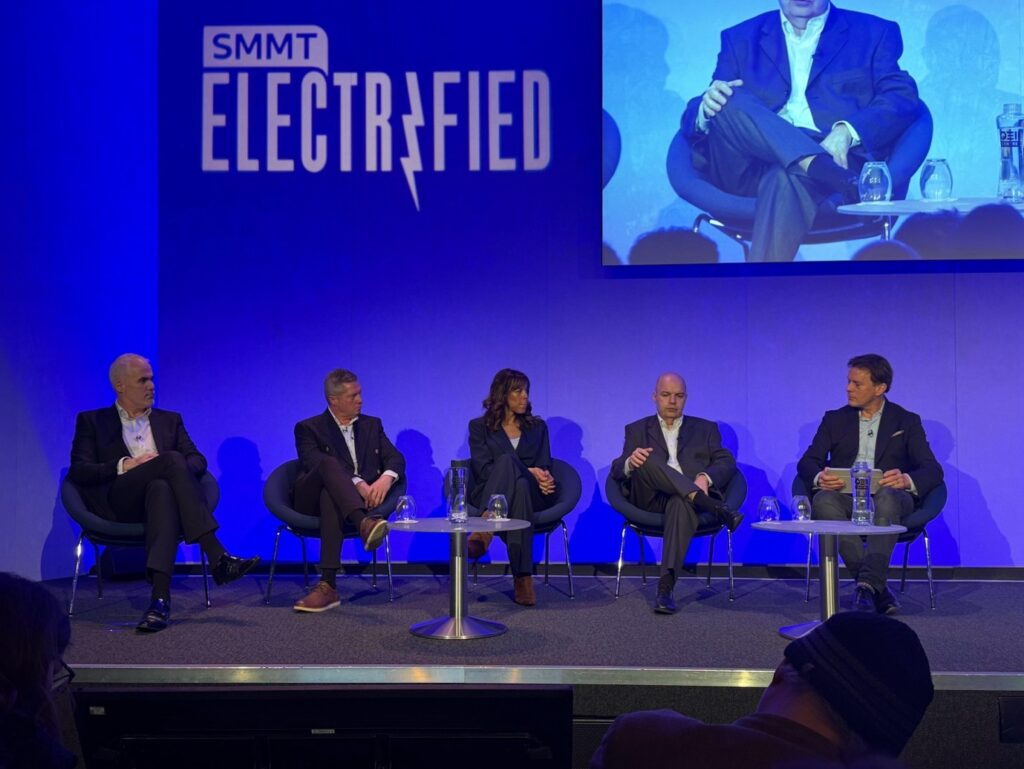
The UK automotive industry needs a review of the ZEV mandate, otherwise it could fall behind in the electrification race. That was the main message from the recent SMMT Electrified conference.

Held in London’s QEII Centre, the event brought together automotive industry executives, regulators and suppliers. They discussed the current state of the UK’s electric vehicle (EV) market.

The conference followed shifting emissions policies in Europe and the dropping of mandated targets in Canada. Meanwhile, the UK Government remains committed to the ZEV mandate. This is despite overall battery-electric vehicle (BEV) registrations failing to meet the 2024 or 2025 targets.

The cost of reaching targets

The ZEV mandate calls on carmakers to meet an increasing share target of zero-emission models in their annual registrations. It first came into effect in 2024, with a 22% requirement for passenger cars. This increased to 28% for 2025, while the target is 33% next year.

This increases annually, reaching 80% by 2030. However, the biggest jump in the requirement comes between 2027 and 2028, with a 14 percentage point rise in the target, to 52%.

The Department for Transport (DfT) released a report on the morning of the conference. It highlighted that all carmakers had complied with the ZEV mandate in 2024. Manufacturers had used conversion flexibility, while also borrowing future credits, with some banked for future years.

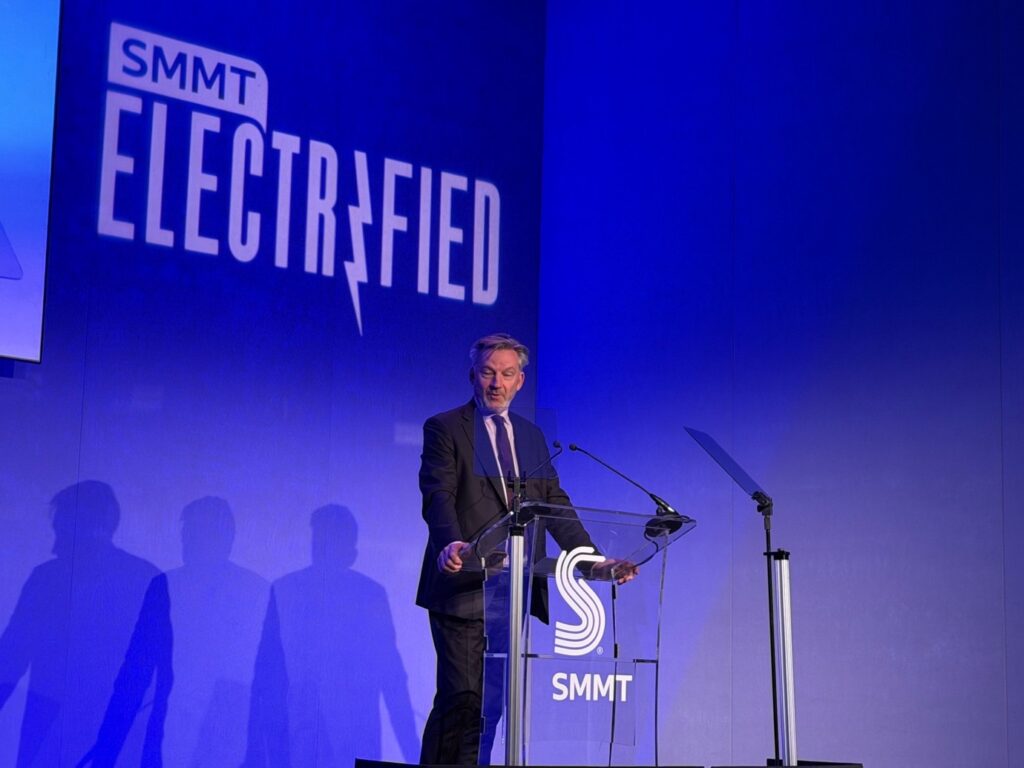
However, SMMT chief executive Mike Hawes highlighted the costs that the industry faced in meeting ZEV mandate targets.

‘Non-compliance is not an option, but compliance comes at a massive cost,’ he told journalists, including Autovista24, during a press conference prior to the event. ‘In the first two years of the mandate, carmakers have spent up to £10 billion (€11.6 billion) in discounting on BEVs. That is in addition to the billions spent on new products, new technologies, and so forth.

Mike Hawes speaking at SMMT Electrified 2026
SMMT chief executive Mike Hawes

‘In 2025, the average discount on a BEV model was £11,000. However, the payment for non-compliance to the ZEV mandate is £12,000 per model. Compliance comes with a tremendous cost, either in incentives, fines, or the need to purchase trading credits.

‘Therefore, while the DfT report shows that carmakers have met the requirements of the mandate in 2024, compliance does not necessarily mean that the mandate is deliverable,’ he stated.

Further ZEV mandate challenges

One issue impacting BEV uptake appears to be costs for consumers. The technology has long been touted as a more affordable alternative to petrol and diesel in terms of use.

However, there is often a cost difference between charging domestically and using public plug-in points. In addition, the implementation of vehicle excise duty (VED) last year increased costs.

A pay-per-mile scheme, known as eVED, for BEVs and plug-in hybrids was also announced in 2026. This is set to be introduced in 2028, at a point when the ZEV mandate target is set to jump. For carmakers, this could be a problem. The affordability of BEVs will be reduced, but the requirement for carmakers will leap forward.

‘Additionally, the flexibilities introduced last year will expire from 2029,’ added Hawes. ‘I do not know of anyone in the industry who thinks we will get to 80% of ZEVs by 2030. Beyond that, we still have a lack of clarity.

‘We have neither the regulation nor the certainty about exactly which technologies can be sold. But what we do know is the gap between ambition and demand is too great. The UK’s attractiveness, not just as a market, but as a manufacturing location, evaporates. De-carbonisation, if we get this wrong, can mean de-industrialisation.’

Good intentions of the ZEV mandate

Hawes stated that the UK’s automotive industry is committed to reducing emissions and working towards net-zero. ‘But sometimes, to reach a destination, you have to take a diversion. When the facts change, you have to adapt,’ he continued.

‘When the ZEV mandate was conceived, the world was a different place,’ Hawes stated. In line with statistics published by the SMMT during the event, he outlined that battery costs were 30% higher in 2025 than anticipated in 2021. Meanwhile, BEVs were 17% more expensive within the same timeframe.

In addition, industrial energy costs were 80% higher than expected, Hawes stated. The costs of public EV charging at 50kW points were 120% higher than thought when the ZEV mandate was first discussed, he added.

‘We need it reviewed now and resolved now. Without change, the sector, the economy, mobility and decarbonisation itself are in jeopardy. So, government needs to be bold enough to lead the change to make sure that we have a system that is fit for the future,’ he concluded.

Carmakers back early review

The ZEV mandate issue remained a constant throughout SMMT Electrified 2026. Carmakers in attendance also backed the need for a review of the current strategy.

‘The ZEV mandate needs to be more aligned to where consumer demand is. Investment is so heavy in the market, then some of the vehicles sold will be loss-making. If you are in that scenario, and you are forced to increase supply as the ZEV mandate does, then that calls investments into question,’ highlighted Eurig Druce, SVP, group managing director at Stellantis UK.

‘If you cannot make a return on investment in a country, then the ability of a company to invest and create the growth that the government is looking for is absent. Therefore, we need to make some quick decisions, and a review next year is too late. We need a review now, to help us make the right decisions on investments,’ he continued.

Carmaker panel at SMMT Electrified 2026
From left to right: Patrick McGillycuddy, managing director at JLR UK, Richard Finchett, deputy managing director at Toyota Manufacturing UK, Nicole Melillo Shaw, Managing Director at Volvo Car UK, Eurig Druce, SVP, group managing director at Stellantis UK

But while development of BEVs continues, the route of discounting is not one that carmakers want to be going down.

‘We put a lot of investment into developing and building the advanced technology in BEVs. The last thing anyone wants to do is bring out a car with that much investment, and then start discounting from the beginning. It is unsustainable. So I think we need to make sure that we are allowing for demand to catch up with supply,’ pointed out Nicole Melillo Shaw, managing director at Volvo Cars UK.

A different approach

Patrick McGillyCuddy, managing director at JLR UK, further underlined the issue of confusion among consumers. ‘We have a very ambitious ZEV mandate, and then we have the eVED, which is proposed to come at a critical time in that journey,’ he said.

‘This causes confusion, and consumers will hesitate. Then we hesitate, and you get an uncertain environment. We produce most of our vehicles in the UK for global export, therefore we have to recognise that different parts of the world are moving at a different pace,’ he added.

Ford Motor Company chair and managing director, Lisa Brankin, also brought up the issue during a candid fireside chat.

‘When it comes to a review, the government needs to consider the customer in two areas. They need to knock down the barriers to entry, but also understand and prevent confusing messages.

‘Last year, for example, we had the launch of the Electric Car Grant incentive scheme. That helped drive sales forward. But a few months later, there was the announcement of eVED. The two messages did not align, so the government really needs to be mindful of what it is saying if the end goal is electrification,’ she said.

Failure from success

Brankin also highlighted how the ZEV mandate directed focus away from Ford’s achievements in 2025. Instead, it suggested failure in the company’s performance, she explained.

 Lisa Brankin and Katie Derham at SMMT Electrified 2026
From left to right: Lisa Brankin, chair and managing director, Ford Motor Company, Katie Derham, host and broadcaster

‘Our sales grew by 20% in 2025, which was a great success. But we count it as a failure as we got to just under 24% of the fleet being ZEVs, when the target in the mandate was 28%. We are moving in the right direction, but not meeting targets,’ she stated

‘We have invested heavily in our facilities in Europe to build EVs, but we are having to discount heavily to meet targets. We may also be forcing people into vehicles that maybe they do not necessarily want, or maybe are not appropriate for them,’ she said.

Brankin also pointed to the changes in other ZEV policies that have taken place around the world. ‘Canada has made a change, and our closest partners in the EU have already made adjustments. That was carried out in a matter of months rather than over a longer period. So, I would say to the UK government to get on with it, start the review, decide, and make the announcement this year,’ she continued.

Government committed to 2027 ZEV mandate review

Taking to the stage at SMMT Electrified 2026, Keir Mather MP, minister for Aviation, Maritime and Decarbonisation, spoke of the success of the UK’s EV market. He highlighted that the country had the largest BEV share of Europe’s major economies, as a result of ambition, partnership and investment.

Autovista24 analysis shows that in 2025, the UK saw its BEV share reach 23.9%, with 473,348 units. While this share was higher than the 19.1% achieved in the closest market, Germany, the volume of BEVs was lower. In 2025, the country saw 545,142 units delivered.

Mather also stated that the EV transition in the UK is being backed by tens of billions of pounds in public and private investment. But he acknowledged that the ZEV mandate is potentially a challenge for the industry.

‘Is [the ZEV mandate] ambitious? Yes, of course it is, and we as government are committed to giving you the tools you need to make it happen. The industry successfully complied with the 2024 target, using the flexibilities built into the mandate, and provisional 2025 data also looks promising,’ he commented.

‘We are committed to publish a review of the mandate early in 2027, and we are listening, and we are engaging with stakeholders across the industry.’

When asked about the potential for an early review, as called for throughout the conference, Mather stated: ‘Work on the review needs to begin this year. But early 2027, we feel, is the right point to make sure that we can see properly where the pressure points lie in this ZEV mandate and make sure that it continues to work for manufacturers.’

Join our list!

To get the latest insights, announcements, and industry intelligence from our JD Power experts delivered right to your inbox, we invite you to sign up for the mailing lists that are critical to your role: